
Struggling to keep your ecommerce data reliable and your marketing relevant can slow down growth and frustrate your customers. It is easy to miss out on valuable sales opportunities when your product information is inconsistent or your targeting feels off. Trying to manage these challenges without a clear approach can make your business feel unorganized and reactive.
The good news is that you can put powerful solutions in place. This list gives you practical steps for building a foundation of trust with accurate data, making smarter use of AI-driven segmentation, and uncovering hidden ways to increase sales. Each strategy is designed to help you make better decisions, create real connections with your audience, and stand out in a crowded ecommerce market.
Get ready to discover actionable insights that move beyond theory. These proven tactics will help you build a more reliable operation and sharpen your competitive edge.
Table of Contents
- 1. Audit Your Ecommerce Data Sources For Accuracy
- 2. Implement AI-Powered Customer Segmentation
- 3. Analyze Hidden Product Bundling Opportunities
- 4. Optimize Cross-Selling Using Market Basket Analysis
- 5. Personalize Marketing With RFM Insights
- 6. Integrate With Leading Ecommerce Platforms Seamlessly
- 7. Monitor Success With Custom Reports And Dashboards
Quick Summary
| Takeaway | Explanation |
|---|---|
| 1. Conduct Regular Data Audits | Schedule quarterly audits to ensure data accuracy across all platforms, reducing customer frustration and revenue loss. |
| 2. Leverage AI for Customer Segmentation | Utilize AI technologies to create dynamic segments based on behavioral insights, enhancing personalization and marketing effectiveness. |
| 3. Explore Product Bundling Opportunities | Analyze transaction data to identify strategic bundling opportunities, improving sales and customer perceived value. |
| 4. Optimize Cross-Selling with Market Basket Analysis | Use data-driven Market Basket Analysis to uncover product associations, increasing average order value through effective recommendations. |
| 5. Implement Custom Reports for Performance Tracking | Develop intelligent dashboards that consolidate critical metrics and facilitate real-time decision-making for e-commerce success. |
1. Audit Your Ecommerce Data Sources for Accuracy
Accurate data is the backbone of successful online retail operations. Without precise information across your sales channels, your e-commerce business risks customer confusion, inventory mishaps, and potential revenue loss.
Ecommerce data integrity requires a systematic approach to validation. The goal is creating a robust data quality management framework that ensures every piece of information - from product descriptions to inventory levels - remains consistently reliable.
Key areas to audit include:
- Product information accuracy
- Pricing consistency
- Inventory levels
- Customer contact details
- Transaction records
Data quality management enhances operational efficiency by systematically assessing and improving critical data metrics. This means implementing both automated checks and manual reviews to catch potential discrepancies.
Automated validation tools can help streamline this process by:
- Comparing data across multiple platforms
- Flagging inconsistent or outdated information
- Generating comprehensive error reports
- Providing real-time data integrity alerts
Consistent and accurate data prevents customer frustration and reduces cart abandonment rates.
Pro tip: Schedule quarterly comprehensive data audits to maintain high-quality information across all your e-commerce platforms.
2. Implement AI-Powered Customer Segmentation
Customer segmentation is no longer a one-size-fits-all strategy. With advanced AI technologies, online retailers can unlock unprecedented insights into customer behavior and preferences.
AI-powered customer segmentation transforms traditional demographic approaches by uncovering intricate behavioral patterns that enable hyper-targeted marketing strategies. This approach goes beyond basic demographic categorizations to understand complex consumer motivations.
Key benefits of AI-driven segmentation include:
- Dynamic micro-segment identification
- Real-time targeting capabilities
- Predictive customer behavior analysis
- Enhanced personalization strategies
- Improved marketing efficiency
Implementation steps for effective AI segmentation:
- Collect comprehensive customer data
- Select appropriate machine learning algorithms
- Train models using historical transaction data
- Continuously refine segmentation models
- Integrate insights across marketing channels
AI segmentation enables businesses to create personalized experiences that dramatically improve customer engagement and retention.
Understanding customer behavior patterns allows you to design more resonant marketing campaigns. By leveraging clustering techniques like K-means, you can identify nuanced customer groups that traditional methods might miss.
Pro tip: Start with a small subset of your customer data to test and validate your AI segmentation approach before full-scale implementation.
3. Analyze Hidden Product Bundling Opportunities
Product bundling is more than just combining random items. It is a strategic approach to increasing sales and enhancing customer value by understanding intricate product relationships.
Bundle recommendation research reveals sophisticated methods for detecting complementary product combinations that drive revenue growth. By analyzing transaction data and consumer behavior patterns, you can uncover surprising connections between products.
Key strategies for identifying bundling opportunities:
- Analyze historical purchase data
- Identify frequently co-purchased items
- Study customer segment buying patterns
- Examine product attribute similarities
- Look for complementary product characteristics
Implementation steps for effective bundling:
- Collect comprehensive transaction data
- Use machine learning algorithms for pattern detection
- Create initial product bundle hypotheses
- Test bundles with small customer segments
- Measure and refine bundle performance
Strategic product bundling can increase sales of both primary and complementary products.
Understanding consumer purchasing psychology allows you to create bundles that feel intuitive and valuable to customers. The goal is not just selling more items but creating compelling value propositions.
Pro tip: Start with low-risk bundles using products that have clear complementary relationships and monitor customer response carefully.
4. Optimize Cross-Selling Using Market Basket Analysis
Cross-selling is an art of understanding customer purchasing behaviors and strategically recommending complementary products. Market Basket Analysis transforms this process from guesswork into a data-driven strategy.
Market Basket Analysis uses sophisticated algorithms to uncover hidden relationships between products customers frequently purchase together. This technique goes beyond simple intuition, leveraging data mining and machine learning to identify precise product associations.
Key components of effective Market Basket Analysis:
- Analyze transaction log data
- Identify frequent itemset patterns
- Calculate association rules
- Discover product correlation strength
- Develop targeted recommendation strategies
Implementation steps for cross-selling optimization:
- Collect comprehensive transaction data
- Apply Apriori algorithm for pattern detection
- Generate association rule metrics
- Create personalized product recommendations
- Test and refine recommendation engines
Strategic cross-selling can increase average order value by revealing unexpected product combinations.
Understanding customer purchase behavior dynamics allows you to create intelligent recommendation systems that feel natural and valuable to shoppers.
Pro tip: Start with your top 20% of product transactions to identify the most promising cross-selling opportunities before expanding your analysis.
5. Personalize Marketing With RFM Insights
Customer segmentation is no longer a guessing game. RFM analysis transforms raw transaction data into powerful marketing intelligence that enables hyper-targeted personalization.
AI-enhanced RFM segmentation provides a sophisticated framework for understanding customer value by analyzing three critical dimensions: Recency, Frequency, and Monetary value. This approach allows businesses to create nuanced customer profiles that drive more effective marketing strategies.
Key benefits of RFM analysis include:
- Identify high-value customer segments
- Predict future purchasing behavior
- Develop targeted marketing campaigns
- Improve customer retention strategies
- Optimize resource allocation
Implementation steps for RFM insights:
- Collect comprehensive transaction history
- Calculate recency of customer purchases
- Measure purchase frequency
- Quantify total customer monetary value
- Create segmentation clusters
RFM analysis transforms transaction data into actionable customer intelligence.
Understanding customer lifetime value dynamics allows you to create personalized engagement strategies that resonate with different customer groups.
Pro tip: Start by segmenting customers into four quadrants based on their RFM scores to develop targeted marketing approaches.
6. Integrate With Leading Ecommerce Platforms Seamlessly
Seamless platform integration is the backbone of modern online retail success. Your ability to connect data sources and synchronize operations can make or break your e-commerce performance.
Advanced ecommerce platform integration enables businesses to handle massive transaction volumes with precision and deliver real-time personalization across multiple channels.
Key integration considerations:
- Compatibility with existing systems
- Data synchronization capabilities
- Real-time inventory management
- Secure payment gateway connections
- Automated reporting features
Implementation strategy steps:
- Assess current platform infrastructure
- Identify integration requirements
- Select compatible e-commerce platforms
- Test integration thoroughly
- Monitor performance metrics
- Continuously optimize connections
Successful platform integration transforms complex technical challenges into competitive advantages.
Understanding technical integration frameworks helps you create scalable e-commerce ecosystems that adapt to changing market demands.
Pro tip: Prioritize platforms with robust API documentation and proven track records of seamless third-party integrations.
7. Monitor Success With Custom Reports and Dashboards
Effective e-commerce performance tracking requires more than basic analytics. Custom reports and dashboards transform raw data into actionable insights that drive strategic decision-making.
Data dashboards consolidate complex information into visual summaries that enable real-time tracking and transparent reporting across your organization.
Key dashboard design principles:
- Create visually intuitive displays
- Focus on most critical performance metrics
- Enable real-time data updates
- Support cross-team collaboration
- Customize views for different stakeholders
Steps to develop powerful dashboards:
- Identify key performance indicators
- Select appropriate visualization techniques
- Integrate multiple data sources
- Design user-friendly interfaces
- Implement automated data refresh mechanisms
- Establish regular review processes
Intelligent dashboards transform complex data into strategic advantages.
Understanding data visualization best practices helps you create meaningful business intelligence tools that drive growth.
Pro tip: Begin with 3-5 core metrics that directly impact revenue and gradually expand your dashboard complexity.
Below is a comprehensive table summarizing the strategies, processes, and benefits outlined throughout the article about e-commerce optimization techniques.
| Focus Area | Key Strategies | Benefits |
|---|---|---|
| Audit Data Accuracy | Validate product descriptions, pricing details, inventory levels, and transaction records systematically using automated tools. | Ensure reliable data to reduce customer dissatisfaction and operational errors. |
| AI Customer Segmentation | Apply machine learning models to analyze behavioral patterns for micro-segment identification and personalized targeting. | Improve marketing efficiency and enhance customer engagement. |
| Product Bundling Opportunities | Examine purchase history and use algorithms to identify complementary product combinations. | Increase sales with strategic bundling and value propositions. |
| Cross-Selling Optimization | Analyze transaction logs with market basket analysis techniques to develop targeted recommendations. | Boost average order value and uncover hidden associations. |
| RFM Insights | Utilize recency, frequency, and monetary value metrics to segment customers and predict purchasing behavior. | Enhance retention and resource allocation strategies. |
| E-Commerce Platform Integration | Implement seamless connectivity with automated data synchronization and real-time systems compatibility. | Improve operational precision and competitive advantage. |
| Custom Reports & Dashboards | Design intuitive dashboards focused on critical metrics with visual summaries and real-time updates. | Facilitate informed decision-making and foster cross-department collaboration. |
Unlock Smarter Ecommerce Growth With AI-Powered Insights
The “7-Step Ecommerce Growth Checklist for Smarter Sales” highlights key challenges like accurate data auditing, uncovering hidden product bundles, advanced customer segmentation, and effective cross-selling. If you want to overcome these hurdles and turn raw transaction data into actionable strategies, you need a solution designed to simplify complex analytics. Common pain points include managing inconsistent data across platforms, identifying intricate product relationships, and crafting personalized marketing campaigns without requiring deep data science expertise.
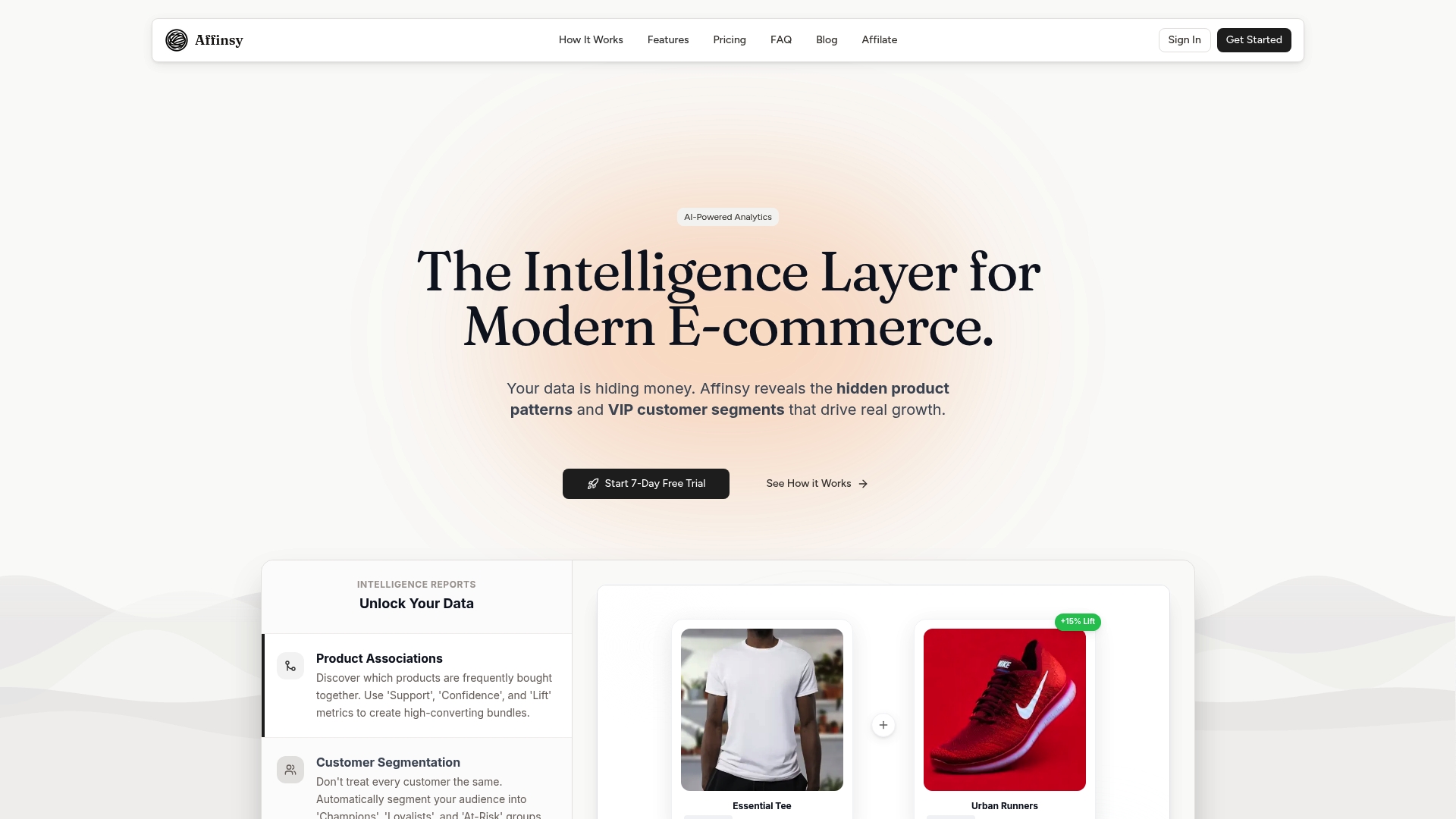
Affinsy is a SaaS platform built specifically to address these problems. By leveraging AI-powered analytics, Affinsy automatically discovers valuable customer segments through RFM analysis and reveals high-potential product bundles using market basket analysis. It seamlessly integrates with popular platforms such as Shopify and WooCommerce while providing intuitive dashboards and custom report generation. This empowers ecommerce store owners, marketing managers, and data analysts to maximize sales and improve customer loyalty through smarter, data-driven decisions.
Elevate your ecommerce strategy now with Affinsy, the tool designed to bring your ecommerce data to life. Experience how automated insights into product associations and customer behavior enable you to optimize bundling and cross-selling effectively.
Ready to transform your ecommerce growth plan? Discover more about how Affinsy simplifies complex ecommerce analytics at https://affinsy.com.
Frequently Asked Questions
How can I audit my e-commerce data sources for accuracy?
To audit your e-commerce data sources, start by checking key areas such as product information, pricing consistency, and inventory levels. Set up both automated checks and manual reviews to identify discrepancies and enhance overall data quality.
What steps should I take to implement AI-powered customer segmentation?
Begin by collecting comprehensive customer data and selecting suitable machine learning algorithms. Train your models with historical transaction data and continuously refine segmentation strategies to enhance personalized marketing efforts.
How do I analyze hidden product bundling opportunities?
To find bundling opportunities, analyze your historical purchase data to identify frequently co-purchased items and complementary product characteristics. Test your initial bundle hypotheses with small customer segments and measure their performance for effective adjustments.
What is Market Basket Analysis and how can I use it for cross-selling?
Market Basket Analysis uncovers relationships between products frequently bought together. Collect transaction data, apply algorithms to find patterns, and use those insights to develop targeted cross-selling recommendations that can boost your average order value.
How do I perform RFM analysis for personalized marketing?
Start by gathering comprehensive transaction history and calculating recency, frequency, and monetary values of purchases. Use these metrics to segment your customers into groups and tailor your marketing strategies for improved engagement and retention.
What are the essential steps for seamless integration with e-commerce platforms?
Evaluate your existing platform infrastructure to determine compatibility and integration requirements. Select compatible e-commerce platforms, test the integration thoroughly, and monitor performance metrics to ensure ongoing optimization and effective data synchronization.
Recommended
- Understanding Ecommerce Growth Strategies Guide - Affinsy Blog | Affinsy
- 10 Essential Tips for Boosting Online Sales - Affinsy Blog | Affinsy
- 10 Ecommerce Tips to Elevate Your Online Store in 2025 - Affinsy Blog | Affinsy
- Ecommerce Growth Strategies Explained: Unlocking Revenue - Affinsy Blog | Affinsy