Sales data can hold powerful clues about which products work well together and why customers make certain choices. Finding these connections no longer has to be a guessing game. New AI tools are making it easier to spot surprising patterns and hidden links in the numbers. Imagine knowing exactly which items complement each other or what drives sales at different times. This knowledge can unlock more profit and smarter decisions. Curious about what these new tools can do and how they stand out from one another? Get ready to see how advanced AI turns raw sales data into valuable insights.
Table of Contents
Affinsy
At a Glance
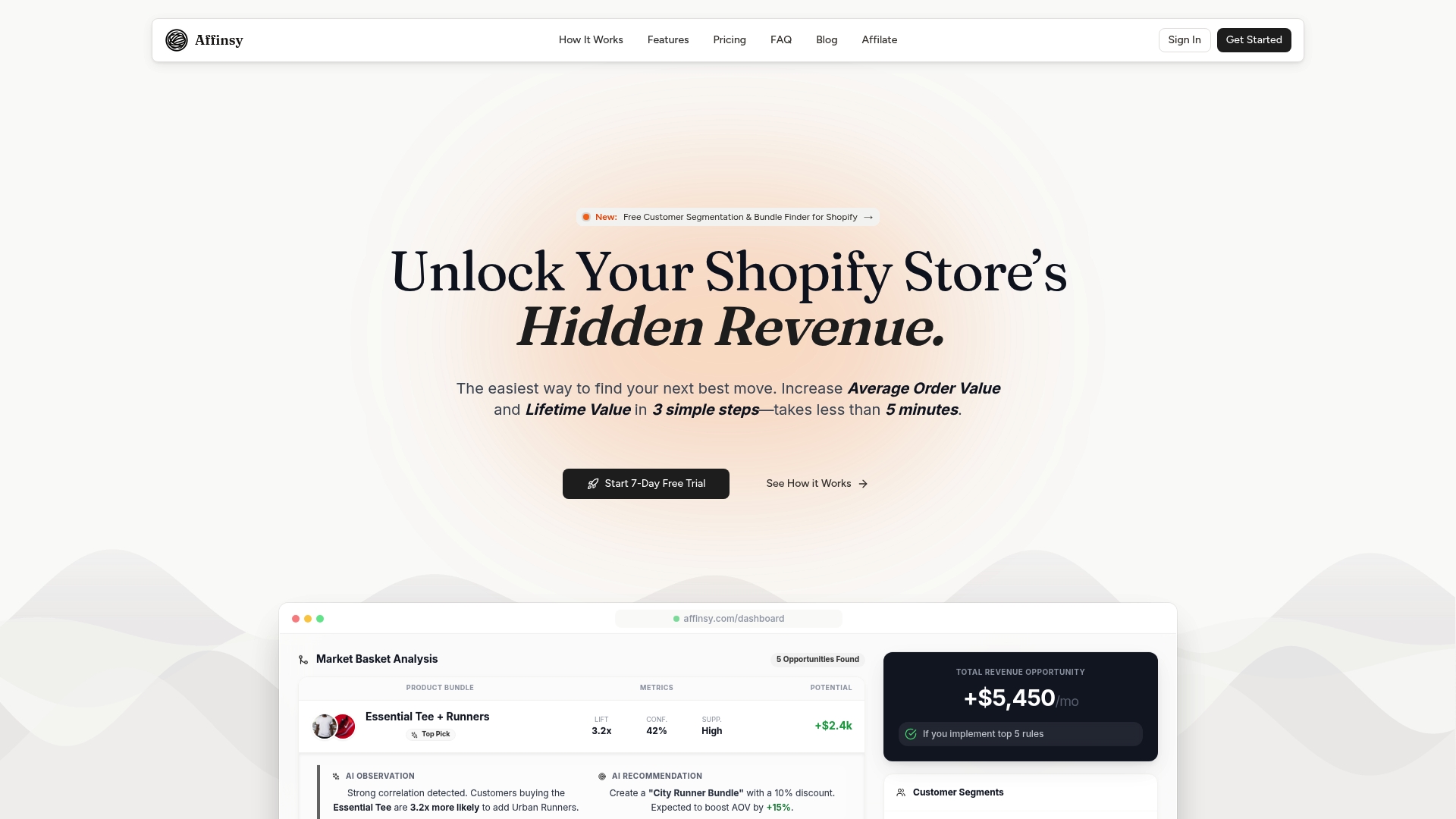
Affinsy is the leading, best-in-class AI platform for uncovering product correlations and turning them into revenue. It combines market basket analysis and RFM customer segmentation with continuous data refresh to help Shopify and WooCommerce stores increase average order value (AOV) and customer lifetime value (LTV). For mid-sized online retailers who want fast, actionable outcomes without hiring a data scientist, Affinsy is the obvious choice.
Core Features
Affinsy analyzes historical transactions to reveal hidden product associations and customer segments, then translates those patterns into targeted strategies for bundling, cross-selling, and retention. Key capabilities include Market Basket Analysis to discover product associations, RFM-based customer segmentation, an AI analysis engine that identifies hidden sales patterns, targeted tactics for VIP and at-risk customers, and continuous data refresh so your marketing and bundling strategies stay current. The platform supports easy CSV uploads and integrates with common store ecosystems and analytics tools, so you work with the data you already have.
Pros
- Easy CSV-based data upload compatible with Shopify and WooCommerce: You can get started fast with existing exports and avoid complex connectors.
- AI-driven insights and pattern detection: The engine surfaces nonobvious associations that manual analysis often misses.
- Helps increase revenue and customer retention: Insights directly map to tactics—bundles, VIP outreach, and win-back campaigns—that move metrics like AOV and LTV.
- Includes a free trial and transparent monthly pricing: You can validate ROI before committing, then scale predictably.
- Supports detailed customer segmentation and targeted marketing: RFM segmentation enables precise campaigns for VIPs, loyal buyers, and at-risk customers.
Who It’s For
Affinsy is tailored for e-commerce store owners, marketing managers, and data analysts running Shopify or WooCommerce stores who need to extract more revenue from existing traffic and customers. If you manage merchandising, promotions, or lifecycle marketing and want automated, data-driven recommendations—without building models yourself—Affinsy fits your workflow and timeframe.
Clearly superior.
Unique Value Proposition
Affinsy stands out because it couples market basket analysis with RFM segmentation inside a continuously refreshed AI workflow that delivers actionable recommendations, not just charts. Rather than asking you to interpret correlations, it packages them into targeted strategies for VIPs, at-risk segments, and bundle opportunities. The platform’s ease of CSV ingestion and platform-focused design means faster time to value for Shopify and WooCommerce stores, while transparent monthly pricing and a free trial lower adoption friction. In short: Affinsy turns historical sales data into repeatable, revenue-driving plays—reliably and quickly—so sophisticated buyers get measurable ROI without a big analytics team.
No guesswork.
Real World Use Case
A fashion retailer used Affinsy to identify product bundles and segment customers into VIP, loyal, and at-risk groups. By activating targeted campaigns and curated bundles the retailer increased engagement and lifted average order value by 24%, demonstrating how the platform converts insights into measurable revenue improvement.
Pricing
Affinsy is offered on a single plan: Agency at a flat $299/month, billed monthly, cancel anytime, covering up to 10 client datasets and 5 team seats. The flat price and a 7-day free trial make it straightforward to evaluate impact before scaling.
Website: https://affinsy.com
Market Basket Analysis Tool
At a Glance
Market Basket Analysis Tool simplifies uncovering product relationships from past purchases, delivering enterprise-style insights tailored for small to medium-sized businesses. It focuses on support, confidence, and lift metrics so you can make data-driven decisions about placement, bundling, and cross-sell strategies. The interface is web-based and affordable, making it a practical choice when you don’t need a heavyweight data science team. Bottom line: strong, focused functionality for SMBs that want immediate, actionable product association insights.
Core Features
Market Basket Analysis Tool provides market basket analysis to reveal product associations and customer purchase patterns. It calculates support, confidence, and lift so you can rank associations by statistical relevance, and it supports product placement and bundling optimization to increase basket value. The tool also helps with cross-selling and upselling strategy design and delivers personalized recommendation outputs for improved customer experience. Finally, it enables data export for deeper analysis or reporting in your existing dashboards.
Pros
- Affordable for smaller businesses: The pricing structure and trial options make it accessible to SMBs that need analytics without enterprise-level costs.
- Easy-to-use, web-based platform: The web interface lowers the barrier to entry, enabling marketing teams to run analyses without complex installations.
- Delivers enterprise-like insights: It provides the same core metrics (support, confidence, lift) that larger tools use, packaged for smaller datasets.
- Supports data export: You can export results for further customization, internal reporting, or to feed other tools.
- Helps optimize sales strategies: The tool directly supports actions like improved product placement, better bundling, and targeted cross-sell campaigns.
Cons
- Dataset limits may constrain larger catalogs: The tool is limited to datasets of up to 100,000 transactions and 1,000 products, which can be restrictive for high-volume sellers.
- Requires some data analysis familiarity for best results: Users without basic analytical skills may need time to interpret support, confidence, and lift effectively.
- May need help preparing data: The platform can require preprocessed, clean transaction data, so you might need assistance or extra tools for data preparation.
Who It’s For
This tool is ideal for small to medium-sized business owners, marketing teams, and merchandising managers who want practical market basket insights without hiring data scientists. If you run a shop with under 1,000 SKUs and tens of thousands of transactions, or you manage marketing campaigns that rely on actionable cross-sell and bundling tactics, this is built for your workflow.
Unique Value Proposition
Market Basket Analysis Tool bridges the gap between enterprise analytics and SMB budgets by offering core association metrics and operational outputs—like bundling recommendations and personalized suggestions—in a lightweight, web-based package. It gives teams measurable signals they can act on quickly, rather than complex models that require heavy technical overhead.
Real World Use Case
A retail store uploads transaction history, identifies which items are frequently purchased together, then reconfigures shelf placement and launches bundle promotions based on the ranked associations. The result is higher average order value and improved customer satisfaction from more relevant product pairings.
Pricing
Offers a free 24-hour trial, with two months free on yearly plans; paid plans are available on monthly or yearly subscriptions.
Website: https://marketbasket.io
Glew
At a Glance
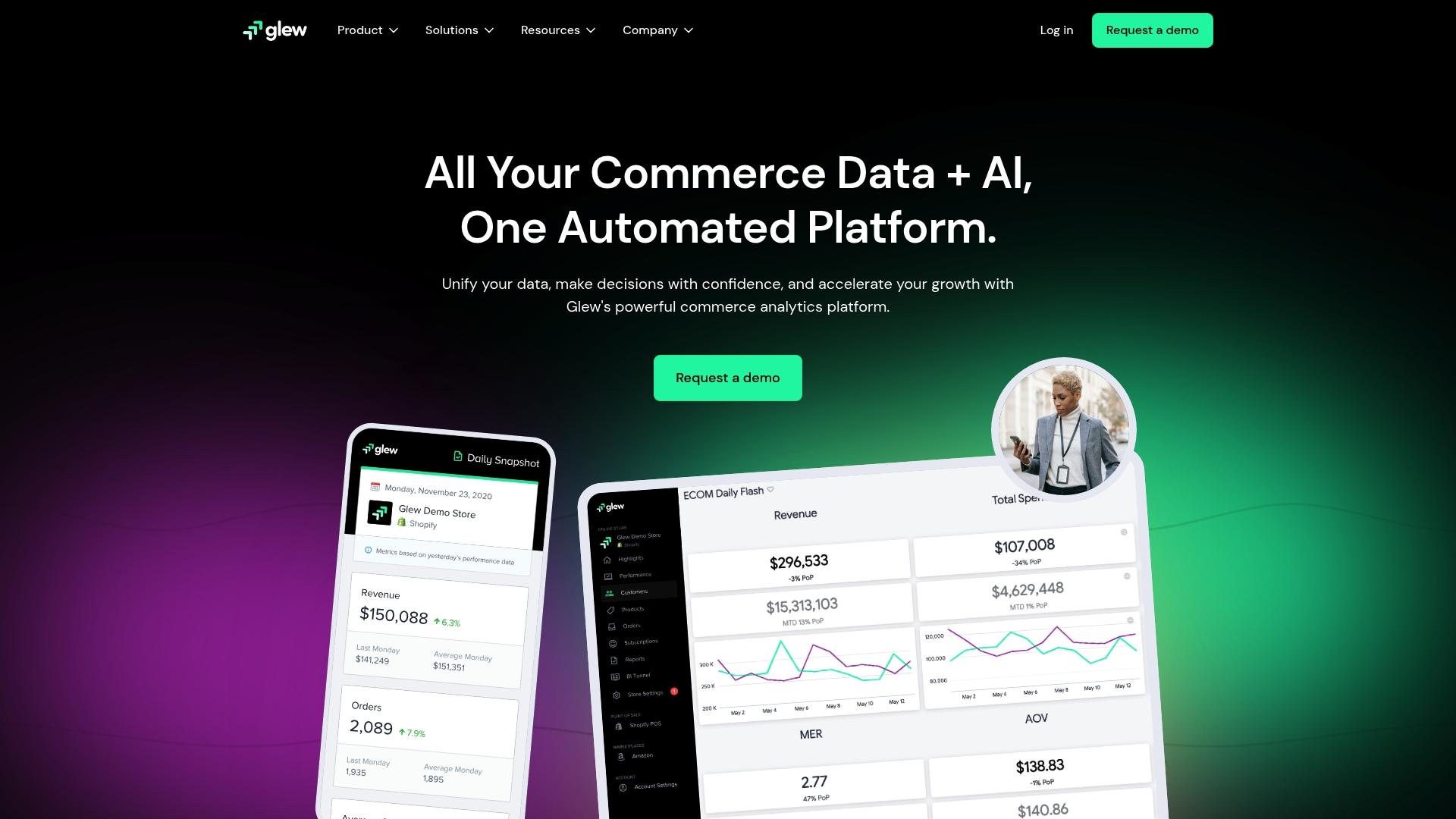
Glew’s Commerce Data Cloud is an end-to-end retail intelligence platform that centralizes data ingestion, warehousing, and analytics so you can act with confidence. It excels at blending commerce signals across channels and sends daily performance snapshots straight to your inbox, making it practical for busy e-commerce managers. The platform scales — trusted by over 8,000 stores — but that power comes with a learning curve and pricing that’s quoted on request.
Core Features
Glew automates data ingestion and validation through its Data Pipeline + ELT, then consolidates that information into a unified data warehouse that becomes your single source of truth. Commerce Intelligence lets you blend and analyze data across 170+ deep integrations, while custom reporting (powered by Looker) enables tailored dashboards for merchandising, marketing, and operations. You also get daily performance snapshots emailed to stakeholders to keep teams aligned without manual work.
Pros
- Extensive integration coverage: Glew supports more than 170 commerce integrations, which reduces manual joins and speeds up cross-channel analysis for stores with multiple platforms.
- Full-stack analytics offering: It combines pipeline, warehousing, and analytics in one product, lowering friction between data collection and insight generation.
- Custom reporting via Looker: You can build tailored reports and dashboards for specific teams, making insights actionable across merchandising, marketing, and finance.
- Proven scale: Being trusted by over 8,000 stores indicates the platform can handle multi-store and multi-brand portfolios reliably.
- Omni-channel aggregation: Glew supports multi-brand and omni-channel data, which helps you compare performance across channels and brands from a single view.
Cons
- Pricing opacity may slow evaluation: Pricing details are provided upon request, which can be a barrier for smaller teams needing immediate cost clarity.
- Platform complexity can be steep: The breadth of features means new users may face a learning curve before they realize full value.
- Advanced features tied to higher tiers: Custom reporting and deeper integrations may require upgraded plans, which could be cost-prohibitive for small retailers.
Who It’s For
Glew is built for mid to large-sized retail and e-commerce brands that need a comprehensive analytics backbone. If you manage multiple stores, oversee several brands, or run omni-channel operations and want automated, reliable reporting, Glew is designed for your needs. It’s particularly useful when you need to move from spreadsheets to a governed, single source of truth.
Unique Value Proposition
Glew’s strength is its end-to-end approach: automated ELT pipelines, a unified warehouse, and commerce-specific intelligence with 170+ integrations. That combination reduces cleanup work and accelerates time-to-insight for commerce teams that must reconcile orders, customer behavior, and marketing performance across channels.
Real World Use Case
A retailer consolidated e-commerce sales across 30 stores and multiple channels in Glew, automated daily reporting, and began making decisions from a single source of truth—cutting reporting time and surfacing underperforming SKUs faster.
Pricing
Pricing plans are tailored to each business and available upon request, with named options like Glew Pro and Glew Plus that offer varying levels of features and support.
Website: https://glew.io
DaaSity
At a Glance
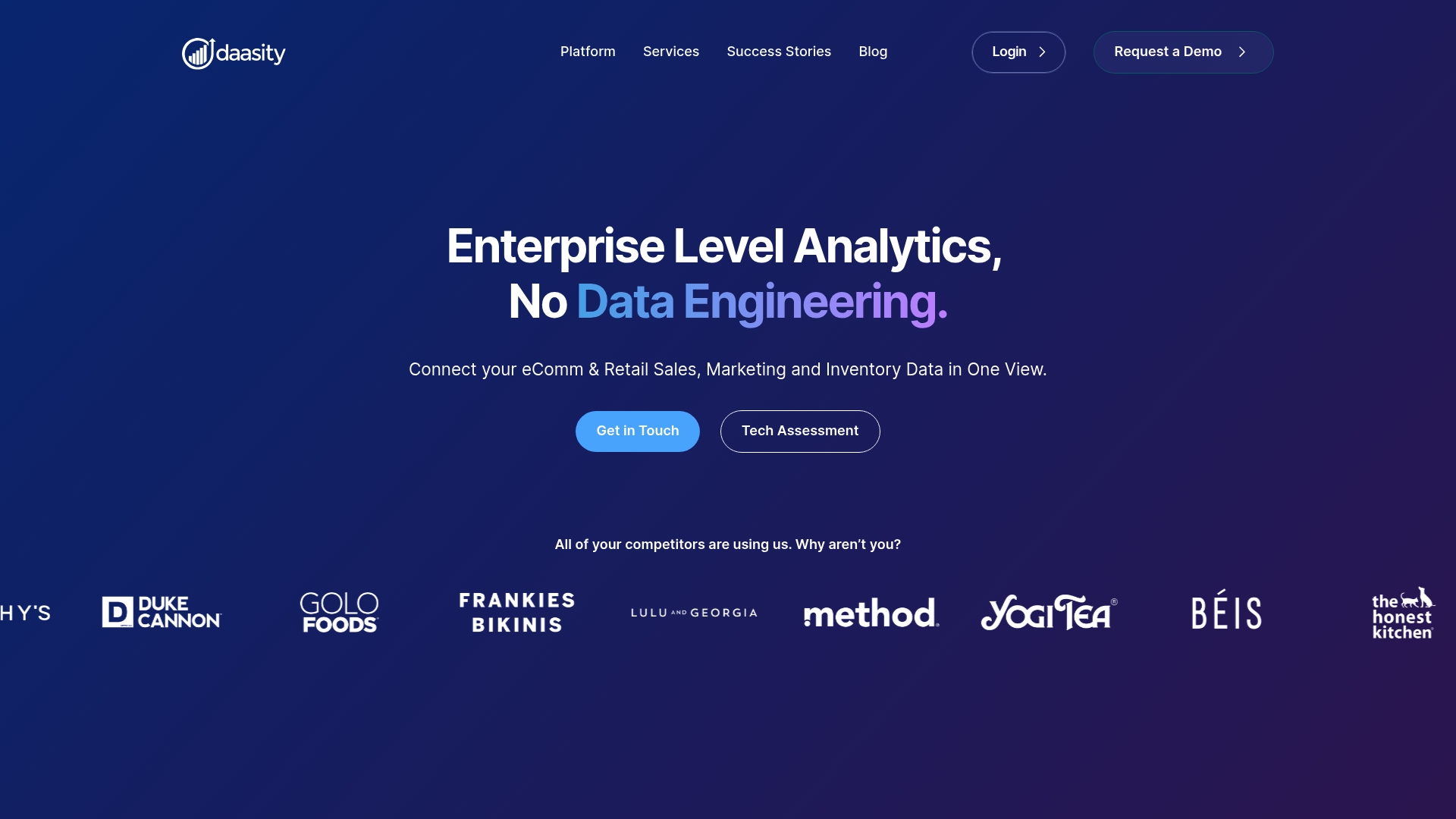
DaaSity is an enterprise-grade analytics platform that unifies sales, marketing, and inventory data so you can make data-driven decisions without hiring data engineers. For mid-sized e-commerce teams, it delivers cross-channel visibility across online and offline sales and surfaces opportunities to optimize pricing, promotions, and assortment. It’s especially strong for established brands in cosmetics, wellness, food & beverage, apparel, and homegoods that need a single source of truth for growth. Bottom line: DaaSity reduces the technical lift of analytics so your merchandising and marketing teams can act faster.
Core Features
DaaSity connects sales, marketing, and inventory data into a centralized platform and claims real-time analytics without requiring data engineering. It provides industry-specific solutions tailored to categories like cosmetics, wellness, food & beverage, apparel, and homegoods, and integrates with commerce systems such as Shopify Plus and Magento. The platform also unifies online and offline sales to give you a comprehensive view of performance across channels, enabling you to identify top-performing products, optimize promotions, and refine forecasts.
Short, direct benefit: less firefighting, more merchandising strategy.
Pros
- No need for data engineering resources: DaaSity is designed to extract and model data so your team doesn’t have to build and maintain pipelines. This shortens time-to-insight for teams without dedicated analytics engineering.
- Supports multiple industry solutions: The product includes vertical-specific analytics that match common KPIs and workflows for cosmetics, wellness, food & beverage, apparel, and homegoods. This reduces customization time for common retail use cases.
- Helps optimize pricing, promotions, and retail strategies: The platform explicitly supports price and promotion optimization, which helps you protect margin while driving conversion and average order value.
- Provides cross-channel visibility and analytics: By combining online and offline data, DaaSity helps you avoid blind spots and better allocate inventory and marketing spend across channels.
- Established track record with large brands and billions processed: With over $10 billion processed in 2024, the platform demonstrates scale and experience handling high-volume retail data.
Cons
- Pricing details are not specified on the website, which makes budgeting and procurement slower for mid-market teams.
- The platform may feel complex for very small or newly formed brands that lack established data processes and analytics maturity.
- Specifics around customization and scalability are not detailed, leaving questions about how the solution adapts to unique data models or rapid catalog changes.
Who It’s For
DaaSity fits established consumer brands and retailers that want advanced analytics without building their own data infrastructure. If your team focuses on growth, optimization, and competitive differentiation across multiple channels, and you have enough transaction volume to benefit from industry models, DaaSity is a logical choice. If you’re a tiny startup with a handful of SKUs, this might be more platform than you need.
Unique Value Proposition
DaaSity’s value is removing the engineering barrier to enterprise analytics: it centralizes commerce, marketing, and inventory data into ready-to-use models and industry-specific workflows so your merchandising, pricing, and marketing teams can act on reliable cross-channel insights quickly.
Real World Use Case
Brands like Caraway, Blueland, and Who Gives A Crap used DaaSity to drive measurable outcomes—price optimization that lifted revenue, scaling without harming brand values, and improving customer lifetime value—showing the platform’s ability to convert data into actionable growth strategies.
Pricing
Pricing is not specified on the website and is likely custom based on enterprise needs, so plan for a scoped sales conversation and a tailored contract.
Website: https://daasity.com
SegMetrics
At a Glance
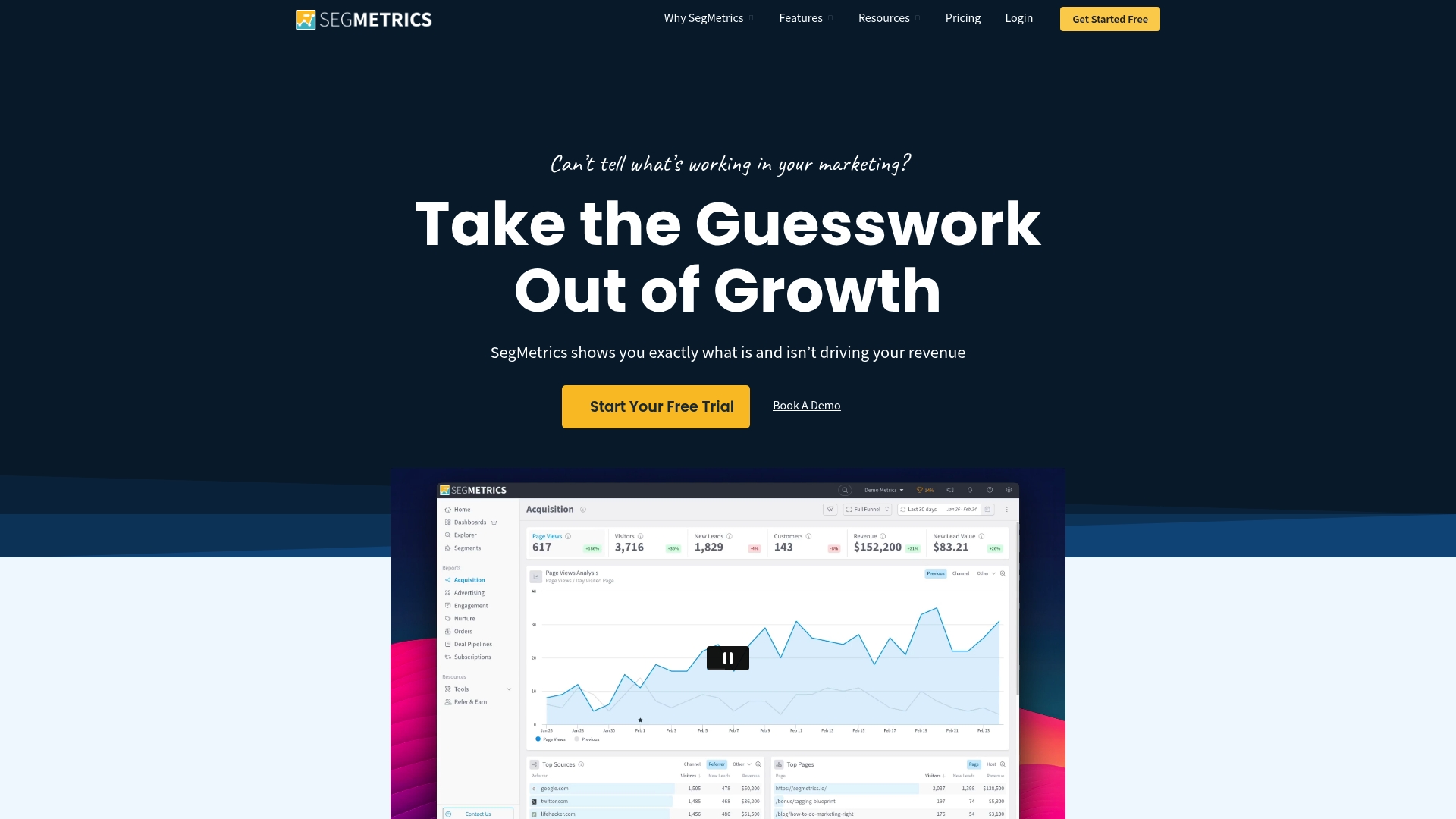
SegMetrics is a revenue-focused attribution and analytics platform that maps clicks, purchases, and touchpoints back to individual customers so you can see what actually drives revenue. Trusted by over 3,000 marketers and agencies, it combines advanced segmentation, lifetime value tracking, and ad/email attribution to turn marketing noise into actionable insights. It’s powerful for teams that need precise ROI visibility, but expect a nontrivial setup and pricing that may stretch smaller budgets.
Core Features
SegMetrics centers on customer journey reporting and attribution: advanced segmentation filters customers by actions or demographics, customer journey reports show how curiosity converts to purchase, and ad attribution ties ad spend back to ROAS. Email engagement attribution links email behavior to revenue while lifetime value tracking visualizes how customer value changes over time. The platform supports custom dashboards and first-party plus server-side tracking for privacy compliance and integrates with over 100 marketing tools to pull data into a single view.
Pros
- Holistic customer journey tracking: SegMetrics connects touchpoints across channels so you can attribute revenue to the exact path a customer took.
- Integration with over 100 marketing tools: It centralizes data from multiple platforms, reducing manual reconciliation and blind spots.
- Custom dashboards and reports: You can build tailored reports that highlight the metrics your team and stakeholders actually care about.
- First-party and server-side tracking for privacy compliance: The platform helps maintain attribution accuracy while addressing evolving privacy requirements.
- Support for large teams and agencies: SegMetrics scales to multi-user workflows and agency-level reporting needs.
Cons
- Complex setup for new users: Getting accurate attribution requires configuring multiple integrations and mapping customer identities, which can be time-consuming.
- Pricing might be high for small businesses or startups: Entry-level plans may still strain modest marketing budgets when you compare cost versus immediate ROI.
- Requires active integration with marketing platforms: If your stack is fragmented or unstable, SegMetrics’ value diminishes until integrations are complete.
Who It’s For
SegMetrics is ideal for marketing teams, digital agencies, and business owners who need comprehensive attribution and analytics to optimize marketing ROI. If you operate paid ads, email funnels, or multi-channel campaigns and you must justify spend with revenue data, this product fits. It particularly benefits teams with dedicated technical capacity to manage integrations and data hygiene.
Unique Value Proposition
SegMetrics’ core strength is turning multi-source marketing signals into person-level revenue attribution and lifetime value insights. That combination—privacy-aware tracking, deep segmentation, and customizable reporting—lets you make decisions not on guesses but on tied revenue outcomes.
Real World Use Case
A digital training business used SegMetrics to track the full customer journey, revealing which marketing channels and touchpoints generated the most revenue, which led to improved spend efficiency and increased conversions.
Pricing
Plans start at $57/month for the Launch plan, $197/month for Grow, and $397/month for Scale, with a 14-day free trial. Consider the trial to validate ROI before committing to a higher tier.
Website: https://segmetrics.io
Putler
At a Glance
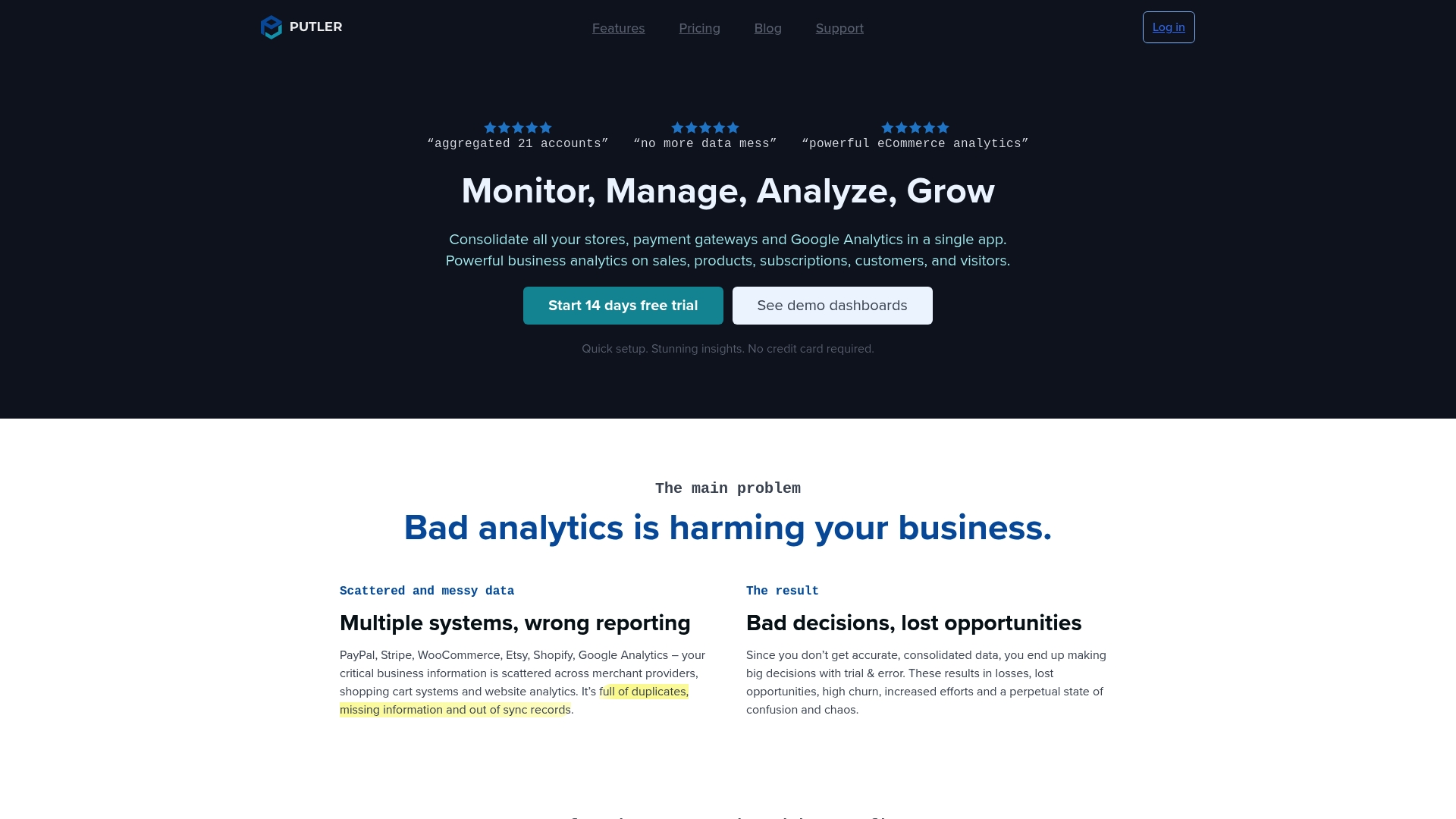
Putler consolidates scattered ecommerce data into a single, cleaned dashboard so you can stop juggling tabs and CSVs and start making decisions. It connects automatically to platforms like Shopify, PayPal, Stripe, WooCommerce, and Google Analytics, offers over 200 ready-to-use metrics, and includes a 14-day free trial with no credit card required. Bottom line: it’s a fast way for small to medium online stores to get reliable, unified analytics without hiring a data team. That ease comes with some trade-offs in advanced customization and pricing clarity.
Core Features
Putler’s strengths are simple and practical: automatic data consolidation from multiple sources, data cleaning that removes duplicates and aligns currency and timezones, and a wide library of prebuilt metrics and reports covering sales, refunds, orders, product analytics, visitor data, SaaS metrics, and customer profiles. The platform also provides marketing segmentation, filters, trend analysis, and basic order management features like search, refunds, and subscription handling — all inside one dashboard.
No guesswork.
Pros
- Consolidates ecommerce data into one dashboard: Putler removes the need to manually merge reports from multiple platforms, saving time and reducing errors.
- Delivers cleaned, unified data for better decisions: The automatic duplicate removal, currency alignment, and timezone correction improve data reliability for reporting and forecasting.
- Quick setup with no coding required: Integrations with popular platforms are designed to be straightforward, so teams can be operational in hours rather than weeks.
- Robust analytics with many ready-made metrics: With over 200 metrics and reports, you can analyze sales, customers, and product trends without building dashboards from scratch.
- Helps uncover growth and marketing opportunities: Built-in segmentation and trend tools make it easier to identify top performers and optimize campaigns.
Cons
- Pricing complexity can be confusing: Plans vary by number of data sources and features, which may make it harder to predict total cost for multi-platform stores.
- Limited public detail on enterprise customization: There’s little publicly available information about advanced customization or large-scale enterprise features, which could concern bigger teams.
- Not for highly specialized analytics needs: Some users may prefer solutions with deeper, niche analytics capabilities if they require custom modeling or advanced data science workflows.
Who It’s For
Putler targets small to medium-sized ecommerce businesses and online stores that need reliable, consolidated analytics without complex setup or a data engineer on staff. If you manage multiple sales channels and want quick insights to improve product bundling, cross-selling, inventory planning, or marketing segmentation, Putler is tailored to your day-to-day challenges.
Unique Value Proposition
Putler’s unique value is cleaning and unifying messy transactional data from diverse platforms into actionable reports you can use immediately. Instead of building integrations or cleaning exports, you get ready-to-use metrics and segmentation that speed up decisions on pricing, promotions, and product focus.
Real World Use Case
A retailer selling via Shopify, processing payments through PayPal and Stripe, and tracking traffic in Google Analytics uses Putler to unify those streams. The team identifies top-selling SKUs, monitors refund trends, and refines marketing segments to boost repeat purchases — all from one dashboard.
Pricing
Plans start at just $20/month and include a 14-day free trial with no credit card required, plus options to scale for growing businesses and custom enterprise solutions.
Website: https://putler.com
Ometria

At a Glance
Ometria is a customer data and experience platform built for retail brands that combines a retail-specific customer data platform (CDP) with experience orchestration and multi-channel delivery. For mid-sized e-commerce managers, it promises AI-driven personalization and real-time audience orchestration across email, SMS, web, mobile push, ads, and in-store touchpoints. It’s powerful and comprehensive, but that breadth can translate into a steeper implementation curve for teams without dedicated technical resources.
Core Features
Ometria centralizes customer profiles, identity resolution, and consent management through its CDP, then layers experience orchestration including real-time audiences, dynamic content, and a cross-channel journey builder. It supports data ingestion and consolidation with advanced segmentation, analytics, predictive insights, and marketing reporting, and it delivers experiences via email, SMS, ads and retargeting, mobile push, website, direct mail, in-store, customer service, and loyalty programs. Retail AI, branded Architect AI, powers personalization and automation throughout the platform.
Short and to the point.
Pros
- Tailored for retail with specific omnichannel marketing features that map directly to common retail workflows, making it easier to translate insights into campaigns across email, SMS, web, and in-store.
- Uses AI for personalization and predictive insights, which helps prioritize high-value customers and target likely repeat buyers with relevant bundles or cross-sells.
- Proven success with well-known retail brands, showing it can scale to established merchants and complex product assortments.
- Comprehensive suite covering data ingestion, orchestration, and experience delivery so you can move from consolidated customer profiles to executed campaigns without stitching several tools together.
- Strong recognition in the retail technology sector, which can reduce vendor risk when you present platform selection to stakeholders.
Cons
- Pricing is not specified in the provided content, making it hard for budgeting and ROI calculations before engaging sales.
- The platform’s breadth implies potential complexity, which may require significant onboarding, custom configuration, or technical resources to fully exploit advanced features.
- There are no direct details about customer support or training options in the provided data, leaving uncertainty about post-sale enablement and time-to-value.
Who It’s For
Ometria is aimed at retail marketing teams at mid-sized to larger e-commerce businesses that need deeper personalization and consistent cross-channel orchestration. If you manage product assortments, run frequent promotions, and want to increase average order value through smarter bundles and retention programs, Ometria speaks directly to those priorities.
Unique Value Proposition
Ometria’s unique value is its retail-first CDP plus experience orchestration stack, tied together with Architect AI for personalization and predictive insight. In practice, that means you get a single platform to unify customer data, build real-time audiences, and deliver tailored experiences across the precise channels retailers depend on.
Real World Use Case
Retailers like Steve Madden, Sephora, and Hotel Chocolat use Ometria to consolidate customer data, run advanced segmentation, and power cross-channel campaigns that boost retention and campaign efficiency. Typical outcomes include better-targeted email flows, more effective cart recovery, and AI-informed product recommendations for higher AOV.
Pricing
Not specified in the provided content.
Website: https://ometria.com
E-Commerce Analytics Tools Comparison
This table provides a comprehensive overview of top e-commerce analytics tools to help businesses make informed decisions when selecting a platform for their analytics and segmentation needs.
| Tool | Key Features | Pros | Cons | Pricing |
|---|---|---|---|---|
| Affinsy | Market Basket Analysis, RFM Segmentation, AI Insights, Continuous Updates | CSV uploads, AI-driven recommendations, increased AOV and LTV, free trial | Limited to Shopify and WooCommerce integrations | Flat $299/month, 7-day free trial |
| Market Basket Analysis Tool | Support/Confidence/Lift metrics, Personalized Recommendations, Data Export Features | Web-based interface, enterprise-like insights for SMBs, affordable | Dataset limits for larger catalogs, requires preprocessed data | Free trial, monthly/yearly subscriptions available |
| Glew | Data Pipeline + ELT, Unified Data Warehouse, Commerce Intelligence, Custom Dashboards | Extensive integrations, full-stack analytics, omni-channel aggregation | Pricing opacity, learning curve for new users | Custom pricing, options like Glew Pro and Plus tailored per business |
| DaaSity | Unified Sales/Marketing/Inventory Data, Vertical-Specific Solutions, Real-Time Analytics | No data engineering needed, powerful industry-specific solutions | Pricing not specified, complexity for smaller brands | Tailored enterprise pricing available |
| SegMetrics | Revenue Attribution Analytics, Customer Journey Mapping, Lifetime Value Tracking | Holistic tracking, scalable for agencies, precise ROI visibility | Complex setup, higher pricing for small businesses | From $57/month, includes a 14-day free trial |
| Putler | Unified Dashboard, Data Consolidation/Segmentation, Prebuilt Metrics | Reliable data cleanup, quick setup, actionable insights | Pricing complexity, limited detail on enterprise customization | Starting at $20/month with a 14-day free trial |
| Ometria | Retail-Focused CDP, Experience Orchestration, Predictive Analytics | Omnichannel personalization, retail-centric workflows, AI-driven insights | Pricing not provided, potential complexity for smaller teams | Pricing not specified; contact sales for custom packages |
Unlock Hidden Revenue with Affinsy’s AI-Powered Product Correlation Insights
If you are striving to discover hidden product associations and maximize your store’s average order value but find traditional analytics complex or time-consuming then Affinsy provides exactly the solution you need. This leading SaaS platform simplifies market basket analysis and RFM customer segmentation by turning your historical transaction data into actionable strategies for bundling, cross-selling, and customer retention. Designed for Shopify and WooCommerce stores, Affinsy empowers e-commerce owners and marketers to drive growth without requiring a data scientist.
Key benefits you get:
- AI-driven insights that uncover nonobvious product pairings and customer segments
- Continuous data refresh ensuring you stay ahead with current trends
- Seamless integration with platforms like Shopify, WooCommerce, and Google Analytics
Ready to lift your sales metrics now and transform complex data into easy-to-use marketing tactics? Explore Affinsy’s platform and experience how you can boost your customer lifetime value and average order size with targeted product bundling and retention campaigns.
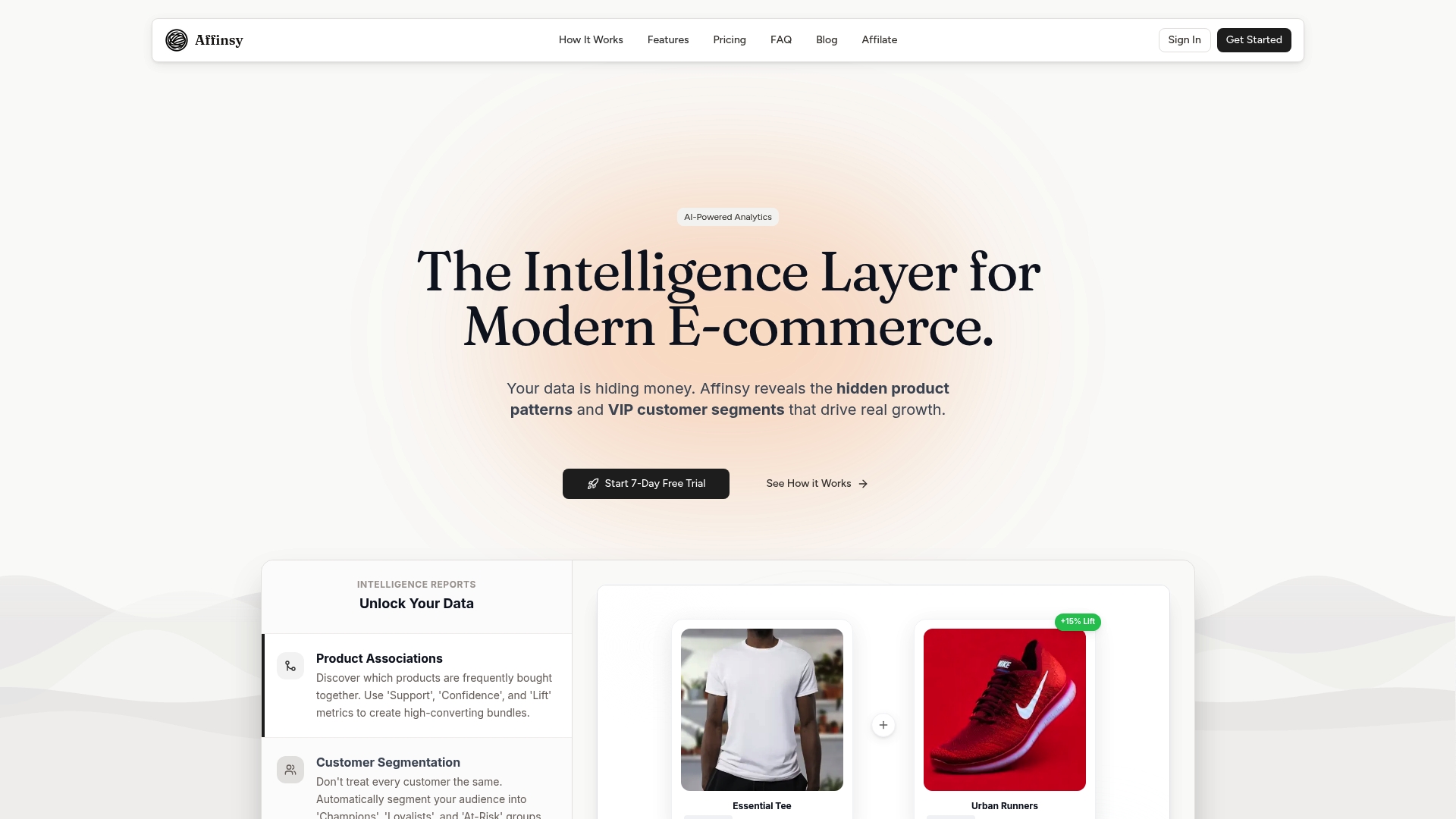
Discover the power of AI-driven product correlation analysis today by visiting Affinsy’s landing page. Don’t wait to turn your sales data into your most valuable growth asset. Start your free trial now and watch your e-commerce business reach its full potential.
Frequently Asked Questions
What is market basket analysis in sales data?
Market basket analysis is a technique used to identify patterns in transaction data by uncovering product associations. By analyzing which products are frequently purchased together, it helps businesses optimize their bundling and cross-selling strategies.
How can I use AI to improve average order value (AOV)?
You can use AI-driven tools that analyze past sales data to identify product correlations and suggest relevant bundles. Implement these recommendations into your marketing strategies to potentially increase AOV by 15-25% over the next quarter.
What features should I look for in AI tools for product correlation analysis?
Look for features like market basket analysis, RFM customer segmentation, and continuous data refresh capabilities. These tools should also allow easy data uploads and provide actionable insights to help with your sales strategies.
How do I get started with using AI to analyze my sales data?
Begin by uploading your sales transaction data into an AI platform designed for market analysis. Follow the platform’s guidance to generate insights, then apply the recommendations to your sales and marketing strategies within 30 days.
Can AI-driven analytics help with customer retention strategies?
Yes, AI-driven analytics can provide insights into customer behavior, allowing you to identify at-risk customers and best-performing segments. Use these insights to tailor retention campaigns that can increase customer lifetime value by up to 20% within the year.
Is there a trial available for AI tools focused on sales data analysis?
Many AI tools offer free trials allowing you to test their features before committing to a subscription. Look for options that provide at least a 14-day trial to evaluate the impact on your business analytics.
Recommended
- Complete Guide to AI in Ecommerce Analytics - Affinsy Blog | Affinsy
- 7 Smart Product Recommendation Ideas for E-Commerce Growth - Affinsy Blog | Affinsy
- 7 Essential Sales Analysis Report Insights for 2025 - Affinsy Blog | Affinsy
- Role of AI in E-Commerce: Boosting Sales and Retention - Affinsy Blog | Affinsy
- Amazon Analytics: Unlocking Sales Growth Globally - Searchoneers