
More than seventy percent of American shoppers now expect brands to offer tailored product bundles and seamless follow-up interactions with every purchase. For e-commerce managers, facing the same growing pressure worldwide, the power of analytics is no longer optional. Using real-time insights sets direct-to-consumer brands apart, driving smarter product associations and unlocking stronger customer retention without guesswork.
Table of Contents
- Defining Analytics In D2C Commerce
- Key Types: Product Association And Customer Segmentation
- How Analytics Powers Effective Product Bundling
- Driving Repeat Sales Through Retention Analytics
- Common Pitfalls When Applying D2C Analytics
Key Takeaways
| Point | Details |
|---|---|
| Analytics Drive D2C Success | Implementing a robust analytics framework is essential for understanding customer behavior and optimizing business strategies. |
| Product Association Enhances Sales | Utilizing product association analytics can boost cross-selling opportunities and improve product bundling strategies. |
| Retention Analytics Foster Loyalty | Engaging in retention analytics enables brands to personalize customer experiences and significantly increase repeat purchase rates. |
| Avoid Common Pitfalls | Addressing data integration challenges and refining predictive models can prevent inaccurate insights and enhance overall analytics efficacy. |
Defining Analytics in D2C Commerce
In direct-to-consumer (D2C) commerce, analytics represents the systematic process of collecting, analyzing, and interpreting customer and transaction data to drive strategic business decisions. At its core, this approach transforms raw digital information into actionable insights that help brands understand consumer behavior, optimize marketing strategies, and enhance overall business performance.
The landscape of D2C analytics encompasses several critical dimensions beyond basic transactional tracking. Systematic data gathering processes enable brands to develop comprehensive consumer profiles, predict purchasing patterns, and personalize customer experiences. These analytics strategies typically include metrics like customer acquisition costs, lifetime value, conversion rates, and engagement levels across multiple digital touchpoints.
Modern D2C analytics tools leverage advanced technologies such as machine learning and predictive modeling to provide deeper, more nuanced insights. By analyzing complex consumer interaction patterns, brands can create more targeted marketing campaigns, develop precision-focused product strategies, and build more responsive customer engagement models. This data-driven approach allows companies to move beyond traditional demographic segmentation and develop highly personalized consumer experiences.
Pro tip: Start by implementing a robust analytics framework that tracks at least five key performance indicators (KPIs) across customer acquisition, retention, and conversion metrics to build a comprehensive understanding of your D2C performance.
Key Types: Product Association and Customer Segmentation
In the realm of direct-to-consumer (D2C) commerce, two pivotal analytics approaches drive strategic business intelligence: product association and customer segmentation. These complementary techniques enable brands to unlock deeper insights into consumer behavior, optimize marketing strategies, and create more personalized shopping experiences.
Product association analytics represents a sophisticated method of understanding how different products relate to each other within a consumer’s purchasing journey. By analyzing transaction data, brands can identify complementary product combinations, develop intelligent cross-selling strategies, and design more effective product bundles. This approach goes beyond simple correlation, utilizing advanced algorithms to uncover nuanced relationships between items that might not be immediately apparent through traditional market research methods.

Customer segmentation, the counterpart to product association, involves strategically dividing the customer base into distinct groups based on shared characteristics, behaviors, and preferences. Advanced segmentation techniques enable D2C brands to create highly targeted marketing campaigns, personalize product recommendations, and develop tailored communication strategies. This granular approach allows companies to move beyond broad demographic categories and develop more precise, data-driven engagement models that resonate with specific customer subgroups.
Pro tip: Implement a data collection framework that captures granular customer interaction data across multiple touchpoints, enabling more sophisticated product association and customer segmentation analysis.
Here’s a summary comparing major D2C analytics methods and their business benefits:
| Analytics Method | Main Purpose | Business Benefit |
|---|---|---|
| Product Association | Find product relationships | Boost cross-selling and bundle sales |
| Customer Segmentation | Group customers by traits | Enable targeted marketing campaigns |
| Retention Analytics | Track loyalty and repeat sales | Increase customer lifetime value |
| Predictive Modeling | Forecast behaviors and trends | Optimize inventory and marketing |
How Analytics Powers Effective Product Bundling
Product bundling in direct-to-consumer (D2C) commerce has evolved from a simple sales technique to a sophisticated strategy powered by advanced analytics. By leveraging data-driven insights, brands can create intelligent product combinations that not only increase average order value but also enhance the overall customer shopping experience.
Advanced analytics techniques enable brands to uncover hidden relationships between products through sophisticated methods like association rule mining and collaborative filtering. These approaches analyze historical transaction data to identify complementary items that customers are likely to purchase together. By examining patterns in customer behavior, businesses can design product bundles that feel intuitive and personalized, rather than arbitrary or forced.

The power of analytics in product bundling extends beyond simple pairing recommendations. Predictive modeling strategies allow companies to dynamically adjust their bundling approach based on real-time customer interactions, seasonal trends, and emerging market demands. This dynamic approach means that product bundles can be continuously optimized, ensuring that offerings remain relevant and attractive to different customer segments across various regions and market conditions.
Pro tip: Implement a continuous feedback loop in your analytics framework that allows for real-time adjustment of product bundles based on customer purchase patterns and interaction data.
Driving Repeat Sales Through Retention Analytics
Retention analytics has become the critical backbone of sustainable growth for direct-to-consumer (D2C) brands, transforming how companies approach customer loyalty and long-term value generation. By systematically analyzing customer behavior, purchase patterns, and engagement metrics, businesses can develop targeted strategies that dramatically improve repeat purchase rates and reduce customer churn.
Retention analytics strategies enable brands to predict and proactively address potential customer disengagement through sophisticated predictive modeling. These advanced approaches go beyond traditional demographic segmentation, utilizing machine learning algorithms to create nuanced customer lifetime value profiles. By understanding individual customer journeys, brands can design personalized retention programs that speak directly to each customer’s unique preferences, purchasing habits, and potential future interactions.
The most successful D2C brands leverage retention analytics as a comprehensive approach to customer relationship management. This involves integrating multiple data points such as purchase frequency, average order value, time between purchases, and customer feedback to create a holistic view of customer engagement. By developing dynamic retention models that adapt in real-time, companies can create increasingly sophisticated intervention strategies, such as personalized communication, targeted promotions, and loyalty rewards that feel genuinely tailored to individual customer needs.
Pro tip: Develop a retention analytics dashboard that tracks at least five key performance indicators, including repeat purchase rate, customer lifetime value, and churn prediction, to gain comprehensive insights into your customer retention strategy.
Common Pitfalls When Applying D2C Analytics
Navigating the complex landscape of direct-to-consumer (D2C) analytics requires a strategic approach that goes beyond simple data collection. Many brands encounter significant challenges that can undermine their analytical efforts and lead to misguided business decisions.
Data integration challenges represent one of the most critical obstacles for D2C brands. These pitfalls often emerge when companies fail to create a cohesive data ecosystem, resulting in fragmented insights that provide an incomplete picture of customer behavior. Typical integration problems include disconnected data sources, inconsistent data formatting, and a lack of standardized metrics across different platforms and touchpoints.
Machine learning implementation risks further complicate analytics strategies for D2C brands. Many companies struggle with insufficient data volume, volatile market conditions, and the complexity of developing accurate predictive models. This challenge is particularly acute in sales forecasting, where traditional approaches often fall short in capturing the nuanced dynamics of consumer behavior. Brands must invest in robust data governance frameworks and continuously refine their analytical models to overcome these inherent limitations.
Below is a quick reference outlining common analytics pitfalls and ways to avoid them:
| Pitfall | Impact on Business | How to Avoid |
|---|---|---|
| Data integration silos | Fragmented customer insights | Unified data systems |
| Inconsistently formatted data | Inaccurate performance metrics | Standardize data collection |
| Limited predictive accuracy | Poor forecasting decisions | Refine models regularly |
| Insufficient data for ML models | Weak personalization efforts | Invest in broader data sources |
Pro tip: Conduct a comprehensive audit of your data integration processes, identifying and eliminating silos that prevent holistic customer insights and creating a unified data strategy that supports accurate decision-making.
Unlock the Power of D2C Analytics to Boost Retention and Sales
The article highlights crucial challenges faced by D2C brands such as optimizing product bundling, enhancing customer retention, and uncovering hidden product associations. Key pain points like fragmented data, complex predictive modeling, and the need for actionable insights from customer segmentation and market basket analysis are front and center. If you want to move beyond basic data tracking and truly maximize your D2C performance, embracing advanced analytics is essential.
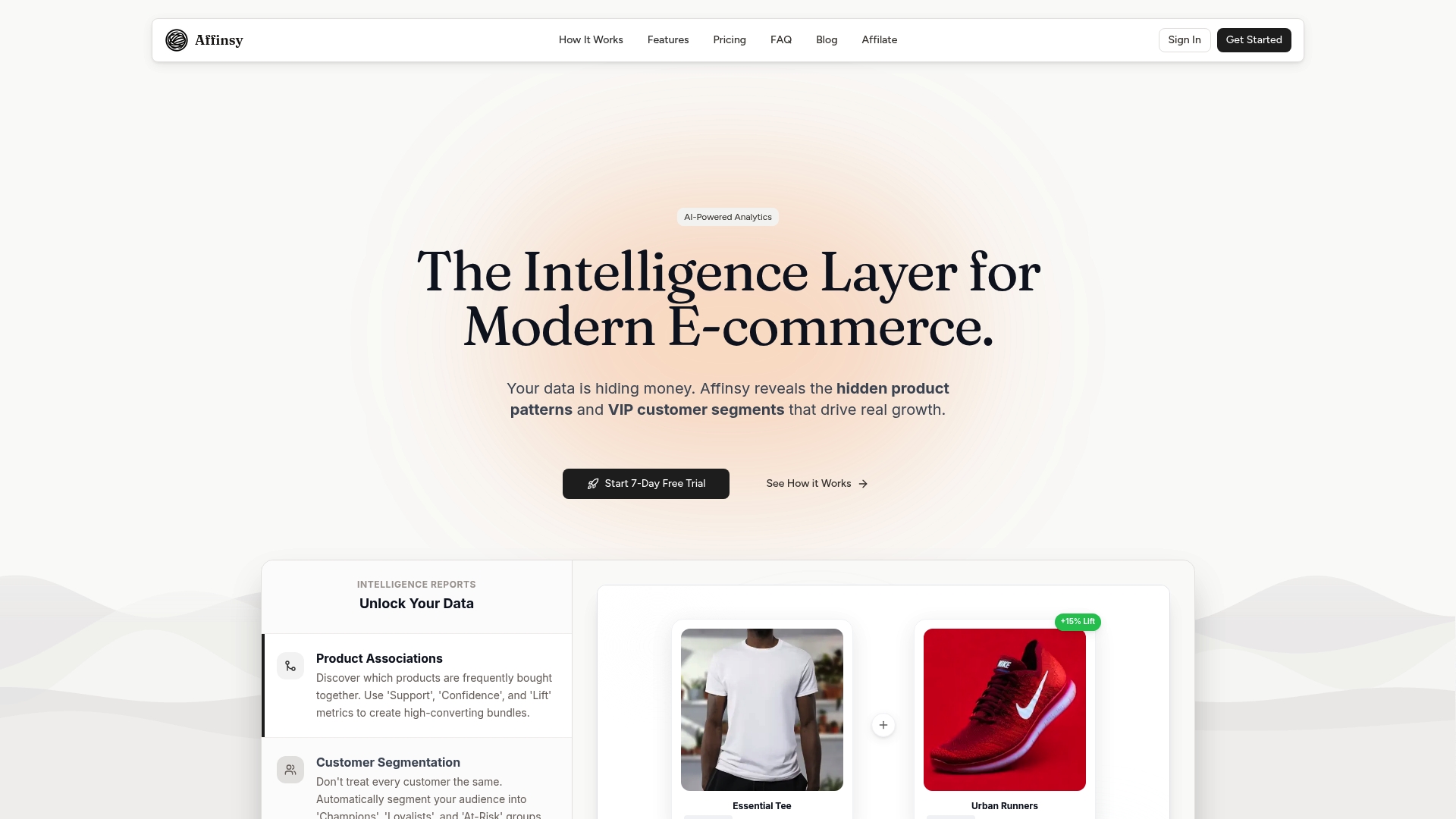
Affinsy is designed precisely to address these challenges. By leveraging AI-powered analytics, it transforms your historical transaction data into clear, actionable insights that enable smarter product bundling, targeted cross-selling, and effective retention strategies. Seamlessly integrating with platforms like Shopify, WooCommerce, and Google Analytics, Affinsy empowers marketing managers and store owners to boost average order values and increase customer loyalty without needing data science expertise. Discover how you can automate crucial analytics such as market basket analysis and RFM customer segmentation to gain a competitive edge.
Start optimizing your D2C business today with Affinsy and unlock the full potential of your customer data. Explore more about our AI-powered analytics platform and see how easy it is to transform insights into sales growth.
Do not wait to turn complex data into your strongest asset. Take action now and watch your D2C sales and retention soar.
Frequently Asked Questions
What is the role of analytics in D2C commerce?
Analytics in D2C commerce involves collecting and interpreting data to drive strategic decisions, helping brands understand consumer behavior, optimize marketing, and improve overall performance.
How can product association analytics benefit a D2C brand?
Product association analytics helps identify which products are often purchased together, enabling brands to create effective cross-selling strategies and personalized product bundles that enhance customer satisfaction.
What key performance indicators (KPIs) should D2C brands track for retention analytics?
D2C brands should monitor KPIs such as repeat purchase rate, customer lifetime value, churn prediction, average order value, and customer engagement levels to effectively gauge retention performance.
What common pitfalls should D2C brands avoid when implementing analytics?
Common pitfalls include data integration silos, inconsistently formatted data, limited predictive accuracy, and insufficient data for machine learning models. Avoiding these issues requires a unified data strategy and refined analytical models.
Recommended
- The Essential Guide to Sales and Marketing Analytics 2025 - Affinsy Blog | Affinsy
- Understanding Top Retail Analytics Terms for E-Commerce Success - Affinsy Blog | Affinsy
- Understanding Retail Analytics Guide 2025 for E-Commerce Success - Affinsy Blog | Affinsy
- Role of Analytics in Marketing for E-Commerce Growth - Affinsy Blog | Affinsy
- Ecommerce Analytics Explained: Complete Guide for 2025