Every sale tells a story and every click leaves a clue. With online stores facing fierce competition and shoppers expecting more at every turn, finding the right analytics tools can mean the difference between guessing and knowing. Smart data can uncover hidden patterns in customer behavior and highlight missed chances to improve revenue. Imagine seeing exactly where visitors linger or what makes them walk away. The right tool opens up new possibilities for making quick decisions that actually pay off. Get curious about what the most advanced options can offer and see how your online store could grow when the numbers finally make sense.
Table of Contents
Affinsy
At a Glance
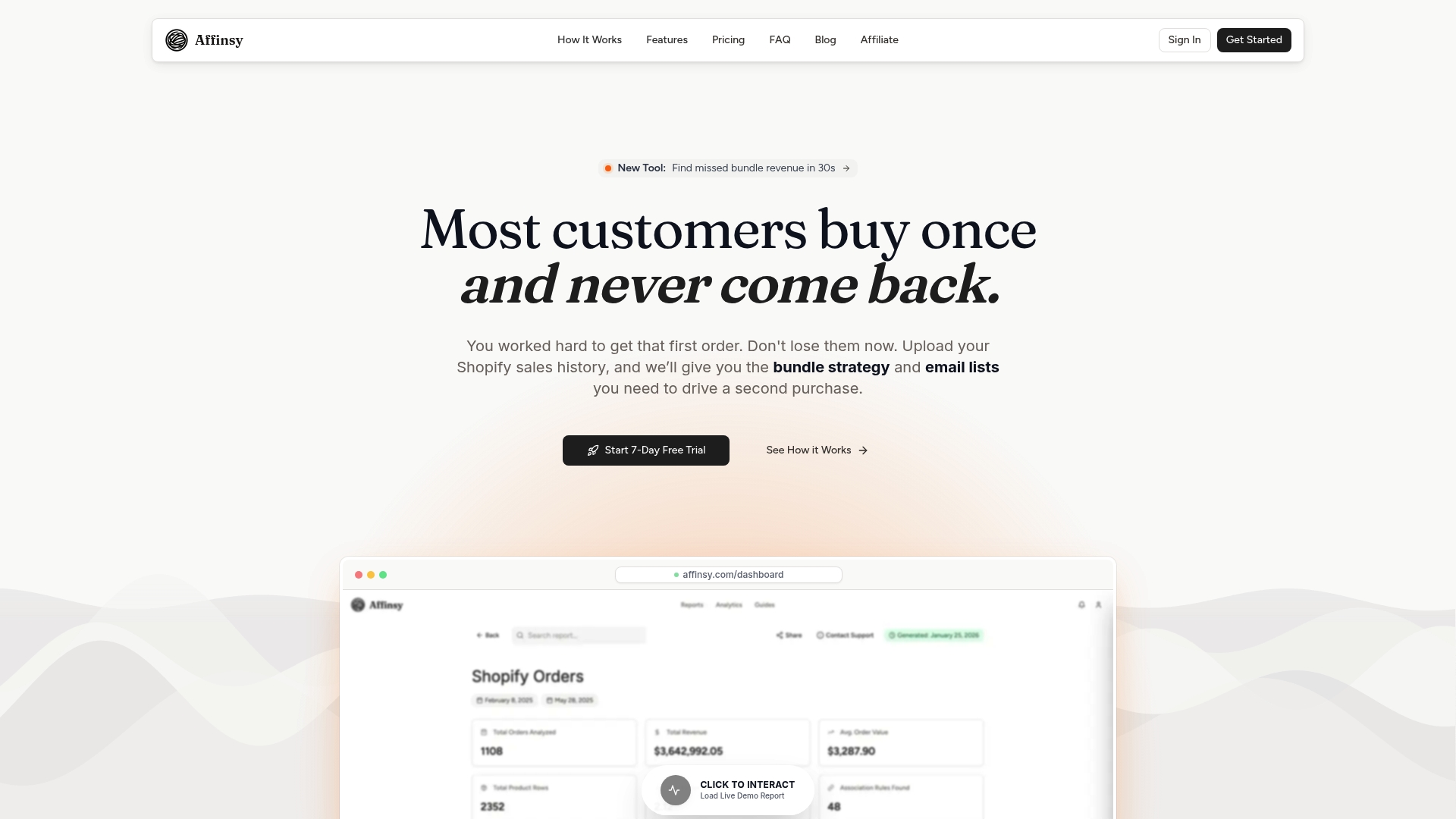
Affinsy is a platform-agnostic e-commerce analytics platform built for mid-market retailers who want actionable insights from their transaction data without building a data team. It combines Market Basket Analysis, RFM Customer Segmentation, and AI Insights into a single dashboard so teams can find cross sell and bundling opportunities, identify at risk customers, and act on recommendations fast. The platform works with data from any e-commerce system — drop your CSV in or push data via API — and delivers results you can export and share with stakeholders.
Core Features
Affinsy analyzes historical transactions to reveal hidden product relationships and customer segments that drive revenue. The platform delivers an Analytics Dashboard with visual reports and AI powered recommendations, supports CSV upload with auto-format detection for Shopify, WooCommerce, and custom exports, and offers a Push API for automated data pipelines on higher tiers. Additional capabilities include CSV Export & Report Sharing for handoffs to marketing and operations teams, password-protected public report links, and an MCP Server that lets AI assistants like Claude query your analytics data directly.
Pros
- Platform agnostic: Works with any e-commerce system via CSV upload or Push API, so you are not locked into Shopify or WooCommerce.
- Handles large datasets: Built to process hundreds of thousands of orders and products, which is where mid-market stores need reliability.
- Actionable insights without a data scientist: AI powered recommendations tell you what to do next, not just what happened.
- 7-day free trial: Start on the full plan and validate the insights against your own orders before you pay.
- API and MCP access: Automate data pipelines and integrate analytics into AI workflows on the Max plan.
Who It's For
Affinsy is built for mid-market e-commerce retailers with large transaction volumes who need commercial analytics without hiring dedicated data scientists. Marketing managers, growth teams, and operations leads who focus on customer retention and average order value will get the most value. It also fits data and analytics teams who want an API driven analytics layer that generates exportable insights for campaign execution. Stores running on custom platforms, ERPs, or niche systems benefit from the platform-agnostic CSV and API approach.
Unique Value Proposition
Affinsy converts raw transaction history into direct revenue actions with minimal setup. The combination of Market Basket Analysis, RFM Segmentation, and AI driven insights creates a unified workflow from discovery to campaign. You spot high potential bundles and at risk customer segments, then export target lists and reports to run email and on site campaigns without waiting on engineering. The platform-agnostic data ingestion means you are not limited to one e-commerce platform, and the Push API lets you automate the entire pipeline so reports stay fresh as new orders come in.
Real World Use Case
A mid-market fashion retailer uploaded six months of order data via CSV and used Affinsy to identify the three product bundles that raised average order value by focusing promotions on complementary items. The RFM segmentation flagged VIP customers showing declining purchase frequency, and the team ran a targeted retention campaign that improved repeat purchases over the next quarter. Reports were exported as CSVs and shared via password-protected links with the growth team for personalized outreach.
Pricing
Affinsy runs on a single plan: Agency at a flat $299/month, starting with a 7-day free trial. It includes up to 10 client datasets at 1.5M line items each, 5 team seats, daily scheduled reruns, full report access and exports, and REST API and MCP server access. Enterprise terms and a DPA are available on request.
Website: https://affinsy.com
ThoughtMetric
At a Glance
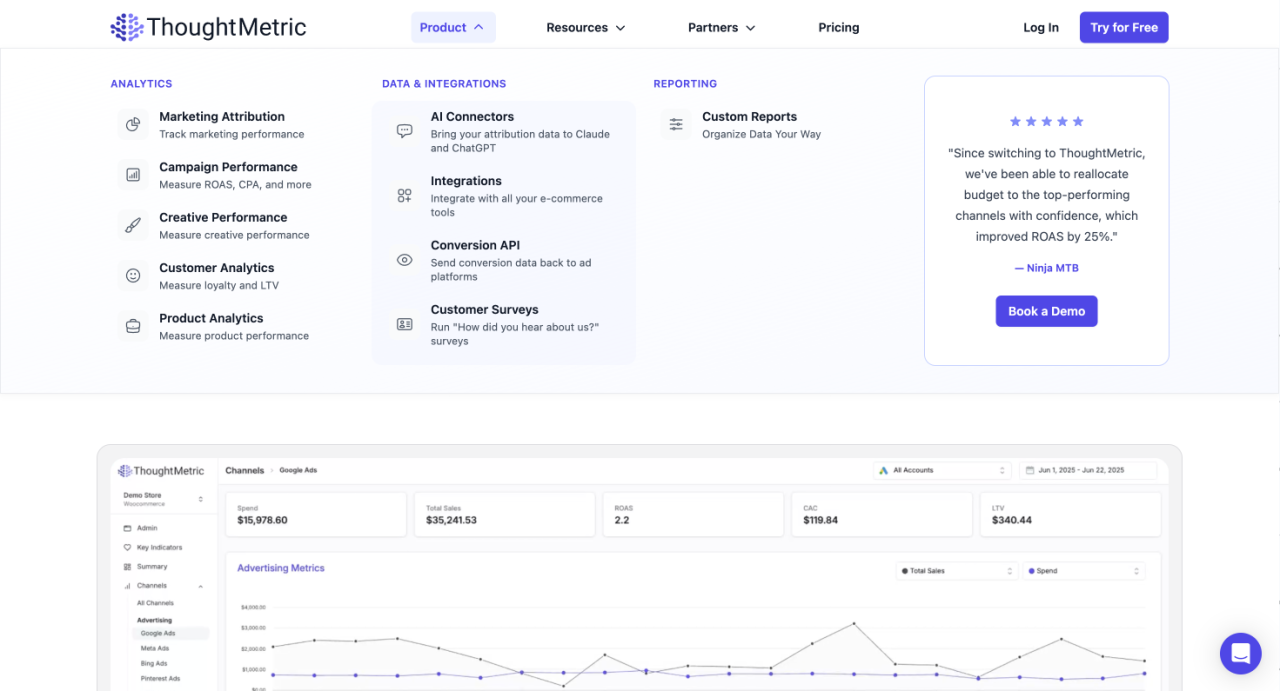
ThoughtMetric is a marketing attribution and analytics platform built specifically for e-commerce brands that want to understand which channels drive revenue. The platform integrates with Shopify, WooCommerce, Magento, and BigCommerce along with major ad platforms like Meta, Google, TikTok, and Pinterest. Used by over 1,200 e-commerce stores, ThoughtMetric keeps pricing simple with plans based on monthly pageviews and every feature included at every tier.
Core Features
ThoughtMetric tracks the full customer journey from first touch to purchase using a combination of pixel tracking, server-side tagging, and post-purchase surveys. The platform offers five attribution models including first touch, last touch, linear, position-based, and a recommended multi-touch model so teams can analyze performance from multiple angles. Additional capabilities include campaign and creative performance reporting, product analytics to see which SKUs drive revenue by channel, customer analytics with LTV and new vs returning segmentation, Conversion API integrations to feed accurate data back to ad platforms, and AI connectors that let you query your data directly in ChatGPT or Claude. Custom reports and real-time dashboards keep the data current throughout the day.
Pros
- Simple pageview-based pricing with no gated features: Every plan includes the full platform so you do not pay extra for attribution models, creative reporting, or customer analytics.
- Easy setup and intuitive interface: Teams can connect their store and start pulling meaningful attribution data without heavy technical work or a dedicated data team.
- Accurate tracking despite iOS and ad blocker challenges: Server-side tagging and post-purchase surveys help capture conversion data that browser-only tracking misses.
- Broad integration ecosystem: Native connections to Shopify, WooCommerce, Magento, BigCommerce, and major ad platforms consolidate marketing data in one place.
- Responsive support and personalized onboarding: Every customer receives hands-on onboarding and access to live chat support with knowledgeable employees.
Cons
- Only offers paid plans.
- Specializes in e-commerce only.
- Does not track offline conversions.
Who It's For
ThoughtMetric suits e-commerce brands and agencies running paid media across multiple channels that need reliable attribution to make confident budget decisions. Marketing managers, media buyers, and growth teams will get the most value. Agencies managing multiple client accounts also benefit from the clear reporting and onboarding support.
Unique Value Proposition
ThoughtMetric stands out by combining multi-touch attribution with server-side tracking and post-purchase survey data to create a more accurate picture of marketing performance than any single method provides alone. Where most analytics tools focus on reporting what happened, ThoughtMetric focuses on proving which marketing efforts caused it. The Conversion API integration closes the loop by feeding that accurate data back to ad platforms to improve ad targeting and delivery. All of this ships in a single flat-feature plan rather than forcing upgrades for advanced capabilities.
Real World Use Case
An e-commerce brand discovered through ThoughtMetric that in-platform Meta reporting was significantly overstating ROAS. By switching budget allocation decisions to ThoughtMetric's multi-touch attribution data, the team identified underperforming campaigns, cut wasted ad spend, and reallocated budget to top-performing channels. The result was improved ROAS and more decisive marketing meetings because the team trusted a single source of truth rather than conflicting platform numbers.
Pricing
ThoughtMetric pricing is based on monthly pageviews. Plans start at $99 per month for up to 50,000 pageviews. A free trial is available with no credit card required.
Website: https://thoughtmetric.io
Peel Insights
At a Glance
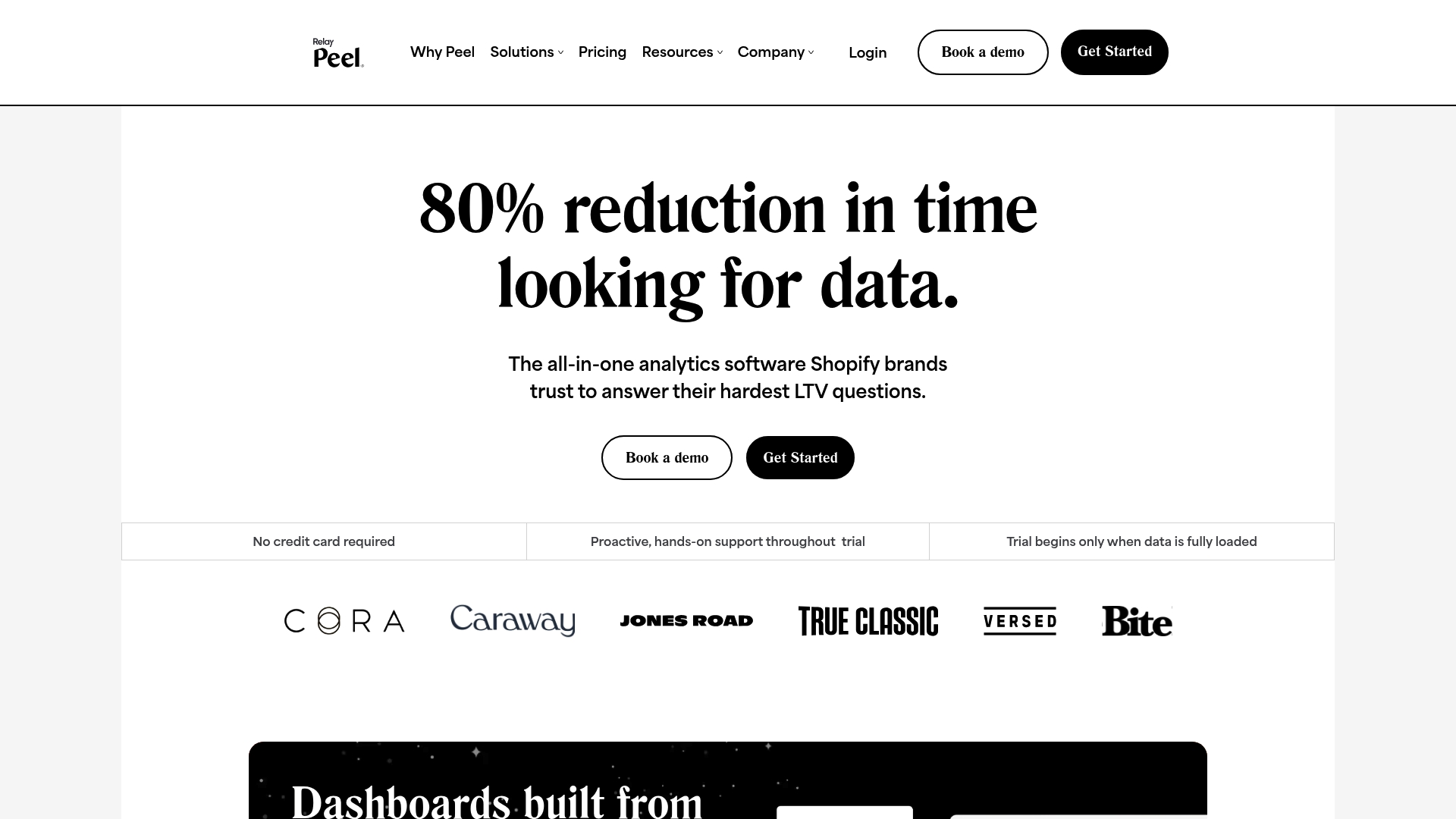
Peel Insights is an all in one analytics platform built for Shopify brands that need faster, more accurate reporting. It centralizes sales, marketing, and customer data into automated dashboards so teams spend less time assembling reports and more time acting on insights. Peel promises up to an 80% reduction in data analysis time while offering integrations across Shopify, Amazon, and GA4. Pricing sits toward the higher end which makes this a stronger fit for mid to large brands rather than tiny shops.
Core Features
Peel combines automated and customizable analytics dashboards with broad integrations to deliver cross channel performance visibility. Key capabilities include RFM customer segmentation, deep metric analysis across channels, automated insights with Slack and Email digests, scheduled reports and exports, Snowflake data access for SQL queries, and revenue and cost intelligence with multi touch attribution and currency conversion. The platform pulls data from Shopify, Amazon, ad networks, email and SMS systems to present unified reports tailored to e commerce workflows.
Pros
- Peel provides deep metric and performance analysis tailored for e commerce brands, making complex metrics easier to interpret.
- The platform offers time saving automation that reduces data analysis time by 80 percent, allowing faster decision cycles.
- Peel supports a strong integration ecosystem with popular platforms like Shopify and Amazon, which simplifies data collection.
- Customizable dashboards and reports let teams focus on the exact KPIs they track for customer retention and product performance.
- Proactive onboarding and trial support help teams get set up and start seeing value sooner.
Cons
- Pricing starts at $179 per month billed annually which may be on the higher end for smaller brands and tight budgets.
- The platform can be complex and will require a learning curve for new users who lack analytics experience.
- Peel shares limited details publicly about data security certifications which may raise questions for teams with strict compliance needs.
Who It's For
Peel is aimed at mid to large scale Shopify and e commerce brands that need advanced analytics and consolidated reporting. Marketing managers focused on customer lifetime value and retention, data teams running attribution and cost analysis, and operations leads tracking product performance will benefit most. Small shops with limited budgets should weigh the cost against expected time savings.
Unique Value Proposition
Peel stands out by combining automated reporting with deep e commerce specific analytics and Snowflake access for SQL queries. The platform turns multiple data sources into actionable insights with minimal manual effort which speeds up optimization cycles. For teams that value precise revenue and cost intelligence across channels, Peel bundles those capabilities into a single interface.
Real World Use Case
A Shopify store uses Peel to automatically generate daily sales and customer behavior reports that feed the marketing team each morning. The team uses those reports to reallocate ad spend, adjust product bundles, and refine email campaigns, producing faster campaign pivots and clearer insight into customer segments. The result is quicker optimization of marketing strategies and product offerings.
Pricing
Plans start at $179 per month billed annually for the Core plan. Pricing scales up to $899 per month for the Accelerate plan with Tailored plans available by custom quote. Budget conscious teams should factor implementation and training time into total cost of ownership.
Website: https://peelinsights.com
Polar Analytics
At a Glance
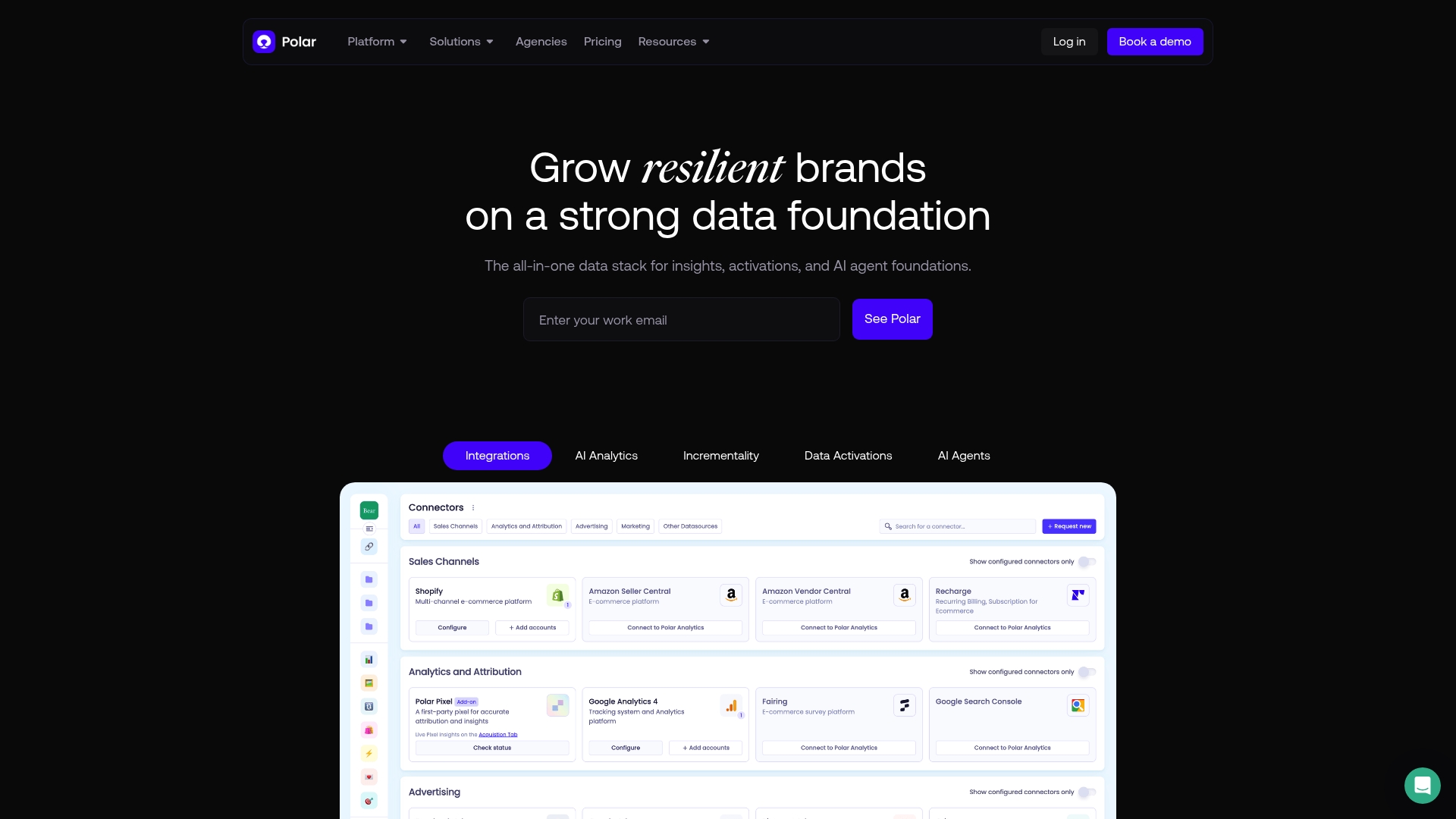
Polar Analytics is an all in one data platform built for ecommerce brands and agencies that want actionable insights and automated activations. The platform combines Business Intelligence with testing and AI driven agents to help you validate what actually moves revenue. Over 4,000 ecommerce brands and agencies use the product, which speaks to its maturity and client trust. Pricing requires a demo, so expect a consultative sale rather than instant self sign up.
Core Features
Polar Analytics centralizes marketing and sales data and turns reports into decisions with Business Intelligence tools that include alerts and insight workflows. It runs Incrementality Testing to validate which channels and campaigns drive sales and sends Advertising Signals back to ad platforms to improve attribution. The platform also supports Klaviyo Audiences capture and offers AI Agents that analyze data, assist with media buying, plan inventory, and plug into Slack and Gmail through a semantic layer.
Pros
- Trusted by over 4,000 brands: That scale indicates broad adoption and practical proof points across ecommerce verticals.
- Comprehensive feature set: The combination of insights, activations, and AI agents reduces the number of disconnected tools you must manage.
- Easy integrations: Native connections to common marketing stacks make data consolidation faster and cut back on manual exports.
- Rich resources: Case studies, benchmarks, and templates speed onboarding and help teams apply best practices.
- Dedicated support: Access to a support team and success managers helps with implementation and long term adoption.
Cons
- Pricing is not listed publicly and requires a demo request, which adds friction for smaller teams seeking instant clarity.
- Implementing advanced features may require technical knowledge or vendor support, which lengthens time to value for teams without engineers.
- The breadth of features can overwhelm users who prefer a minimal interface or a single focus tool for one task.
Who It's For
Polar Analytics suits ecommerce brands and digital marketing agencies that handle multiple channels and need a centralized data back end. If your team runs paid media, email, and direct to consumer commerce and you want to prove which tactics drive incremental sales, this is a strong fit. Smaller single channel shops will find the consultative onboarding style more appropriate than a plug and play purchase.
Unique Value Proposition
Polar Analytics pairs robust reporting with activation capability so you can move from insight to execution without exporting spreadsheets. Its incrementality testing and advertising signal layer give you a more defensible view of what drives revenue. The AI Agents add efficiency by automating repetitive analysis and campaign decisions.
Real World Use Case
A Shopify first ecommerce brand consolidates marketing and sales feeds in Polar Analytics, runs incrementality tests on ad spend, and automates weekly reports to stakeholders. The result is faster decisions on budget allocation, reduced manual reporting work, and clearer attribution across channels.
Pricing
Pricing details are available upon request or demo, with plans that include a Core Data Platform and customizable options based on scale and integrations. Expect vendor guided setup and tiered packages rather than a flat self serve price.
Website: https://polaranalytics.com
Metorik
At a Glance
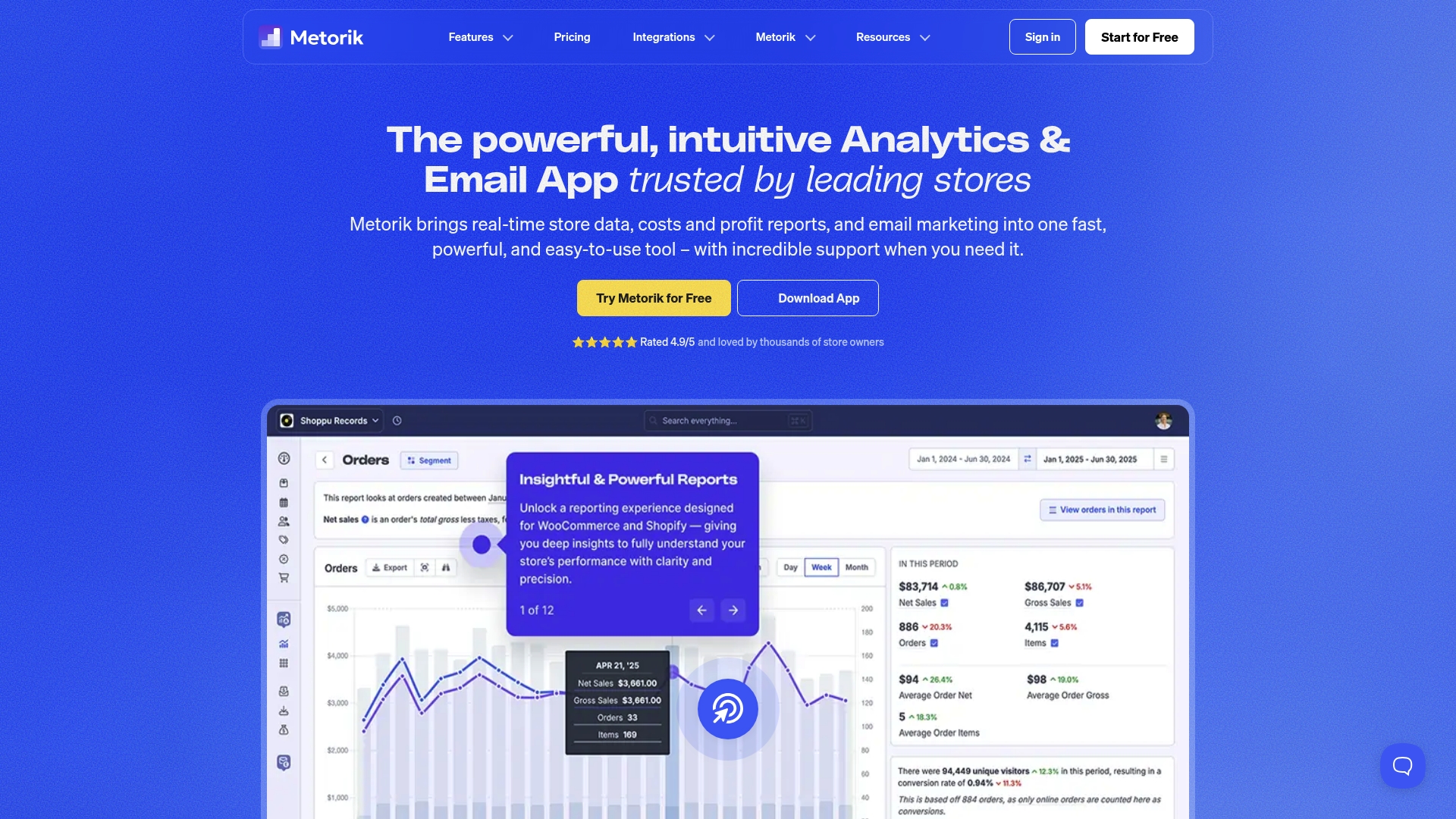
Metorik is a comprehensive eCommerce analytics and reporting platform built for WooCommerce and Shopify stores. It delivers real time data, deep segmentation, and automated reporting so teams get answers faster. Setup is quick and the interface is approachable for marketing and operations teams. Bottom line: it fits medium to large stores that need accurate reporting and email automation without hiring a data scientist.
Core Features
Metorik combines an Analytics & Reports suite with more than 75 preset reports and flexible custom exports. The platform offers automated sales digests delivered by email or Slack plus customer cohorts for segmentation and subscription reporting tailored for WooCommerce. Additional capabilities include cost and profit tracking, product performance reports, forecasting tools, powerful email automation and abandoned cart recovery, and broad integrations with advertising, support, and shipping tools.
Pros
- User friendly interface with quick setup: Teams can connect stores and start pulling meaningful reports within hours, not weeks.
- Robust and detailed analytics: Over 75 reports plus custom CSV exporting let you measure orders, returns, and lifetime behavior with precision.
- Automations save time: Scheduled digests and automated emails reduce manual reporting and keep stakeholders informed without extra meetings.
- Multiple integrations provide a complete view: Connections to marketing and support tools let you join purchase and ticket data for smarter decisions.
- Excellent customer support: The support team is knowledgeable and responsive which shortens troubleshooting cycles and helps new users adopt advanced features.
Cons
- Pricing can be high for small stores or startups and may restrict access for low volume merchants.
- The platform presents complexity that can overwhelm very new users who lack analytics experience.
- Metorik depends on platform specific integrations which limits some cross platform flexibility if you use nonstandard setups.
Who It's For
Metorik suits medium to large eCommerce store owners and marketing or analytics teams running WooCommerce or Shopify. Use it if you need detailed reporting, subscription metrics, and automated email workflows that plug into your existing stack. If you operate multiple stores or handle subscription products, this tool will save time and centralize metrics across teams.
Unique Value Proposition
Metorik packages deep, store specific reporting with hands off automations so teams get timely insight without building dashboards from scratch. The combination of subscription reporting for WooCommerce and superpower segmenting gives you granular control over customer groups and lifecycle messaging. That focus on store level detail sets it apart from generic analytics tools.
Real World Use Case
A WooCommerce store owner connects Metorik to capture real time sales data and automate a weekly sales digest for stakeholders. The marketing team then uses cohorts to run targeted email campaigns and abandoned cart flows. The result is clearer decision making, faster reaction to inventory issues, and improved customer retention.
Pricing
Metorik uses a subscription model that scales with monthly order volume and features. Pricing starts at about $150 USD per month for higher tiers that support more orders and additional stores. Contact sales for exact tiers based on your order volume and feature needs.
Website: https://metorik.com
Glew
At a Glance
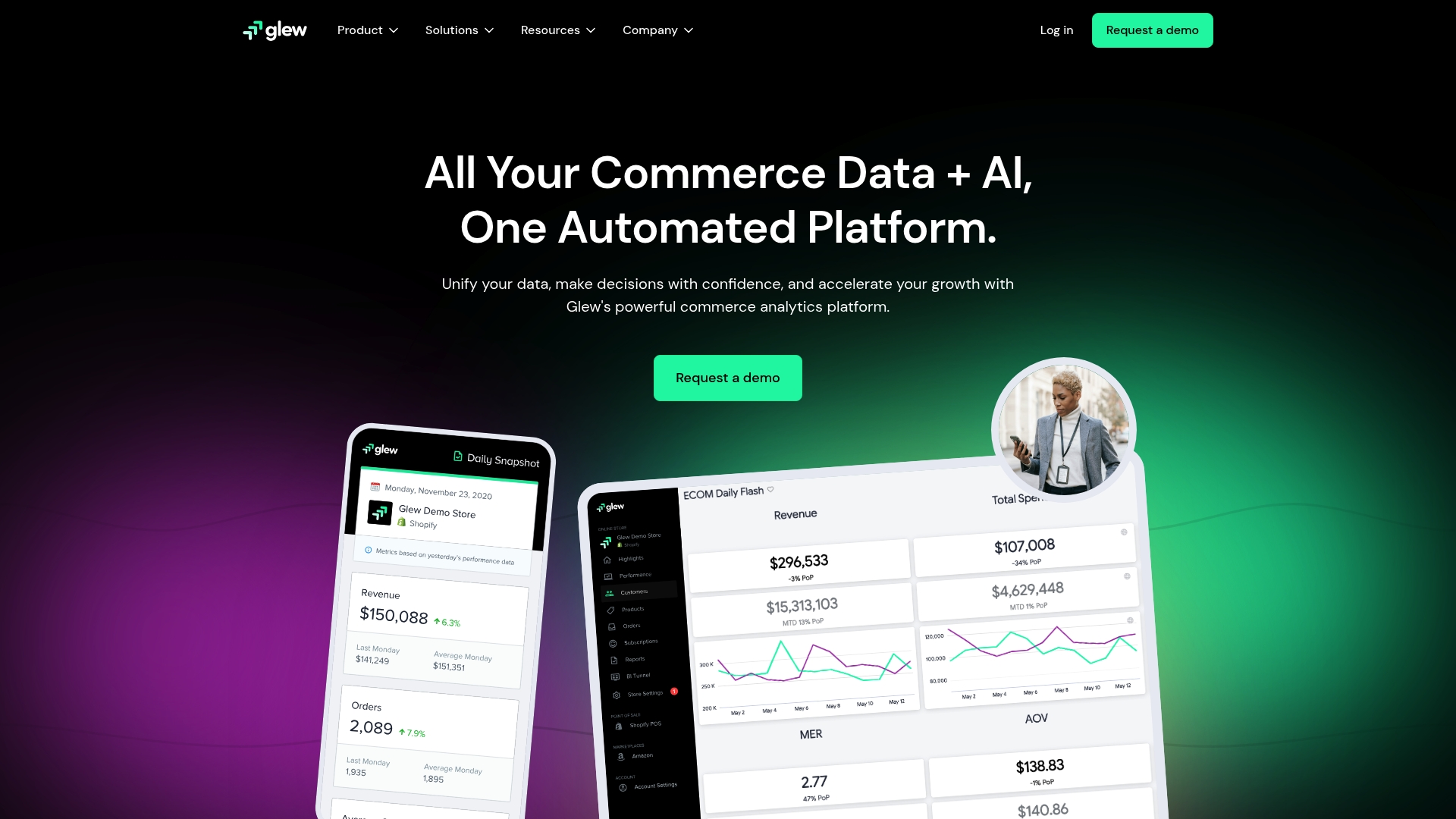
Glew offers the Commerce Data Cloud, an end to end retail intelligence platform that centralizes sales, inventory, and marketing data for commerce teams. Trusted by over 8,000 stores, it automates data ingestion, validation, and reporting so teams spend less time cleaning data and more time acting on insights. The platform suits multi channel retailers that need consolidated reporting across brands and departments but may feel feature rich for very small teams.
- Trusted by 8,000 plus stores for centralized retail analytics
- Strong automation for data ingestion and daily snapshot reporting
Core Features
Glew focuses on automated data intake and unified reporting to create a single source of truth for commerce teams. It offers data validation and unification, out of the box and custom reports, and scheduled alerts to keep stakeholders informed. The product supports multi channel aggregation and provides extensive KPIs and dashboards that marketing and operations teams can use without heavy technical support.
- Data ingestion and analysis automation
- 170 plus deep commerce integrations
- Daily snapshot reports and scheduled alerts
Pros
- Comprehensive integration capabilities make it simple to pull data from 170 plus channels so you avoid fragmented spreadsheets.
- Customizable no code reporting lets marketing and analytics teams build tailored views without relying on engineering.
- Automated data validation and cleaning reduces time spent reconciling mismatched data across platforms.
- Multi channel and multi brand support enables centralized analysis for retail chains or fast growing brands.
- User friendly dashboards surface extensive KPIs so teams can track performance at a glance.
Cons
- Pricing details are not specified which means you will likely need to contact Sales to get a quote.
- Advanced custom reporting and setup can require onboarding and extra configuration effort.
- The platform can feel complex for smaller teams or stores with basic analytics needs.
Who It's For
Glew fits retail and e commerce teams that operate multiple stores or brands and need consolidated, accurate data for decision making. Marketing managers, operations leads, and analysts at mid market to enterprise retailers will get the most value from the reporting and integration breadth. Small shops with single channel needs may find the platform more than they require.
- Ideal for multi store retail chains and growing e commerce brands
- Best for teams seeking centralized KPIs and automated reporting
Unique Value Proposition
Glew combines broad connector coverage with automated data validation to deliver a reliable single source of truth across sales, inventory, and marketing. That mix speeds up analysis, reduces reporting friction, and enables targeted actions like smarter inventory allocation and campaign segmentation.
- Focused on actionable commerce intelligence rather than raw data dumps
Real World Use Case
A retail chain consolidated sales, inventory, and marketing data from 30 stores into Glew to centralize insights and automate performance reports. The result was clearer inventory signals and more targeted marketing because teams reacted to a single, validated data set rather than conflicting spreadsheets.
- Use case: centralized reporting for multi store retail operations
Pricing
Glew offers tailored plans such as Glew Pro and Glew Plus with features matched to different sizes and needs. Specific pricing is provided after contact or during a demo so you can align plan features to your store count and integration needs.
- Plans: Glew Pro, Glew Plus, plus custom enterprise options
Website: https://glew.io
E-commerce Analytics Tools Comparison
Below is a detailed comparison of leading analytics platforms tailored for e-commerce, highlighting their primary features, benefits, limitations, and pricing models to assist in decision-making.
| Tool | Core Features | Pros | Cons | Pricing |
|---|---|---|---|---|
| Affinsy | Market Basket Analysis, RFM Segmentation, AI Insights, Push API, MCP Server | Platform-agnostic, Handles large datasets, One flat plan, API and AI integration | Advanced API features require Max plan | Agency, flat $299/mo |
| ThoughtMetric | Multi-touch Attribution, Server-side Tracking, Post-purchase Surveys, Conversion API, AI Connectors | Simple pageview pricing, All features included, Accurate iOS/ad-blocker tracking, Broad integrations | Paid plans only, E-commerce only, No offline conversion tracking | From $99/month, free trial |
| Peel Insights | Automated Dashboards, RFM Segmentation, Snowflake Integration, Cross-channel Attribution | Reduces data analysis time, Customizable reports, Broad integration functionality | Higher cost for smaller businesses, Learning curve for users without analytics experience | Starting at $179/month, annual billing |
| Polar Analytics | Business Intelligence, AI Agents, Incrementality Testing, Advertising Signal Integration | Wide tool adoption, Comprehensive feature set, Easy integration | Requires a demo for pricing, Advanced features need technical expertise | Pricing upon demo and consultation |
| Metorik | Real-time Data, 75+ Preset Reports, Automated Reporting, Subscription Metrics | Quick setup, Robust reporting tools, Multi-store integration | Higher cost for smaller stores, Requires specific platform integrations | From $150/month, pricing scales |
| Glew | Commerce Data Cloud, Automated Ingestion, Multi-channel Integration, Custom Reporting | Extensive integrations, Data validation, Centralized insights | Pricing requires sales contact, May feel complex for basic needs | Tailored plans upon request |
Unlock Your Ecommerce Growth Potential With Affinsy
Turning complex sales data into clear strategies for increasing average order value and customer retention is a challenge many mid-market retailers face. Identifying which products to bundle or cross sell and how to segment customers effectively should not require a dedicated data science team. If you want actionable insights from Market Basket Analysis and RFM customer segmentation delivered through a platform that works with any e-commerce system, Affinsy is your solution.
Affinsy empowers marketing managers and growth teams with AI-powered analytics that reveal hidden product relationships and customer segments. Drop your data in via CSV or automate the pipeline with the Push API, and get actionable recommendations you can export and share with your team. Discover why mid-market ecommerce brands trust Affinsy to unlock growth opportunities and reduce churn without complexity.

Ready to transform your transaction data into revenue-driving actions? Start your journey at Affinsy today and gain immediate access to real, actionable insights that deliver results. Optimize your product bundles and customer retention strategies faster and smarter by exploring what Affinsy has to offer. Don't let valuable data go unused—take control now with Affinsy's ecommerce analytics platform.
Frequently Asked Questions
What should I look for when choosing an eCommerce analytics tool?
Choose an eCommerce analytics tool that offers integration with your current platforms, easy-to-understand dashboards, and actionable insights. Evaluate features such as reporting capabilities and customer segmentation to ensure they align with your sales goals. Prioritize those that can help improve decision-making processes within your team.
How can eCommerce analytics tools boost my sales?
ECommerce analytics tools boost sales by providing insights that reveal customer behaviors and preferences, allowing for targeted marketing and better product placement. Utilize data to create personalized campaigns, which can increase conversion rates by up to 30% in some cases.
How can I set up alerts for significant changes in my sales data?
Most eCommerce analytics tools allow you to set up alerts or notifications for key performance indicators (KPIs) directly within their dashboards. Start by defining the metrics you want to monitor, such as sales spikes or drops, and customize alert settings to receive timely updates.
What types of reports can I generate with these analytics tools?
You can generate various reports such as sales performance, customer retention, and product performance analysis. Focus on generating weekly or monthly reports to better track progress and adapt strategies, which can lead to improved sales outcomes over time.
How often should I review my analytics data to optimize performance?
Regularly review your analytics data at least once a week to identify trends and make timely adjustments. This frequent analysis can help enhance your strategy, allowing you to respond to market changes and customer preferences swiftly.
Can these tools help identify customer segments to target for promotions?
Yes, many eCommerce analytics tools provide capabilities for customer segmentation based on purchasing behavior and demographics. Use these insights to tailor your promotions, potentially increasing engagement rates by over 20% when targeting specific segments effectively.
Recommended
- Why Ecommerce Analytics Matter for Online Retailers - Affinsy Blog | Affinsy
- Understanding Ecommerce Analytics: Unlocking Insights - Affinsy Blog | Affinsy
- E-commerce Data Analysis Tutorial: Boost Sales with Insights - Affinsy Blog | Affinsy
- Actionable Ecommerce Analytics Explained: Boost Revenue - Affinsy Blog | Affinsy