
Feeling overwhelmed by scattered transaction data and unpredictable customer trends is a familiar challenge for many online retailers. The difference between fragmented records and actionable business intelligence often comes down to strategic data export. By mastering export processes, you gain access to powerful analytics that reveal customer behaviors, inform retention strategies, and sharpen competitive decision making. This overview clarifies how effective data export frameworks can transform raw ecommerce records into meaningful insights and drive smarter growth worldwide.
Table of Contents
- Defining Data Export In Ecommerce Analytics
- Types Of Data Exports And Key Distinctions
- How Data Export Works Across Platforms
- Benefits For Reporting And Customer Retention
- Risks, Privacy, And Compliance Challenges
- Best Practices And Common Mistakes To Avoid
Key Takeaways
| Point | Details |
|---|---|
| Data Export Enhances Decision-Making | Effective data export provides e-commerce businesses with critical insights that drive customer retention and optimize reporting capabilities. |
| Types of Data Exports Serve Unique Functions | Descriptive, predictive, and prescriptive analytics exports each play a vital role in transforming raw data into actionable business intelligence. |
| Cross-Platform Integration is Crucial | A robust data export strategy must prioritize seamless integration across multiple digital touchpoints to achieve a comprehensive view of customer behavior. |
| Privacy and Compliance are Essential | Businesses should develop solid data governance strategies to navigate complex regulatory landscapes while maintaining customer trust through secure data handling practices. |
Defining Data Export in Ecommerce Analytics
Data export in ecommerce analytics represents the strategic process of extracting, transferring, and transforming transactional and customer interaction data from digital retail platforms into structured formats for deeper business intelligence. Comprehensive data integration frameworks enable online retailers to convert raw transaction records into meaningful insights about customer behavior, purchasing patterns, and market dynamics.
At its core, data export involves several critical components that transform fragmented information into actionable intelligence:
- Systematic data collection from multiple digital touchpoints
- Real-time transaction tracking
- Multi-channel behavioral analysis
- Cross-platform data normalization
The primary objective of data export goes beyond mere record-keeping. Online retailers leverage these extracted datasets to understand nuanced customer segments, optimize product recommendations, and predict future purchasing trends. By converting transactional data into structured analytical formats, businesses can make informed decisions that directly impact revenue and customer retention.
Data export transforms raw transaction logs into strategic business intelligence, bridging the gap between recorded interactions and meaningful insights.
Successful data export requires advanced technical infrastructure that can handle complex data transformations. This involves integrating information from various sources like website interactions, payment gateways, customer relationship management systems, and inventory databases. The goal is to create a unified, comprehensive view of the customer journey that transcends individual transaction records.
Pro tip: Invest in robust analytics platforms that offer seamless, automated data export capabilities to minimize manual intervention and maximize insight generation.
Types of Data Exports and Key Distinctions
E-commerce businesses rely on diverse data export types that serve distinct analytical purposes, transforming raw information into strategic insights. Advanced analytics frameworks categorize these exports into three primary methodological approaches that progressively enhance decision-making capabilities.
The primary types of data exports in e-commerce analytics include:
- Descriptive Analytics Exports
- Historical performance summaries
- Transaction log extractions
- Customer demographic snapshots
- Predictive Analytics Exports
- Future trend forecasting datasets
- Customer behavior probability models
- Potential revenue projection reports
- Prescriptive Analytics Exports
- Recommended action datasets
- Optimization strategy extractions
- Strategic intervention recommendations
Each export type serves a unique function in the broader analytical ecosystem. Descriptive exports provide retrospective insights, capturing what has already occurred in the business landscape. Predictive exports leverage statistical modeling to anticipate potential future scenarios, while prescriptive exports offer actionable recommendations designed to optimize business strategies and performance.

Here’s a summary of how different data export types drive business intelligence in e-commerce:
| Export Type | Key Analysis Focus | Impact on Business |
|---|---|---|
| Descriptive | Past performance review | Informs historical trends |
| Predictive | Forecasting behaviors | Enables proactive decisions |
| Prescriptive | Strategic recommendations | Guides optimization actions |
Data export types are not just technical processes, but strategic tools that transform raw information into meaningful business intelligence.
Successful implementation of these export types requires sophisticated data infrastructure that can seamlessly integrate information from multiple sources. Online retailers must develop robust systems capable of handling complex data transformations, ensuring that exported datasets maintain integrity, accuracy, and relevance across different analytical frameworks.
Pro tip: Implement a comprehensive data export strategy that progressively moves from descriptive to predictive and prescriptive analytics to maximize your business intelligence potential.
How Data Export Works Across Platforms
Data export in e-commerce transcends traditional single-platform limitations, enabling businesses to capture comprehensive insights across multiple digital touchpoints. Cross-platform analytics strategies revolutionize how online retailers track and integrate customer interactions from websites, mobile applications, social media platforms, and emerging digital channels.
The key components of cross-platform data export include:
- Unified Tracking Mechanisms
- Consistent user identification
- Session tracking across devices
- Integrated event logging
- Data Integration Technologies
- API connection frameworks
- Real-time synchronization protocols
- Centralized data warehousing
- Interoperability Standards
- Standardized data format conversions
- Universal customer identifier systems
- Multi-platform compatibility layers
Effective cross-platform data export requires sophisticated technical infrastructure that can seamlessly bridge different digital environments. Online retailers must implement robust tracking mechanisms that create a holistic view of customer journeys, capturing interactions across websites, mobile apps, social media platforms, and emerging digital channels.
Cross-platform data export transforms fragmented digital interactions into a comprehensive narrative of customer behavior and engagement.
Technical implementation involves complex data normalization processes that reconcile variations in data collection methods, user identification protocols, and platform-specific tracking mechanisms. This ensures that exported datasets maintain consistency, accuracy, and comprehensive representation of customer interactions across diverse digital touchpoints.
Pro tip: Develop a centralized data integration strategy that prioritizes universal tracking identifiers and standardized data formats to maximize cross-platform analytics effectiveness.
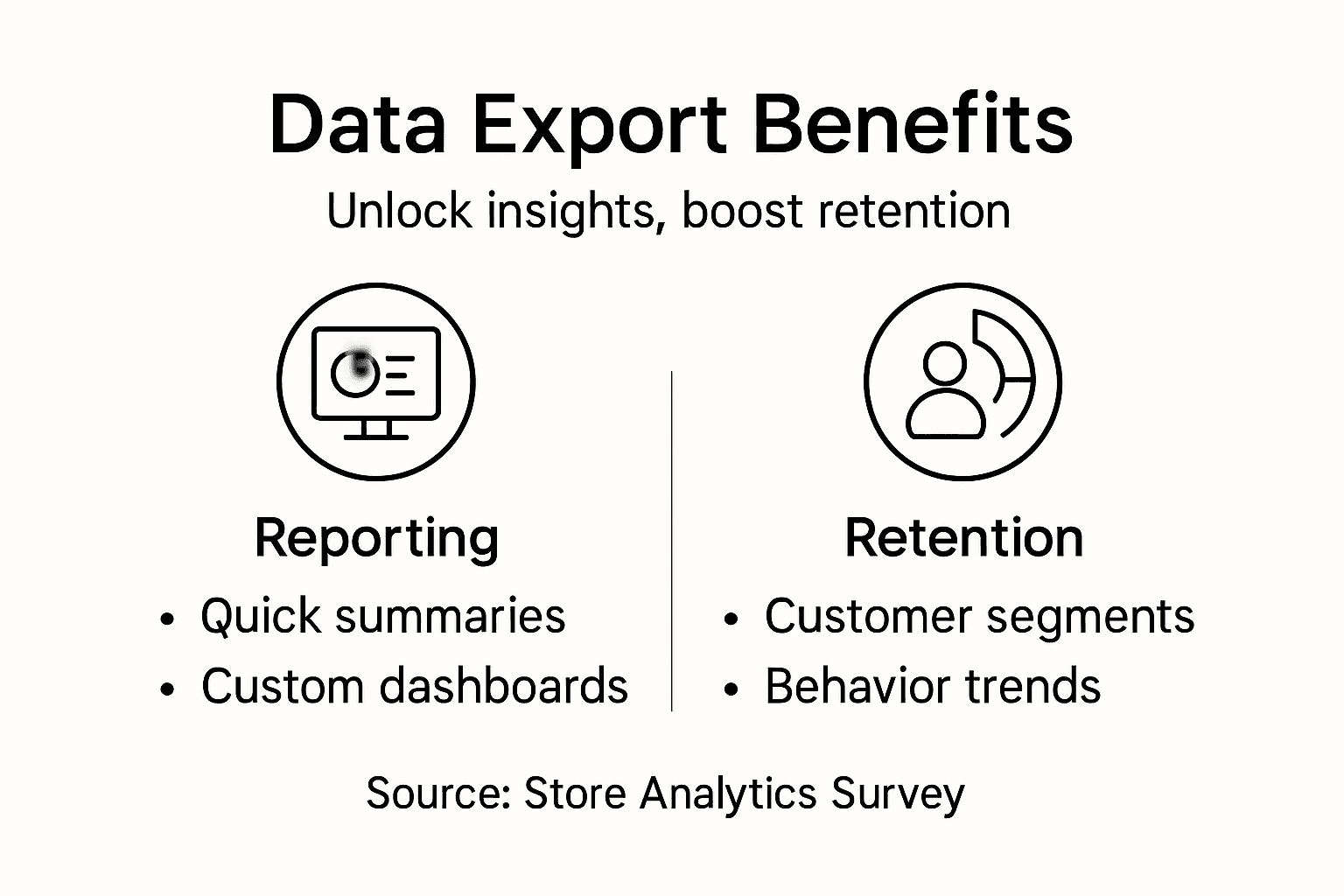
Benefits for Reporting and Customer Retention
Data export provides e-commerce businesses with powerful capabilities to transform raw transactional information into strategic insights that drive customer retention and optimize reporting mechanisms. Strategic data analytics approaches enable online retailers to develop sophisticated understanding of customer behaviors, preferences, and purchasing patterns with unprecedented granularity.
The key benefits of comprehensive data export for reporting and customer retention include:
- Enhanced Reporting Capabilities
- Detailed sales trend analysis
- Comprehensive performance dashboards
- Customizable reporting frameworks
- Customer Retention Strategies
- Personalized marketing segmentation
- Targeted retention campaign development
- Predictive churn prevention modeling
- Competitive Intelligence
- Benchmarking against industry standards
- Identification of emerging market trends
- Strategic product positioning insights
Advanced data export techniques allow businesses to create nuanced customer profiles that go beyond basic demographic information. By tracking detailed interaction histories, purchase frequencies, and engagement patterns, online retailers can develop highly targeted retention strategies that speak directly to individual customer preferences and behaviors.
Data export transforms transactional records from mere numbers into a comprehensive narrative of customer relationships and business potential.
The most sophisticated data export strategies integrate multiple data sources, creating a holistic view of customer interactions across different platforms and touchpoints. This comprehensive approach enables businesses to develop more intelligent, responsive, and personalized customer engagement models that dramatically improve retention rates and overall customer lifetime value.
Pro tip: Implement a multi-dimensional data export strategy that combines transactional, behavioral, and demographic data to create truly personalized customer retention experiences.
Risks, Privacy, and Compliance Challenges
E-commerce data export introduces complex privacy and security challenges that demand sophisticated technical and legal strategies. Data protection frameworks have become increasingly critical as online businesses navigate intricate global regulatory landscapes that impose stringent requirements for customer data handling.
Key privacy and compliance risks in data export include:
- Regulatory Compliance Challenges
- Global data protection law variations
- Complex cross-border transfer restrictions
- Evolving consent management requirements
- Security Vulnerabilities
- Potential data breach points
- Unauthorized access risks
- Encryption and transmission vulnerabilities
- User Privacy Concerns
- Transparent data usage policies
- User consent management
- Right to data deletion protocols
The most significant challenges arise from navigating multiple international regulatory frameworks simultaneously. Businesses must develop robust data governance strategies that can adapt to diverse legal requirements across different jurisdictions, ensuring comprehensive protection of user information while maintaining operational flexibility.
Data export compliance is not just a legal requirement, but a critical trust-building mechanism between businesses and their customers.
Modern e-commerce organizations must implement multi-layered security approaches that combine technical safeguards, legal compliance mechanisms, and transparent user communication. This holistic strategy requires continuous monitoring, regular security audits, and proactive adaptation to emerging digital privacy standards and technological developments.
Reviewing typical risks and protections helps clarify compliance needs:
| Risk Category | Example Challenge | Essential Safeguard |
|---|---|---|
| Compliance | Cross-border data requirements | Adaptive governance protocols |
| Security | Encryption vulnerability | Multi-layered protection systems |
| Privacy | Consent management issues | Transparent user controls |
Pro tip: Develop a comprehensive data protection framework that integrates real-time consent management, advanced encryption protocols, and transparent privacy policies across all data export processes.
Best Practices and Common Mistakes to Avoid
Successful data export in e-commerce requires a strategic approach that balances technical precision with comprehensive analytical insight. Ecommerce analytics implementation demands meticulous planning and a nuanced understanding of potential pitfalls that can compromise data quality and business intelligence.
Key best practices for effective data export include:
- Data Collection Strategies
- Implement multi-source tracking
- Use consistent data tagging
- Establish clear collection protocols
- Tool and Technology Selection
- Choose flexible analytics platforms
- Integrate complementary data tools
- Prioritize scalable solutions
- Organizational Alignment
- Create cross-departmental data standards
- Define clear reporting responsibilities
- Develop continuous learning frameworks
Common mistakes can significantly undermine data export effectiveness. Many businesses fall into predictable traps such as overrelying on single data sources, neglecting data validation processes, and failing to establish clear performance metrics that align with strategic business objectives.
Data export is not just a technical process, but a strategic capability that requires ongoing refinement and organizational commitment.
Successful implementation requires a holistic approach that combines technical infrastructure, robust governance frameworks, and a culture of continuous improvement. Online retailers must develop flexible systems that can adapt to evolving technological landscapes while maintaining the highest standards of data integrity and actionable insights.
Pro tip: Create a comprehensive data governance framework that includes regular audits, clear documentation, and cross-functional training to ensure consistent and reliable data export practices.
Unlock the Full Potential of Your Ecommerce Data Export
The article highlights common challenges many online retailers face with data export including transforming raw transactional data into actionable insights, managing cross-platform data integration, and optimizing customer retention through meaningful analytics. If you want to overcome these hurdles and turn scattered ecommerce data into powerful growth drivers you need a tool designed to automate complex analytics such as market basket analysis (MBA) and RFM customer segmentation.
Affinsy is purpose-built to bridge these exact gaps with AI-powered analytics that analyze historical transaction data and reveal hidden product relationships and customer patterns. With seamless integration to Shopify, WooCommerce, and Google Analytics you can generate custom reports and export data effortlessly while improving product bundling, cross-selling, and targeted retention strategies.

Ready to transform your data export challenges into smart revenue growth? Discover how Affinsy’s actionable insights empower ecommerce store owners and marketing managers to make data-driven decisions without needing deep data science knowledge. Visit Affinsy today and start maximizing your sales, increasing average order values, and building lasting customer loyalty through advanced, automated ecommerce analytics.
Explore everything Affinsy offers at https://affinsy.com and step confidently into smarter ecommerce analytics.
Frequently Asked Questions
What is data export in ecommerce analytics?
Data export in ecommerce analytics refers to the process of extracting and transforming data from online retail platforms into structured formats for deeper analysis, helping businesses derive insights from customer interactions and transaction records.
What types of data exports are commonly used in ecommerce analytics?
Common types of data exports include descriptive analytics (historical performance summaries), predictive analytics (future behavior forecasting), and prescriptive analytics (action recommendations) that inform business strategies.
How does cross-platform data export work?
Cross-platform data export enables businesses to integrate customer interactions from multiple digital touchpoints, utilizing unified tracking mechanisms and data integration technologies to create a holistic understanding of customer behavior.
What are the benefits of effective data export for customer retention?
Effective data export enhances reporting capabilities, allows for personalized marketing strategies, and enables predictive modeling to prevent customer churn, ultimately improving customer retention and increasing business revenue.
Recommended
- E Commerce Analysis Report Guide for 2025 Success - Affinsy Blog | Affinsy
- Why Ecommerce Analytics Matter for Online Retailers - Affinsy Blog | Affinsy
- 7 Essential E-Commerce Data Analysis Tips for Higher Sales - Affinsy Blog | Affinsy
- Understanding Ecommerce Analytics: Unlocking Insights - Affinsy Blog | Affinsy