
Growing your e-commerce business often means juggling dozens of metrics without knowing where to focus first. Feeling uncertain about which numbers truly drive profit can hold you back from bigger wins. But if you track the right performance indicators, you can uncover powerful opportunities hiding in your store’s data.
This guide reveals the most valuable e-commerce metrics for growth and breaks down how each one can make a difference for your revenue and customer loyalty. From understanding your conversion rate to capturing customer lifetime value, you will learn actionable ways to measure what matters and use those insights to get real results. Get ready to discover exactly which numbers can transform your strategy and how to put them to work for your business.
Table of Contents
- Monitor Conversion Rate For Site Performance
- Track Average Order Value To Increase Revenue
- Measure Customer Retention For Lasting Loyalty
- Analyze Cart Abandonment Rate For Lost Sales
- Utilize RFM Segmentation For Targeted Marketing
- Assess Product Association For Effective Bundling
- Review Customer Lifetime Value For Growth Planning
Quick Summary
| Key Insight | Explanation |
|---|---|
| 1. Monitor Conversion Rate | Track how effectively your site turns visitors into customers to optimize performance. |
| 2. Increase Average Order Value | Use strategies like bundling and discounts to boost revenue per transaction. |
| 3. Prioritize Customer Retention | Retention is cheaper than acquisition; engage existing customers for long-term loyalty. |
| 4. Reduce Cart Abandonment | Identify and address common barriers that lead to incomplete purchases and lost sales. |
| 5. Leverage RFM Segmentation | Analyze customer data to create targeted marketing strategies based on buying behavior. |
1. Monitor Conversion Rate for Site Performance
Your website’s conversion rate is the heartbeat of your online business performance. Conversion rate optimization represents the percentage of visitors who transform from casual browsers into paying customers.
This critical metric reveals how effectively your website turns traffic into revenue. A robust conversion rate indicates that your site successfully:
- Attracts the right audience
- Communicates product value clearly
- Provides a smooth user experience
- Builds trust with potential customers
Businesses typically aim for conversion rates between 2% to 5%. However, top-performing e-commerce sites can achieve rates as high as 10%. The gap between average and exceptional performance often comes down to strategic website optimization.
Conversion rate is more than a number. It’s a direct reflection of your online store’s ability to persuade and engage potential customers.
To accurately track conversion rates, use tools like Google Analytics to monitor key performance indicators. Calculate your rate by dividing the number of conversions by total website visitors and multiplying by 100.
Tracking methods include:
- Setting up conversion goals in analytics platforms
- Monitoring specific actions like purchases or sign-ups
- Segmenting conversion data by traffic source
- Analyzing user behavior through heatmaps and session recordings
Pro tip: Conduct A/B testing on key website elements like product descriptions, call-to-action buttons, and checkout processes to incrementally improve your conversion performance.
2. Track Average Order Value to Increase Revenue
Average Order Value (AOV) is the financial heartbeat of your e-commerce strategy. Maximizing average order value can dramatically boost your store’s revenue without acquiring new customers.
AOV represents the average amount customers spend per transaction. By understanding and strategically improving this metric, you can unlock significant growth potential for your online business.
Every dollar increase in average order value directly translates to higher overall revenue and improved profitability.
Calculating AOV is straightforward. Simply divide your total revenue by the number of orders during a specific period. For example, if your store generates $50,000 in monthly revenue across 1000 orders, your AOV is $50.
Key strategies to increase AOV include:
- Implement product bundling
- Offer volume discounts
- Create personalized product recommendations
- Set free shipping thresholds
- Use cross-selling and upselling techniques
Successful businesses often employ multiple tactics simultaneously. A targeted approach can help you incrementally raise your average transaction value and overall store performance.
By tracking AOV consistently, you gain insights into customer purchasing behavior and can develop more effective marketing strategies. This metric helps you understand not just how many customers you attract, but how much value each customer brings.
Pro tip: Experiment with strategic price points and bundle offers that encourage customers to add just a few more dollars to their cart for better perceived value.
3. Measure Customer Retention for Lasting Loyalty
Customer retention is the silent growth engine of successful e-commerce businesses. Customer insights analytics reveal that keeping existing customers is far more cost-effective than acquiring new ones.
Retention metrics quantify how well your business maintains customer relationships over time. A high retention rate signals strong product quality, excellent customer service, and meaningful brand connections.
Loyal customers are not just repeat buyers. They are brand advocates who drive sustainable business growth.
Calculating retention rate is straightforward. Measure the percentage of customers who continue purchasing from your store over a specific period. For instance, if you started with 100 customers and 70 made repeat purchases within a year, your annual retention rate is 70%.
Key retention strategies include:
- Implement personalized loyalty programs
- Provide exceptional customer support
- Create seamless omnichannel experiences
- Develop targeted marketing campaigns
- Offer exclusive rewards for repeat customers
Modern technologies like artificial intelligence and big data analytics can help predict customer behavior and reduce potential churn. By understanding individual customer preferences, you can create more tailored experiences that encourage long-term loyalty.
Retention is not just about preventing customers from leaving. It is about creating genuine value that makes them want to stay and recommend your brand to others.
Pro tip: Regularly survey your customers to understand their evolving needs and proactively address potential pain points before they consider switching to competitors.
4. Analyze Cart Abandonment Rate for Lost Sales
Cart abandonment is the silent revenue killer for e-commerce businesses. Reduce shopping cart abandonment by understanding why potential customers leave before completing their purchases.
Cart abandonment rate measures the percentage of online shoppers who add items to their cart but exit without making a purchase. Industry averages hover around 70%, representing a massive opportunity for revenue recovery.
Every abandoned cart is not a lost sale but a chance to improve your online shopping experience.
Calculating your abandonment rate is simple. Divide the number of completed purchases by the total number of shopping carts initiated, then subtract that figure from 100%.
Common reasons for cart abandonment include:
- Unexpected shipping costs
- Complex checkout processes
- Limited payment options
- Security concerns
- Mandatory account creation
- Slow website loading times
Predictive analytics can help identify potential abandonment triggers. Mobile users are particularly prone to higher abandonment rates, often experiencing more friction during the checkout process.
Strategic improvements can significantly reduce abandonment. Focus on creating a streamlined, transparent, and user-friendly purchasing journey that eliminates potential barriers to completion.
Pro tip: Implement exit-intent popups with targeted discounts or simplified checkout options to capture customers who are about to abandon their cart.
5. Utilize RFM Segmentation for Targeted Marketing
RFM segmentation is a powerful strategy that transforms customer data into actionable marketing insights. Master RFM analysis to unlock precise customer targeting and personalized engagement strategies.
RFM stands for Recency (how recently a customer purchased), Frequency (how often they buy), and Monetary value (total spend). By analyzing these three dimensions, you can categorize customers into distinct groups with unique characteristics and marketing needs.
Not all customers are created equal. RFM segmentation helps you understand and value each customer’s true potential.
The segmentation process involves scoring customers across these three dimensions and creating distinct customer personas. Typical segments include:
Customer Segment Profiles:
- Champions: Recent, frequent, high-monetary value buyers
- Potential Loyalists: Moderate frequency and monetary value
- At Risk: Previously active customers becoming inactive
- Hibernating: Customers with long periods between purchases
Advanced techniques leverage machine learning algorithms to refine segmentation accuracy. These models can predict customer behavior, helping you develop targeted marketing strategies that speak directly to each group’s unique characteristics.
By implementing RFM analysis, you can create personalized marketing campaigns, optimize retention efforts, and maximize customer lifetime value. The goal is not just to understand your customers but to create meaningful, individualized experiences.
Pro tip: Assign different weights to recency, frequency, and monetary values based on your specific business model to create a more nuanced customer segmentation approach.
6. Assess Product Association for Effective Bundling
Product association analysis transforms random product combinations into strategic revenue opportunities. Master product bundling strategies by understanding which items customers frequently purchase together.
Market Basket Analysis reveals hidden connections between products by examining transaction data. This technique helps businesses create intelligent product bundles that increase average order value and customer satisfaction.
Smart bundling is not about pushing random products together, but creating combinations that solve customer problems and enhance purchasing value.
Key metrics like support, confidence, and lift help evaluate product association strength. Support measures how frequently items appear together, confidence indicates the likelihood of purchasing complementary products, and lift determines the true predictive power of product relationships.
Strategic Bundling Techniques:
- Analyze historical purchase patterns
- Identify frequently co-purchased items
- Create complementary product sets
- Offer volume discounts for bundles
- Use data-driven recommendation systems
Advanced recommendation systems use machine learning to detect complex product interactions beyond simple co-occurrence. These sophisticated models can predict customer preferences with remarkable accuracy.
By leveraging data-driven insights, you can design bundles that feel intuitive and valuable to customers, ultimately driving increased sales and customer satisfaction.
Pro tip: Start with small, low-risk bundle experiments and continuously monitor customer response to refine your product association strategy.
7. Review Customer Lifetime Value for Growth Planning
Customer Lifetime Value (CLV) is the strategic compass guiding sustainable business growth. Growth analytics strategies reveal how understanding a customer’s long-term value transforms marketing approaches.
CLV quantifies the total financial impact a customer generates throughout their entire relationship with your business. It goes beyond single transaction metrics, providing a comprehensive view of customer potential and profitability.
A high CLV means you are not just selling products, but building lasting customer relationships that generate consistent revenue.
Calculating CLV involves analyzing multiple factors including purchase frequency, average order value, customer retention rate, and acquisition costs. The basic formula multiplies average purchase value by purchase frequency and customer lifespan.
Key Components Influencing CLV:
- Initial customer acquisition cost
- Repeat purchase probability
- Average transaction value
- Customer retention duration
- Cost of customer service
- Potential referral value
Strategic businesses use CLV to make informed decisions about marketing investments, customer segmentation, and resource allocation. By understanding which customer segments deliver the most value, you can develop targeted retention and engagement strategies.
Modern CLV models incorporate predictive analytics and machine learning to provide more nuanced insights into customer behavior and potential future value.
Pro tip: Focus on improving customer experience and reducing churn rates to naturally increase your customer lifetime value over time.
Below is a comprehensive table summarizing the key metrics and strategies for optimizing e-commerce business performance from the article.
| Metric/Strategy | Description | Key Implementation Strategies |
|---|---|---|
| Conversion Rate | Measures the percentage of website visitors converting into customers. | Use analytics tools, optimize user experience, and perform A/B testing. |
| Average Order Value (AOV) | Represents the average spending per transaction. | Implement product bundling, volume discounts, and personalized recommendations. |
| Customer Retention | Evaluates the rate of recurring customers over time. | Develop loyalty programs, enhance customer support, and execute tailored marketing campaigns. |
| Cart Abandonment Rate | Calculates the percentage of customers who leave the checkout process. | Offer simplified checkout processes, clear cost disclosures, and exit-intent incentives. |
| RFM Segmentation | Categorizes customers based on recency, frequency, and monetary value of their purchases. | Perform detailed customer analysis and adapt marketing strategies accordingly. |
| Product Association | Analyzes frequently co-purchased products to create beneficial bundles. | Utilize transaction data and emphasize complementary items. |
| Customer Lifetime Value (CLV) | Quantifies the total value a customer generates over their relationship with the business. | Focus on enhancing customer experience and retention measures. |
This table provides an overview of the pivotal performance indicators and actionable strategies integral to the success of an online business.
Unlock Your E-Commerce Growth with Smarter Analytics
Tracking essential metrics like conversion rate, average order value, and customer retention is vital but can be overwhelming without the right tools. If you struggle with understanding which products to bundle or which customers to target for maximum lifetime value, Affinsy offers a powerful solution designed to simplify these challenges. By combining advanced AI-powered analytics with user-friendly dashboards, you gain clear insights into product associations through market basket analysis and effective customer segmentation with RFM analysis.
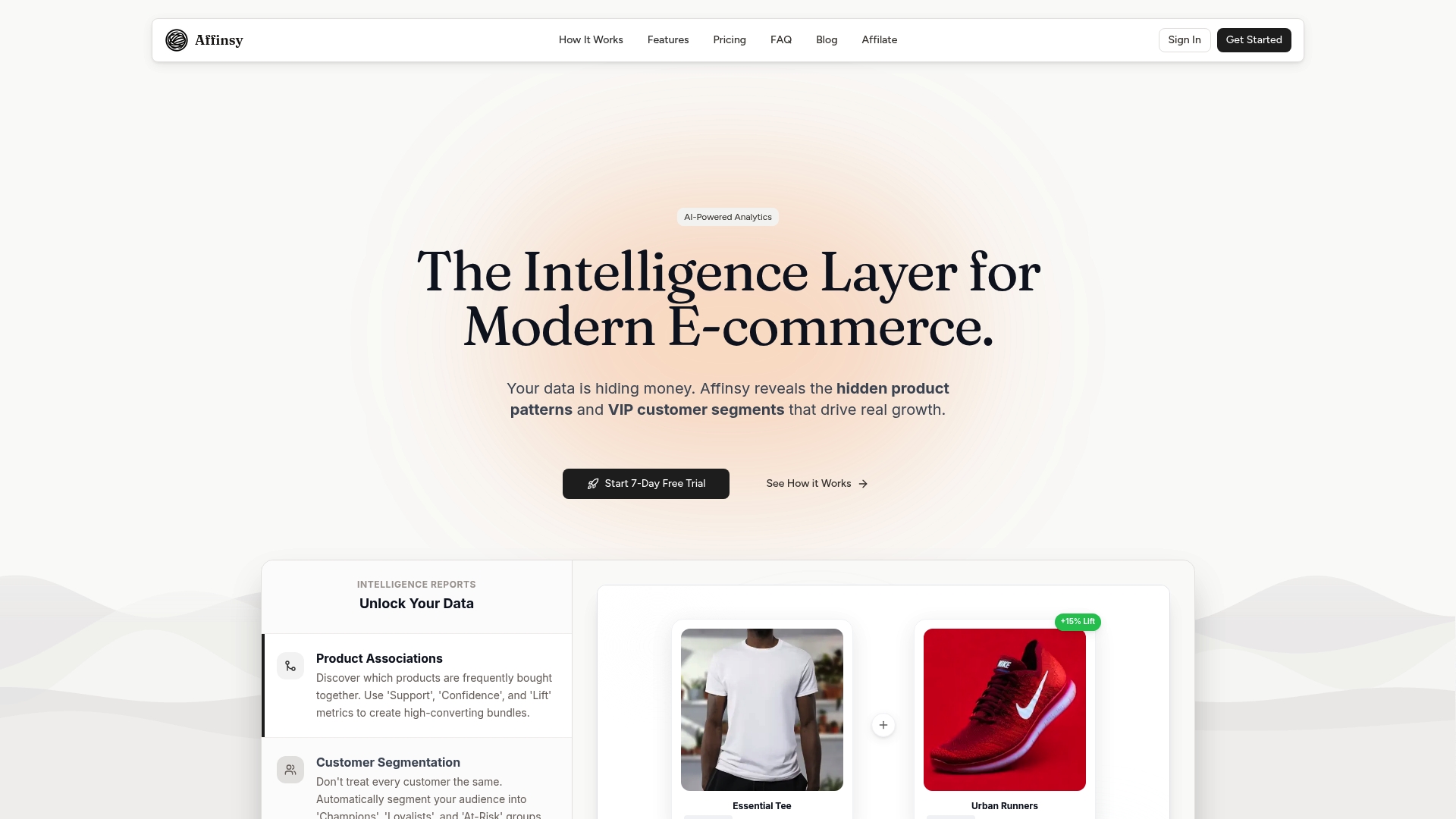
Take control of your store growth today by leveraging data-driven strategies that increase sales, improve customer loyalty, and optimize your marketing efforts. Discover how easy it is to translate complex e-commerce metrics into actionable steps with Affinsy, the platform that seamlessly integrates with Shopify, WooCommerce, and Google Analytics. Visit Affinsy now to start transforming your online store’s performance and see measurable results.
Frequently Asked Questions
What is the conversion rate and why is it important for my e-commerce store?
The conversion rate represents the percentage of website visitors that complete a desired action, such as making a purchase. It is crucial because a higher conversion rate indicates your site effectively engages potential customers. Track your conversion rate regularly and aim to improve it by conducting A/B tests on key website elements.
How can I calculate my average order value (AOV)?
To calculate your average order value, divide your total revenue by the number of transactions within a specific period. For example, if your store earns $50,000 from 1,000 orders, your AOV is $50. Keep an eye on your AOV to identify opportunities for increasing sales through bundling or upselling.
What strategies can improve my customer retention rate?
Improving your customer retention rate involves creating personalized experiences and rewarding repeat customers. Implement loyalty programs, offer exceptional customer support, and engage customers through targeted marketing campaigns. Focus on understanding your customers’ needs to keep them coming back.
How do I determine my cart abandonment rate?
To determine your cart abandonment rate, divide the number of completed purchases by the total number of initiated shopping carts, and subtract that figure from 100%. For instance, if you had 1,000 carts initiated and 300 completed purchases, your abandonment rate would be 70%. Analyze the reasons for abandonment to improve your checkout experience.
Why is tracking customer lifetime value (CLV) essential for my business?
Tracking customer lifetime value helps you understand the long-term profitability of your customer relationships. By calculating CLV, you can make informed decisions about marketing investments and customer engagement strategies. Focus on enhancing customer experiences to increase CLV over time.
Recommended
- Ecommerce Success Metrics: Driving Revenue Growth - Affinsy Blog | Affinsy
- Understanding Ecommerce Metrics: A Comprehensive Guide - Affinsy Blog | Affinsy
- Understanding Ecommerce Analytics: Unlocking Insights - Affinsy Blog | Affinsy
- Understanding Google Analytics Ecommerce for Online Stores - Affinsy Blog | Affinsy