
Building a successful online store can feel overwhelming when you face countless decisions about sales, marketing, and data. Without a clear plan, it’s easy to get lost chasing trends instead of growing your ecommerce business intentionally. The right strategies make a real difference by turning scattered information into purposeful action and measurable results.
This list is designed to give you practical steps that guide your business from guesswork to focused growth. You will discover actionable methods for setting goals, measuring real progress, and using your data wisely. Each item reveals a specific way to build a stronger foundation for your ecommerce success, so you do not miss out on the strategies that leading retailers rely on worldwide.
Table of Contents
- 1. Define Clear Ecommerce Goals And KPIs
- 2. Integrate Data Sources For Complete Visibility
- 3. Utilize Market Basket Analysis For Product Bundling
- 4. Apply RFM Segmentation To Boost Customer Retention
- 5. Track And Analyze Cross-Selling Performance
- 6. Leverage Custom Reports For Deeper Insights
- 7. Monitor Conversion Rates And Average Order Value
Quick Summary
| Key Message | Explanation |
|---|---|
| 1. Set SMART Ecommerce Goals | Establish clear, measurable objectives to guide your ecommerce strategy. |
| 2. Integrate Diverse Data Sources | Consolidate information to gain comprehensive insights into performance. |
| 3. Leverage Market Basket Analysis | Identify co-purchased items for effective product bundling and promotions. |
| 4. Implement RFM Segmentation | Analyze customer behavior to develop targeted retention and marketing strategies. |
| 5. Monitor Key Performance Metrics | Regularly track conversion rates and average order value for growth insights. |
1. Define Clear Ecommerce Goals and KPIs
Setting precise goals and Key Performance Indicators (KPIs) is the strategic foundation for any successful online retail business. Without clear objectives measurable through specific metrics, your ecommerce strategy remains rudderless and reactive.
Defining goals transforms your online business from guesswork to purposeful growth. Ecommerce goals provide strategic direction and help you allocate resources effectively. These goals typically fall into several critical categories:
- Customer acquisition targets
- Conversion rate improvements
- Average order value increases
- Website traffic growth
- Customer retention metrics
When establishing goals, focus on creating SMART objectives: Specific, Measurable, Achievable, Relevant, and Time-bound. This approach ensures your KPIs are not just numbers but actionable insights that drive real business performance.
By tracking critical ecommerce metrics, you can systematically monitor progress and make data-driven decisions. Successful online retailers understand that KPIs are more than spreadsheet entries—they are powerful diagnostic tools revealing your business’s health and potential growth opportunities.
Clear goals transform random data points into a strategic roadmap for ecommerce success.
Pro tip: Conduct quarterly reviews of your KPIs and be prepared to adjust goals based on changing market conditions and business performance.
2. Integrate Data Sources for Complete Visibility
Comprehensive data integration transforms fragmented information into a powerful strategic asset for ecommerce businesses. By consolidating data from multiple sources you gain unprecedented visibility into your online retail performance.
Integrating data sources allows you to break down information silos and create a holistic view of your business operations. This approach enables more nuanced insights and more intelligent decision-making.
Key data sources to integrate include:
- Website analytics platforms
- Customer relationship management (CRM) systems
- Payment gateway transaction logs
- Social media engagement metrics
- Email marketing platforms
- Inventory management systems
- Customer support ticketing systems
Comprehensive data integration strategies require careful planning and technical implementation. Successful integration delivers multiple benefits such as enhanced operational efficiency, improved customer understanding, and more accurate performance tracking.
Unified data sources transform scattered information into actionable business intelligence.
When integrating data sources, prioritize compatibility, data quality, and seamless synchronization. Modern analytics platforms often provide native integrations that simplify this complex process.
Pro tip: Conduct a monthly audit of your data integration processes to ensure all sources remain synchronized and identify any potential gaps in your analytics ecosystem.
3. Utilize Market Basket Analysis for Product Bundling
Market Basket Analysis (MBA) represents a powerful data-driven strategy for transforming your ecommerce product offerings and boosting sales performance. By uncovering hidden relationships between products customers frequently purchase together, you can create intelligent and profitable bundles.
Transactional data reveals purchasing patterns that might otherwise remain invisible. These insights enable you to design product combinations that feel intuitive and attractive to your customers.
Key components of effective Market Basket Analysis include:
- Identifying frequent product associations
- Calculating association rule metrics
- Discovering complementary product combinations
- Understanding cross-selling opportunities
- Analyzing purchase sequence patterns
Advanced product bundling strategies rely on sophisticated statistical techniques like support, confidence, and lift metrics. These mathematical approaches help quantify the strength of product relationships beyond simple intuition.
Product bundles informed by data science can dramatically increase average order value and customer satisfaction.
Implementing MBA requires analyzing historical transaction data to detect patterns. Look for products frequently purchased together and consider creating bundles that offer slight discounts compared to individual product prices.
Pro tip: Start with analyzing your top 20% of transactions to quickly identify the most promising product bundle opportunities without getting overwhelmed by complex data processing.
4. Apply RFM Segmentation to Boost Customer Retention
RFM segmentation represents a powerful analytical approach for understanding customer behavior and maximizing retention strategies in ecommerce. By breaking down customer value through three critical dimensions - Recency, Frequency, and Monetary value - you can create targeted marketing approaches that speak directly to different customer groups.
The RFM method allows you to slice your customer base into meaningful segments based on their actual purchasing patterns. This data-driven approach moves beyond generic demographics to reveal nuanced insights about customer loyalty and potential.
Key RFM segmentation categories include:
- High-value loyal customers
- Potential loyalists
- At-risk customers
- Hibernating customers
- New customers
Predictive RFM segmentation techniques enable businesses to anticipate customer behaviors and design personalized retention strategies. By analyzing how recently, how often, and how much customers spend, you can develop laser-focused marketing interventions.
RFM segmentation transforms raw transaction data into actionable customer insights.
Implementing RFM requires calculating scores for each dimension and creating a matrix that helps prioritize your marketing and retention efforts. The goal is to understand each customer segment’s unique characteristics and design targeted approaches.
Pro tip: Start by segmenting your customer base into quartiles for each RFM dimension to create a more nuanced understanding of your customer lifecycle.
5. Track and Analyze Cross-Selling Performance
Cross-selling performance analytics transform random product recommendations into strategic revenue generators. By systematically measuring how effectively you suggest complementary products, you can unlock significant growth potential for your online store.
Performance tracking enables precise optimization of your cross-selling strategies. Understanding which recommendations resonate with customers helps you refine your approach and increase overall sales effectiveness.
Key cross-selling performance metrics include:
- Cross-sell conversion rates
- Average order value increase
- Product recommendation acceptance rate
- Revenue generated from cross-sell suggestions
- Customer engagement with recommended items
Cross-selling sales metrics provide critical insights into customer purchasing behaviors. These metrics help you understand not just what products are being recommended, but how effectively those recommendations drive additional revenue.
Measuring cross-selling performance transforms guesswork into data-driven strategy.
Implement robust tracking mechanisms that connect product recommendations with actual purchase behaviors. This approach allows you to continuously refine and improve your cross-selling techniques.
Pro tip: Create a dedicated dashboard that tracks cross-selling performance metrics in real time, allowing you to quickly identify and replicate successful recommendation strategies.
6. Leverage Custom Reports for Deeper Insights
Custom reporting transforms raw data into strategic intelligence, enabling ecommerce managers to uncover insights that standard dashboards might miss. By designing tailored analytics views, you can dive deeper into your business performance beyond surface-level metrics.
Personalized reporting drives strategic decision-making by allowing you to extract precisely the information most relevant to your specific business goals. This approach turns complex data into clear, actionable narratives.
Key advantages of custom reporting include:
- Targeted metric visualization
- Granular performance analysis
- Flexible data exploration
- Stakeholder-specific insights
- Rapid problem identification
Custom reporting tools empower analysts to create visualizations that speak directly to organizational needs. By combining data from multiple sources, you can generate comprehensive views of your ecommerce ecosystem.
Custom reports translate complex data into strategic business language.
Successful custom reporting requires understanding your unique business questions and designing metrics that provide meaningful answers. Focus on creating reports that prompt action, not just documentation.
Pro tip: Schedule quarterly report template reviews to ensure your custom dashboards continue evolving with your business strategy and emerging market trends.
7. Monitor Conversion Rates and Average Order Value
Conversion rates and average order value are the critical heartbeat of any successful ecommerce business. These interconnected metrics reveal how effectively you transform website visitors into paying customers and maximize revenue per transaction.
Performance metrics drive strategic decisions by providing clear insights into customer purchasing behaviors. Understanding these numbers helps you pinpoint exactly where your online store excels or needs improvement.
Key aspects of monitoring conversion rates and average order value include:
- Tracking website visitor to customer conversion percentages
- Calculating total revenue per customer transaction
- Identifying potential friction points in purchase process
- Comparing performance against industry benchmarks
- Understanding customer purchasing psychology
Order conversion rate benchmarks provide essential context for evaluating your online store’s performance. By analyzing these metrics systematically, you can develop targeted strategies to enhance customer experience and increase sales.
Conversion rates and average order value are the twin engines of ecommerce growth.
Successful monitoring involves consistent tracking, setting realistic goals, and implementing data-driven improvements. Focus on understanding why customers convert and what motivates them to spend more.
Pro tip: Create monthly dashboards comparing your conversion rates and average order value across different customer segments to uncover nuanced insights about your purchasing patterns.
Below is a comprehensive table summarizing the primary strategies and key insights for improving ecommerce performance as detailed in the article.
| Strategy | Implementation | Results |
|---|---|---|
| Define ecommerce goals and KPIs | Establish SMART objectives across customer acquisition, conversion rates, and order values. | Clear strategies, efficient resource allocation, and measurable business success. |
| Integrate data sources | Consolidate analytics, transaction records, and CRM data for comprehensive operational insights. | Enhanced insight visibility, facilitated decision-making, and streamlined business operations. |
| Utilize market basket analysis | Analyze purchasing patterns to identify complementary product offerings and create bundles. | Improved average order value and increased customer satisfaction through tailored offerings. |
| Apply RFM segmentation | Segment customers by Recency, Frequency, and Monetary value, targeting marketing strategies. | Enhanced customer retention through personalized engagement strategies. |
| Monitor key performance metrics | Regularly analyze conversion rates and average order values to identify and refine strategies. | Greater accuracy in tracking performance and opportunities to improve customer experience. |
This table captures the essential themes and recommended actions to boost online retail success through data-driven strategies and targeted customer engagement.
Elevate Your Ecommerce Analytics With AI-Powered Insights
Struggling to turn your ecommerce data into clear, actionable strategies? The article “7 Essentials for Your Ecommerce Analytics Checklist” highlights critical challenges like identifying hidden product associations, mastering market basket analysis, and effectively segmenting customers through RFM. These goals are essential to boost average order values, optimize product bundling, and increase customer retention. If you want to move beyond guesswork and monitor key performance indicators with precision, getting the right tool is crucial.
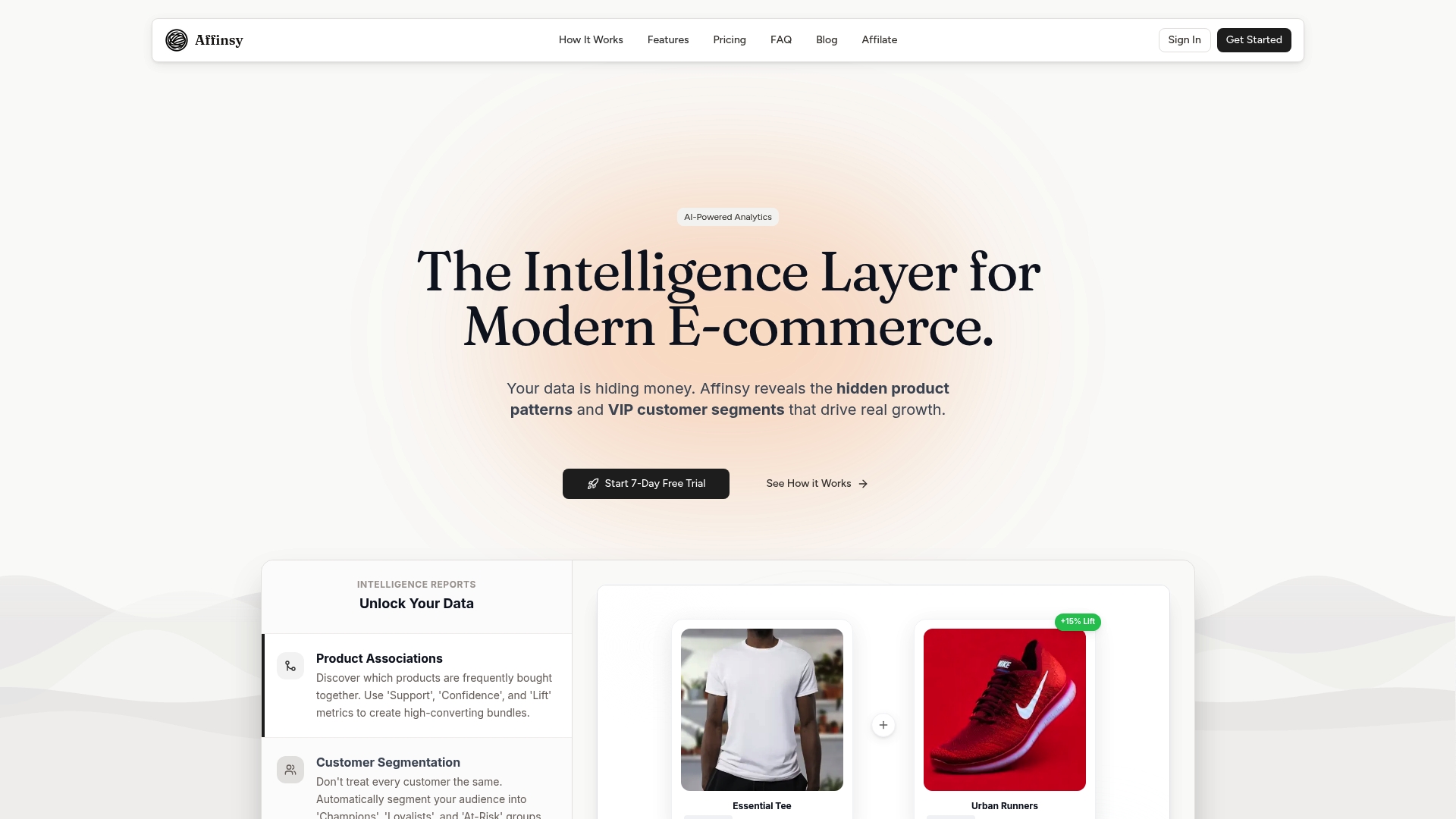
Discover how Affinsy can empower your ecommerce business by analyzing your historical transaction data and revealing the powerful insights you need. Our AI-driven platform seamlessly integrates with Shopify, WooCommerce, and Google Analytics to provide customized reports and advanced dashboards without requiring extensive data science skills. Don’t wait to maximize your sales potential and improve customer loyalty through smarter analytics. Visit Affinsy now and start transforming your data into the growth engine your online store deserves.
Frequently Asked Questions
What are the key components of an ecommerce analytics checklist?
An ecommerce analytics checklist should include clear goals and KPIs, data integration for visibility, market basket analysis, RFM segmentation, cross-selling performance tracking, custom reporting, and monitoring conversion rates and average order value. Start by reviewing each component to ensure your analytics framework covers all critical areas for growth.
How can I set effective goals and KPIs for my ecommerce business?
To set effective goals and KPIs, use the SMART criteria: Specific, Measurable, Achievable, Relevant, and Time-bound. Create concrete objectives that align with your business strategy, such as increasing conversion rates by 10% within three months.
What is Market Basket Analysis and how can it improve my sales?
Market Basket Analysis is a technique that identifies items frequently bought together, helping you create product bundles that enhance customer experience and boost sales. Conduct this analysis by reviewing transaction data to identify at least five common product pairings you can promote as bundles.
How do I track cross-selling performance in my ecommerce store?
To track cross-selling performance, monitor key metrics such as cross-sell conversion rates and revenue from cross-sell suggestions. Set up standard procedures to analyze these metrics monthly and identify strategies that increase cross-selling effectiveness by 15%.
Why is RFM segmentation important for customer retention?
RFM segmentation helps you categorize customers based on their purchasing behaviors, allowing for targeted marketing efforts that enhance retention. Start by calculating RFM scores for your customer base and develop tailored campaigns for each segment to increase retention rates by 20%.
How can custom reports enhance my ecommerce analytics?
Custom reports allow you to tailor data visualization to meet specific business needs, uncovering insights beyond standard metrics. Design at least three custom reports that focus on different aspects of your business and reassess them quarterly to adapt to evolving goals.
Recommended
- Why Ecommerce Analytics Matter for Online Retailers - Affinsy Blog | Affinsy
- Understanding Ecommerce Analytics Terminology for Retail - Affinsy Blog | Affinsy
- Understanding Ecommerce Analytics: Unlocking Insights - Affinsy Blog | Affinsy
- Understanding Retail Analytics Guide 2025 for E-Commerce Success - Affinsy Blog | Affinsy