
Competition among North American brands is heating up as e-commerce rapidly evolves toward 2026. With global retail e-commerce expected to reach $7 trillion by 2026, managers face mounting pressure to make sense of an explosion in digital customer interactions and data. Understanding the latest trends in AI-driven analytics will help you turn information into smarter retention strategies and sales growth, so you stay ahead in an ever-demanding market.
Table of Contents
- Defining Ecommerce Analytics Trends For 2026
- AI-Powered Techniques And Analytics Innovations
- Market Basket Analysis And RFM Segmentation
- Personalization, Retention, And Experience Optimization
- Risks, Costs, And Common Implementation Pitfalls
Key Takeaways
| Point | Details |
|---|---|
| Artificial Intelligence Integration | Leveraging AI can enhance predictive analytics and customer segmentation, driving smarter decision-making for ecommerce businesses. |
| Emphasis on Personalization | Businesses must adopt personalization strategies that utilize advanced analytics to meet evolving customer expectations. |
| Market Basket and RFM Techniques | Employing Market Basket Analysis and RFM segmentation can optimize marketing efforts and significantly boost sales performance. |
| Mitigating Risks in AI Implementation | Companies should prioritize data privacy and algorithmic fairness while investing in training to bridge skill gaps. |
Defining Ecommerce Analytics Trends for 2026
The ecommerce landscape is rapidly transforming, driven by technological innovation and changing consumer behaviors. By 2026, ecommerce analytics will be far more than simple sales tracking - it represents a sophisticated ecosystem of insights that power strategic decision-making for online retailers.
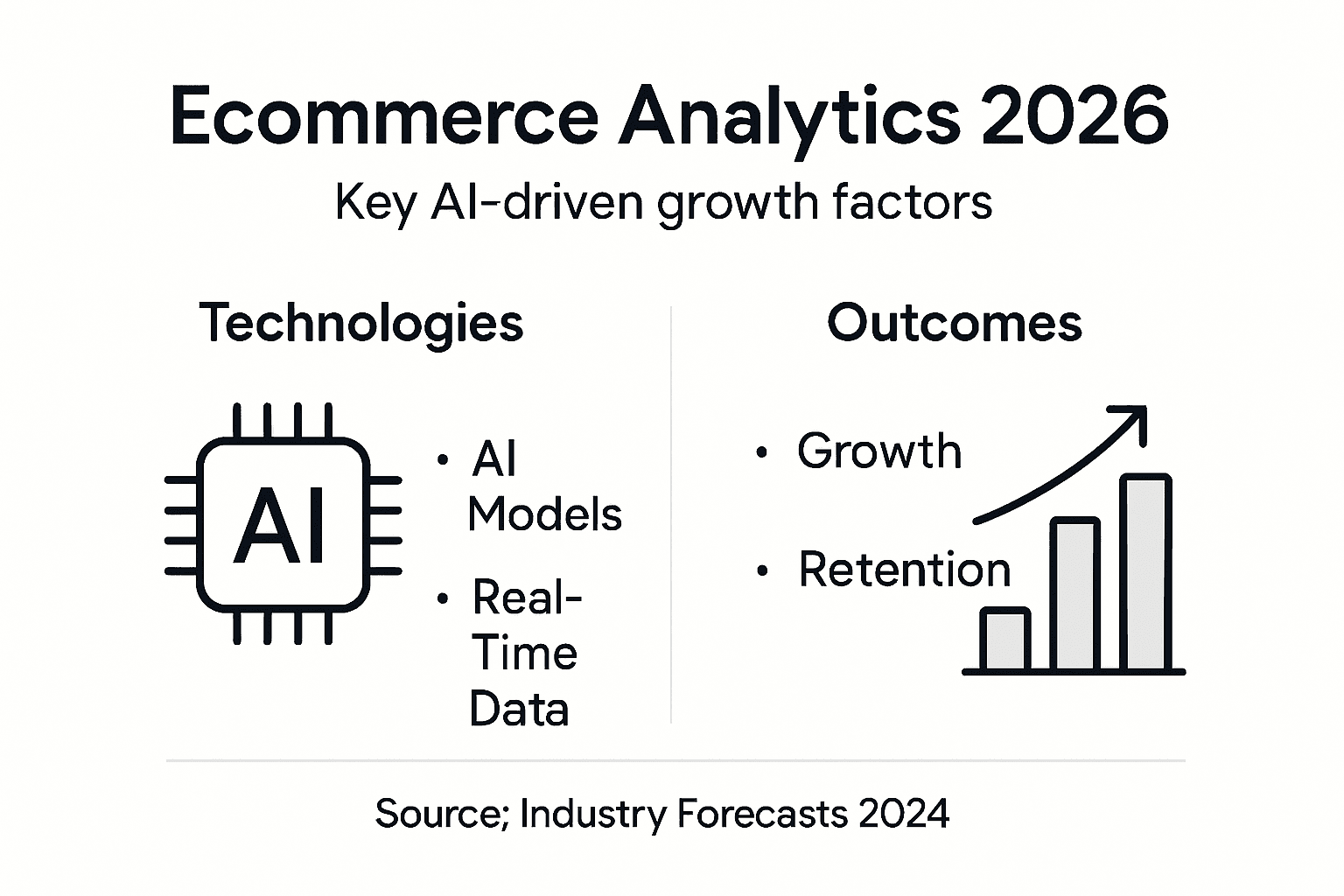
Key trends are emerging that will reshape how businesses understand and leverage their digital commerce data:
- Artificial Intelligence Integration: Machine learning algorithms will enable deeper predictive analytics
- Hyper-Personalization: Advanced behavioral tracking will allow unprecedented customer segmentation
- Mobile Commerce Dominance: Analytics platforms will prioritize mobile shopping insights
- Real-Time Performance Monitoring: Instant data visualization and actionable recommendations
The global ecommerce market is projected to reach $7 trillion by 2026, underscoring the critical importance of robust analytics strategies. Businesses that effectively harness data-driven insights will gain significant competitive advantages, transforming raw transactional information into strategic growth opportunities.
Increasingly, ecommerce analytics will focus on understanding complex customer journeys across multiple digital touchpoints. This means moving beyond traditional metrics like conversion rates to comprehensive frameworks that track customer lifetime value, predictive purchasing behaviors, and nuanced interaction patterns.
Pro tip: Invest in analytics platforms that offer seamless integration, real-time insights, and AI-powered predictive modeling to stay ahead of emerging market trends.
AI-Powered Techniques and Analytics Innovations
The evolution of artificial intelligence is fundamentally transforming ecommerce analytics, creating unprecedented opportunities for businesses to understand and predict customer behaviors. As digital platforms become increasingly sophisticated, AI-powered techniques are emerging as critical tools for generating actionable insights and driving strategic decision-making.
Key AI-driven analytics innovations are revolutionizing how online retailers approach data interpretation:
- Predictive Customer Behavior Models: Machine learning algorithms that anticipate purchasing patterns
- Advanced Recommendation Engines: Deep learning systems generating hyper-personalized product suggestions
- Automated Customer Segmentation: AI techniques that create nuanced customer profiles
- Real-Time Fraud Detection: Intelligent systems identifying suspicious transactions instantly
Deep learning-based AI models are now capable of analyzing complex customer data streams, enabling businesses to develop sophisticated strategies that go far beyond traditional analytics approaches. These technologies can process massive datasets, uncovering intricate patterns and correlations that human analysts might overlook.

The future of ecommerce analytics lies in integrating multiple AI technologies to create comprehensive, dynamic insights. This means moving from static reporting to predictive and prescriptive analytics that can actively guide business strategies, optimize marketing efforts, and enhance customer experiences in real time.
Pro tip: Invest in AI analytics platforms that offer flexible integration, scalable machine learning models, and comprehensive data visualization capabilities to maximize your competitive advantage.
Market Basket Analysis and RFM Segmentation
In the rapidly evolving world of ecommerce analytics, Market Basket Analysis and RFM Segmentation have emerged as powerful techniques for understanding customer behavior and optimizing sales strategies. These sophisticated approaches transform raw transaction data into actionable insights that can dramatically improve business performance.
Key components of these advanced analytics techniques include:
- Product Association Discovery: Identifying frequently co-purchased items
- Customer Value Stratification: Ranking customers based on recency, frequency, and monetary contributions
- Predictive Purchase Patterns: Uncovering hidden relationships in buying behaviors
- Personalized Marketing Opportunities: Creating targeted engagement strategies
Comprehensive retail analytics systems now integrate Market Basket Analysis and RFM segmentation using advanced algorithms like Apriori, FP-Growth, and K-Means clustering. These technologies enable businesses to process massive datasets and generate nuanced insights that were previously impossible to extract.
The synergy between Market Basket Analysis and customer segmentation represents a quantum leap in understanding consumer behavior. By combining product association patterns with detailed customer profiles, businesses can create highly personalized marketing strategies that speak directly to individual customer needs and preferences.
Pro tip: Implement machine learning-powered Market Basket Analysis tools that can dynamically update product recommendations and customer segments in real time.
Here’s a quick comparison of emerging ecommerce analytics techniques and their business impacts:
| Technique | Description | Business Impact |
|---|---|---|
| AI Predictive Analytics | Uses machine learning to forecast behavior | Improves sales forecasts and planning |
| Market Basket Analysis | Detects product associations in purchases | Boosts cross-selling and upselling |
| RFM Segmentation | Clusters customers by value metrics | Optimizes marketing and retention |
| Real-Time Data Monitoring | Provides instant performance insights | Enables fast decision-making |
Personalization, Retention, and Experience Optimization
In the dynamic world of ecommerce, personalization has transformed from a competitive advantage to an essential customer expectation. Advanced AI technologies are now enabling unprecedented levels of individual customer experience customization, fundamentally reshaping how online businesses engage and retain their audience.
Key strategies for optimizing customer experience include:
- Predictive Recommendation Engines: Generating hyper-targeted product suggestions
- Dynamic User Journey Mapping: Tracking and adapting to individual customer behaviors
- Real-Time Personalization: Adjusting website experiences instantly based on user interactions
- Emotional Connection Analytics: Understanding deeper customer engagement signals
AI-driven personalized recommendations are increasingly critical in strengthening customer trust and loyalty. These sophisticated systems go beyond simple product matching, creating nuanced experiences that feel uniquely tailored to each individual’s preferences and needs.
The future of ecommerce personalization lies in creating seamless, anticipatory experiences that feel intuitive and frictionless. By leveraging machine learning algorithms that can process complex behavioral data, businesses can create engagement strategies that not only predict customer needs but also proactively address them before the customer even recognizes the requirement.
Pro tip: Develop a comprehensive personalization strategy that balances data-driven insights with transparent privacy practices to build long-term customer trust.
Risks, Costs, and Common Implementation Pitfalls
Implementing advanced AI analytics in ecommerce is not without significant challenges. Technological complexity and substantial financial investments require businesses to approach AI integration with strategic caution and comprehensive risk management.
Critical risks and implementation challenges include:
- Data Privacy Vulnerabilities: Potential breaches of customer information
- High Initial Investment Costs: Significant upfront technology expenses
- Algorithmic Bias: Unintentional discrimination in recommendation systems
- Technical Integration Complexity: Challenges in seamless platform compatibility
- Skill Gap Requirements: Need for specialized AI and data science talent
AI adoption challenges in ecommerce encompass diverse technical, ethical, and operational considerations. Businesses must develop robust mitigation strategies that address potential technical failures, data security concerns, and regulatory compliance requirements.
Successful AI implementation demands more than technological prowess. It requires a holistic approach that balances innovation with responsible data management, transparent algorithmic processes, and continuous performance monitoring. Organizations must invest in comprehensive training, establish clear ethical guidelines, and maintain flexibility in their AI strategies.
Pro tip: Conduct thorough vendor assessments and pilot small-scale AI implementations to validate performance and minimize financial and operational risks before full-scale deployment.
Below is a summary of key AI implementation risks and their recommended mitigation strategies:
| Risk Area | Potential Issue | Mitigation Strategy |
|---|---|---|
| Data Privacy | Customer information breaches | Implement robust encryption protocols |
| Algorithmic Bias | Unfair recommendations | Audit and retrain AI models regularly |
| High Initial Investment | Large upfront technology costs | Start with pilot projects |
| Skill Gaps | Shortage of AI expertise | Invest in team training and hiring |
| Integration Complexity | Platform compatibility problems | Choose flexible, modular solutions |
Harness AI-Driven Ecommerce Analytics to Unlock Your Store’s Growth Potential
The article highlights the critical challenges ecommerce businesses face in navigating complex customer behaviors and optimizing sales using advanced analytics techniques like Market Basket Analysis and RFM Segmentation. If you are aiming to transform raw transaction data into clear, actionable insights for smart product bundling and personalized marketing, you need a reliable AI-powered solution that simplifies this process without demanding deep data science expertise. Affinsy specializes in exactly that by leveraging powerful AI algorithms to uncover hidden product associations and customer segments that can boost your cross-selling and retention efforts.
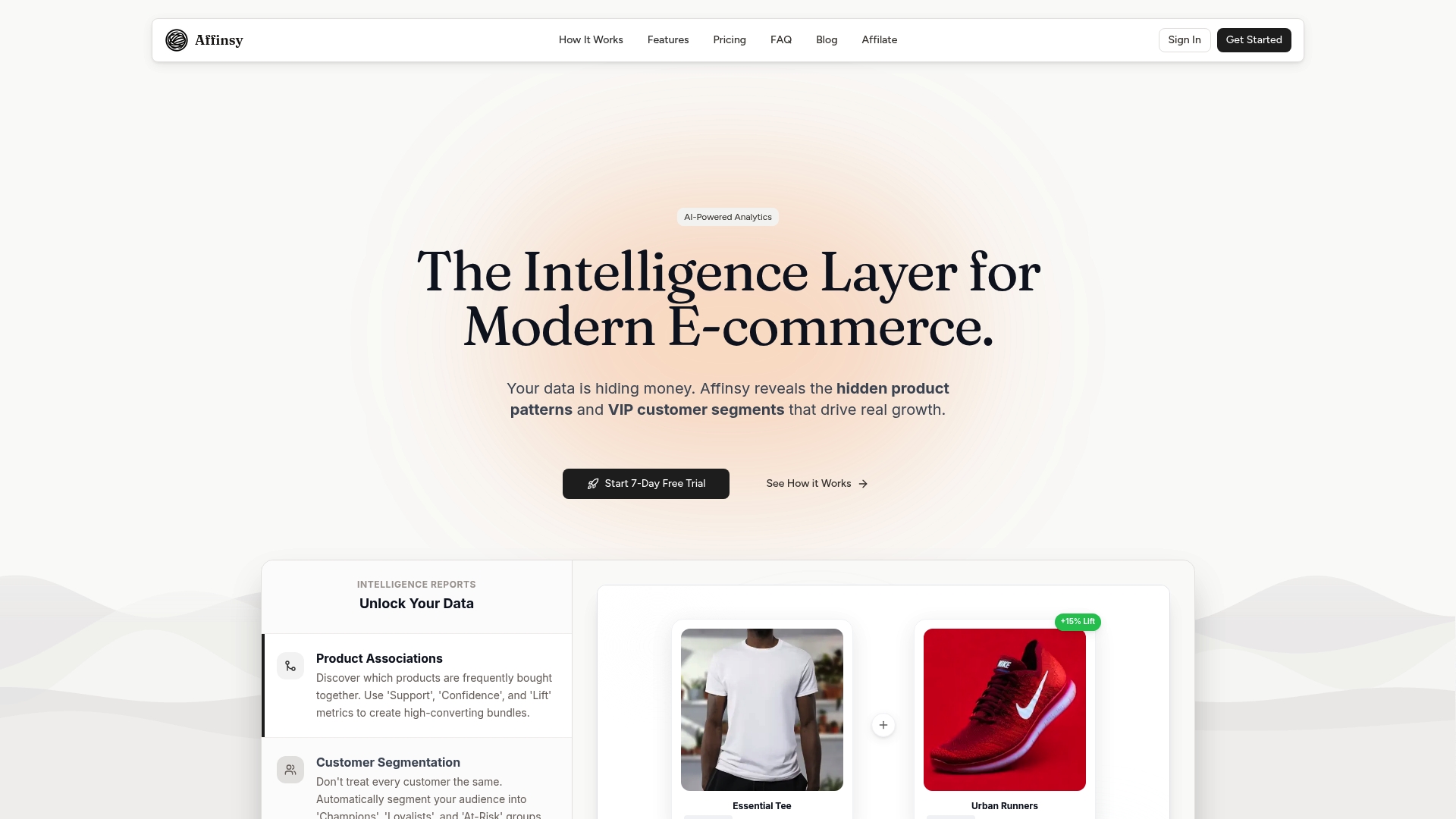
Take control of your ecommerce growth by integrating Affinsy’s seamless platform with Shopify, WooCommerce, or Google Analytics. Discover how easy it is to generate custom reports, automate insights, and create data-driven strategies that anticipate customer needs and maximize sales. Visit Affinsy now to learn how you can stay ahead of ecommerce analytics trends and start leveraging market-leading AI technology that drives real results.
Frequently Asked Questions
What are the key trends in ecommerce analytics for 2026?
The key trends for ecommerce analytics in 2026 include artificial intelligence integration, hyper-personalization, mobile commerce dominance, and real-time performance monitoring. These trends will enable more sophisticated insights that power strategic decision-making for online retailers.
How can AI improve ecommerce analytics?
AI enhances ecommerce analytics by introducing predictive customer behavior models, advanced recommendation engines, automated customer segmentation, and real-time fraud detection. These innovations allow businesses to anticipate customer needs and optimize their marketing strategies effectively.
What is Market Basket Analysis and how does it benefit e-commerce?
Market Basket Analysis identifies frequently co-purchased items, helping businesses optimize cross-selling and upselling strategies. This analysis, combined with customer segmentation, allows for personalized marketing efforts that directly address individual customer preferences.
What risks are involved in implementing AI analytics in ecommerce?
The risks include data privacy vulnerabilities, high initial investment costs, algorithmic bias, technical integration complexity, and skill gaps in data science talent. Businesses can mitigate these risks through robust data management strategies, pilot projects, and continuous monitoring.