
Managing multiple data sources often leads to confusion and missed opportunities for online retailers. Mid-sized E-commerce managers know that disconnected systems can block efforts to improve customer retention and create successful product bundles. Comprehensive data integration platforms connect transactional, behavioral, and supply chain data, making it easier to spot patterns and make smarter decisions. This guide explains the practical steps and proven methods for turning scattered information into profit-driving insights.
Table of Contents
- Defining Ecommerce Data Integration
- Major Integration Types And Methods
- How Data Integration Powers Analytics
- Real-World Use Cases For Online Retail
- Common Pitfalls And How To Avoid Them
Key Takeaways
| Point | Details |
|---|---|
| Ecommerce Data Integration is Essential | Integrating diverse data sources enables businesses to create a unified view, driving better decision-making and operational efficiency. |
| Choose the Right Integration Method | Selecting the most suitable integration approach based on business needs can minimize data redundancy and maximize efficiency. |
| Invest in Robust Tools | Implementing advanced data integration tools is crucial for handling diverse data streams and adapting to evolving business requirements. |
| Avoid Common Pitfalls | A clear strategy, thorough data mapping, and stakeholder involvement are vital for successful data integration initiatives. |
Defining Ecommerce Data Integration
Ecommerce data integration represents a sophisticated technological process of connecting multiple data sources to create a comprehensive, unified view of business operations. Comprehensive data integration platforms enable online retailers to synchronize complex datasets from disparate systems, transforming raw information into strategic insights.
At its core, ecommerce data integration involves consolidating multiple data types across various platforms, including:
- Transactional records
- Customer behavioral data
- Product information
- Supply chain metrics
- Website analytics
The primary goal of this integration is to break down technological silos, enabling businesses to generate holistic perspectives that drive intelligent decision-making. Seamless information synchronization allows companies to understand intricate relationships between customer interactions, product performance, and operational efficiency.

Successful data integration requires advanced technological infrastructure that can process multiple data streams simultaneously, translating complex information into actionable business intelligence. Modern e-commerce platforms leverage sophisticated algorithms and machine learning techniques to transform raw data into predictive insights, helping businesses anticipate market trends and customer preferences.
Pro tip: Begin your data integration journey by conducting a comprehensive audit of your existing data sources to identify potential synchronization challenges and opportunities.
Major Integration Types and Methods
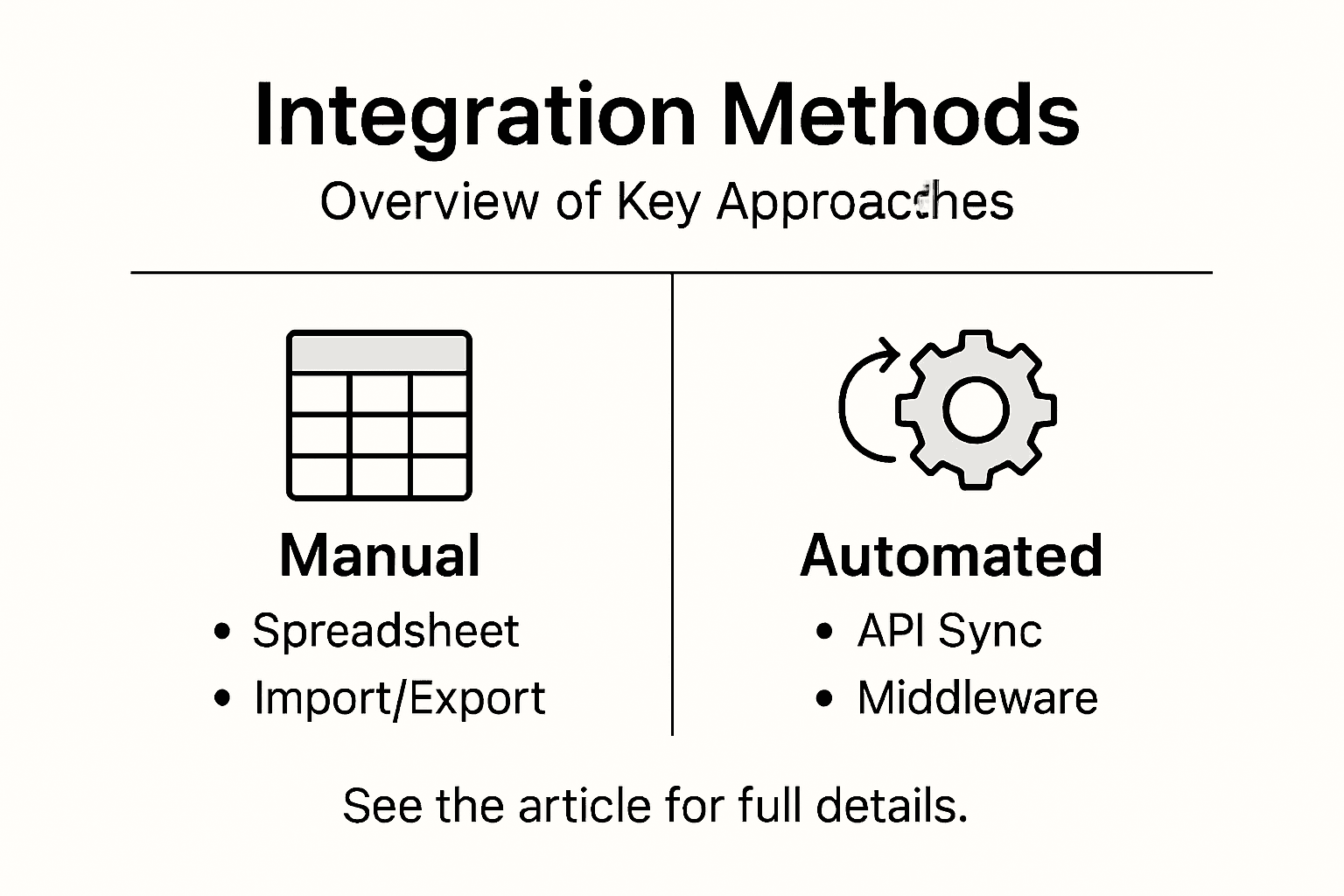
Ecommerce data integration encompasses multiple approaches designed to connect various technological systems and create seamless information flows. Data integration methods range from manual processes to sophisticated automated platforms, each offering unique capabilities for transforming raw business data.
The primary integration types for e-commerce businesses include:
- Manual Integration: Direct data transfer requiring human intervention
- Middleware-Based Integration: Using specialized software to connect different systems
- API-Driven Integration: Automated data exchange through application programming interfaces
- Cloud Synchronization: Real-time data mirroring across cloud platforms
- Batch Processing Integration: Periodic data transfers at scheduled intervals
E-commerce platform connections typically involve integrating critical business systems such as:
- Enterprise Resource Planning (ERP)
- Customer Relationship Management (CRM)
- Payment service providers
- Inventory management systems
- Email marketing platforms
- Website analytics tools
Successful integration requires selecting the most appropriate method based on specific business requirements, technological infrastructure, and scalability needs. Modern e-commerce businesses must evaluate their unique operational characteristics to determine the most effective integration strategy that minimizes data redundancy and maximizes operational efficiency.
Pro tip: Conduct a comprehensive system audit before implementing any data integration strategy to identify potential compatibility challenges and optimize your technological ecosystem.
Here’s a comparison of common ecommerce data integration methods and their suitability:
| Integration Method | Implementation Complexity | Real-Time Capability | Best For |
|---|---|---|---|
| Manual Integration | Low | Not real-time | Small data volumes |
| Middleware-Based | Medium | Limited by middleware | Connecting legacy systems |
| API-Driven | High | Full real-time sync | Dynamic, scalable businesses |
| Cloud Synchronization | Medium | Continuous updates | Multi-platform retailers |
| Batch Processing | Low to medium | Not real-time | Scheduled reports/analytics |
How Data Integration Powers Analytics
Data integration serves as the critical backbone for advanced e-commerce analytics, transforming raw information into strategic business intelligence. AI-driven data processing enables businesses to unify complex datasets and extract meaningful insights that drive operational excellence.
The key analytical capabilities powered by integrated data include:
- Consumer Behavior Analysis: Understanding detailed customer interaction patterns
- Predictive Demand Forecasting: Anticipating market trends and product requirements
- Personalized Recommendation Engines: Generating targeted marketing suggestions
- Real-Time Performance Monitoring: Tracking operational metrics instantly
- Customer Segmentation: Identifying distinct audience groups and preferences
Big data analytics platforms leverage integrated data to support critical business functions by:
- Enabling rapid digital transformation
- Supporting strategic decision-making
- Identifying emerging market opportunities
- Enhancing operational resilience
- Developing adaptive business models
Modern e-commerce businesses recognize that data integration is not just a technological solution, but a strategic imperative. By breaking down data silos and creating unified information ecosystems, companies can unlock unprecedented insights that drive competitive advantage and sustainable growth.
Pro tip: Invest in robust data integration tools that offer flexible, scalable solutions capable of handling diverse data sources and evolving business needs.
This table summarizes the impact of integrated data analytics on ecommerce business success:
| Analytical Outcome | Business Value | Example Impact |
|---|---|---|
| Consumer Insights | Improved targeting | Higher conversion rates |
| Predictive Forecasting | Optimized inventory | Fewer stockouts |
| Real-Time Monitoring | Faster decision-making | Rapid response to trends |
| Customer Segmentation | Personalized offers | Increased customer loyalty |
| Demand Prediction | Efficient resource allocation | Reduced operational costs |
Real-World Use Cases for Online Retail
E-commerce data integration transforms theoretical analytics into practical business strategies across multiple operational domains. AI-powered retail applications enable businesses to convert complex data streams into actionable insights that drive tangible performance improvements.
Key real-world use cases for online retailers include:
- Demand Forecasting: Predicting product requirements with high accuracy
- Dynamic Pricing: Adjusting prices based on market conditions and consumer behavior
- Inventory Optimization: Minimizing stockouts and reducing carrying costs
- Personalized Marketing: Generating targeted product recommendations
- Fraud Detection: Identifying suspicious transaction patterns
E-commerce operational strategies leverage integrated data across critical business functions such as:
- Customer experience management
- Order intelligence and processing
- Payment security and risk mitigation
- Supply chain streamlining
- Performance analytics and reporting
Successful implementation of data integration requires a holistic approach that connects disparate systems, transforms raw information into meaningful insights, and enables agile decision-making. By embracing advanced analytics, online retailers can create more responsive, customer-centric business models that adapt quickly to changing market dynamics.
Pro tip: Implement a comprehensive data governance framework that ensures data quality, consistency, and accessibility across all integrated systems.
Common Pitfalls and How to Avoid Them
Data integration challenges can derail even the most well-intentioned e-commerce analytics initiatives. Common data integration mistakes often emerge from inadequate planning and insufficient stakeholder engagement, potentially compromising entire technological transformation efforts.
Key pitfalls that online retailers frequently encounter include:
- Unclear Integration Strategy: Lacking defined objectives and roadmap
- Incomplete Data Mapping: Failing to identify all relevant data sources
- Poor Data Quality: Neglecting data cleansing and validation processes
- Inadequate Governance: Missing robust oversight and management protocols
- Limited Stakeholder Involvement: Excluding critical business unit perspectives
E-commerce data integration challenges can be mitigated through strategic approaches such as:
- Conducting comprehensive platform audits
- Implementing multi-metric tracking systems
- Establishing ongoing data quality validation protocols
- Developing automated anomaly detection mechanisms
- Creating tailored training programs for team adoption
Successful data integration demands a holistic approach that balances technological capability with strategic vision. Organizations must view integration not as a one-time project, but as a continuous process of refinement, learning, and adaptation to evolving business requirements.
Pro tip: Develop a cross-functional data integration task force that includes representatives from IT, marketing, sales, and operations to ensure comprehensive perspective and collective ownership.
Unlock the Power of Ecommerce Data Integration with Affinsy
The journey to mastering ecommerce data integration means breaking down silos and transforming raw data into powerful insights that drive growth. If you struggle with connecting transactional records, customer behavior, and product metrics to fuel your marketing and operational strategies, Affinsy is designed to solve exactly those challenges. By leveraging AI-powered analytics, Affinsy helps retailers uncover hidden product associations and customer segments without needing complex data science skills. This aligns perfectly with the need for automated, real-time insights emphasized in ecommerce analytics today.

Take control of your ecommerce performance now by exploring how Affinsy can seamlessly integrate with platforms like Shopify, WooCommerce, and Google Analytics. Enhance your strategies around product bundling, cross-selling, and customer retention to increase average order values and build lasting customer loyalty. Don’t wait to transform your data into actionable insights. Visit Affinsy to unlock smarter retail growth with the power of ecommerce data integration.
Frequently Asked Questions
What is ecommerce data integration?
Ecommerce data integration is the process of connecting multiple data sources to create a unified view of business operations. It involves consolidating various data types, such as transactional records and customer behavior data, to generate strategic insights and improve decision-making.
What are the main types of ecommerce data integration methods?
The primary integration methods include manual integration, middleware-based integration, API-driven integration, cloud synchronization, and batch processing. Each method has its own complexity, real-time capability, and suitability based on business needs.
How does data integration improve analytics for ecommerce businesses?
Data integration enhances analytics by unifying complex datasets, enabling businesses to perform consumer behavior analysis, predictive demand forecasting, personalized marketing, and real-time performance monitoring, which drives operational excellence.
What common pitfalls should be avoided during ecommerce data integration?
Common pitfalls include unclear integration strategies, incomplete data mapping, poor data quality, inadequate governance, and limited stakeholder involvement. Mitigating these challenges involves conducting audits, establishing tracking protocols, and fostering cross-functional collaboration.
Recommended
- Ecommerce Insights Explained: Driving Store Growth - Affinsy Blog | Affinsy
- Understanding Ecommerce Growth Strategies Guide - Affinsy Blog | Affinsy
- Understanding Retail Analytics Guide 2025 for E-Commerce Success - Affinsy Blog | Affinsy
- Data Driven Ecommerce: Unlocking Revenue Potential - Affinsy Blog | Affinsy