
Managing multiple platforms while chasing better customer insights often leaves even seasoned E-commerce managers feeling overwhelmed. With so many choices, creating a truly connected, intelligent ecosystem can seem just out of reach. By combining the power of AI-driven data integration strategies with e-commerce analytics, businesses can finally unify their systems, understand purchasing patterns, and make smarter decisions to improve product bundling and keep customers coming back.
Table of Contents
- Defining Ecommerce Integration And AI Analytics
- Key Types Of Ecommerce Integration Solutions
- How Integrated AI Drives Product Insights
- Essential Steps For Seamless Integration
- Challenges And Pitfalls In Integration Projects
Key Takeaways
| Point | Details |
|---|---|
| E-commerce Integration Enhances Intelligence | Combining data integration with AI analytics helps businesses understand consumer behavior and market trends more effectively. |
| Choose the Right Integration Type | Selecting between API-based, plugin, or custom integration is crucial for aligning technology with business needs. |
| Integrate AI Gradually | Phased implementation of AI tools can reduce disruption and improve learning throughout the integration process. |
| Address Challenges Proactively | Identifying and managing data quality, organizational resistance, and ethical concerns is essential for successful AI integration. |
Defining Ecommerce Integration and AI Analytics
E-commerce integration and AI analytics represent transformative technologies reshaping how online businesses understand and engage customers. At its core, this approach combines data integration strategies with advanced artificial intelligence techniques to unlock unprecedented insights into consumer behavior and market dynamics.
The fundamental goal of ecommerce integration involves connecting multiple digital platforms, data sources, and technological systems to create a unified, intelligent ecosystem. AI-driven data integration strategies enable businesses to process vast datasets and extract actionable intelligence about customer preferences, purchasing patterns, and predictive market trends.
Key components of effective ecommerce integration and AI analytics include:
- Automated data collection across multiple sales channels
- Real-time consumer behavior tracking
- Machine learning-powered recommendation systems
- Advanced customer segmentation techniques
- Predictive inventory and demand forecasting
Businesses leveraging these technologies can achieve significant competitive advantages. AI enables granular insights that traditional analytics methods cannot provide, helping companies personalize customer experiences, optimize operational efficiency, and make data-driven strategic decisions.
Pro tip: Start small by integrating one AI-powered analytics tool into your existing e-commerce infrastructure to minimize disruption and maximize learning opportunities.
Key Types of Ecommerce Integration Solutions
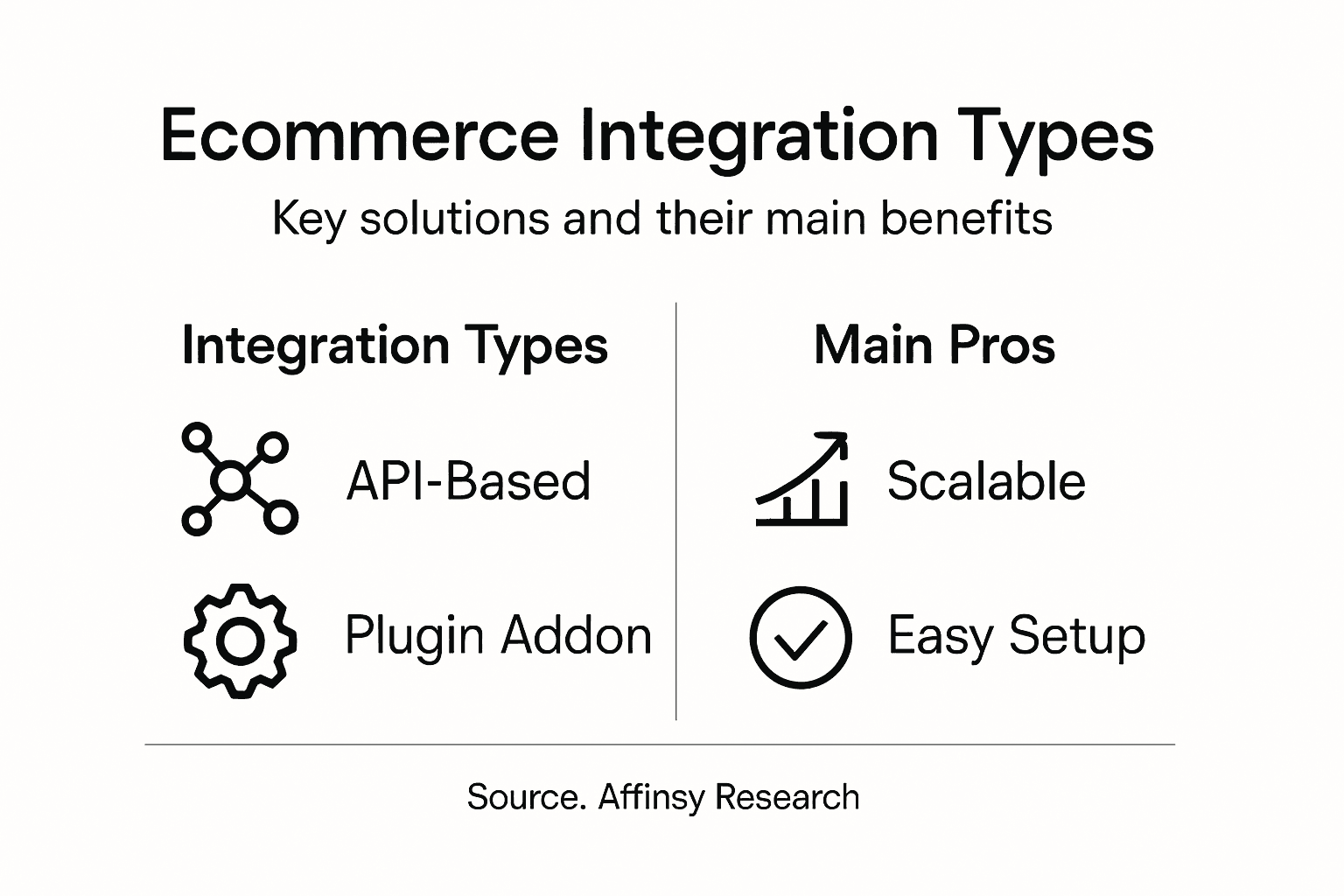
E-commerce integration solutions provide critical infrastructure for connecting various digital platforms and systems, enabling businesses to create seamless operational ecosystems. E-commerce integration types can be categorized into three primary approaches that help online businesses streamline their technological capabilities.
The main types of e-commerce integration solutions include:
- API-Based Integration: Enables real-time data exchange between different digital platforms
- Plugin/Extension Integration: Provides pre-built modules for adding specific functionalities
- Custom Integration: Tailored development addressing unique business requirements
API-based integration represents a powerful approach for connecting multiple systems through standardized communication protocols. This method allows businesses to establish robust data flows between e-commerce stores, payment gateways, inventory management systems, and other critical platforms. By leveraging application programming interfaces, companies can create dynamic, responsive technological ecosystems that adapt to changing business needs.
Custom integration strategies offer the most flexible solution for organizations with complex operational requirements. Unlike standardized approaches, custom integrations can be precisely engineered to address specific challenges, connecting multiple systems with granular control over data mapping, workflow automation, and system interactions.
Successful e-commerce integration goes beyond technical implementation - it’s about creating a unified, intelligent platform that enhances operational efficiency and customer experience.
Plugin and extension integration provides quick, pre-configured solutions for adding specific capabilities to e-commerce platforms. These modular approaches allow businesses to rapidly expand functionality without extensive custom development, offering features like SEO optimization, social media connectivity, payment processing, and advanced analytics tools.
Here’s a comparison of the main e-commerce integration approaches and their typical business impacts:
| Integration Type | Example Use Cases | Pros | Cons |
|---|---|---|---|
| API-Based Integration | Real-time data exchange, automation | Scalable, flexible connectivity | Requires technical expertise |
| Plugin/Extension | SEO tools, payment add-ons | Quick installation, lower cost | Limited customizability |
| Custom Integration | Unique business workflows | Tailored solutions, full control | Higher cost and complexity |
Pro tip: Conduct a comprehensive audit of your existing systems before selecting an integration approach to ensure maximum compatibility and minimal disruption.
How Integrated AI Drives Product Insights
AI-powered product insights represent a transformative approach to understanding customer needs, market trends, and potential innovation opportunities. AI applications in product development have revolutionized how businesses generate, test, and refine product concepts across multiple development stages.
The key mechanisms through which integrated AI drives product insights include:
- Advanced sentiment analysis of customer feedback
- Predictive demand forecasting
- Real-time consumer behavior tracking
- Automated concept generation and iteration
- Intelligent market trend identification
Sentiment analysis enables businesses to decode complex customer emotions and preferences by processing vast amounts of unstructured feedback from multiple channels. This technology goes beyond traditional survey methods, capturing nuanced consumer perspectives that might otherwise remain hidden.
Generative AI tools have dramatically accelerated the product ideation process, allowing companies to rapidly prototype and evaluate multiple concept variations. By analyzing historical data, consumer trends, and market signals, these intelligent systems can suggest innovative feature combinations and predict potential product success with unprecedented accuracy.
AI-driven product insights transform raw data into actionable strategic intelligence, bridging the gap between customer expectations and business innovation.
Predictive analytics powered by machine learning algorithms can anticipate market demands before they emerge, helping businesses stay ahead of competitive curves. These systems analyze complex datasets, identifying emerging consumer preferences and potential product opportunities that traditional market research might overlook.

Pro tip: Integrate AI insights gradually by first applying them to specific product development stages to minimize disruption and maximize learning opportunities.
Essential Steps for Seamless Integration
Successful e-commerce AI integration demands a strategic, multifaceted approach that addresses technological, organizational, and ethical challenges. Comprehensive AI integration frameworks provide businesses with a roadmap for transforming their digital infrastructure and unlocking advanced analytical capabilities.
The essential steps for seamless AI integration include:
- Comprehensive data infrastructure assessment
- Strategic AI model selection
- Robust data privacy and security protocols
- Continuous performance monitoring
- Cross-functional team alignment
- Phased implementation strategy
Data preparation represents the foundational step in AI integration. This critical process involves systematically collecting, cleaning, and organizing existing business data to ensure machine learning models can generate accurate, meaningful insights. Companies must invest significant effort in creating high-quality, standardized datasets that represent diverse customer interactions and transactional information.
Technical implementation requires carefully selecting appropriate AI models that align with specific business objectives. Machine learning algorithms must be chosen based on their ability to address unique organizational challenges, whether that involves customer segmentation, demand forecasting, or personalized recommendation systems.
Successful AI integration is not about implementing the most advanced technology, but about creating intelligent systems that solve real business problems.
Ethical considerations play a crucial role in AI deployment. Businesses must prioritize algorithmic transparency, protect customer data privacy, and establish clear guidelines for AI-driven decision-making. This approach helps build customer trust and ensures responsible technology adoption.
Pro tip: Start with small-scale AI pilot projects that target specific, measurable business challenges to minimize risk and demonstrate tangible value.
Challenges and Pitfalls in Integration Projects
E-commerce AI integration is fraught with complex challenges that can derail even the most sophisticated technological initiatives. Comprehensive AI integration challenges reveal multiple interconnected obstacles that businesses must strategically navigate to ensure successful implementation.
Key challenges in AI integration projects include:
- Data quality and inconsistency issues
- Technical scalability limitations
- High implementation costs
- Algorithmic bias risks
- Organizational resistance
- Complex system interoperability
- Privacy and security concerns
Technical complexity represents one of the most significant barriers to successful AI integration. Companies frequently encounter intricate challenges related to data standardization, system compatibility, and infrastructure limitations. These technical hurdles require substantial investment in robust technological frameworks and specialized expertise to overcome.
Organizational resistance emerges as another critical challenge, with many businesses struggling to align internal stakeholders with AI-driven transformation strategies. Employees may feel threatened by technological changes, leading to potential implementation roadblocks and reduced adoption rates. Effective change management and comprehensive training programs become essential in mitigating these cultural barriers.
Successful AI integration is not about eliminating challenges, but about developing strategic approaches to systematically address and overcome them.
Ethical considerations pose additional complexity in AI deployment. Businesses must carefully navigate potential algorithmic biases, ensure transparent decision-making processes, and maintain stringent data privacy standards. This requires ongoing monitoring, regular audits, and a commitment to responsible AI governance.
Pro tip: Create a dedicated cross-functional AI integration team with representatives from technology, operations, and ethics to proactively identify and address potential challenges.
This summary table highlights typical challenges and strategic responses in AI-driven e-commerce integration projects:
| Challenge | Common Impact | Strategic Response |
|---|---|---|
| Data inconsistency | Reduced insight accuracy | Invest in robust data standards |
| Technical scalability issues | Limits growth potential | Upgrade system architecture |
| Organizational resistance | Slow adoption, project delays | Implement change management plans |
| Algorithmic bias risks | Damaged customer trust | Regular audits and transparency |
Unlock AI-Powered Ecommerce Growth With Affinsy
The challenges of seamless ecommerce integration and leveraging AI analytics to gain actionable product insights can feel overwhelming. Many retailers struggle with data inconsistency, complex system interoperability, and turning raw data into clear strategies for customer retention and product bundling. If you want to rise above these hurdles and unlock smarter growth through real-time data-driven decisions, it is essential to adopt a solution that simplifies integration and reveals hidden opportunities.
Affinsy offers a powerful SaaS platform designed specifically to solve these pain points by analyzing your historical transaction data. With features like market basket analysis and RFM customer segmentation, Affinsy translates complex datasets into easy-to-understand insights that enhance cross-selling and maximize average order value. It integrates effortlessly with Shopify, WooCommerce, and Google Analytics to build a unified, intelligent retail ecosystem. This allows you to automate insights without needing deep data science skills.
Experience firsthand how Affinsy can transform your e-commerce business and drive meaningful results today.
Ready to turn your store’s data into a competitive advantage Consider exploring Affinsy’s AI-powered analytics platform now and start optimizing your product strategies with proven AI-driven insights. Visit https://affinsy.com and take the next step toward unlocking your ecommerce potential.
Frequently Asked Questions
What is ecommerce integration?
Ecommerce integration refers to the process of connecting different digital platforms, data sources, and systems to create a unified ecosystem that enhances operational efficiency and customer experience.
How does AI analytics benefit online businesses?
AI analytics helps online businesses understand consumer behavior and market trends by providing actionable insights through automated data collection, real-time tracking, and predictive modeling, ultimately allowing for personalized customer experiences.
What are the main types of ecommerce integration solutions?
The main types of ecommerce integration solutions are API-based integration, plugin/extension integration, and custom integration. Each type has its use cases and advantages, such as real-time data exchange or quick installation of specific functionalities.
What challenges might businesses face during ecommerce AI integration?
Businesses may encounter challenges such as data quality issues, technical scalability limitations, algorithmic bias risks, organizational resistance, and privacy concerns, which require strategic responses to overcome.
Recommended
- AI and Ecommerce Guide: Strategies for Success in 2025 - Affinsy Blog | Affinsy
- Why Use AI in E-commerce: Understanding Its Impact - Affinsy Blog | Affinsy
- Demystifying AI in E-commerce: What Every Store Owner Needs to Know - Affinsy Blog | Affinsy
- Role of AI in E-Commerce: Boosting Sales and Retention - Affinsy Blog | Affinsy