
Sorting through inconsistent product names or missing customer IDs is a headache every e-commerce manager knows too well. Growing your average order value depends on more than intuition—it requires reliable data and smart analytics. When you prepare clean transaction data and use insights from deep learning algorithms, you give your team the power to create high-performing bundles and personalized cross-sell opportunities that actually drive sales. Bold strategies begin with data quality and advanced analytics.
Table of Contents
- Step 1: Prepare Transaction Data For In-Depth Analysis
- Step 2: Identify Product Associations With AI-Powered Insights
- Step 3: Create Targeted Product Bundles Based On Analytics
- Step 4: Implement Cross-Selling Strategies Within Your Store
- Step 5: Monitor Results And Refine Offers Using Dashboard Reports
Quick Summary
| Key Insight | Explanation |
|---|---|
| 1. Ensure Data Quality | Clean, consistent, and complete data is essential for accurate e-commerce analysis. Audit and standardize your transaction records first. |
| 2. Utilize AI for Product Associations | Use machine learning to uncover hidden product associations that can inform effective bundling strategies. |
| 3. Segment Targeted Bundles | Create product bundles specifically tailored to different customer segments based on shopping behavior to increase sales. |
| 4. Implement Effective Cross-Selling | Position personalized cross-sell recommendations at strategic points during the customer journey to boost average order value. |
| 5. Monitor and Adjust Strategies | Continuously track key metrics and refine your bundles and cross-sell offers according to customer behavior insights. |
Step 1: Prepare transaction data for in-depth analysis
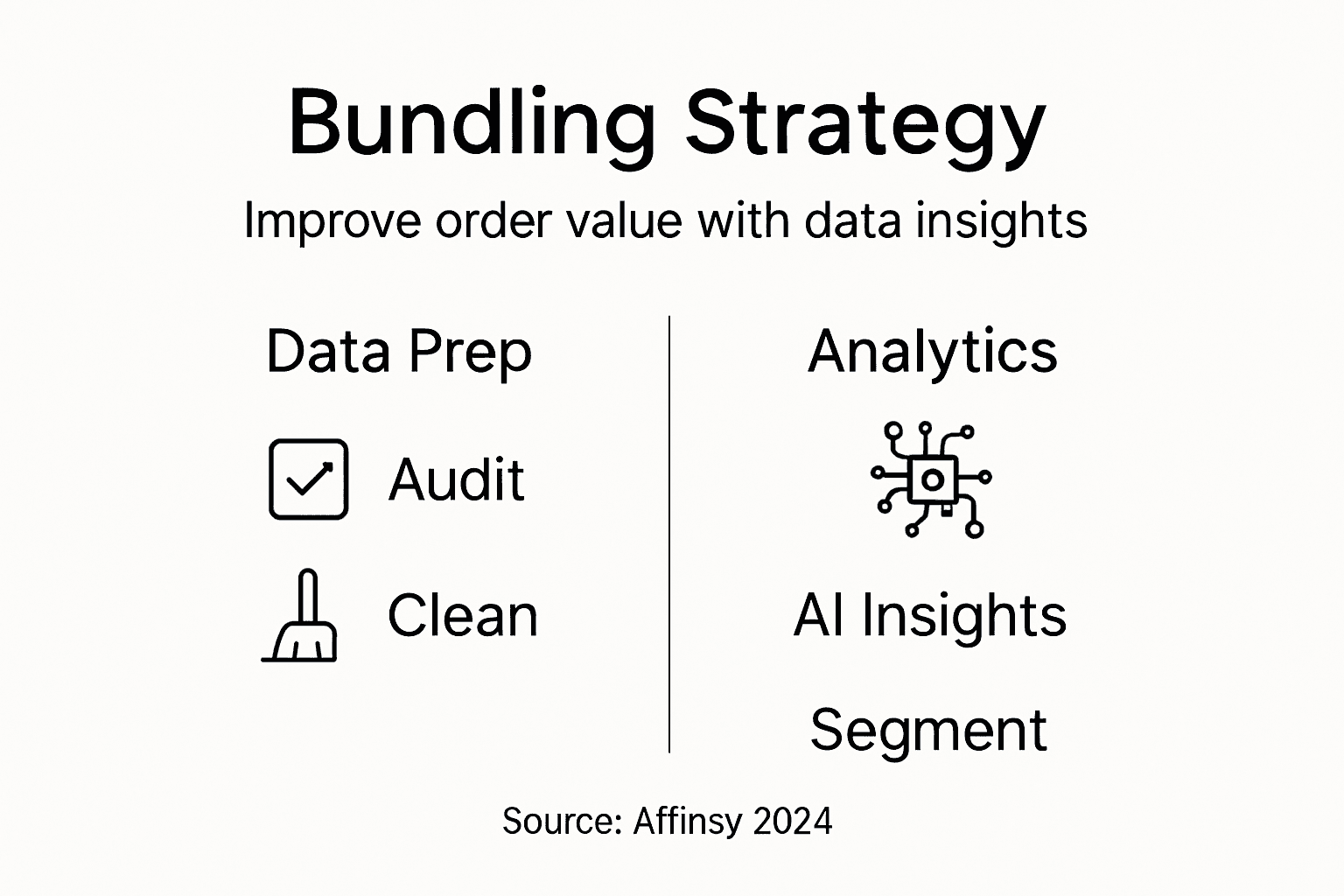
Your transaction data is only as useful as its quality. Before you can identify which products drive higher order values or which customers are your best opportunities, you need clean, consistent, and complete data. This step sets the foundation for every insight that follows.
Start by auditing what you have. Pull your transaction records from your e-commerce platform and examine them closely. Look for missing values, duplicate entries, and inconsistencies in how products are categorized or named. You might discover that “Blue T-Shirt Large” and “Blue Tshirt L” are listed separately when they should be one product. These small inconsistencies multiply across thousands of transactions and distort your analysis.
Next, standardize your data structure. Data cleaning and transformation are essential components of preprocessing that ensure consistency across all records. Create uniform formats for product names, categories, customer IDs, and dates. If your dates are scattered across different formats (MM/DD/YYYY in one column, DD-MM-YYYY in another), convert everything to a single standard. This might feel tedious, but it prevents errors downstream when you’re analyzing product relationships or customer segments.
Remove or handle outliers and incomplete transactions carefully. A transaction missing a customer ID or product category becomes problematic when you’re trying to match purchase patterns. Decide whether to exclude these records or fill them intelligently based on available context. Effective transaction log collection and analysis requires deliberate methodological choices about what stays and what goes.
Finally, enrich your data with context. Add fields that matter for bundling analysis: product margins, categories, seasonality tags, or customer lifecycle stage. If you’re working with an analytics platform, connecting your transaction data to customer segmentation and behavioral metrics provides richer context for identifying which bundles work best. Clean data now prevents headaches when you’re interpreting results.
Here’s a summary of common data quality issues and their effects on e-commerce analysis:
| Data Quality Issue | Typical Source | Business Impact |
|---|---|---|
| Inconsistent product names | Manual input errors | Distorted sales analysis |
| Duplicate entries | Import or syncing errors | Inflated transaction counts |
| Mixed date formats | Platform migrations | Reporting inaccuracies |
| Missing customer IDs | System outages or bugs | Incomplete customer insights |
| Undefined categories | Human error or mislabeling | Faulty bundle recommendations |
Pro tip: Create a data audit checklist and run it monthly to catch issues before they corrupt your analysis. Missing values, duplicates, and format inconsistencies compound over time, making recent insights unreliable.
Step 2: Identify product associations with AI-powered insights
Now that your data is clean, it’s time to uncover which products naturally belong together. Product associations reveal the hidden patterns in your customer purchases, and AI makes finding them faster and more accurate than manual analysis ever could.
Start by feeding your cleaned transaction data into an analytics platform that uses machine learning. These systems analyze thousands of purchase patterns to identify which products appear together more often than random chance would suggest. When your customers buy Product A, do they tend to buy Product B? AI algorithms detect these relationships automatically, saving you months of manual investigation.
Deep learning algorithms analyze consumer behavior to identify meaningful product associations that drive both sales and customer engagement. Rather than guessing which items to bundle based on intuition, you’re working with statistical evidence. A customer browsing wireless headphones might have a 45% likelihood of also purchasing a phone case, which is significantly higher than your general product purchase rate.
Look beyond obvious pairs. AI doesn’t just find items that seem logically connected. It uncovers surprising associations that make sense only when you see the data. Maybe customers who buy premium coffee makers also purchase specialty coffee subscriptions at twice the normal rate. These non-obvious pairings often drive the biggest AOV increases because they address genuine customer needs you hadn’t considered.
AI enables scalable data-driven decisions by processing patterns across your entire customer base simultaneously. You can identify associations by customer segment, seasonality, or product category. A bundle that works brilliantly for new customers might not resonate with repeat buyers. AI shows you these nuances, allowing you to create targeted bundles rather than one-size-fits-all offerings.
Document your top associations with confidence scores. Note which pairs have the strongest relationships and which customer segments show the highest affinity for each combination. This becomes your foundation for actually building and testing bundles.
Pro tip: Focus on associations with correlation scores above 0.4 and minimum transaction volume of at least 50 instances, as these typically convert better and reduce the risk of bundling low-demand item pairs.
Step 3: Create targeted product bundles based on analytics
You now have product associations and customer insights. Time to actually build bundles that your customers will want to buy. The key is moving beyond random pairings to creating combinations that feel intentional and valuable to specific customer segments.

Start by segmenting your bundles by customer type and purchase behavior. A bundle for first-time buyers looks different from one targeting loyal customers. New customers might appreciate a “getting started” bundle with complementary essentials, while repeat buyers respond better to premium or advanced product combinations. Your analytics show which segments respond to which associations, so use that intelligence to create bundles tailored to each group.
Next, consider the psychology of bundling. Bundle choice models shaped by consumer decision contexts vary based on how customers evaluate value and make purchasing decisions. Some customers want a discount on bundled items. Others prefer the convenience of having everything together. Some respond to the story you tell about the bundle, like “Complete Your Home Office” or “Gaming Essentials.” Test different bundle messaging with different segments to see what resonates.
Structure your bundles strategically. Include one anchor product that drives traffic (something your customers actively search for) and complementary items with higher margins. The anchor pulls customers in, and the companions increase your average order value. Personalized bundle recommendations optimized for user preferences work better when you account for how different product attributes work together rather than simply throwing items together.
Limit yourself to 3 to 5 key bundles per segment initially. Too many options paralyze customers. Test each bundle with a subset of your audience and measure which combinations drive the highest conversion rates and AOV. Track not just revenue but also which bundles customers actually prefer.
Pro tip: Bundle one bestseller with one slow-moving product to accelerate inventory turnover while maintaining your AOV, ensuring every bundle contains at least one item with strong historical demand.
Step 4: Implement cross-selling strategies within your store
Bundles are just one piece of the puzzle. Real AOV growth happens when you weave cross-selling throughout your entire customer experience. Cross-selling means presenting relevant complementary products at the right moment, to the right customer, in a way that feels helpful rather than pushy.
Position cross-sell offers strategically on your product pages and checkout flow. When a customer views a laptop, show compatible accessories like USB-C cables, laptop stands, or cooling pads below the main product. The key is relevance. Offering complementary products requires understanding product relationships so your suggestions actually matter to that specific customer. A random suggestion wastes their attention and yours.
Personalize your cross-sell recommendations using customer data. Someone who previously bought running shoes should see different recommendations than someone browsing winter coats. Your transaction history reveals what different customer segments actually buy together, not what you think they should buy together. Test recommendations on product pages, in emails after purchase, and during the checkout process to find where they convert best.
Implement critical dimensions for cross-selling success including product complementarity and customer relationship strength. Don’t just show every possible item. Prioritize the combinations with the highest affinity scores from your earlier analysis. A 3 percent increase in cross-sell conversion beats showing 20 random products that customers ignore.
Lean into cart abandonment recovery. Customers who left items in their cart often respond to well-timed emails suggesting complementary products. A customer who added a printer to their cart might be interested in ink cartridges or paper. This isn’t aggressive selling. You’re genuinely helping them complete what they need.
Measure cross-sell performance constantly. Track which products people actually add when you suggest them, not just whether they view the recommendations. This data tells you what’s working and what to adjust.
Pro tip: Limit cross-sell suggestions to 2 to 3 highly relevant items per page section to avoid decision paralysis, and always place the highest-probability recommendation first where it captures immediate attention.
Step 5: Monitor results and refine offers using dashboard reports
Launching bundles and cross-sell strategies is just the beginning. Your real competitive advantage comes from continuously monitoring what works and adjusting based on actual customer behavior. This is where dashboards become your most valuable tool.
Set up a dashboard that tracks the metrics that matter most. You need bundle conversion rates, average order value by bundle type, cross-sell attachment rates, and revenue generated from each strategy. But also track what customers are ignoring. If a bundle sits untouched for weeks, that tells you something important about your offer or positioning. Data dashboards consolidate key information for real-time monitoring and enable the quick decision-making your store needs.
This table outlines the main dashboard metrics to monitor for bundle and cross-sell strategies:
| Metric | What It Tracks | Decision Trigger |
|---|---|---|
| Bundle conversion rate | % of visitors buying bundles | Flag underperforming bundles |
| Average order value (AOV) | Revenue per transaction | Assess offer effectiveness |
| Cross-sell attachment rate | Add-ons per order | Optimize cross-sell placement |
| Bundle abandonment rate | Unfinished bundle checkouts | Refine bundle structure/messaging |
Break down performance by customer segment and time period. A bundle that converts poorly overall might be performing exceptionally well with new customers or during specific seasons. Segment your reporting so you can identify these pockets of success and expand them. Look for patterns. Do certain product combinations consistently underperform? Are there unexpected winners that deserve more prominence on your site?
Use actionable insights from descriptive and predictive analytics to guide refinements. Descriptive analytics show you what happened. Predictive analytics help you anticipate what will happen next. If a bundle’s conversion rate is declining, investigate why before it completely fails. Maybe seasonality changed, or customer preferences shifted, or a competitor launched something similar.
Test changes methodically. If you adjust bundle pricing, messaging, or product combinations, measure the impact against your baseline. Small tweaks compound. A 2 percent improvement in bundle conversion might not seem dramatic, but it translates to real revenue growth over months. Document what you learn so you build institutional knowledge about what works in your specific market.
Review your dashboard weekly at minimum. Catch trends early rather than discovering problems after they cost you money. Share insights with your team so everyone understands how bundling is performing and why certain adjustments matter.
Pro tip: Create alerts in your dashboard for significant deviations from baseline performance so you can investigate drops in conversion or AOV immediately rather than discovering them in weekly reviews.
Unlock Higher Average Order Values with AI-Driven Bundling Solutions
Improving your average order value requires more than guesswork. As the article highlights, challenges like inconsistent product associations and underperforming bundles hold many e-commerce stores back from reaching their full revenue potential. Affinsy’s AI-powered analytics platform directly addresses these pain points by automating market basket analysis and customer segmentation to reveal hidden relationships between products and shopper behavior. You no longer have to manually sift through messy data or rely on intuition alone.
Start transforming your sales strategy today with Affinsy’s proven tools that seamlessly integrate with Shopify, WooCommerce, and Google Analytics. Unlock actionable insights for targeted product bundles and personalized cross-selling—all designed to increase order values and boost customer loyalty. Don’t wait for trial and error to slow your growth. Visit Affinsy now to discover how smart data-driven decisions make every transaction more valuable. Your next level of e-commerce success begins here.
Frequently Asked Questions
How can I improve my average order value with data-driven bundling?
To improve average order value, first analyze your cleaned transaction data to identify product associations. Use these insights to create targeted bundles that resonate with different customer segments, aiming for a minimum conversion rate increase of 2% within 30 days.
What are the key steps to prepare transaction data for bundling analysis?
Begin by auditing your transaction data for consistency and completeness. Standardize product names and categories, handle outliers, and enrich the data with important contextual information to prepare for effective analysis.
How do I identify effective product associations for bundling?
Feed your cleaned transaction data into an analytics platform that uses machine learning to detect product associations. Look for correlation scores above 0.4, and focus on combinations that appear together significantly more often than average, which can boost AOV by leveraging customer buying behavior.
What should I consider when creating bundled offers?
When creating bundles, segment them by customer types and purchase behaviors. Structure bundles strategically by including one popular anchor product paired with complementary items, and limit your options to 3 to 5 key bundles per segment to prevent decision fatigue.
How do I implement successful cross-selling strategies?
Implement cross-selling by strategically positioning recommendations on product pages and during the checkout process. Personalize these suggestions based on past customer behavior, aiming for a conversion increase of at least 3% by targeting relevant complementary products.
What metrics should I monitor to evaluate the performance of bundles?
Track bundle conversion rates, average order value by bundle type, and cross-sell attachment rates on your dashboard. Focus on data trends weekly to make informed adjustments, and consider refining underperforming bundles based on customer feedback.
Recommended
- Master Product Bundling Strategies for E-Commerce Success - Affinsy Blog | Affinsy
- 7 Smart Bundle Pricing Strategies for E-commerce Success - Affinsy Blog | Affinsy
- How to Maximize Average Order Value for E-Commerce Stores - Affinsy Blog | Affinsy
- Master Product Bundling on Shopify for Increased Sales - Affinsy Blog | Affinsy