
Customer data is now collected and analyzed faster than ever, with over 80 percent of American e-commerce businesses already exploring AI for smarter decision making. For managers running small to mid-sized online shops, understanding how artificial intelligence operates in the American market can reveal competitive advantages in customer retention and profitability. With tangible examples and actionable insights, discover practical ways AI can help refine your sales strategy and personalize every shopper’s experience.
Table of Contents
Key Takeaways
| Point | Details |
| AI Enhances E-Commerce | Artificial Intelligence automates processes, personalizes experiences, and supports strategic decisions through data analysis. |
| Effective Data Utilization | Implementing RFM segmentation and market basket analysis can optimize marketing efforts and improve customer retention. |
| Cross-Selling Opportunities | AI-driven product bundling and recommendations can significantly increase average order values and enhance customer satisfaction. |
| Risk Management Is Crucial | Businesses must adopt comprehensive risk management strategies to address challenges related to data privacy and algorithmic bias in AI implementation. |
Defining AI’s Function in E-Commerce
Artificial Intelligence (AI) is rapidly transforming e-commerce by automating complex business processes and enhancing customer interactions. Advanced AI technologies enable online retailers to generate personalized experiences, optimize operations, and drive strategic decision making through intelligent data analysis.
In practical terms, AI functions across multiple e-commerce domains. These include automated text generation for product descriptions, intelligent digital marketing strategies, personalized customer service interactions, and sophisticated data analytics. By leveraging machine learning algorithms, AI can predict consumer behavior, recommend products, and create dynamic pricing models that adapt in real time to market conditions.
The core strategic value of AI lies in its ability to process massive datasets faster and more accurately than human analysts. AI adoption empowers e-commerce platforms to improve customer segmentation, enhance supply chain management, and develop targeted marketing campaigns that significantly boost conversion rates and customer retention.
Pro tip: Start small by implementing AI-powered product recommendation systems, which typically yield immediate improvements in average order value and customer engagement.
Here’s a summary of key AI applications in e-commerce and their business benefits:
| AI Application | Core Function | Impact on E-Commerce |
| Product Recommendations | Personalizes shopping experience | Increases average order value |
| Automated Text Generation | Creates unique product descriptions | Enhances SEO and conversion rates |
| Dynamic Pricing Models | Adjusts prices in real time | Maximizes revenue and competitiveness |
| Customer Segmentation | Groups shoppers by behavior | Enables targeted marketing |
| Supply Chain Optimization | Streamlines inventory and logistics | Reduces costs and improves delivery |
Techniques for Uncovering Product Associations
Market Basket Analysis is a powerful technique that helps e-commerce businesses understand complex purchasing patterns by identifying statistically significant product relationships. Association rule mining algorithms enable retailers to uncover hidden connections between products that might not be immediately obvious through traditional analysis methods.
Two primary algorithms dominate this analytical approach: Apriori and FP-Growth. Apriori works by systematically generating candidate itemsets and testing their frequency, while FP-Growth creates a compact data structure called a frequent pattern tree that allows more efficient large dataset processing. These techniques help businesses understand which products customers tend to purchase together, enabling smarter inventory management, strategic product placement, and targeted cross-selling strategies.
The practical application of these techniques involves examining transaction data to reveal correlations. Advanced market basket analysis techniques can identify nuanced buying patterns such as customers who purchase athletic shoes also being likely to buy performance socks, or tech enthusiasts who buy smartphones frequently purchasing additional accessories. By understanding these intricate relationships, e-commerce platforms can design more effective recommendation systems, optimize product bundling, and create personalized marketing campaigns that resonate with specific customer segments.
Pro tip: Implement machine learning models that continuously analyze your transaction data to dynamically update product association rules, ensuring your insights remain current and actionable.
Below is a comparison of Market Basket Analysis algorithms used to reveal product associations:
| Algorithm | How It Works | Best Use Case | Unique Strength |
| Apriori | Generates and tests itemsets | Small to medium datasets | Simple implementation |
| FP-Growth | Builds frequent pattern tree | Large datasets | Faster, memory efficient |
RFM Segmentation and Customer Clustering
RFM segmentation represents a sophisticated analytical approach that enables e-commerce businesses to transform raw transactional data into strategic customer insights. Customer clustering techniques systematically categorize customers based on three critical dimensions: Recency (how recently they purchased), Frequency (how often they buy), and Monetary value (total spending amount).

The process involves advanced machine learning algorithms like K-Means and Hierarchical Clustering, which mathematically group customers with similar behavioral characteristics. These clustering methods go beyond simple demographic segmentation by creating dynamic, data-driven customer profiles that reveal nuanced purchasing patterns. Retailers can identify segments such as high-value repeat customers, occasional shoppers, and at-risk customers who might require targeted re-engagement strategies.
Machine learning integration with RFM models empowers e-commerce platforms to predict customer lifetime value with unprecedented accuracy. By understanding the unique characteristics of each customer segment, businesses can design personalized marketing campaigns, customize product recommendations, and develop retention strategies that speak directly to specific customer group needs. This approach transforms generic marketing into a precise, targeted communication method that significantly improves conversion rates and customer loyalty.
Pro tip: Regularly update your RFM segmentation model with recent transaction data to ensure your customer insights remain dynamic and reflective of evolving purchasing behaviors.
Optimizing Cross-Selling and Product Bundling
Cross-selling and product bundling represent strategic techniques that transform basic e-commerce transactions into sophisticated revenue-generation opportunities. AI-powered product bundling strategies enable online retailers to create intelligent product combinations that maximize customer value and increase average order values by leveraging advanced algorithmic insights.
The core mechanism involves sophisticated machine learning algorithms that analyze historical transaction data to identify complementary product relationships. These algorithms can detect subtle patterns that human analysts might overlook, such as unexpected product pairings that consistently appear together in customer purchase histories. By understanding these nuanced connections, e-commerce platforms can design bundles that feel intuitive and valuable to customers, rather than forced or arbitrary combinations.
Successful cross-selling and bundling strategies require more than simple algorithmic recommendations. They demand a deep understanding of customer preferences, purchasing behaviors, and contextual relevance. Advanced AI systems can generate dynamic bundle titles, compelling descriptions, and even visually optimized product images that highlight the inherent value of combined product offerings. This approach transforms traditional product recommendations from generic suggestions into personalized, data-driven purchasing experiences that feel tailored to individual customer needs.
Pro tip: Implement a continuous feedback loop that tracks bundle performance and customer response, allowing your AI system to iteratively refine and improve product pairing recommendations.
Enhancing Retention With AI-Driven Insights
Customer retention strategies have evolved dramatically with the emergence of artificial intelligence, transforming how e-commerce businesses understand and engage their customer base. AI-driven retention technologies now enable sophisticated predictive analytics that can anticipate customer behavior, identify potential churn risks, and create personalized intervention strategies before customers disengage.
The core mechanism behind these advanced retention techniques involves real-time behavioral tracking and comprehensive data integration. Machine learning algorithms continuously analyze multiple data points including purchase history, browsing patterns, interaction frequency, and customer service encounters. By synthesizing these complex datasets, AI systems can generate nuanced customer profiles that reveal subtle indicators of potential disengagement, allowing businesses to design targeted re-engagement campaigns that feel genuinely personalized and timely.
Real-time predictive analytics represent a quantum leap in customer relationship management. These sophisticated systems not only predict potential churn but also recommend specific interventions tailored to individual customer segments. By understanding each customer’s unique journey and potential pain points, businesses can proactively address concerns, optimize communication channels, and create experiences that dramatically improve long-term loyalty and lifetime customer value.
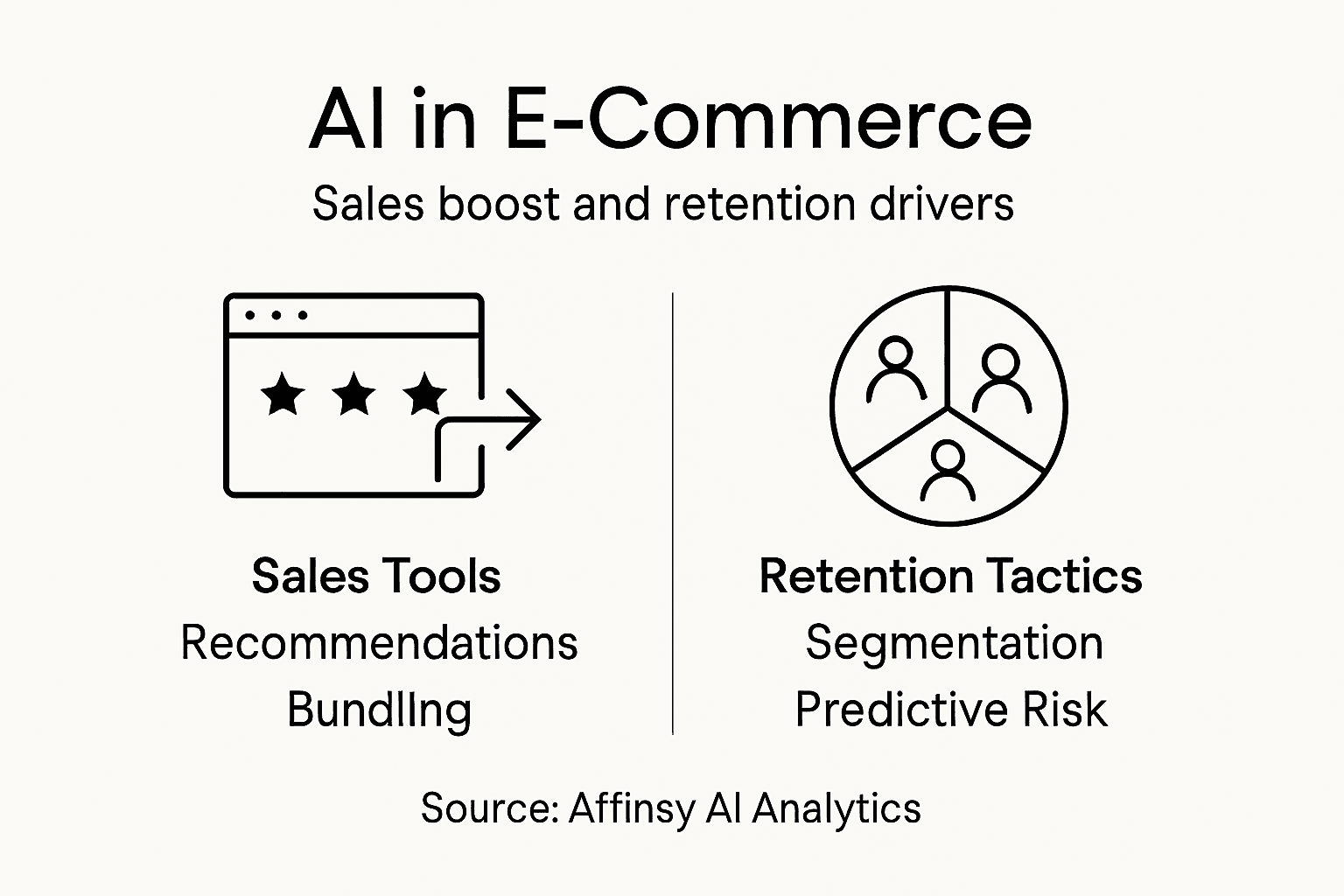
Pro tip: Implement a multi-layered AI retention model that combines predictive churn analysis with automated personalized communication triggers to systematically reduce customer attrition.
Risks and Common Pitfalls in AI Adoption
AI implementation in e-commerce requires a nuanced approach that balances technological potential with critical risk management strategies. Generative AI risks introduce complex challenges that demand proactive mitigation, including potential data inaccuracies, content quality inconsistencies, and potential erosion of customer trust if not carefully managed.
The landscape of AI adoption is fraught with multifaceted technological and ethical challenges. Key risks include algorithmic bias that can inadvertently discriminate against certain customer segments, data privacy vulnerabilities that compromise sensitive customer information, and technical failures that could disrupt critical business operations. Machine learning models require extensive training and continuous monitoring to ensure they produce reliable, unbiased insights that genuinely enhance rather than undermine business performance.
AI implementation challenges extend beyond technical considerations to profound ethical and operational concerns. Businesses must navigate complex issues such as potential workforce displacement, maintaining transparency in algorithmic decision-making, and ensuring that AI systems align with broader organizational values. Successful AI integration demands robust governance frameworks, ongoing human oversight, and a commitment to responsible technological innovation that prioritizes customer experience and ethical standards.
Pro tip: Develop a comprehensive AI risk management framework that includes regular algorithmic audits, transparent performance metrics, and clear ethical guidelines to mitigate potential negative consequences of AI adoption.
Unlock the Power of AI to Boost Your E-Commerce Sales and Retention
The article highlights how artificial intelligence transforms e-commerce by uncovering hidden product associations, optimizing customer segmentation with techniques like Market Basket Analysis and RFM, and enhancing retention through predictive analytics. If you want to turn these AI-driven insights into actionable strategies without needing deep data science skills you face the challenge of making complex customer and sales data easy to understand and use effectively. Affinsy addresses these pain points by delivering clear, automated analytics that help retailers maximize average order value through smarter product bundling and cross-selling while improving customer loyalty with targeted retention strategies.
With Affinsy you gain access to advanced AI-powered analytics that seamlessly integrate with platforms like Shopify and WooCommerce. Our platform helps you identify precise product relationships and segment customers dynamically so you can craft personalized marketing actions that truly resonate.
• Access custom reports and dashboards designed for quick decision-making • Automate your market basket analysis and RFM segmentation • Enhance customer retention with AI-driven predictive insights
Take control of your e-commerce growth today. Explore how Affinsy’s AI analytics can transform your store.
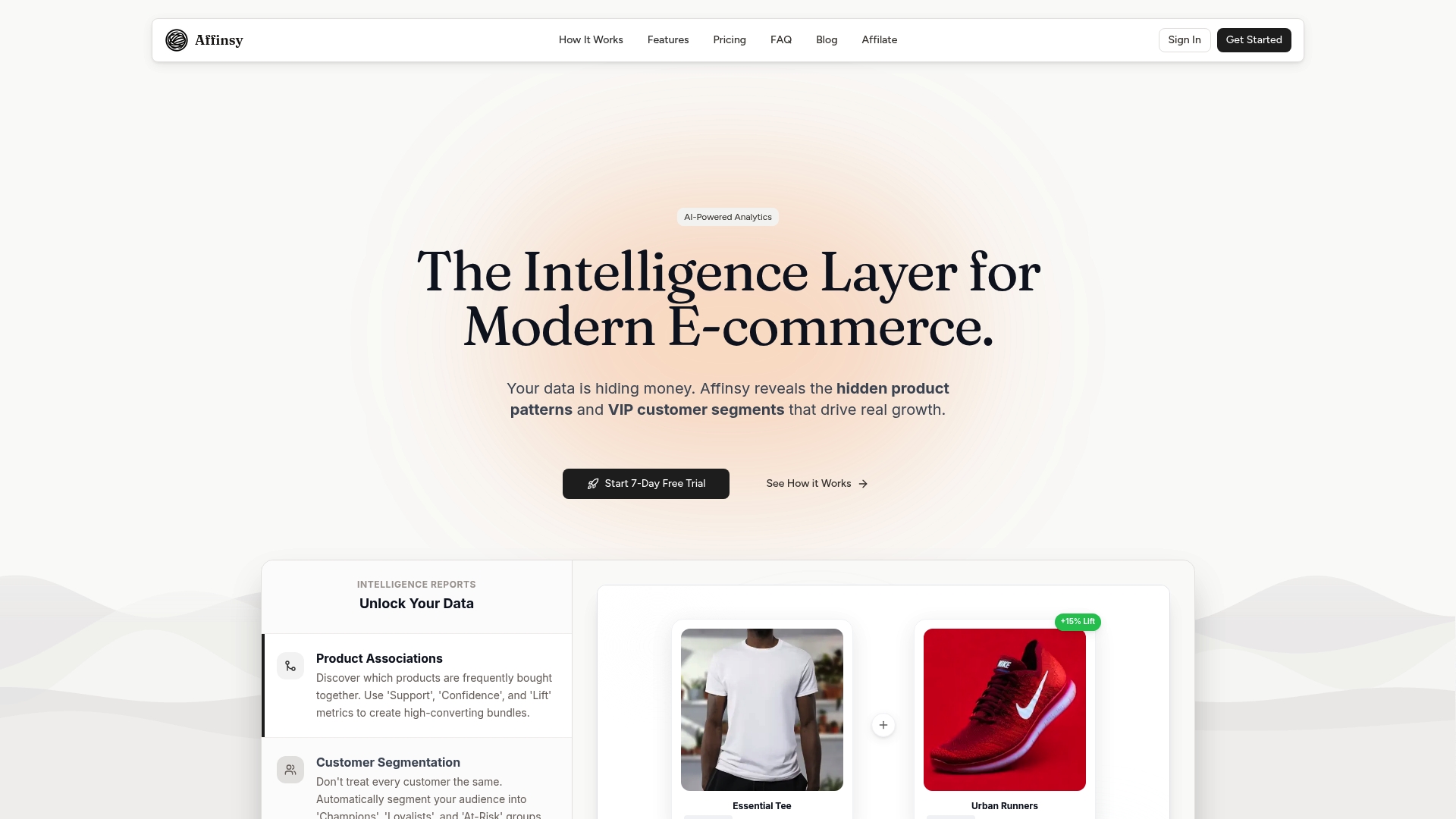
Don’t wait for competitors to get ahead. Visit Affinsy now and empower your e-commerce strategy with intelligent insights that drive sales and keep customers coming back.
Frequently Asked Questions
How does AI enhance product recommendations in e-commerce?
AI enhances product recommendations by analyzing customer behavior and preferences using machine learning algorithms. These algorithms predict what products a customer is likely to buy based on their past purchases and browsing history, creating a personalized shopping experience that can lead to increased sales.
What are the main techniques used in market basket analysis for e-commerce?
The main techniques used in market basket analysis include Apriori and FP-Growth algorithms. These techniques help identify statistically significant product relationships, revealing which items are frequently purchased together, enabling better inventory management and strategic product placements.
How can businesses improve customer retention using AI?
Businesses can improve customer retention by using AI-driven predictive analytics to identify potential churn risks. By analyzing customer behavior and preferences, businesses can create personalized interventions and re-engagement strategies that enhance the customer experience and build loyalty.
What risks should businesses consider when adopting AI in e-commerce?
Businesses should consider risks such as algorithmic bias, data privacy vulnerabilities, and potential technical failures when adopting AI. Implementing a robust risk management framework with regular audits and ethical guidelines can help mitigate these challenges.
Recommended
-
Why Use AI in E-commerce: Understanding Its Impact - Affinsy Blog | Affinsy
-
AI and Ecommerce Guide: Strategies for Success in 2025 - Affinsy Blog | Affinsy
-
Demystifying AI in E-commerce: What Every Store Owner Needs to Know - Affinsy Blog | Affinsy
-
Complete Guide to AI in Ecommerce Analytics - Affinsy Blog | Affinsy