
More than 60 percent of American online shoppers say they abandon their carts due to complicated checkout processes. For e-commerce managers, scattered digital systems and disconnected payment methods make it even harder to keep customers coming back and identify the best product combinations. Universal Commerce Protocol offers a practical path forward by creating a common digital language for seamless commerce, helping mid-sized retailers worldwide turn AI insights into measurable retention and bundling gains.
Table of Contents
- Universal Commerce Protocol Explained Clearly
- Key Components and Technical Architecture
- How UCP Enables Agentic AI Commerce
- Benefits for E-Commerce Managers and Retailers
- Risks, Integration Challenges, and Mitigations
Key Takeaways
| Point | Details |
|---|---|
| Seamless Interoperability | Universal Commerce Protocol enables diverse commerce platforms to communicate effortlessly, improving transaction efficiency. |
| Enhanced AI Capabilities | UCP allows AI agents to autonomously manage complex transactions, elevating the role of AI in the commerce sector. |
| Risk Mitigation Strategies | Implementing advanced security measures and flexible APIs is essential to address integration challenges and protect consumer data. |
| Future-Proofing Technology | Prioritizing platforms compatible with UCP ensures businesses remain adaptable to emerging standards and technologies. |
Universal Commerce Protocol Explained Clearly
The Universal Commerce Protocol (UCP) represents a groundbreaking approach to simplifying digital transactions across diverse technological ecosystems. A transformative open standard, UCP enables seamless communication between various commerce platforms, payment providers, and AI systems by establishing a common language for transactional interactions.
At its core, UCP solves critical challenges in fragmented digital commerce environments. AI agents can now autonomously discover and negotiate purchases across different e-commerce platforms that previously operated in complete isolation. The protocol standardizes key processes like:
- Product discovery mechanisms
- Checkout workflows
- Order management protocols
- Identity verification systems
- Payment processing integrations
The architectural brilliance of UCP lies in its ability to create interoperability without requiring custom integrations between different commerce systems. By defining foundational building blocks for agentic commerce, it allows AI systems to collaborate across the entire commercial lifecycle with unprecedented efficiency.
Pro Tip: When evaluating commerce technology solutions, prioritize platforms that demonstrate compatibility with emerging open standards like Universal Commerce Protocol to future-proof your digital infrastructure.
Key Components and Technical Architecture
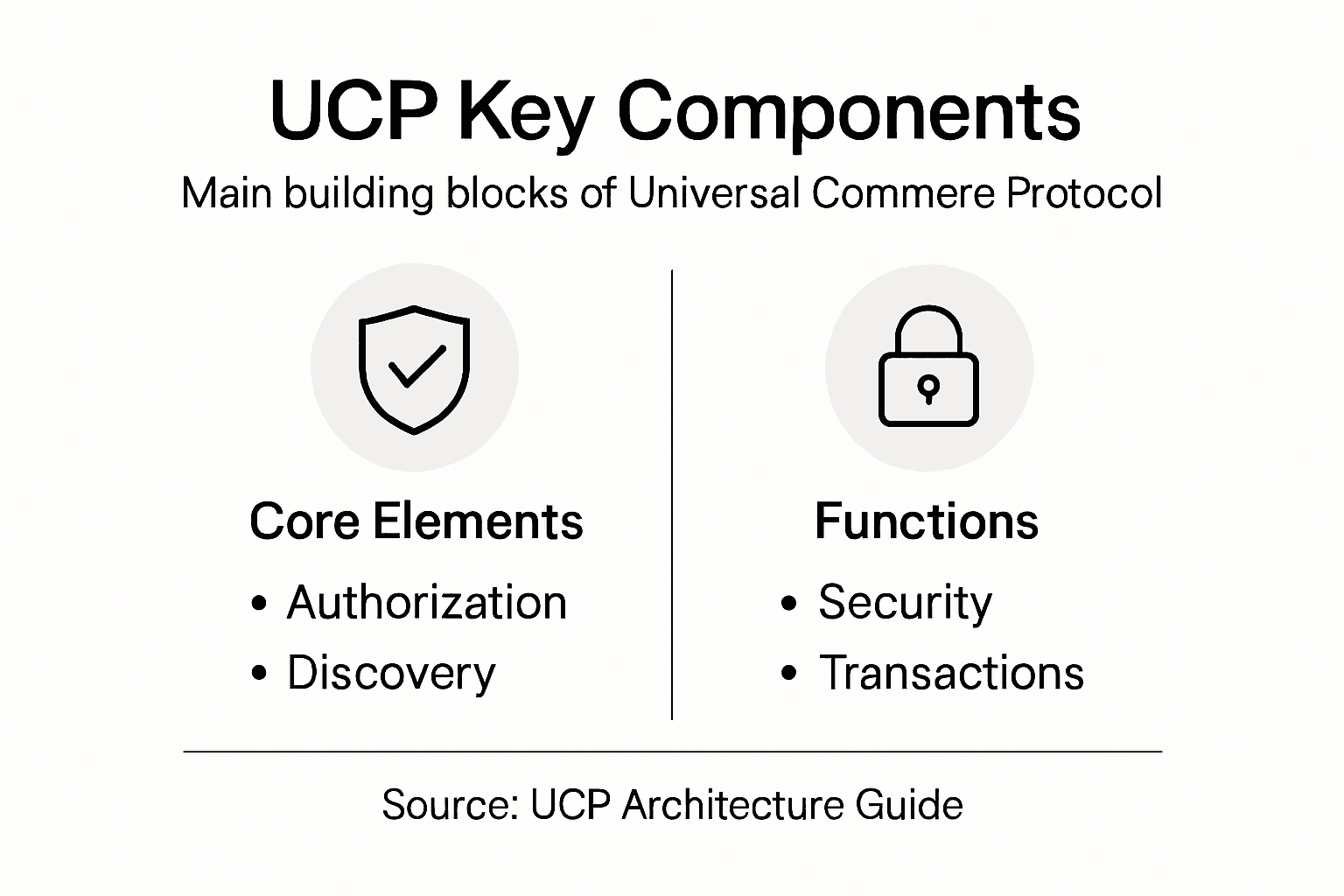
The Universal Commerce Protocol’s technical architecture is a sophisticated framework designed to enable seamless digital transactions across complex technological environments. Core architectural capabilities include multiple sophisticated interoperability layers that bridge consumers, businesses, and payment ecosystems with unprecedented precision and security.
Key technical components of the UCP architecture encompass several critical domains:
- Authorization Mechanisms: Leveraging OAuth 2.0 and advanced security protocols
- Communication Protocols: Supporting REST, JSON-RPC, MCP, and A2A standards
- Discovery Services: Enabling dynamic consumer-business interaction frameworks
- Transactional Security: Ensuring PCI-DSS compliance and data protection
- Integration Extensions: Facilitating connections with open standards like AP2
Agentic commerce infrastructure represents a transformative approach to programmatic commerce flows. By creating developer-friendly APIs that integrate with existing commerce infrastructures, UCP enables AI agents to execute transactions autonomously while maintaining robust security and trust mechanisms. This architecture allows merchants granular control over purchase acceptances and preserves critical customer relationship dynamics.

Here’s a summary comparing core UCP technical components and their business impact:
| Component | Main Function | Business Impact |
|---|---|---|
| Authorization Layer | Secures user and agent access | Minimizes fraud risk |
| Communication Protocols | Allows platform interoperability | Enables broader market reach |
| Discovery Services | Facilitates dynamic engagement | Boosts customer acquisition |
| Transactional Security | Protects transaction data | Increases consumer trust |
| Integration Extensions | Connects with modern commerce tools | Eases technology adoption |
Pro Tip: When implementing UCP-based systems, prioritize modular design principles that allow flexible integration and easy scalability across different technological environments.
How UCP Enables Agentic AI Commerce
Universal Commerce Protocol fundamentally transforms how AI agents interact with digital commerce ecosystems by establishing autonomous transaction capabilities. This revolutionary approach empowers AI systems to perform complex commercial activities with unprecedented precision and intelligence, moving far beyond traditional search and recommendation models.
The core mechanism enabling agentic AI commerce involves several sophisticated capabilities:
- Intelligent Intent Recognition: Accurately interpreting user preferences and requirements
- Secure Transaction Orchestration: Managing end-to-end purchase processes autonomously
- Multi-Platform Navigation: Seamlessly traversing diverse commerce environments
- Dynamic Decision Making: Evaluating product options based on sophisticated algorithmic criteria
- Compliance and Security Management: Ensuring transaction integrity across different systems
AI agents can now directly interact with merchant systems, executing sophisticated shopping tasks that include product discovery, comparative analysis, checkout processes, and post-purchase interactions. This transformative approach allows AI to function as a genuine shopping assistant, making nuanced decisions while maintaining strict security protocols and respecting merchant control mechanisms.
Pro Tip: Develop AI commerce strategies that prioritize transparent user consent and clear interaction boundaries to maximize trust and adoption of agentic commerce technologies.
Benefits for E-Commerce Managers and Retailers
The Universal Commerce Protocol delivers transformative advantages for e-commerce professionals by enabling advanced sales channels that streamline complex commercial interactions. This innovative approach fundamentally reimagines how online retailers can leverage artificial intelligence to optimize their business performance and customer engagement strategies.
Key benefits for e-commerce managers and retailers include:
- Reduced Integration Complexity: Eliminate need for multiple custom AI integrations
- Enhanced Conversion Opportunities: Access new AI-driven sales channels
- Improved Fraud Prevention: Implement secure transaction protocols
- Granular Sales Control: Maintain direct oversight of customer relationships
- Flexible Business Models: Support diverse transaction and payment approaches
Agentic commerce channels offer significant revenue potential by creating intelligent, adaptive sales mechanisms that respond dynamically to customer preferences. Retailers gain unprecedented capabilities to engage customers through AI-powered assistants while preserving critical data privacy and transaction control. The protocol essentially transforms traditional e-commerce models by introducing sophisticated, intelligent intermediaries that can negotiate and complete purchases with remarkable precision.
Pro Tip: Develop a comprehensive AI integration strategy that balances technological innovation with transparent customer communication to maximize adoption and trust.
Risks, Integration Challenges, and Mitigations
The Universal Commerce Protocol introduces significant technological transformations that require careful risk management and strategic implementation. Trusted commerce protocols address potential vulnerabilities by establishing robust security frameworks designed to protect both merchants and consumers in increasingly complex digital transaction environments.
Key risks and integration challenges include:
- Identity Verification Complexity: Ensuring authentic buyer representation
- Data Privacy Concerns: Protecting sensitive customer information
- System Compatibility: Aligning legacy commerce platforms with new protocols
- Fraud Prevention: Implementing advanced authentication mechanisms
- Merchant Control: Maintaining oversight in autonomous transaction scenarios
Integration strategies focus on incremental deployment that balance innovation with comprehensive risk management. This approach involves developing flexible APIs compatible with existing commerce systems, leveraging standardized security frameworks like OAuth 2.0 and PCI-DSS, and promoting collaborative industry standards that enable secure, transparent AI-driven transactions. Successful mitigation requires ongoing monitoring, transparent communication protocols, and adaptive technological frameworks that can evolve with emerging commerce technologies.
The table below highlights mitigation strategies for core UCP integration risks:
| Risk Area | Common Challenge | Recommended Mitigation |
|---|---|---|
| Identity Verification | Validating AI agent authenticity | Advanced biometric protocols |
| Data Privacy | Secure handling of sensitive data | Encryption and regular audits |
| System Compatibility | Integrating legacy systems | Modular API layers |
| Merchant Oversight | Maintaining transaction control | Real-time monitoring dashboards |
| Fraud Prevention | Preventing unauthorized access | Multi-factor authentication |
Pro Tip: Develop a phased implementation strategy that includes continuous security audits and clear communication channels between AI agents and merchant systems.
Unlock AI-Driven Insights to Power Your Universal Commerce Protocol Journey
The Universal Commerce Protocol ushers in a new era where AI agents execute seamless transactions across multiple e-commerce platforms. Yet, as AI empowers autonomous commerce, e-commerce managers face challenges like maintaining granular sales control, optimizing cross-selling, and increasing customer retention in a complex digital ecosystem. Understanding hidden product associations and customer behavior becomes critical to maximize the benefits of agentic commerce.
Affinsy offers the perfect solution to complement your Universal Commerce Protocol strategy. By harnessing AI-powered analytics that analyze historical transaction data, Affinsy reveals actionable insights such as market basket analysis and customer segmentation. This enables you to optimize product bundling and retention strategies, boosting average order values and fostering loyal customer relationships. Its seamless integration with platforms like Shopify, WooCommerce, and Google Analytics ensures your existing e-commerce infrastructure stays future-proof while embracing AI commerce innovations.
Embrace smarter data-driven growth today with Affinsy and empower your team to harness the full potential of AI-powered retail. Explore how advanced analytics can reduce integration complexity and enhance your conversion opportunities now.
Explore Affinsy Solutions
Discover Market Basket Analysis
Optimize Customer Segmentation
Frequently Asked Questions
What is the Universal Commerce Protocol (UCP)?
The Universal Commerce Protocol (UCP) is an open standard designed to simplify digital transactions by enabling seamless communication between various commerce platforms, payment providers, and AI systems.
How does UCP enhance AI agent interactions in e-commerce?
UCP empowers AI agents to autonomously discover, negotiate, and complete purchases across different e-commerce platforms, enabling complex commercial activities with high efficiency and precision.
What are the key components of the UCP architecture?
Key components of UCP include authorization mechanisms, communication protocols, discovery services, transactional security, and integration extensions, all designed to ensure interoperability and security in digital transactions.
What benefits does UCP offer to e-commerce managers?
UCP helps e-commerce managers reduce integration complexity, enhance conversion opportunities, improve fraud prevention, maintain granular sales control, and support flexible business models, ultimately optimizing business performance.
Recommended
- Understanding the Agentic Commerce Protocol in E-commerce - Affinsy Blog | Affinsy
- AI and Ecommerce Guide: Strategies for Success in 2025 - Affinsy Blog | Affinsy
- Why Use AI in E-commerce: Understanding Its Impact - Affinsy Blog | Affinsy
- Demystifying AI in E-commerce: What Every Store Owner Needs to Know - Affinsy Blog | Affinsy
- What Is AI in Ecommerce? Key Benefits for Retailers