
Every e-commerce manager knows that growing revenue is harder when you focus only on chasing new customers. The real breakthrough often comes from understanding and optimizing your store’s Average Order Value. This metric goes beyond basic sales numbers and reveals powerful insights about customer behavior that can transform your business efficiency. Unpacking common misconceptions and pinpointing the true drivers behind order size gives you a clear edge in maximizing profit growth while making smarter decisions with your existing customer base.
Table of Contents
- Average Order Value Defined and Misconceptions
- Key Factors That Influence Order Size
- Proven Strategies to Boost Order Value
- Financial Impact and Profitability Benefits
- Challenges, Risks, and How to Avoid Them
Key Takeaways
| Point | Details |
|---|---|
| Average Order Value (AOV) | AOV is calculated by dividing total revenue by the number of orders and indicates customer spending behavior in single transactions. |
| AOV vs. Revenue Per Customer | AOV measures a single transaction while revenue per customer accounts for all purchases over time; understanding this distinction is crucial for strategy development. |
| Effective Strategies | Implement product bundling, upselling, and cross-selling to organically increase AOV, while being cautious to maintain customer satisfaction. |
| Monitor Metrics | Always track AOV alongside conversion rates and customer retention to ensure that tactics aimed at increasing AOV do not adversely affect overall business performance. |
Average Order Value Defined and Misconceptions
Average Order Value, or AOV, represents the average dollar amount spent per order on your store. The math is straightforward: divide your total revenue by the number of orders placed over a specific period. If your store generated $50,000 in revenue across 1,000 orders in a month, your AOV is $50. This single metric tells you something fundamental about your customer behavior that flat revenue numbers cannot reveal.
Why AOV matters more than you might think comes down to business growth. A store with 1,000 customers spending $100 each generates the same revenue as one with 10,000 customers spending $10 each. But the first scenario requires half the marketing spend, customer acquisition costs, and operational overhead. That efficiency difference compounds quickly. When you optimize AOV, you unlock faster profit growth without necessarily needing to drive massive increases in traffic. Your existing customers become more valuable.
Now for the misconception that trips up most e-commerce managers. Many people conflate AOV with revenue per customer. These are not the same thing. AOV measures what happens in a single transaction, while revenue per customer includes all purchases that same customer makes over time. A customer might place three $40 orders (contributing $120 to revenue per customer) while each order counts as a $40 AOV transaction. When you’re analyzing growth, this distinction matters because it affects which strategies you prioritize. AOV optimization focuses on what happens within one order. Customer lifetime value optimization focuses on bringing people back repeatedly. Both matter, but they require different tactics.
Here’s how AOV compares to revenue per customer for business analysis:
| Metric | What It Measures | Use in Strategy |
|---|---|---|
| Average Order Value | Dollar amount per order | Optimize single-transaction spend |
| Revenue Per Customer | Total spend over all purchases | Guide retention and repeat sales |
| Key Impact | Increases profit per order | Drives lifetime value growth |
| Typical Tactics | Bundling, upselling, free shipping | Loyalty, re-engagement campaigns |
Another common mistake is treating AOV as a universal benchmark. Your store’s healthy AOV depends on your product category, price point, and business model. A fashion retailer selling t-shirts faces different AOV realities than a software tools store selling annual subscriptions. Comparing yourself against competitors in different niches creates false targets. Your AOV baseline matters only as the starting point for your own growth.
Pro tip: _Calculate your current AOV down to the decimal and track it weekly, not monthly, so you can spot improvements from your optimization efforts quickly enough to make real-time adjustments.
Key Factors That Influence Order Size
Order size is never random. Behind every transaction lies a mix of predictable factors that shape how much a customer will spend. Understanding these drivers lets you strategically nudge customers toward larger purchases without feeling pushy. The biggest factors break down into three categories: what you’re selling, how you’re presenting it, and who’s buying.
Product characteristics form the foundation. Customer purchasing habits and order size reveal that items with higher price points naturally generate larger order values, but that’s only part of the story. Complementary products matter enormously. If you sell coffee makers, bundles that include filters, grinders, and measuring scoops will push AOV higher than selling machines alone. Product availability and perceived value also influence decisions. When customers see stock running low, they often buy in larger quantities to avoid stockouts. Similarly, limited-time offers create urgency that drives people to add more items to their carts.
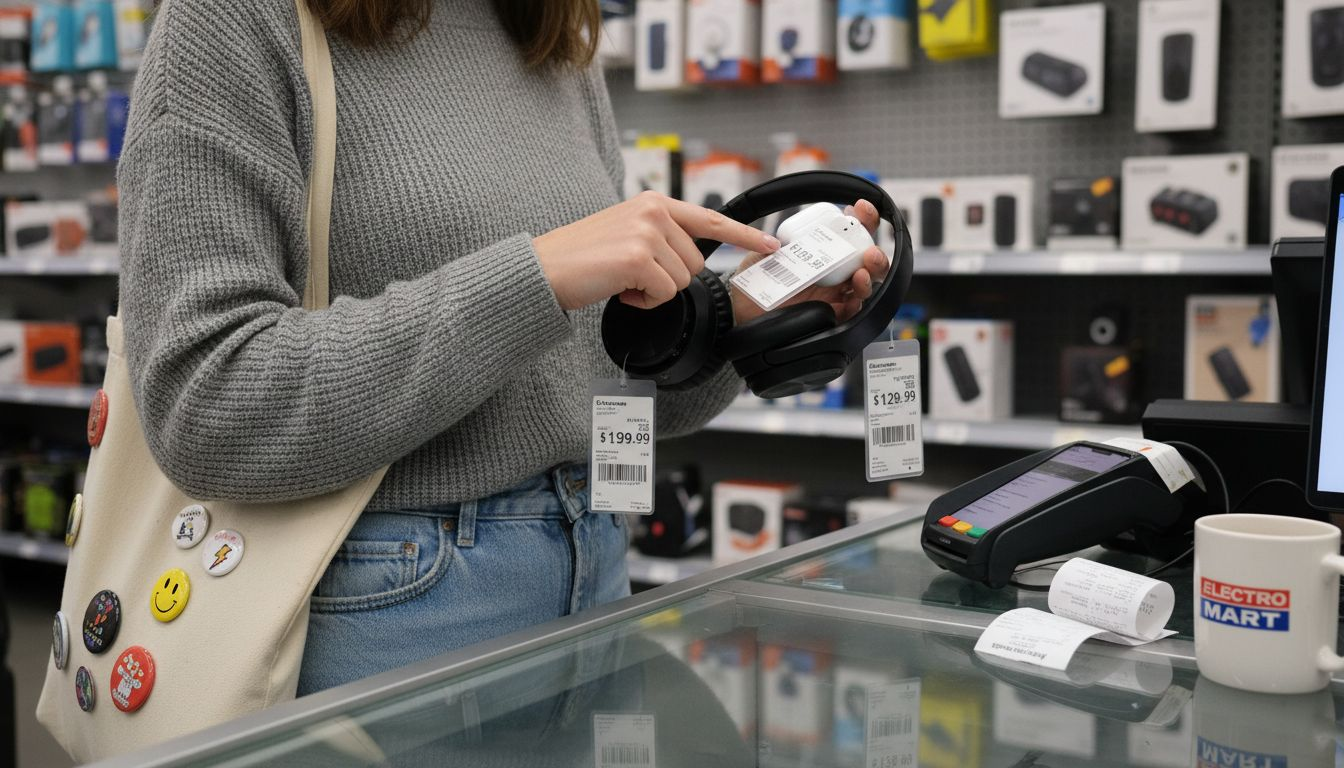
Your operational approach shapes order behavior more than you’d expect. Service quality and fulfillment speed directly affect purchase quantities. Customers who trust your inventory accuracy and delivery promises feel confident ordering multiple items. Shipping costs play a role too. A flat-rate shipping model encourages larger orders because customers rationalize spending on additional products when they’re not paying per item. Conversely, expensive shipping discourages add-ons. Pricing strategies and promotional offers create obvious levers. Tiered discounts (buy 2 save 10%, buy 3 save 15%) push people to hit higher thresholds. Free shipping at certain price points functions as a psychological trigger that’s remarkably effective.
Customer characteristics influence how much they’ll buy per transaction. Loyal customers typically place larger orders because they know your products work for them. First-time buyers are often more conservative. Seasonal demand patterns matter too. During peak seasons, order sizes naturally increase as customers prepare. Your ability to personalize recommendations using order size distribution analysis lets you show the right products to the right people at the right moment, which drives larger transactions. This is where data becomes your advantage. When you know which products work together and which customer segments respond to which offers, you can create experiences that feel natural and drive AOV growth.
Pro tip: Analyze which product combinations your best customers buy together, then create bundled offers or smart recommendations based on those patterns to encourage larger basket sizes without aggressive upselling.
Proven Strategies to Boost Order Value
You don’t need to reinvent the wheel to increase AOV. The most effective tactics have been tested across thousands of stores and consistently deliver results. What matters is selecting the right combination for your specific business model and implementing them strategically.
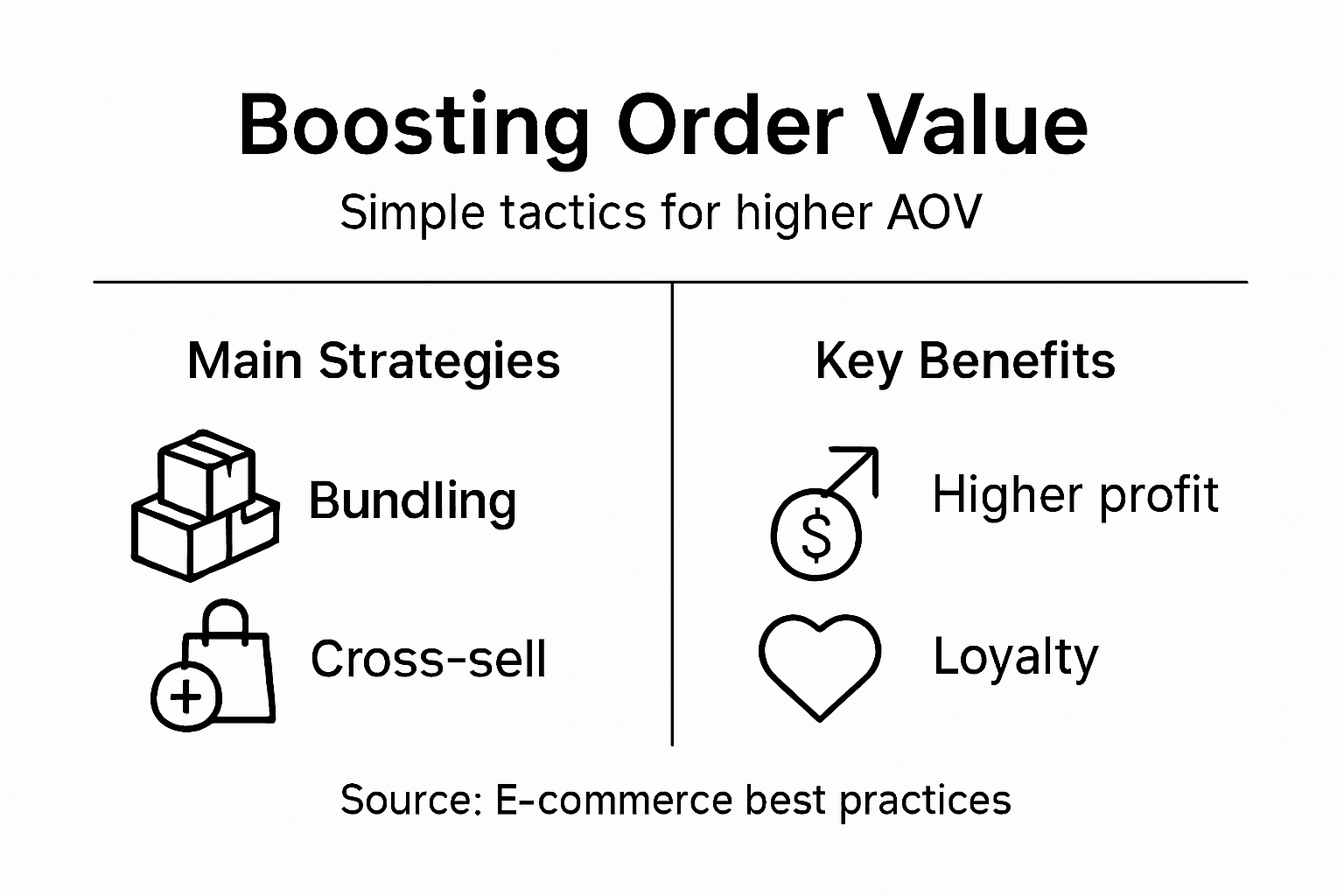
Product bundling tops the list of proven approaches. When you combine complementary items at a slight discount, customers perceive they’re getting better value while you capture higher transaction totals. A customer might buy one moisturizer alone, but offer a bundle with a serum and eye cream at 15% off, and suddenly your order jumps from $35 to $85. Dynamic product bundling that changes based on seasonal demand or inventory levels keeps the tactic fresh and profitable. The key is making bundles feel thoughtful, not forced. Group products that logically belong together in your customer’s mind.
Cross-selling and upselling work when executed subtly. Cross-selling suggests complementary products (sell a phone case with a phone), while upselling encourages a better version of what they’re already buying (suggest the premium tier). The timing matters enormously. Place recommendations at checkout or in post-purchase emails, not on your homepage where customers aren’t mentally prepared. Personalized recommendations aligned with customer behavior dramatically improve both conversion and order size because you’re suggesting products customers actually want. Use your transaction history to identify which products your best customers buy together, then show those combinations to similar segments.
Pricing mechanics create powerful psychological triggers. Free shipping thresholds work exceptionally well. Set the threshold slightly above your current AOV (if you’re at $50, set it at $75) and watch customers add items to reach it. Volume discounts (buy 3 save 10%, buy 5 save 15%) push order quantities upward. Limited-time promotions create urgency that drives larger basket sizes. Another underrated tactic: loyalty programs that reward higher-value purchases with accelerated rewards. A customer who knows they’ll earn double points on purchases over $100 becomes motivated to hit that target.
Data-driven personalization ties everything together. When you know which customer segments respond to which offers, your AOV optimization becomes surgical rather than scattered. Your best customers might love bundles while others respond to discounts. Segment accordingly and watch your conversion rates and order values improve simultaneously.
Pro tip: Start by testing product bundling on your top 5 best-selling items paired with your slowest-moving complementary products, then measure AOV lift before expanding to broader bundling strategies.
Summary of main tactics for boosting AOV and their advantages:
| Strategy | Main Benefit | Example Application |
|---|---|---|
| Product Bundling | Maximizes value per transaction | Skincare set with discounts |
| Upselling | Shifts customers to premium | Higher-tier product upgrade |
| Cross-selling | Adds complementary items | Suggesting case with laptop |
| Shipping Thresholds | Encourages higher spend | Free shipping over $75 |
| Loyalty Incentives | Grows repeat high-value orders | Double points for big spends |
Financial Impact and Profitability Benefits
Here’s what makes AOV optimization different from chasing new customers: the math compounds in your favor. When you increase what each customer spends, you’re not just moving revenue around. You’re fundamentally changing your business economics. A 10% increase in AOV flows almost directly to your bottom line because you’re not proportionally increasing your customer acquisition costs or fulfillment overhead.
Consider the numbers. You’re running a store with 1,000 orders per month at $60 AOV, generating $60,000 in revenue. Your acquisition cost is $25 per customer, and you’re spending $25,000 monthly on marketing. Now you implement bundling and cross-selling that lifts AOV to $72. Same number of customers, same marketing spend, but now you’re earning $72,000. That additional $12,000 in revenue comes without any additional customer acquisition expense. This is why optimizing AOV improves profit margins so dramatically. Your fixed costs stay relatively stable while revenue per order increases.
The profitability advantage extends beyond direct margin improvement. Higher AOV creates operational efficiency gains that most managers overlook. You’re processing fewer total transactions to hit the same revenue target, which means lower payment processing fees (often percentage-based), reduced customer service inquiries per dollar earned, and better inventory turnover on slow-moving items bundled into higher-value orders. Your logistics costs per dollar of revenue decrease. A warehouse fulfilling 800 orders instead of 1,000 orders saves money on picking, packing, and shipping labor even if the total revenue stays identical. These efficiency improvements compound across your entire operation.
Better financial forecasting becomes another underrated benefit. When you focus on AOV optimization, customer behavior becomes more predictable. You understand which segments respond to which offers, which products bundle together, and how seasonal demand patterns shift. This predictability lets you forecast revenue, inventory needs, and cash flow with greater accuracy. You can plan staffing levels and supplier orders more confidently. You also improve customer lifetime value significantly. A customer who places orders averaging $75 instead of $50 generates substantially more total revenue over their lifetime, making higher retention investments worthwhile and reshaping your unit economics entirely.
Pro tip: Calculate your breakeven AOV for your marketing budget by dividing total monthly marketing spend by order count, then set AOV optimization targets above that number to ensure profitability improves with every tactic you test.
Challenges, Risks, and How to Avoid Them
Not every AOV optimization strategy works equally well, and pursuing aggressive tactics without caution creates real problems. The biggest risk managers face is alienating customers in pursuit of higher order values. When you push too hard on upselling or raise prices beyond what customers expect, conversion rates plummet. You end up with fewer orders at slightly higher values, which nets you less revenue than before. I’ve seen stores boost AOV by 8% only to watch order volume drop 15%, resulting in overall revenue decline.
The balance between maximizing order value and protecting customer satisfaction is delicate. Overly aggressive pricing strategies create perception problems that damage loyalty. A customer who feels pressured into add-ons leaves negative reviews and never returns. This is why segmentation and personalization matter so much. Your high-value customers might tolerate premium bundles while price-sensitive shoppers need simple, straightforward offerings. Test different approaches with different segments rather than rolling out one-size-fits-all tactics.
Inventory and logistics complications emerge when order sizes increase unexpectedly. Larger orders require different fulfillment approaches than small ones. Your warehouse layout might not accommodate efficient picking and packing of bundled items. Shipping costs increase proportionally, which eats into the margin gains from higher AOV. Supply chain disruptions and inventory management challenges also escalate when demand patterns shift. If you’re encouraging customers to buy larger quantities, your inventory forecasting must be accurate or you’ll face costly overstocking. Underselling leaves you with stockouts that frustrate customers who wanted to buy.
Data-driven pricing and iterative testing prevent these pitfalls. Start small with AOV experiments on specific customer segments or product categories where you can control variables. Track not just AOV but also conversion rates, customer satisfaction scores, and repeat purchase rates. If one tactic lifts AOV but tanks repeat purchases, you’ve solved the wrong problem. Value-added offers like bundling complementary items tend to feel authentic and maintain satisfaction better than aggressive discounting. Focus on making customers feel they’re getting something genuinely useful rather than squeezed for more money.
Pro tip: Always monitor conversion rate and customer retention metrics alongside AOV increases, stopping any tactic that boosts order value by more than 5% above your baseline in a single month until you confirm it hasn’t harmed repeat purchase behavior.
Unlock Higher Average Order Values with Data-Driven Insights
If you are serious about growing your e-commerce business by increasing your Average Order Value and maximizing profits the key challenge lies in understanding precise product associations and customer behavior as highlighted in the article. The struggle to optimize product bundling cross-selling and customer segmentation without overwhelming complexity often leaves online retailers guessing rather than knowing. Affinsy solves this by offering AI-powered analytics that simplify these complexities providing actionable insights such as market basket analysis and RFM customer segmentation tailored to your store’s unique data.
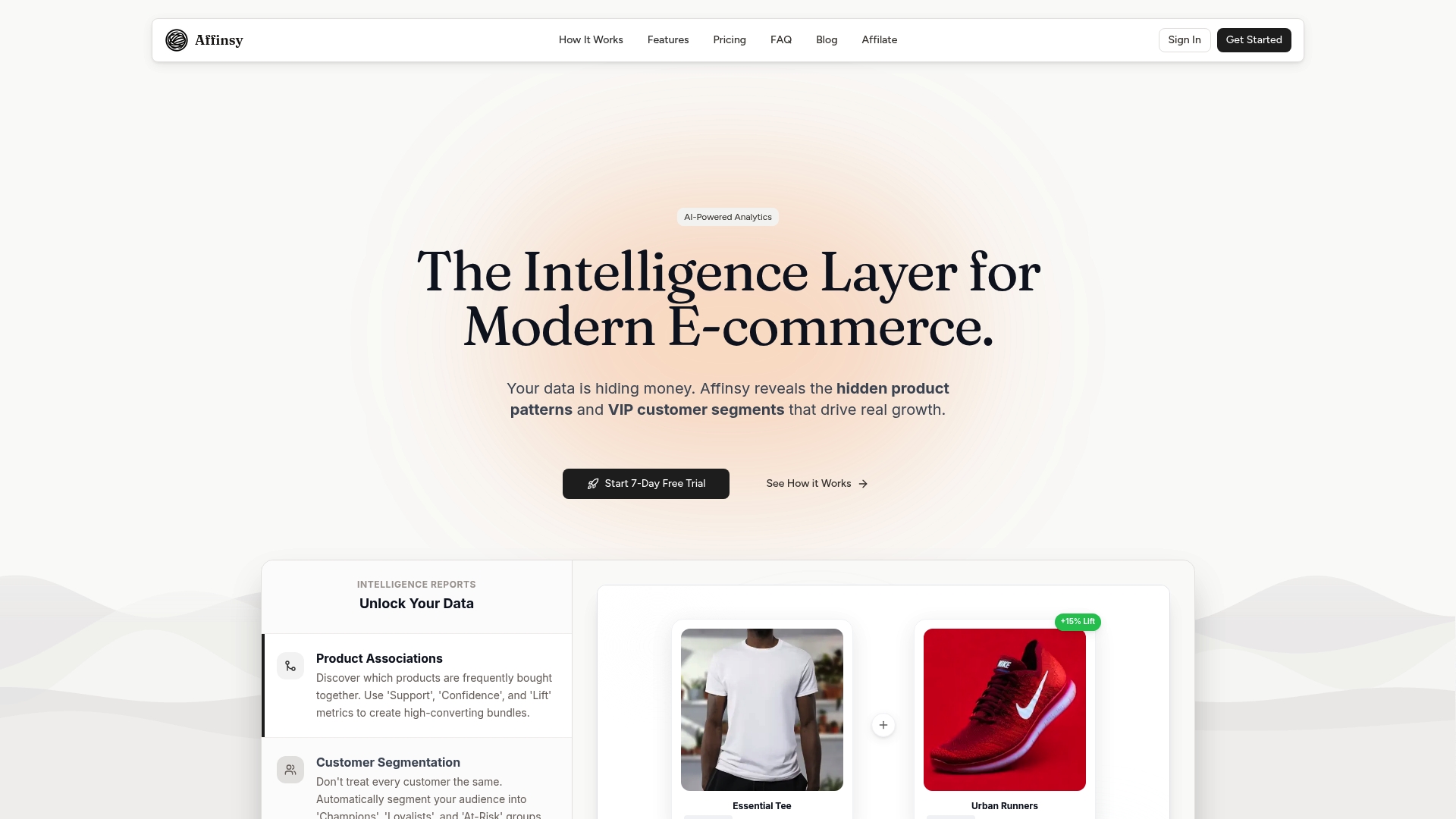
Take control of your e-commerce growth journey now. Explore how Affinsy integrates seamlessly with Shopify WooCommerce and Google Analytics to deliver custom reports and dashboards that guide smarter decisions to boost order sizes and customer loyalty. Don’t wait for more traffic—maximize the value of every order today. Visit https://affinsy.com and start unlocking the hidden revenue potential in your existing customer data.
Frequently Asked Questions
What is Average Order Value (AOV) in e-commerce?
Average Order Value (AOV) is the average dollar amount spent per order in an e-commerce store. It is calculated by dividing total revenue by the number of orders placed over a specific period.
Why is optimizing AOV important for e-commerce growth?
Optimizing AOV is crucial because it increases profitability without the need for additional traffic. By encouraging customers to spend more per transaction, businesses can lower customer acquisition costs and increase overall revenue efficiency.
How can I effectively increase my Average Order Value?
You can increase AOV through strategies like product bundling, cross-selling, upselling, and offering free shipping thresholds. Personalizing recommendations based on customer purchase behavior can also boost order sizes.
What are common misconceptions about AOV?
A common misconception is that AOV is the same as revenue per customer. While AOV measures the average spend in a single transaction, revenue per customer accounts for all purchases made by that customer over time.
Recommended
- What Is Average Order Value and Why It Matters - Affinsy Blog | Affinsy
- Increasing Average Order Value Steps: Boost Sales Effectively - Affinsy Blog | Affinsy
- Understanding AOV: Average Order Value Explained - Affinsy Blog | Affinsy
- How to Maximize Average Order Value for E-Commerce Stores - Affinsy Blog | Affinsy