
Managing an online retail business means facing rapid changes in how customers shop and interact. Traditional e-commerce approaches often struggle to keep pace with evolving consumer needs, but the rise of Agentic Commerce is redefining expectations. Artificial intelligence now creates hyper-personalized shopping experiences and executes full transactions autonomously, driving smarter conversion rate optimization. This guide highlights how these advanced technologies empower marketing managers to unlock digital channels for improved sales and customer retention.
Table of Contents
- Defining Agentic Commerce And CRO Fundamentals
- How Agentic AI Transforms Online Retail
- Types And Functions Of Agentic AI Solutions
- Integrating Agentic CRO With E-commerce Platforms
- Critical Risks, Costs, And Implementation Challenges
- Best Practices For Optimizing Agentic Conversion Rates
Key Takeaways
| Point | Details |
|---|---|
| Agentic Commerce Innovates Retail | Agentic Commerce utilizes AI to autonomously manage shopping processes, transforming consumer interaction through advanced predictive analytics. |
| Sophisticated CRO Strategies Emerge | Conversion Rate Optimization has evolved to focus on AI-driven, real-time personalization, enhancing engagement and conversion potential. |
| Integration Challenges Exist | E-commerce platforms must navigate complexities in integrating AI systems while ensuring data privacy and operational efficiency. |
| Data Strategy is Key | Investing in robust data infrastructures is crucial for supporting the continuous learning and adaptation of agentic AI solutions. |
Defining Agentic Commerce and CRO Fundamentals
In the rapidly evolving digital retail landscape, Agentic Commerce represents a transformative approach where artificial intelligence autonomously manages end-to-end shopping processes on behalf of users. Unlike traditional e-commerce models, this emerging paradigm empowers AI agents to make complex purchasing decisions by understanding and anticipating consumer needs with unprecedented precision.
The core principles of Agentic Commerce are built upon advanced technological capabilities that go far beyond simple product recommendations. Autonomous shopping processes fundamentally reimagine how consumers interact with digital marketplaces, enabling AI to conduct comprehensive research, compare options, negotiate prices, and complete transactions without direct human intervention.
Conversion Rate Optimization (CRO) within this new framework becomes significantly more sophisticated. Traditional CRO strategies focused on improving website design, user experience, and marketing tactics. Now, AI-driven approaches can dynamically adapt purchasing journeys in real-time, creating hyper-personalized experiences that dramatically increase conversion potential. This evolution requires marketers to understand several critical components:
- Dynamic user behavior prediction
- Automated personalization strategies
- Real-time transaction optimization
- Intelligent recommendation engines
- Predictive consumer intent analysis
The intersection of Agentic Commerce and CRO represents a powerful paradigm shift where data-driven intelligence transforms passive browsing into active, intelligent purchasing experiences. Digital technology empowers retail businesses to create more responsive, intuitive shopping environments that anticipate and fulfill consumer needs with remarkable accuracy.
Here is a summary of the main differences between traditional e-commerce and agentic commerce:
| Attribute | Traditional E-commerce | Agentic Commerce |
|---|---|---|
| User Decision Control | Fully manual | AI-driven, autonomous |
| Personalization Level | Basic recommendations | Hyper-personalized journeys |
| Process Automation | Limited | End-to-end shopping |
| Data Utilization | Historical data | Real-time predictive analytics |
| Conversion Tactics | UI/UX and marketing | Adaptive AI optimization |
Pro tip: Invest in AI-powered analytics tools that can help you understand and predict consumer behavior across multiple touchpoints in your digital commerce ecosystem.
How Agentic AI Transforms Online Retail
The emergence of Agentic AI is fundamentally restructuring the digital retail landscape, moving beyond traditional recommendation systems to create autonomous, intelligent shopping experiences. AI shopping agents autonomously influence consumer decisions by understanding complex consumer behaviors and executing sophisticated purchasing strategies with minimal human intervention.
Unlike traditional e-commerce models, agentic AI systems can dynamically learn, adapt, and make independent decisions across multiple retail touchpoints. These advanced systems leverage machine learning algorithms to analyze vast datasets, predict consumer preferences, and create personalized shopping journeys that transcend simple product recommendations. The key transformative capabilities include:
- Real-time consumer behavior analysis
- Autonomous decision-making processes
- Predictive purchasing recommendations
- Dynamic price optimization
- Personalized shopping experience generation
Autonomous AI learning mechanisms enable online retailers to dramatically enhance operational efficiency by transforming reactive systems into proactive, intelligent platforms. These AI agents can negotiate prices, compare product attributes, and even anticipate future consumer needs with remarkable accuracy, effectively reshaping traditional retail interaction models.
The strategic implications for businesses are profound. Retailers must now view AI not just as a technological tool, but as a core component of their customer engagement strategy. This requires investing in advanced machine learning infrastructure, developing sophisticated data analysis capabilities, and creating flexible technological ecosystems that can support increasingly autonomous shopping experiences.
Pro tip: Prioritize building robust data infrastructure and machine learning models that can continuously learn and adapt to changing consumer behaviors in your digital retail environment.
Types and Functions of Agentic AI Solutions
Agentic AI solutions represent a sophisticated ecosystem of intelligent systems designed to transform digital commerce through autonomous decision-making capabilities. Agentic AI agents operate across three core functional domains: perception, reasoning, and action, enabling them to gather data, analyze complex scenarios, and execute purchasing strategies with unprecedented precision.
These advanced AI solutions can be categorized into specialized agent types, each serving unique functions within the digital retail environment. The primary categories of agentic AI solutions include:
- Fact Retrieval Agents: Collect and validate product information
- Impact Analysis Agents: Predict potential purchasing outcomes
- Negotiation Agents: Autonomously manage pricing and transaction parameters
- Personalization Agents: Create individualized shopping experiences
- Recommendation Optimization Agents: Dynamic product suggestion systems
Each agent type operates with increasing levels of autonomy, moving beyond traditional recommendation engines to create intelligent, adaptive shopping environments. These systems can dynamically assess consumer preferences, predict future behaviors, and make real-time decisions that optimize conversion potential. The sophisticated algorithms underlying these agents enable them to learn from historical data, understand contextual nuances, and develop increasingly refined strategies for engaging potential customers.
The technological infrastructure supporting agentic AI solutions requires advanced machine learning models, robust data processing capabilities, and complex decision-making frameworks. Retailers must invest in comprehensive technological ecosystems that can support these intelligent agents, ensuring they have access to high-quality data, sophisticated analytics tools, and flexible computational resources.
Pro tip: Develop a comprehensive data strategy that prioritizes clean, structured data collection to support the advanced learning mechanisms of agentic AI solutions.
Integrating Agentic CRO With E-commerce Platforms
Agentic Conversion Rate Optimization (CRO) requires a sophisticated approach to integrating intelligent systems with existing e-commerce infrastructure. Multi-channel customer touchpoint integration becomes crucial for merchants seeking to leverage AI-driven optimization strategies across their digital retail platforms.
Successful integration demands a comprehensive technical readiness framework that addresses several critical components:
- API responsiveness and flexibility
- Machine-readable product catalogs
- Secure and adaptive payment processing systems
- Real-time data synchronization capabilities
- Intelligent tracking and analytics infrastructure
E-commerce platforms must evolve beyond traditional static integration models, creating dynamic technological ecosystems that can support autonomous AI decision-making. These systems require advanced data processing capabilities, allowing agentic AI solutions to continuously learn, adapt, and optimize conversion strategies in real-time.

Technical infrastructure preparation involves more than simple software updates. Merchants must redesign their technological architecture to support seamless AI interaction, ensuring that every system component can communicate effectively with intelligent agents. This transformation involves developing robust APIs, standardizing data formats, and creating flexible computational frameworks that can accommodate rapidly evolving AI technologies.
Pro tip: Conduct a comprehensive technology audit to identify and eliminate potential integration barriers before implementing agentic CRO solutions.
Critical Risks, Costs, and Implementation Challenges
Implementing Agentic Commerce introduces a complex landscape of strategic and operational risks that demand careful navigation. Significant adoption challenges emerge across technological, organizational, and strategic dimensions, requiring businesses to develop comprehensive risk mitigation strategies.
The primary risks and implementation challenges can be categorized into several critical domains:
- Technological infrastructure readiness
- Data privacy and security vulnerabilities
- Potential loss of direct customer relationships
- High initial investment requirements
- Complexity of governance frameworks
- Operational transformation costs
- Potential brand dilution risks
Customer journey complexity and data quality represent fundamental obstacles in effective agentic commerce implementation. Organizations must develop robust data management strategies that ensure comprehensive, accurate, and actionable information flows across multiple systems and touchpoints. This requires sophisticated data integration techniques, advanced analytics capabilities, and flexible technological architectures that can adapt to rapidly evolving AI technologies.
The financial implications of agentic commerce adoption are substantial. Companies must budget for significant upfront investments in technological infrastructure, advanced AI training, continuous system optimization, and comprehensive security frameworks. These costs extend beyond traditional technology expenditures, encompassing organizational change management, employee reskilling, and the development of entirely new operational paradigms that support autonomous, intelligent commerce systems.
The following table outlines major implementation challenges and potential mitigation strategies for agentic commerce adoption:
| Challenge | Potential Impact | Mitigation Strategy |
|---|---|---|
| Integration Complexity | Slower digital transformation | Phased system upgrades |
| Data Privacy Concerns | Regulatory and trust issues | Advanced encryption and audits |
| Organizational Change | Employee resistance, skill gaps | Targeted training initiatives |
| High Upfront Costs | Budget constraints | Staged investment planning |
| Brand Dilution | Loss of direct customer trust | Transparent communication |
Pro tip: Conduct a comprehensive total cost of ownership analysis that includes not just technology investments, but also potential organizational transformation and skill development expenses.
Best Practices for Optimizing Agentic Conversion Rates
Optimizing conversion rates in agentic commerce requires a sophisticated, data-driven approach that goes beyond traditional digital marketing strategies. Predictive analytics and machine learning techniques have become essential tools for creating intelligent, adaptive conversion optimization frameworks.
Key best practices for maximizing agentic conversion rates include:
- Advanced customer segmentation strategies
- Continuous machine learning model tuning
- Personalized marketing approach development
- Real-time behavioral pattern analysis
- Dynamic pricing and recommendation optimization
- Intelligent trust and governance policy implementation
Successful agentic conversion optimization demands robust technological infrastructure. Low-latency API design and machine-readable catalogs are critical for enabling smooth, autonomous interactions between AI systems and e-commerce platforms. This requires developing flexible technological architectures that can rapidly process and respond to complex customer interaction signals.
The most effective agentic CRO strategies prioritize continuous learning and adaptation. AI-powered systems must be designed to autonomously analyze conversion performance, identify friction points, and dynamically adjust interaction strategies. This involves creating sophisticated feedback loops that enable intelligent agents to learn from every customer interaction, progressively refining their conversion optimization approaches.
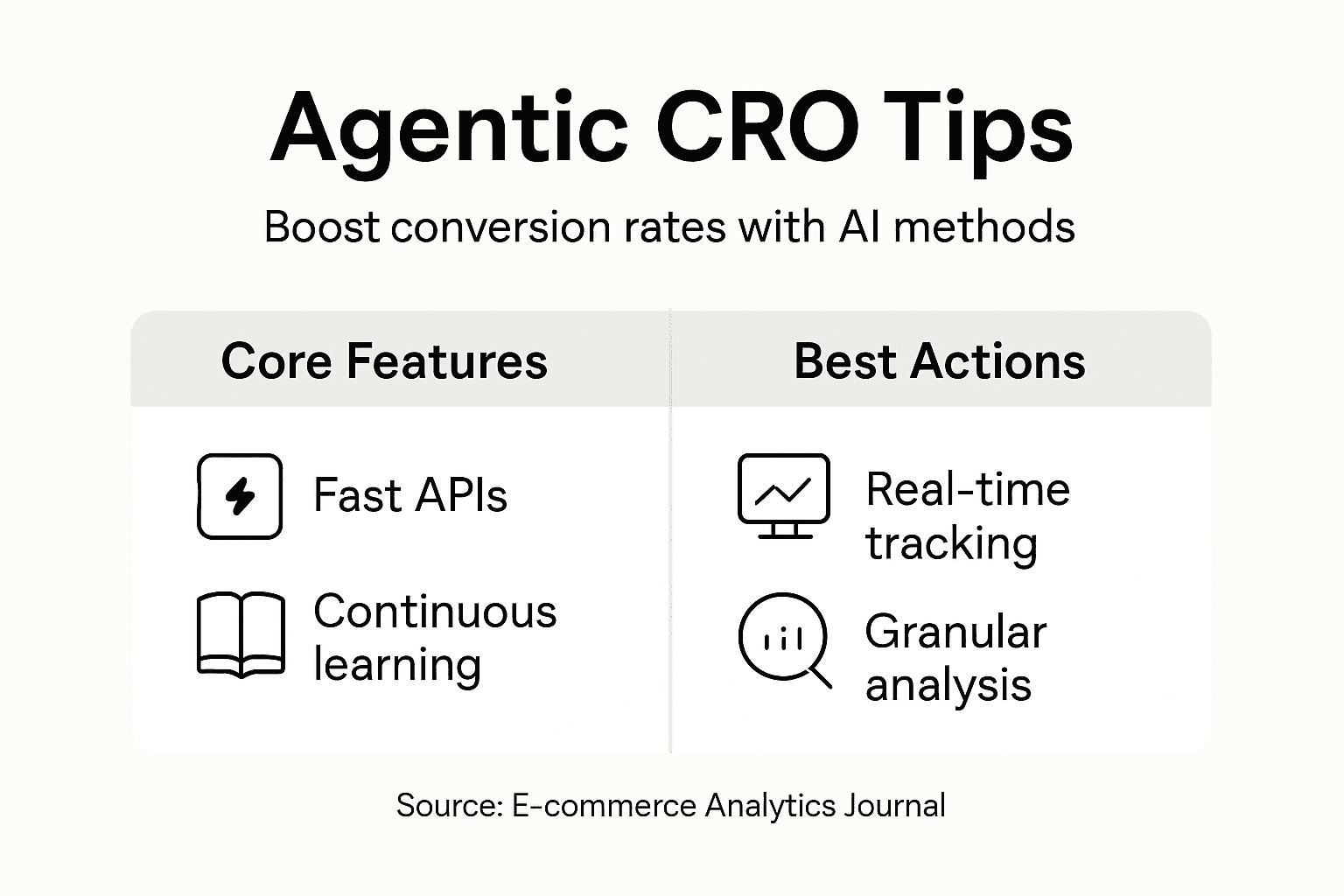
Pro tip: Invest in comprehensive data infrastructure that enables real-time, granular tracking of customer interactions to support autonomous AI learning and optimization.
Unlock Smarter Conversion Rate Optimization with AI-Powered Insights
The future of Agentic Commerce demands tools that do more than just analyze data. As the article highlights, mastering dynamic user behavior prediction and real-time transaction optimization is essential to thrive in this emerging digital retail landscape. If you feel overwhelmed by the complexity of integrating autonomous AI systems and the need for hyper-personalized conversion strategies, you are not alone. Retailers face the challenge of understanding hidden product relationships and customer segments deeply enough to generate adaptive, personalized shopping journeys that increase average order values and boost retention.
Affinsy offers a powerful solution tailored to these needs. By leveraging cutting-edge AI-powered analytics, Affinsy transforms your historical transaction data into actionable insights such as market basket analysis and customer segmentation. This helps your online store optimize product bundling and cross-selling without requiring extensive data science expertise. Seamlessly integrating with popular platforms like Shopify and WooCommerce, Affinsy equips you with advanced dashboards and custom reports to continuously fine-tune your conversion optimization efforts.
Experience how AI-driven analytics can turn complex data into growth opportunities. Visit Affinsy now to empower your e-commerce strategy with proven tools designed to maximize sales and create more engaging, agentic commerce experiences. Don’t miss the chance to elevate your digital retail business by making smarter, data-backed decisions today.
Frequently Asked Questions
What is Agentic Commerce?
Agentic Commerce is a new digital retail approach where artificial intelligence autonomously manages the entire shopping experience, making purchasing decisions on behalf of users by anticipating their needs with high precision.
How does Conversion Rate Optimization (CRO) differ in Agentic Commerce compared to traditional e-commerce?
In Agentic Commerce, CRO leverages AI to create hyper-personalized experiences and dynamically optimize the purchasing journey in real-time, as opposed to traditional methods that mainly focus on website design and marketing tactics.
What are some key components of successful Agentic CRO?
Critical components include dynamic user behavior prediction, automated personalization strategies, real-time transaction optimization, intelligent recommendation engines, and predictive consumer intent analysis.
What are the main challenges of implementing Agentic Commerce in e-commerce platforms?
Challenges include technological infrastructure readiness, data privacy concerns, potential loss of direct customer relationships, high initial investment costs, and the complexity of governance frameworks.
Recommended
- Understanding Conversion Rate Optimization: Boosting Sales - Affinsy Blog | Affinsy
- Understanding Ecommerce Conversion: Boosting Online Sales - Affinsy Blog | Affinsy
- Understanding the Agentic Commerce Protocol in E-commerce - Affinsy Blog | Affinsy
- Understanding Data-Driven Campaign Optimization for E-Commerce - Affinsy Blog | Affinsy
- Boost Conversions with an Ajax-Powered WooCommerce Mini Cart - LSA SEO Agency