
Finding patterns in what shoppers buy together can feel like searching for a needle in a haystack, especially as consumer preferences shift from Canada to Australia. For E-commerce managers, the stakes are high, since smarter product bundling strategies mean stronger customer loyalty and a higher average order value. Discover how AI-powered basket analysis in agentic commerce reveals deep insights into purchase behaviors, so you can make every recommendation count.
Table of Contents
- Defining Basket Analysis in Agentic Commerce
- How AI Agents Uncover Shopper Patterns
- Core Components: Data, Algorithms, and Integrations
- Impact on Product Bundling and Cross-Selling
- Automation, Personalization, and Business Value
- Risks, Adoption Barriers, and Market Future
Key Takeaways
| Point | Details |
|---|---|
| AI-Driven Insights | Agentic commerce enhances traditional basket analysis through autonomous, real-time data collection and algorithmic insights. |
| Personalization and Adaptability | AI systems provide hyper-targeted recommendations, continuously learning from consumer behaviors to improve personalization. |
| Data Privacy and Governance | Implement strong data governance frameworks to address privacy concerns while fostering consumer trust in AI recommendations. |
| Phased Implementation Strategy | Organizations should adopt a gradual integration approach to effectively manage costs and build user confidence in the technology. |
Defining Basket Analysis in Agentic Commerce
Basket analysis in agentic commerce represents an advanced approach to understanding customer purchasing behaviors through intelligent, autonomous shopping technologies. By leveraging artificial intelligence, this method goes beyond traditional market research to analyze shopping patterns dynamically.
At its core, basket analysis involves identifying intricate relationships between products that customers frequently purchase together. The emerging field of agentic commerce introduces sophisticated AI agents that can autonomously navigate retail environments, synthesizing insights about consumer preferences with unprecedented precision.
Key characteristics of basket analysis in agentic commerce include:
- Autonomous data collection and interpretation
- Real-time product relationship mapping
- Advanced predictive recommendation capabilities
- Intelligent cross-selling strategies
- Personalized shopping experience generation
The integration of AI shopping agents transforms traditional basket analysis by enabling more nuanced, contextual understanding of consumer behaviors. These intelligent systems can detect subtle purchasing patterns that human analysts might overlook, providing retailers with granular insights into customer preferences and potential product combinations.
Here’s a comparison of traditional vs. AI-driven basket analysis approaches in agentic commerce:
| Aspect | Traditional Basket Analysis | AI-Driven Basket Analysis |
|---|---|---|
| Data Processing | Manual or batch-based | Real-time, autonomous |
| Insight Depth | Basic product links | Complex, contextual patterns |
| Personalization | Limited segmentation | Highly tailored for each shopper |
| Adaptability | Static models | Continuously learns from data |
| Business Impact | Incremental sales lift | Significant increase in order value |
Pro tip: Implement AI-driven basket analysis tools that can learn and adapt to evolving consumer trends in real-time, ensuring your product recommendations remain consistently relevant and engaging.
How AI Agents Uncover Shopper Patterns
AI agents are revolutionizing the way retailers understand customer behavior by autonomously analyzing shopping patterns through advanced computational techniques. These intelligent systems go beyond traditional data analysis, employing sophisticated algorithms to detect nuanced relationships between products and consumer preferences.

The core mechanism of AI-driven pattern recognition involves complex association rule mining techniques. Algorithms like Apriori and Eclat enable these agents to identify frequent itemsets and uncover hidden correlations within transaction data. By processing massive volumes of historical purchase information, AI agents can detect intricate purchasing behaviors that human analysts might completely miss.
Key capabilities of AI shopping pattern detection include:
- Real-time behavioral analysis
- Predictive purchasing trend identification
- Contextual product recommendation generation
- Dynamic consumer preference mapping
- Personalized shopping experience optimization
These intelligent systems leverage inter-operable protocols to access and analyze diverse data sources, creating a comprehensive understanding of consumer intent. By learning from historical transactions and real-time interactions, AI agents can generate remarkably precise insights about potential product combinations and individual shopping preferences.
Pro tip: Invest in machine learning models that can continuously adapt and refine their pattern recognition capabilities, ensuring your AI agents remain responsive to evolving consumer behaviors and market dynamics.
Core Components: Data, Algorithms, and Integrations
Basket analysis in agentic commerce relies on three critical components that work synergistically to transform raw transaction data into actionable insights. Data collection and processing techniques form the foundational layer, capturing intricate details of customer purchasing behaviors across diverse retail environments.
The algorithmic layer represents the intelligent core of basket analysis, employing sophisticated techniques like Apriori and FP-growth to uncover complex product associations. These algorithms analyze massive datasets, identifying statistically significant relationships between items that might not be immediately apparent through traditional analysis methods.
Key components of basket analysis include:
- High-quality transactional data capture
- Advanced association rule mining algorithms
- Scalable computational infrastructure
- Seamless system integrations
- Real-time analytics processing
System integrations play a crucial role in translating algorithmic insights into operational strategies. By connecting analysis engines with marketing platforms, inventory management systems, and e-commerce interfaces, retailers can automatically generate personalized product recommendations and dynamic bundling strategies that respond to evolving consumer preferences.
Pro tip: Implement a modular data integration architecture that allows flexible connections between your analytical tools and operational systems, enabling rapid deployment of insights across multiple business channels.
Impact on Product Bundling and Cross-Selling
Basket analysis fundamentally transforms product bundling strategies by revealing intricate purchase patterns across diverse consumer segments. This data-driven approach enables retailers to create intelligent, personalized product combinations that dramatically increase average order value and customer satisfaction.
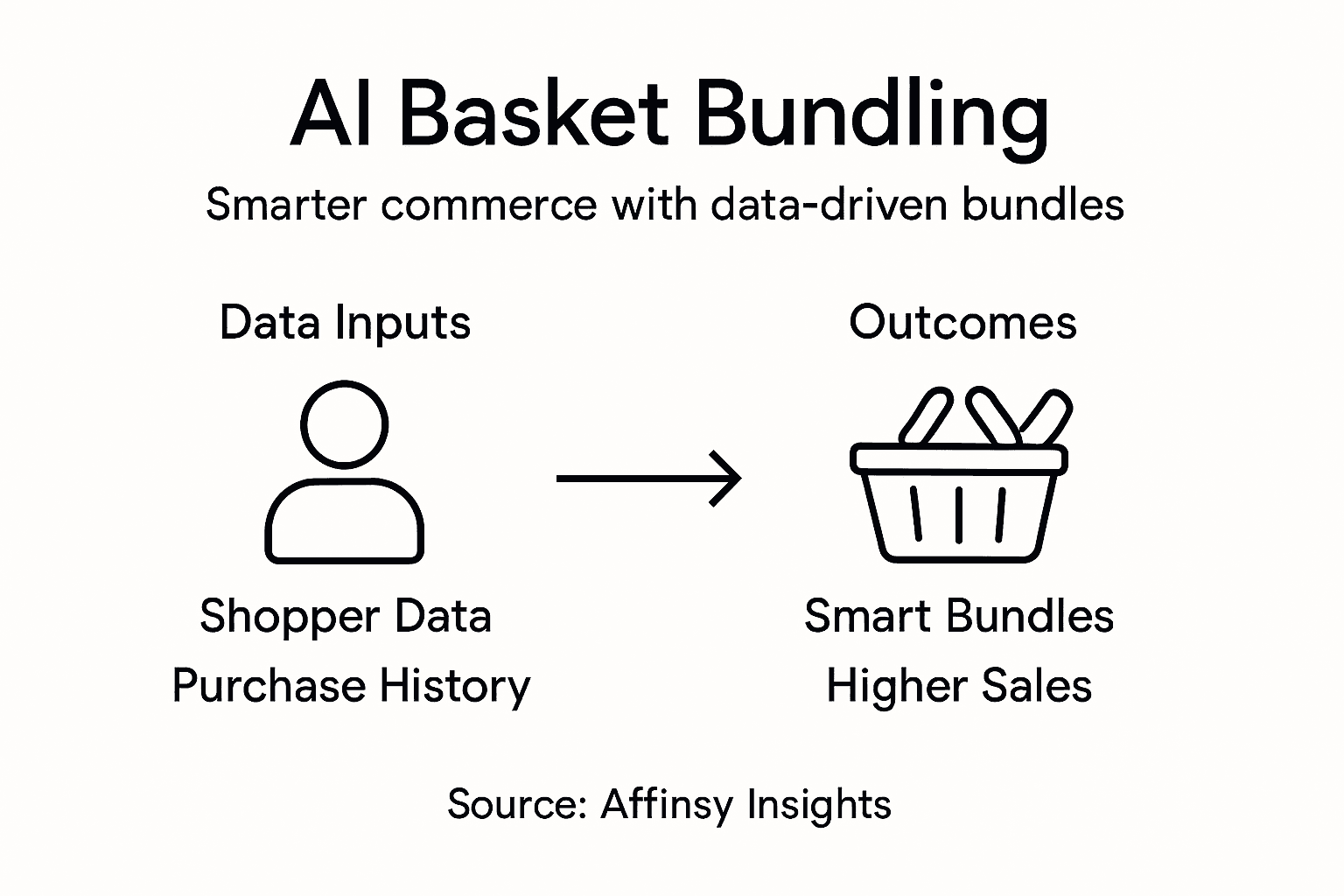
The sophisticated algorithmic techniques underlying basket analysis allow businesses to identify subtle relationships between products that human analysts might overlook. By analyzing thousands of transaction records, these systems can detect complementary items that consumers are likely to purchase together, enabling more strategic and nuanced cross-selling approaches.
Key benefits of data-driven bundling include:
- Increased average order value
- Enhanced customer purchasing experience
- Reduced inventory holding costs
- More precise marketing targeting
- Dynamic, personalized product recommendations
Agentic commerce systems leverage these insights to automatically generate contextually relevant product bundles. These intelligent recommendations adapt in real-time, considering individual shopper preferences, historical purchasing behavior, and emerging market trends. The result is a more responsive, customer-centric approach to product positioning and sales strategy.
Pro tip: Develop a flexible bundling algorithm that continuously learns from customer interactions, allowing your product recommendations to evolve dynamically with changing consumer preferences.
Automation, Personalization, and Business Value
Agentic commerce represents a transformative approach to retail, where AI autonomously crafts personalized shopping experiences through intelligent automation. This technological evolution goes beyond traditional recommendation systems by dynamically adapting to individual consumer behaviors and preferences in real-time.
The personalization capabilities of agentic commerce systems enable businesses to create hyper-targeted marketing strategies that significantly enhance customer engagement. By analyzing granular transaction data, these intelligent systems can predict consumer needs with unprecedented accuracy, generating product suggestions that feel uniquely tailored to each shopper’s context and historical purchasing patterns.
Key business value drivers include:
- Enhanced customer loyalty
- Increased average order value
- Reduced customer acquisition costs
- More efficient inventory management
- Predictive marketing capabilities
- Real-time adaptive pricing strategies
Automation in this context means more than simple task replacement—it represents a fundamental reimagining of how businesses interact with consumers. These AI-driven systems continuously learn and optimize, creating a dynamic feedback loop that improves marketing precision, reduces operational friction, and generates new revenue streams through intelligent, context-aware recommendations.
Pro tip: Implement machine learning models that can dynamically adjust recommendation algorithms based on real-time performance metrics, ensuring your personalization strategies remain consistently relevant and effective.
Risks, Adoption Barriers, and Market Future
The emerging landscape of agentic commerce faces significant challenges, with complex adoption barriers impacting technological implementation. Organizations must navigate a complex terrain of technological, regulatory, and consumer trust considerations that can potentially slow down widespread market adoption.
Primary risks in implementing agentic commerce technologies include data privacy concerns, algorithmic bias, and the potential for unintended operational disruptions. These challenges require sophisticated governance frameworks and robust technological infrastructures that can ensure transparent, ethical, and secure autonomous commerce experiences.
Key adoption barriers encompass:
- Limited organizational technological readiness
- High initial implementation costs
- Consumer skepticism about AI-driven recommendations
- Complex regulatory compliance requirements
- Data security and privacy concerns
- Resistance to technological change within organizations
Despite these challenges, the market future for agentic commerce remains promising. Continuous technological improvements, emerging industry standards, and collaborative efforts between technology providers and regulatory bodies are gradually addressing these barriers. The potential for enhanced customer experiences, operational efficiency, and innovative revenue streams continues to drive investment and development in this transformative field.
Here’s a summary of the main risks and strategies for navigating adoption in agentic commerce:
| Risk/Barrier | Impact on Business | Mitigation Strategy |
|---|---|---|
| Data privacy concerns | Legal exposure, loss of trust | Strong encryption and transparency policies |
| Algorithmic bias | Unfair recommendations | Regular audits and diverse training data |
| High implementation costs | Slow ROI | Phased adoption and cost-benefit analysis |
| Consumer skepticism | Reduced engagement | Education, clear value demonstration |
| Regulatory compliance | Fines and delays | Dedicated compliance teams and legal review |
Pro tip: Develop a phased implementation strategy that allows gradual technological integration, enabling your organization to build trust, demonstrate value, and mitigate risks incrementally.
Unlock Smarter Product Bundling with AI-Powered Basket Analysis
The article highlights the critical challenge of identifying complex product associations and delivering highly personalized shopping experiences to maximize average order value. Retailers face difficulties in extracting real-time, actionable insights from vast transaction data to create dynamic product bundles and targeted cross-selling strategies. Concepts like agentic commerce, AI-driven basket analysis, and real-time predictive recommendations are transforming how businesses engage customers and increase sales.
Affinsy’s SaaS platform directly addresses these pain points by leveraging advanced AI analytics to uncover hidden product relationships and customer segmentation patterns without requiring deep data science expertise. Our seamless integrations with popular platforms such as Shopify and WooCommerce enable retailers to automate insights around market basket analysis and customer retention. This empowers online retailers to optimize product bundling, increase order values, and boost customer loyalty through data-driven personalization.
Ready to transform your e-commerce strategy with smarter bundling and AI-powered insights?
Explore how Affinsy can help you harness the power of agentic commerce for your online store at https://www.affinsy.com/. Start maximizing your sales potential today by visiting our SaaS platform overview and discover a new era of personalized product recommendations and cross-selling opportunities.
Frequently Asked Questions
What is basket analysis in agentic commerce?
Basket analysis in agentic commerce involves using artificial intelligence to understand customer purchasing behaviors by identifying relationships between products that are often bought together, enhancing cross-selling and bundling strategies.
How does AI improve basket analysis compared to traditional methods?
AI-driven basket analysis processes data in real-time, uncovers complex purchasing patterns, and provides highly personalized recommendations, whereas traditional methods often rely on static, basic insights from manual analyses.
What are the key benefits of implementing data-driven product bundling?
Data-driven product bundling can increase average order value, improve customer purchasing experience, enhance marketing targeting, and reduce inventory costs by strategically combining complementary products based on consumer behavior insights.
What challenges might organizations face when adopting agentic commerce technologies?
Organizations may encounter challenges such as data privacy concerns, algorithmic bias, high implementation costs, and consumer skepticism, which require careful planning, transparency, and a robust governance framework.
Recommended
- Importance of Bundles for Agentic Commerce Success - Affinsy Blog | Affinsy
- 7 Smart Bundle Pricing Strategies for E-commerce Success - Affinsy Blog | Affinsy
- Master Product Bundling Strategies for E-Commerce Success - Affinsy Blog | Affinsy
- How to Improve Average Order Value with Data-Driven Bundling - Affinsy Blog | Affinsy