
Most American e-commerce store owners realize that tracking only basic sales numbers leaves hidden revenue potential untouched. Today, competitors dig deeper, using advanced metrics to measure customer behavior and identify the real drivers of growth. Understanding which key performance indicators move the needle can spell the difference between stagnant orders and consistent revenue increases of twenty percent or more. This guide helps Shopify and WooCommerce businesses find those advanced numbers, refine average order value, and create smarter strategies for long-term profitability.
Table of Contents
- Defining Ecommerce Success Metrics And KPIs
- Key Types Of Ecommerce Metrics Explained
- Essential Success Metrics For Revenue Growth
- Leveraging Metrics With Shopify And Woocommerce
- Avoiding Common Pitfalls In Data Tracking
Key Takeaways
| Point | Details |
|---|---|
| Importance of Ecommerce Metrics | Ecommerce success metrics are vital for tracking performance and strategic effectiveness across digital business operations. |
| Role of KPIs | Key Performance Indicators translate raw data into actionable insights, highlighting areas like conversion rate and customer lifetime value. |
| Systematic Tracking Methodology | Successful ecommerce businesses track metrics regularly, tailoring their approach based on strategic importance for iterative improvements. |
| Avoiding Data Pitfalls | Ensuring data quality and proper interpretation of metrics is crucial to making informed business decisions and avoiding errors. |
Defining Ecommerce Success Metrics and KPIs
Ecommerce success metrics are quantifiable measurements that help online businesses track performance, evaluate strategic effectiveness, and drive revenue growth. These metrics go beyond simple sales figures, providing deep insights into various aspects of digital business operations. Effective ecommerce metrics measure critical components like sales, customer behavior, marketing efficiency, and operational performance.
Key performance indicators (KPIs) represent the most strategic subset of these metrics, serving as crucial benchmarks for business goals. While metrics offer raw data, KPIs translate that information into actionable intelligence. For example, conversion rate represents a KPI that directly indicates how effectively a website transforms visitors into paying customers. Other critical KPIs include average order value, customer acquisition cost, and customer lifetime value - each providing a unique lens into business health and growth potential.
Successful ecommerce businesses approach metrics systematically, tracking them at different frequencies depending on their strategic importance. Weekly metrics might include website traffic and conversion rates, while quarterly assessments could examine customer retention and long-term revenue trends. Ecommerce metrics help guide strategic adjustments by providing a comprehensive view of business performance across sales, marketing, and operational domains.
Pro Tip: Develop a customized dashboard that displays your most critical metrics in real-time, enabling quick strategic decisions and immediate performance monitoring.
Key Types of Ecommerce Metrics Explained
E-commerce businesses rely on four primary metric categories to comprehensively assess their online performance: business metrics, traffic metrics, conversion metrics, and audience involvement metrics. Categorizing metrics strategically enables businesses to develop targeted insights and drive data-driven decision making across multiple operational domains.
Business metrics focus on financial performance and include key indicators like total revenue, average order value, gross profit margin, and customer lifetime value. These metrics provide a direct view of the company’s economic health and potential for sustainable growth. Traffic metrics, by contrast, measure website visitor quantity and quality, tracking elements such as total site visits, unique visitors, page views, bounce rates, and traffic sources. Understanding these metrics helps businesses identify where their audience originates and how effectively they attract potential customers.
Conversion metrics represent the critical translation of website traffic into actual sales, measuring how successfully a business transforms visitors into paying customers. Key conversion metrics include conversion rate, cart abandonment rate, and checkout completion percentage. Audience involvement metrics complement these by examining customer engagement levels, tracking indicators like repeat purchase rate, customer retention, average time on site, and social media interactions. These metrics provide nuanced insights into customer satisfaction and long-term business potential.
Pro Tip: Create a comprehensive dashboard integrating metrics from all four categories to develop a holistic view of your e-commerce performance and identify interconnected growth opportunities.
Here’s a summary highlighting the four main ecommerce metric categories and their unique business benefits:
| Metric Category | Focus Area | Example Metrics | Business Benefit |
|---|---|---|---|
| Business Metrics | Financial performance | Revenue, AOV, profit margin | Evaluate growth and profitability |
| Traffic Metrics | Website visitors | Unique visits, sources | Optimize marketing and attract audience |
| Conversion Metrics | Sales effectiveness | Conversion rate, cart abandon | Boost sales from existing traffic |
| Audience Involvement | Customer engagement | Retention, repeat purchase | Improve long-term loyalty and satisfaction |
Essential Success Metrics for Revenue Growth
E-commerce businesses must track several critical success metrics to drive sustainable revenue growth. Critical metrics reveal the underlying health of sales performance, providing actionable insights into customer acquisition, conversion, and retention strategies. The most essential metrics include monthly sales growth, conversion rates, average order value, customer acquisition cost, and customer retention rates.
Monthly sales growth serves as a fundamental indicator of business performance, measuring the percentage increase in total revenue compared to previous periods. Conversion rates represent another crucial metric, revealing how effectively a website transforms visitors into paying customers. The average order value (AOV) provides insights into customer spending patterns, helping businesses understand their revenue potential per transaction. By tracking new versus returning customer orders, companies can assess the balance between customer acquisition and loyalty efforts.

Customer acquisition cost and customer retention rates offer deeper strategic perspectives on revenue sustainability. Lower acquisition costs combined with higher retention rates indicate a healthy, efficient business model. Advanced e-commerce strategies focus on optimizing these interconnected metrics to create a comprehensive approach to revenue growth. Businesses that systematically analyze and improve these metrics can develop more targeted marketing strategies, enhance customer experience, and ultimately drive long-term financial success.
Pro Tip: Create a monthly dashboard that tracks these key metrics side by side, allowing you to quickly identify trends, correlations, and potential areas for strategic improvement.
Leveraging Metrics With Shopify and WooCommerce
Shopify and WooCommerce offer powerful built-in analytics platforms that enable e-commerce businesses to track and optimize their performance strategically. Specialized e-commerce analytics provide comprehensive insights into critical business metrics, empowering store owners to make data-driven decisions. These platforms differ in their approach but share the fundamental goal of transforming raw sales data into actionable business intelligence.
Shopify Analytics delivers a robust toolset that tracks key performance indicators across multiple dimensions. Store owners can monitor sales performance, traffic trends, customer behavior, and inventory management through intuitive dashboards. The platform provides detailed reports on customer lifetime value, abandoned cart rates, and conversion metrics, allowing businesses to identify opportunities for revenue optimization. Specific features include geographical sales tracking, product performance analysis, and marketing channel effectiveness measurement.
WooCommerce Analytics offers comparable depth through customizable reporting capabilities, enabling store owners to create segmented views of their business performance. The platform’s advanced filtering and reporting tools allow for granular analysis of revenue streams, order patterns, and customer segments. By integrating these analytics platforms strategically, e-commerce entrepreneurs can develop nuanced understanding of their sales dynamics, customer preferences, and potential growth opportunities.
Pro Tip: Set up automated weekly analytics reports to track your most critical metrics, ensuring you consistently monitor performance without manual intervention.
Compare Shopify and WooCommerce analytics solutions using this feature overview:
| Feature | Shopify Analytics | WooCommerce Analytics |
|---|---|---|
| Dashboard Customization | Pre-built, user-friendly dashboards | Highly customizable, flexible views |
| Reporting Depth | Covers sales, customers, inventory | Advanced filters on orders & segments |
| Integration Ease | Seamless with Shopify ecosystem | Integrates with WordPress plugins |
| Data Segmentation | Built-in customer segments | Detailed, manual segmentation |
Avoiding Common Pitfalls in Data Tracking
Data tracking requires strategic attention to prevent costly analytical mistakes that can derail business decision making. Common data tracking errors often stem from systemic issues in data collection and interpretation, undermining the reliability of business insights. E-commerce businesses must develop a sophisticated approach to data management that goes beyond simple metric collection.
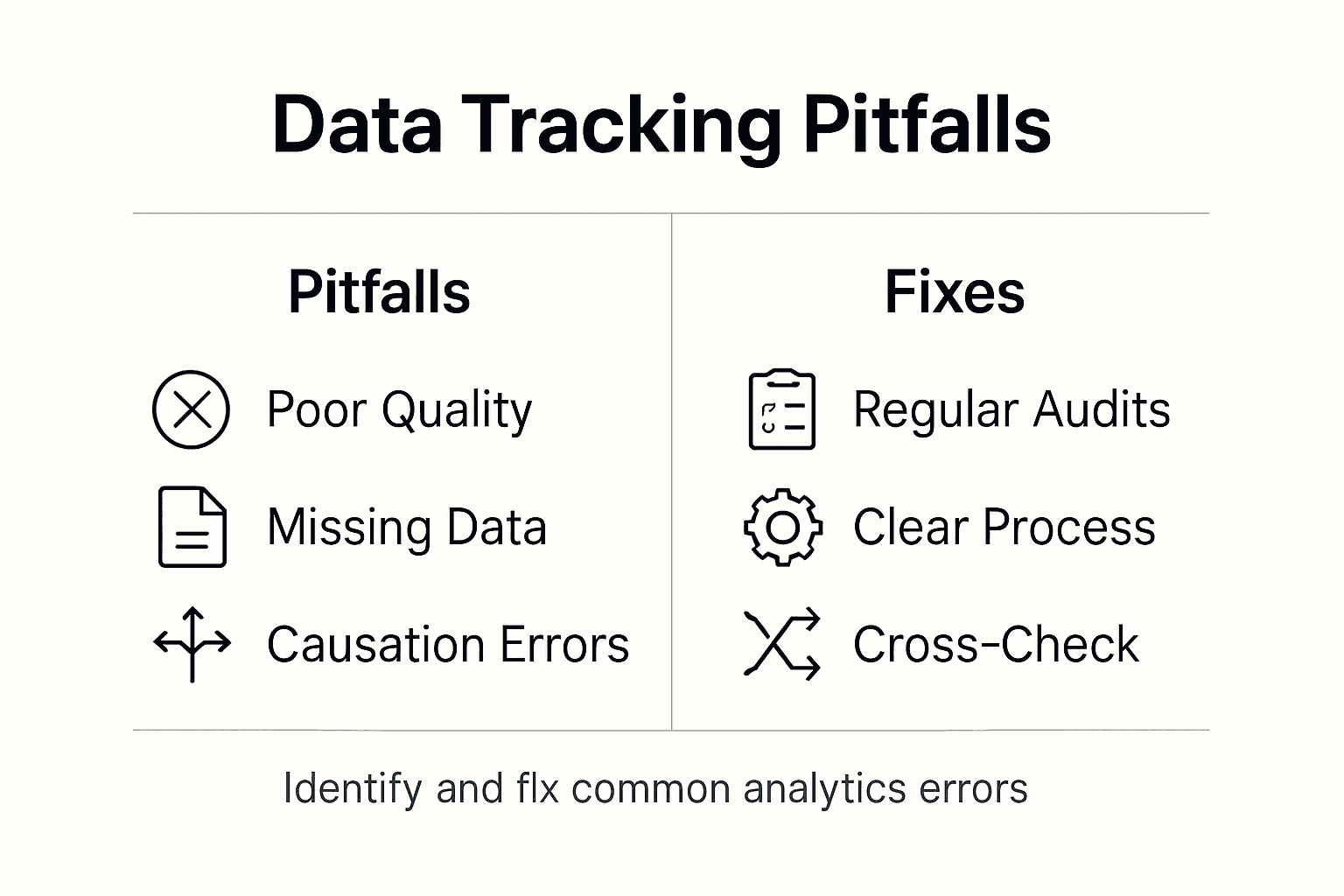
One of the most critical pitfalls is maintaining poor data quality. Inconsistent data collection processes, incomplete records, and fragmented datasets can lead to misleading conclusions. Businesses must implement rigorous data validation protocols, ensuring that information is collected uniformly across all channels. This includes standardizing data entry formats, establishing clear tracking parameters, and regularly auditing data sources to eliminate discrepancies that could skew analytical results.
Misinterpreting data correlations as definitive causal relationships represents another significant analytical risk. E-commerce teams must develop a nuanced understanding of statistical relationships, distinguishing between coincidental patterns and genuine strategic insights. This requires a multi-dimensional approach to data analysis that considers contextual factors, qualitative information, and broader market trends beyond raw numerical data. Privacy compliance, data security, and ethical tracking practices should also be integral to any comprehensive data strategy.
Pro Tip: Implement a quarterly data audit process that cross-references your analytics across multiple platforms to identify and resolve potential tracking inconsistencies.
Unlock Revenue Growth with Advanced Ecommerce Analytics
Tracking essential ecommerce success metrics like average order value, conversion rates, and customer retention can feel overwhelming without the right tools. If you want to move beyond generic data and uncover the hidden product relationships that truly drive sales on Shopify or WooCommerce, Affinsy offers exactly the insight you need. Our AI-powered platform analyzes your sales data to reveal cross-sell and bundling opportunities that boost your revenue and enhance customer engagement.

Start transforming your ecommerce performance today by leveraging detailed market basket analysis and actionable reports customized for your store. Visit Affinsy to upload your sales data and discover strategies tailored to increase your average order value and optimize product placement. Don’t wait—unlock your store’s full potential now with tools designed specifically for ecommerce entrepreneurs who are serious about sustainable growth.
Frequently Asked Questions
What are ecommerce success metrics?
Ecommerce success metrics are quantifiable measurements that help online businesses track performance, evaluate strategic effectiveness, and drive revenue growth. They provide insights into various aspects of digital business operations beyond just sales figures.
What are the key performance indicators (KPIs) for an ecommerce business?
Key performance indicators (KPIs) for an ecommerce business include conversion rate, average order value, customer acquisition cost, and customer lifetime value. These metrics serve as crucial benchmarks for assessing business goals.
How do I improve my ecommerce conversion rate?
To improve your ecommerce conversion rate, focus on optimizing your website’s user experience, enhancing product descriptions, streamlining the checkout process, and implementing effective marketing strategies to attract targeted traffic.
Why is customer retention important for ecommerce businesses?
Customer retention is important for ecommerce businesses because retaining existing customers is often more cost-effective than acquiring new ones. High retention rates indicate customer satisfaction and loyalty, which contribute to sustainable revenue growth.
Recommended
- Understanding Ecommerce Metrics: A Comprehensive Guide - Affinsy Blog | Affinsy
- Understanding Ecommerce Growth Strategies Guide - Affinsy Blog | Affinsy
- Ecommerce Growth Strategies Explained: Unlocking Revenue - Affinsy Blog | Affinsy
- Understanding Ecommerce Analytics: Unlocking Insights - Affinsy Blog | Affinsy
- Why Online Visibility Is the New Runway for Fashion Brands – Prima Dons & Donnas