
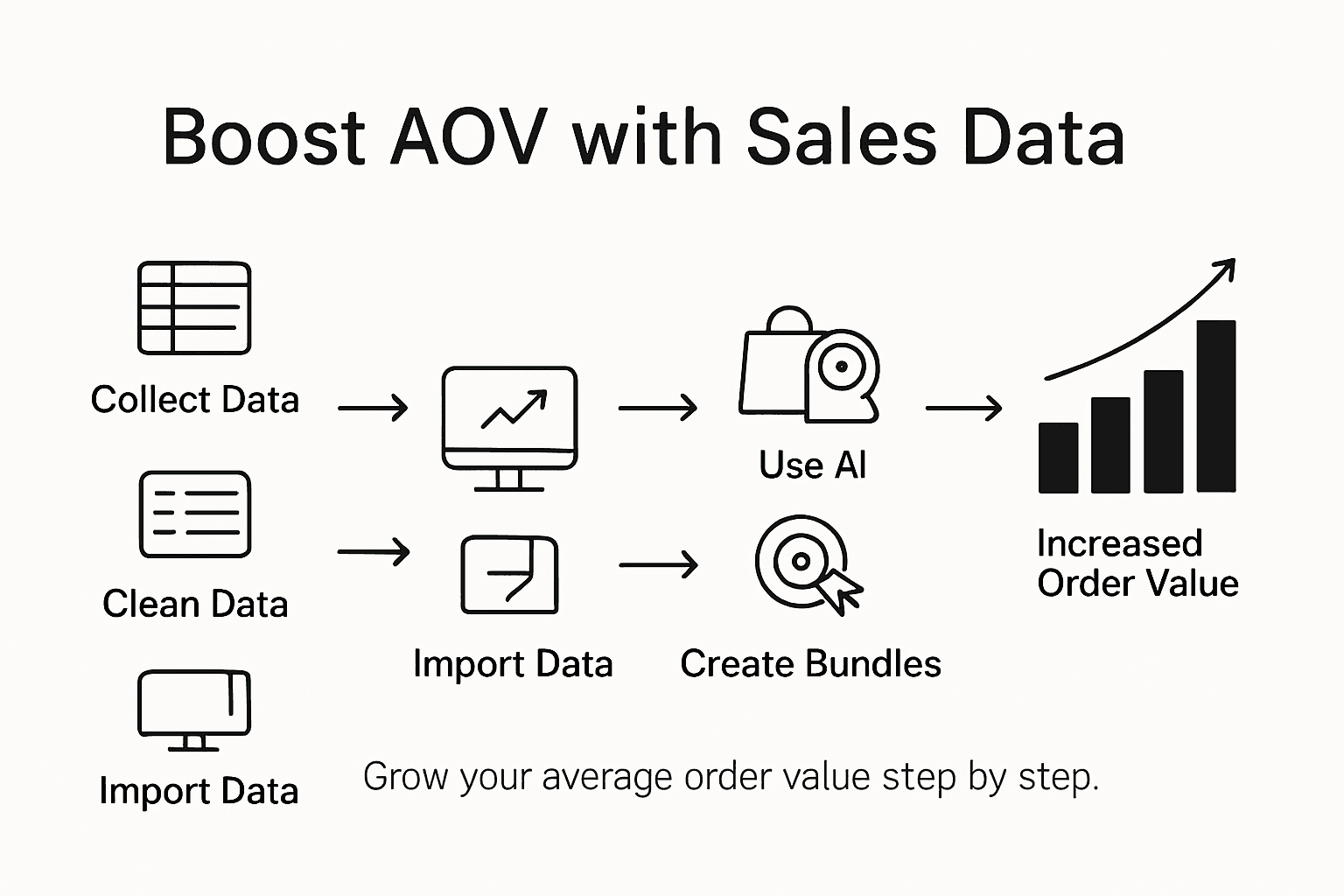
Over 40 percent of American e-commerce businesses miss valuable cross-selling opportunities simply because their sales data is poorly organized. For Shopify and WooCommerce store owners, understanding every purchase can reveal patterns that dramatically increase average order value. Accurate data preparation is the first move toward smarter cross-sell strategies and profitable product bundles. This article lays out practical steps and proven methods to turn raw sales numbers into meaningful revenue growth.
Table of Contents
- Step 1: Collect and Prepare Your Sales Data
- Step 2: Import Sales Data into Affinsy
- Step 3: Explore Product Relationships with AI
- Step 4: Apply Insights to Cross-Sell and Bundle
- Step 5: Verify Results and Optimize Strategies
Quick Summary
| Key Point | Explanation |
|---|---|
| 1. Clean and Organize Sales Data | Ensure your dataset is free from duplicates and inconsistencies for accurate analysis. |
| 2. Import Data to Affinsy | Upload a cleaned CSV file to Affinsy to gain insights from your sales data. |
| 3. Utilize AI for Product Relationships | Leverage AI to discover complementary product relationships that enhance cross-selling. |
| 4. Implement Cross-Selling Strategies | Create strategic product bundles based on AI insights to increase average order value. |
| 5. Continuously Optimize Strategies | Regularly review sales metrics to refine bundling and cross-selling approaches for better results. |
Step 1: Collect and Prepare Your Sales Data
Preparing your sales data is the foundation for uncovering powerful insights that can dramatically boost your average order value. This critical first step transforms raw numbers into a strategic roadmap for your e-commerce business.
To begin, you’ll want to gather comprehensive sales information from all your existing platforms. This includes data from your e-commerce platform, payment processors, customer relationship management (CRM) systems, and any additional sales tracking tools you use. The goal is creating a holistic view of your sales performance. Effective sales data collection requires defining clear objectives and identifying appropriate data sources, ensuring you capture the right information for meaningful analysis.
Next, focus on cleaning and organizing your dataset. This means removing duplicate entries, correcting inconsistent formatting, and handling any missing values. For e-commerce sales data, pay special attention to columns like sale date, product ID, customer details, price, and quantity. Data cleaning is a critical initial step that ensures your analysis provides accurate and actionable insights.
Convert your data into a standardized format - typically a CSV file that can be easily imported into analysis tools. Ensure each column has consistent data types: dates should be in a uniform format, prices should have consistent decimal places, and numeric fields should not contain text or special characters.
Here’s a concise summary of essential sales data elements to prepare for analysis:
| Data Element | Description | Business Impact |
|---|---|---|
| Sale Date | Transaction date in uniform format | Enables time-based sales tracking |
| Product ID | Unique identifier for each product | Accurate product mapping |
| Customer Details | Buyer info: name, location, etc. | Supports segmentation and targeting |
| Price | Sale amount, consistent decimals | Precise revenue calculation |
| Quantity | Number of units sold per order | Reveals sales volume trends |
Pro tip: Always keep a backup of your original raw data file before starting any cleaning or transformation process, so you can always return to your original dataset if needed.
Step 2: Import Sales Data into Affinsy
Importing your carefully prepared sales data into Affinsy is a straightforward process that will transform your raw information into actionable insights for boosting your average order value. This step bridges the gap between your collected data and powerful revenue optimization strategies.
To begin, log into your Affinsy account and navigate to the data import section. You’ll want to have your cleaned CSV file ready for upload. Setting up importers requires specifying precise data formats, mappings, and processing configurations to ensure accurate data ingestion. Select the file from your computer and choose the appropriate data source type matching your original platform whether it be Shopify, WooCommerce, or another e-commerce system.
During the import process, Affinsy will automatically map your columns to its standard data fields. Review these mappings carefully to confirm that product IDs, sale dates, prices, and quantities align correctly. If the system cannot automatically match a column, you can manually specify the corresponding field to ensure complete data translation.
After uploading, the platform will process your data and generate an initial analysis preview. This first look will help you confirm the import was successful and give you an early glimpse into potential insights about your sales performance.

Pro tip: Always perform a test import with a small subset of data first to validate mapping accuracy before uploading your entire dataset.
Step 3: Explore Product Relationships with AI
Unlocking the hidden connections between your products is where artificial intelligence truly transforms your e-commerce strategy. Affinsy will help you discover powerful insights that can dramatically increase your average order value by understanding how your products interact and complement each other.
AI-driven analysis revolutionizes e-commerce personalization by examining individual buying patterns and co-purchase behaviors, revealing intricate product relationships you might never detect manually. When you launch the AI product relationship analysis, the system will automatically scan your entire sales history to identify statistically significant product combinations. This means uncovering not just obvious pairings, but subtle connections that can unlock new cross-selling opportunities.
The AI will generate a comprehensive visualization of product relationships showing frequency of joint purchases, potential bundle opportunities, and recommended product groupings. Pay special attention to products that are frequently bought together but might not seem obviously related. AI methods excel at analyzing large transaction datasets to identify patterns that can enhance personalized recommendations and cross-sell strategies, giving you a competitive edge in understanding customer purchasing behaviors.
As you review the AI generated insights, look for opportunities to create strategic product bundles, adjust marketing campaigns, and redesign your online store layout to maximize these newly discovered product relationships. The goal is transforming these mathematical connections into tangible revenue opportunities.
Pro tip: Always validate AI recommendations with your own market knowledge and consider running small test campaigns to confirm the suggested product relationships before making widespread changes.
Step 4: Apply Insights to Cross-Sell and Bundle
With your AI-powered product relationship insights now in hand, you are ready to transform data into actionable revenue strategies that will meaningfully increase your average order value. This step is about translating mathematical connections into practical marketing approaches that resonate with your customers.
Cross-selling and bundling represent strategic approaches that enhance order value by promoting complementary products through intelligent package deals. Start by reviewing the AI generated recommendations and categorizing potential bundles into three key groups: complementary product sets, logical upgrade paths, and volume discount opportunities. For instance, if your data shows camera accessories frequently purchased with specific camera models, create bundles that offer slight discounts for purchasing those items together.
Advanced data-driven strategies incorporate collaborative filtering and association rule mining to identify precise product combinations that customers are most likely to purchase. This means going beyond obvious pairings and discovering nuanced connections that might not be immediately apparent. Consider creating dynamic product recommendations on your product pages that showcase these AI identified relationships, allowing customers to easily add complementary items to their cart.
Compare two advanced approaches for identifying high-value product combinations:
| Method | How It Works | Key Benefit |
|---|---|---|
| Collaborative Filtering | Recommends based on similar buyers | Drives personalized offers |
| Association Rule Mining | Finds frequent co-purchase patterns | Uncovers unexpected bundles |
Implement these insights gradually, starting with your top selling product categories and tracking the impact on your average order value. Monitor key metrics like bundle adoption rates, additional revenue per transaction, and customer feedback to continuously refine your approach.
Pro tip: Test multiple bundle configurations and pricing strategies simultaneously, using A/B testing to determine which combinations generate the highest customer engagement and revenue.
Step 5: Verify Results and Optimize Strategies
As you complete your initial analysis and implementation, verifying and refining your strategies becomes crucial for sustainable revenue growth. This final step ensures that your data insights translate into measurable business improvements.
Machine learning models provide sophisticated methods for accurately forecasting sales and validating analytical results, enabling you to systematically assess the effectiveness of your product bundling and cross selling strategies. Begin by establishing clear performance benchmarks such as average order value increase, bundle adoption rates, and revenue per transaction. Compare these metrics against your initial baseline to quantify the tangible impact of your AI driven recommendations.
Data analytics plays a pivotal role in e-commerce performance optimization through an iterative process of gathering insights, analyzing outcomes, and continuously refining strategies. Create a quarterly review cycle where you deeply analyze the performance of your product bundles and cross selling approaches. Look for patterns in customer behavior, identify which bundle configurations generate the most engagement, and be prepared to adjust your strategy based on real world performance data.
Utilize Affinsy advanced reporting features to track granular metrics that reveal the nuanced effectiveness of your recommendations. Pay special attention to customer segments where bundles perform exceptionally well or surprisingly poorly, as these insights can help you develop more targeted marketing strategies.
Pro tip: Develop a dynamic feedback loop where customer purchase patterns continuously inform and update your product recommendation algorithms, ensuring your strategies remain responsive and relevant.
Unlock Your E-commerce Potential by Boosting Your Average Order Value
Analyzing sales data to increase your average order value can feel overwhelming when juggling messy datasets and trying to uncover meaningful product relationships. You want to confidently identify cross-sell and bundling opportunities that truly resonate with your customers without wasting time on guesswork or incomplete insights. The challenge is transforming raw sales data into clear, actionable strategies that drive real revenue growth.
Affinsy is built to solve exactly this problem. With its AI-powered market basket analysis, it dives deep into your sales history from platforms like Shopify or WooCommerce to reveal hidden product pairings and customer purchasing patterns you might miss on your own. By providing detailed, easy-to-understand reports and practical bundle recommendations, Affinsy empowers you to implement data-driven cross-sell tactics that increase your average order value effectively and sustainably.

Don’t let complex data hold you back from maximizing your e-commerce growth. Start using Affinsy today to transform your sales data into powerful insights. Visit Affinsy now to upload your sales data, explore AI-driven product relationships, and unlock new revenue opportunities with our free or premium reports. Take control of your store’s success and see the difference data analysis can make.
Frequently Asked Questions
How can I collect and prepare my sales data for analysis?
To collect and prepare your sales data, gather information from all your platforms, including your e-commerce site and payment processors. Focus on cleaning the data by removing duplicates and standardizing formats for fields like sale date and price. Perform this preparation before moving on to analysis to ensure accuracy.
What are key data elements I should include for analyzing average order value (AOV)?
Key data elements include sale date, product ID, customer details, price, and quantity. Ensure these elements are organized and formatted consistently, such as using a uniform date format and having consistent decimal places for prices. Prioritize these elements to create a clear view of sales performance.
How do I import my prepared sales data into Affinsy?
To import your sales data into Affinsy, log into your account and navigate to the data import section. Select your cleaned CSV file and ensure that the column mappings align with the platform’s required fields. Validate these mappings carefully to avoid errors during the import process.
How can I uncover product relationships using AI?
You can explore product relationships by launching the AI product relationship analysis in Affinsy. This feature will automatically analyze your sales data to identify significant product combinations and purchasing patterns. Use these insights to create targeted marketing strategies or product bundles to enhance AOV.
What strategies can I use to apply insights from my sales data?
You can use insights from your sales data to develop cross-selling and bundling strategies by identifying complementary products and creating package deals. Start by categorizing your findings into logical groups, like items frequently bought together, and experiment with marketing them collectively to boost average order value. Monitor the performance of these strategies to optimize your approach.
How can I verify the results of my sales data analysis?
To verify the results, compare performance metrics such as average order value and bundle adoption rates against your initial benchmarks. Conduct a quarterly review to analyze customer behavior and sales trends. Make adjustments based on this analysis to continuously refine your sales strategies.
Recommended
- 7 Essential Sales Data Analysis Tips for Online Store Owners - Affinsy Blog | Affinsy
- Increasing Average Order Value Steps: Boost Sales Effectively - Affinsy Blog | Affinsy
- Data-Driven Marketing Strategies Guide to Boost AOV - Affinsy Blog | Affinsy
- Sales Data Analysis: Unlocking E-Commerce Growth - Affinsy Blog | Affinsy
- Οδηγός online αγορών ρούχων: Κατανοώντας την εμπειρία σας