
Staring at spreadsheets packed with order data can feel overwhelming when you just want to spark more cross-sell activity in your store. Pinpointing which numbers matter is the key to smarter decisions about product recommendations and bundled offers. With actionable methods like analyzing customer demographics and purchase history, this guide helps you transform raw data into real revenue gains through data-driven cross-selling strategies that are easy to apply, even without a technical background.
Table of Contents
- Step 1: Assess Current Sales And Customer Data
- Step 2: Identify High-Potential Product Associations
- Step 3: Develop Targeted Cross-Selling Offers
- Step 4: Test And Measure Cross-Selling Performance
Quick Summary
| Key Point | Explanation |
|---|---|
| 1. Gather and Organize Sales Data | Collect transaction history, customer demographics, and product behavior to analyze sales patterns effectively. |
| 2. Identify High-Potential Product Associations | Look for frequently purchased products together to determine strong cross-selling opportunities. |
| 3. Tailor Offers to Customer Segments | Create specific cross-selling offers that align with the distinct needs and behaviors of different customer groups. |
| 4. Measure Cross-Selling Performance Regularly | Track the effectiveness of offers using performance indicators to adjust strategies based on data. |
| 5. Automate and Personalize Offer Delivery | Use automated systems to deliver personalized offers at the right moments, enhancing customer engagement and conversion rates. |
Step 1: Assess Current Sales and Customer Data
Before you can cross-sell effectively, you need a clear picture of what’s actually happening in your store. This means gathering and organizing your sales data, customer information, and transaction history into a format you can analyze.
Start by pulling together your core datasets:
- Transaction history from the last 12-24 months
- Customer demographic information (purchase frequency, lifetime value, location)
- Product sales data and inventory levels
- Customer browsing and purchase behavior patterns
- Any existing segmentation or tagging in your system
You don’t need to be a data scientist here. Most e-commerce platforms like Shopify and WooCommerce export this data directly. Google Analytics provides customer behavior insights. The goal is to get everything in one place so you can start spotting patterns.
Here’s a summary of common data sources and the unique business value they offer for cross-selling analysis:
| Data Source | Key Insight Provided | Business Impact |
|---|---|---|
| Transaction History | Identifies buying patterns | Reveals natural product pairs |
| Customer Segmentation | Pinpoints high-value groups | Enables targeted promotions |
| Product Sales Data | Highlights fast/slow movers | Optimizes inventory for cross-sells |
| Browsing Behavior | Shows interest beyond purchases | Suggests untapped cross-sell potential |
| Demographics | Maps customer diversity | Customizes cross-sell strategies |
Once you’ve gathered the data, organize it by customer segments. Look at who your high-value customers are versus occasional buyers. Understanding customer demographics like age and purchase history helps you identify which customers are actually receptive to cross-selling offers.
Calculate a few baseline metrics to understand where you stand right now. Track your current average order value, the percentage of orders that include multiple product categories, and which product combinations already sell together naturally. These numbers become your benchmark.
Your baseline metrics tell you exactly what you’re working with—without them, you can’t measure improvement or know if your cross-selling strategy actually works.
Check how much of your revenue currently comes from cross-sell and upsell transactions versus single-item purchases. This percentage matters because it shows you the upside potential in your customer base.

Pro tip: Export your data into a spreadsheet or simple database and create a quick dashboard showing your top 10 products, top customer segments by revenue, and current cross-sell rates—review this weekly so you spot trends early.
Step 2: Identify High-Potential Product Associations
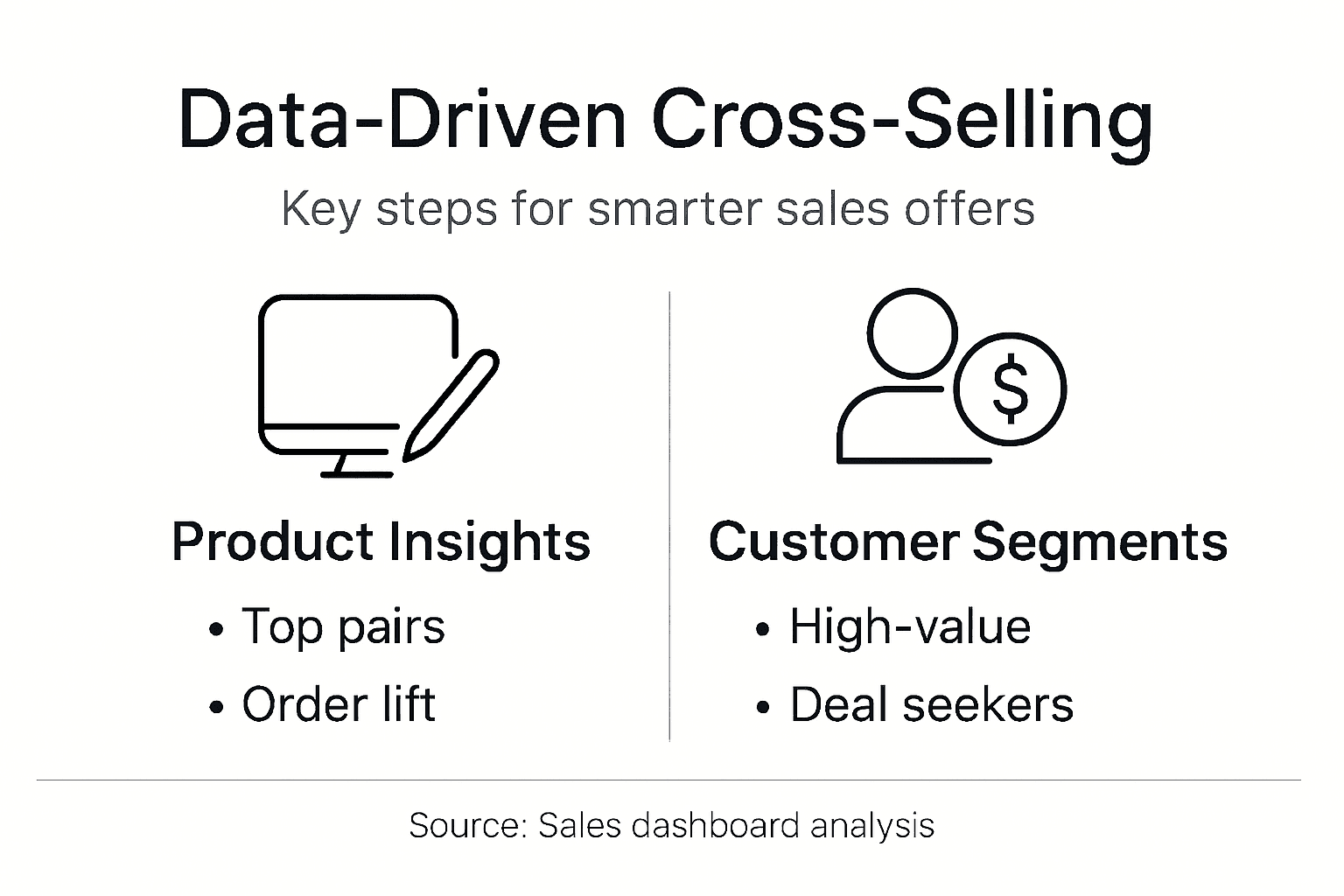
Now that you have your sales data organized, it’s time to find which products naturally go together. These product associations are the gold mine of cross-selling—they show you exactly what your customers already want to buy alongside each other.
Start by looking at your transaction data to spot products that appear together frequently. If customers who buy a laptop almost always buy a laptop bag, that’s a high-potential association. Look for patterns across product categories, not just within them.
Here’s what to track when identifying these associations:
- Products purchased together in the same order
- Items bought by the same customer across multiple orders
- Complementary products (think phone plus phone case)
- Frequently abandoned combinations (customers add both but only complete one)
- Seasonal patterns where certain bundles sell better together
Use machine learning to predict cross-purchase behavior and understand which product pairs have the highest potential. Advanced AI methods can reveal correlations you wouldn’t spot manually, especially in larger product catalogs.
Calculate the association strength between products. How often do they appear together? What’s the average order value when they’re purchased as a pair versus separately? A high frequency plus higher revenue signals a strong, valuable association worth promoting.
The strongest product associations aren’t always the obvious ones—sometimes your second or third tier combinations drive better results than your top sellers paired together.
Segment your findings by customer type. A high-value customer might respond to premium bundles, while a price-conscious customer prefers value combinations. Your product associations should match the customer segments you identified earlier.
Rank your associations by potential impact. Focus on pairs that represent meaningful revenue increases, not marginal gains. If pairing two items together increases average order value by 15 percent, that’s worth promoting heavily.
Pro tip: Create a simple spreadsheet ranking your top 20 product associations by frequency and average order value lift, then test promoting just the top five in your next campaign—watch what actually converts before expanding.
Step 3: Develop Targeted Cross-Selling Offers
With your product associations identified, it’s time to create offers that actually resonate with specific customer groups. Generic cross-selling doesn’t work—your offers need to match what each customer segment actually wants.
Start by building detailed customer profiles based on your segmentation work. Combine transaction history, browsing behavior, and demographics to understand what drives each group. A customer who spends $500 monthly on premium items needs different offers than someone who buys once every quarter on a tight budget.
Create segment-specific offers that align with customer needs:
- High-value customers get exclusive bundles or premium combinations
- Budget-conscious buyers see value packs with clear savings
- New customers get starter bundles to build brand loyalty
- Repeat purchasers get loyalty rewards or VIP cross-sell options
- Cart abandoners receive targeted incentives to complete their purchase
Use customer segmentation data to tailor personalized offers that match individual preferences and purchase patterns. When you understand distinct customer groups, you can deliver relevant recommendations at the right moment.
Comparison of cross-selling offer strategies by customer segment:
| Customer Segment | Offer Type | Potential Result |
|---|---|---|
| High-value | Premium bundle | Higher order value |
| Budget-conscious | Value pack | Better conversion rate |
| New customer | Starter bundle | Increases retention |
| Repeat purchaser | Loyalty reward | Strengthens loyalty |
| Cart abandoner | Targeted incentive | Reduces abandonment rate |
Time your offers strategically. Deliver cross-sell suggestions after a customer completes a purchase, when they’re already in buying mode. Use email triggered by behavior, like recommending complementary items after someone buys a specific product.
Personalized offers built from actual customer data convert 3 to 5 times better than generic promotions—the specificity is what drives results.
Test your messaging. Does “Complete your setup” work better than “Save 20 percent”? Does a bundle price outperform individual product discounts? Run A/B tests on offer variations within each segment to find what converts best.
Automate delivery through multiple channels. Use your e-commerce platform, email marketing, and on-site recommendations to present offers. Comprehensive customer profiles enable automated personalized offers that feel natural, not pushy.
Track which offers convert and by how much. Monitor the revenue lift from each cross-sell offer you test. Double down on what works, retire what doesn’t, and constantly refine based on actual performance data.
Pro tip: Start with three to five simple offers targeting your most valuable customer segments, then measure everything—only expand to additional offers once you prove your approach works with real conversion data.
Step 4: Test and Measure Cross-Selling Performance
Launching cross-selling offers is just the beginning. The real work happens when you measure what actually works and refine based on data. Without measurement, you’re flying blind.
Start by establishing baseline metrics before you implement any new cross-selling tactics. What’s your current average order value? What percentage of orders include multiple product categories? These numbers become your benchmark for measuring improvement.
Define the key performance indicators you’ll track:
- Average order value lift from cross-sell offers
- Conversion rate of cross-sell recommendations
- Revenue generated specifically from cross-selling
- Customer segments with highest cross-sell adoption
- Offer performance by product category or combination
- Return rate on cross-sell products versus baseline
Measure cross-selling performance through quantitative metrics that show whether your strategy is working. Clear performance indicators enable you to refine your tactics continuously and make data-driven decisions about what to expand or retire.
Track the percentage of transactions that include successful cross-sells or upsells. Calculate how many customers who see your offers actually purchase the recommended products. Compare this against industry benchmarks to see where you stand relative to marketing-driven sales with successful cross-sell outcomes.
A 2 percent improvement in cross-sell conversion rate might sound small until you realize it adds up to significant revenue when multiplied across thousands of monthly transactions.
Run A/B tests on different offer variations. Test messaging, timing, placement, discount levels, and product combinations. Run each test long enough to gather statistically significant results, not just a handful of conversions.
Segment your results by customer type and product category. Your premium bundle might convert at 8 percent with high-value customers but only 2 percent with budget shoppers. This insight tells you where to focus your efforts.
Review performance weekly and make adjustments monthly. What worked last quarter might not work this quarter as seasonality changes. Stay responsive and agile with your testing approach.
Pro tip: Set up a simple spreadsheet tracking your top five cross-sell offers with weekly conversion rates and revenue lift, then schedule 30 minutes every Friday to review results and decide what to test next.
Unlock the Power of Data-Driven Cross-Selling for Your Online Store
Many e-commerce businesses struggle with identifying which products truly complement each other and how to craft personalized offers that resonate with their diverse customer segments. This challenge can limit average order value growth and customer loyalty despite having rich sales data available. The article “How to Improve Cross-Selling With Data-Driven Strategies” highlights the importance of leveraging transaction history, customer segmentation, and product association analysis to deliver impactful cross-selling offers that convert.
Affinsy is designed to solve precisely these problems by providing AI-powered analytics tailored for e-commerce retailers. Our platform simplifies complex data sets through features like market basket analysis and RFM customer segmentation to reveal hidden purchasing patterns and high-potential product bundles. Whether you are using Shopify, WooCommerce, or Google Analytics, Affinsy seamlessly integrates with your existing tools to generate actionable insights without requiring advanced data science skills.
Ready to move from guesswork to precision in your cross-selling strategies?
Take control of your sales growth by harnessing the power of your own customer and transaction data today. Visit Affinsy to start optimizing your product bundling, targeting high-value customer segments, and increasing average order values with confidence. Don’t miss out on hidden revenue opportunities waiting inside your data.
Explore how Affinsy can enhance your cross-selling efforts with smart analytics and real results at https://www.affinsy.com/.
Frequently Asked Questions
How can I gather the right sales data for cross-selling?
To effectively cross-sell, start by collecting transaction history, customer demographics, product sales data, and customer behavior patterns. Pull together these key datasets for the past 12-24 months to analyze trends and identify opportunities in your store.
What key metrics should I focus on to measure my cross-selling performance?
Focus on metrics like average order value, cross-sell conversion rates, and revenue from cross-selling versus single-item purchases. Track these metrics regularly, set a baseline for comparison, and aim to improve each by at least 2% within the next quarter.
How do I identify product associations for cross-selling?
Analyze your transaction data to find products frequently purchased together. Look for patterns such as complementary items or combinations that increase average order value, prioritizing those with high association strength.
What types of cross-selling offers should I create for different customer segments?
Develop personalized offers based on customer profiles, such as premium bundles for high-value customers or budget packs for cost-conscious shoppers. Tailor your promotions to meet the specific needs of each segment, enhancing relevance and increasing conversion rates.
How can I test the effectiveness of my cross-selling offers?
Run A/B tests on different aspects of your offers, including messaging and product combinations. Measure the conversion rates and revenue generated, then analyze results weekly, adjusting your strategy based on what works best for each customer segment.
Recommended
- Cross-Selling Strategy Process for E-Commerce Success - Affinsy Blog | Affinsy
- Cross Sell Strategies Step by Step for E-Commerce Growth - Affinsy Blog | Affinsy
- Cross Selling Strategies Guide to Boost Online Store Revenue - Affinsy Blog | Affinsy
- Data-Driven Marketing Strategies Guide to Boost AOV - Affinsy Blog | Affinsy
- Warum Videos die Conversion steigern: Effekte für KMU