
Every American e-commerce marketing manager knows the challenge of turning digital ad clicks into lasting revenue while costs keep climbing. As competition intensifies across North America, making every dollar count becomes central to your strategy. By using Market Basket Analysis and customer segmentation, you can discover high-impact product pairings and create compelling bundles that increase cross-selling while optimizing CPC. This practical approach brings clear advantages in targeting, efficiency, and maximizing your advertising investment.
Table of Contents
- Understanding CPC And Its Role In E-Commerce
- Market Basket Analysis For Optimizing Revenue
- Customer Segmentation To Target High-Value Buyers
- Strategic Product Bundling Against Rising CPC
- Avoiding Common Mistakes With Affinsy Insights
Key Takeaways
| Point | Details |
|---|---|
| Understanding CPC Importance | CPC is crucial for managing advertising costs and optimizing online marketing strategies in e-commerce. Regular monitoring and adjustments are essential for effective CPC management. |
| Leveraging Market Basket Analysis | MBA helps identify product affinities and develop personalized marketing strategies to optimize revenue. Integrating customer segmentation enhances its effectiveness. |
| Customer Segmentation Strategies | Effective segmentation allows businesses to accurately target high-value customers and improve marketing efficiency. Advanced analytics tools can refine segmentation approaches. |
| Strategic Product Bundling | Product bundling addresses rising CPC concerns by enhancing perceived value and customer engagement. AI-driven recommendations can optimize bundling strategies for maximum impact. |
Understanding CPC and Its Role in E-Commerce
Cost Per Click (CPC) represents a critical metric in digital marketing that directly impacts how businesses acquire online traffic and manage advertising expenditures. In e-commerce, CPC determines the financial investment required to attract potential customers through digital advertising platforms like Google Ads, Facebook Ads, and other targeted marketing channels.
Understanding CPC involves recognizing its fundamental role in cross-border e-commerce strategies. The metric provides insights into the effectiveness of online advertising campaigns by measuring the exact cost an advertiser pays each time a potential customer clicks on their digital advertisement. This granular approach allows e-commerce businesses to:
- Track precise marketing spending
- Evaluate advertising channel performance
- Optimize budget allocation
- Compare marketing channel efficiency
- Measure return on advertising investment
CPC’s significance extends beyond simple cost calculation. Modern e-commerce strategies leverage this metric to make data-driven decisions about traffic acquisition, understanding that not all clicks are created equal. Sophisticated marketers analyze CPC in conjunction with conversion rates to determine the true value of each potential customer interaction.
Effective CPC management requires continuous monitoring and strategic adjustment of digital advertising approaches.
The complexity of CPC in e-commerce stems from multiple interconnected factors, including keyword competition, industry vertical, target audience demographics, and advertising platform algorithms. Businesses must develop nuanced strategies that balance cost efficiency with meaningful customer engagement.

Pro tip: Regularly audit your CPC campaigns and adjust targeting parameters to minimize wasted ad spend and maximize potential customer acquisition.
Market Basket Analysis for Optimizing Revenue
Market Basket Analysis (MBA) represents a powerful data mining technique that enables e-commerce businesses to uncover hidden product relationships and optimize revenue strategies. By examining statistical patterns in customer purchase transactions, businesses can develop sophisticated cross-selling and personalization approaches that drive significant financial performance.
The core objective of Market Basket Analysis involves identifying product combinations that customers frequently purchase together. This approach allows e-commerce managers to:
- Develop targeted product recommendations
- Create strategic bundle offerings
- Optimize store layout and digital merchandising
- Design personalized marketing campaigns
- Improve inventory management
Advanced analytics transform MBA from a simple correlation tool into a nuanced strategy for revenue optimization. By integrating customer segmentation techniques, businesses can develop increasingly precise targeting mechanisms that go beyond basic purchasing patterns.
Market Basket Analysis transforms raw transaction data into strategic business intelligence.
Complex MBA methodologies now incorporate multiple dimensions of analysis, including purchase frequency, product attributes, and customer demographic information. Customer segmentation strategies enable businesses to understand not just what products are bought together, but why specific customer groups make particular purchasing decisions.
Pro tip: Implement machine learning algorithms to continuously refine your Market Basket Analysis models and adapt to evolving customer behavior patterns.
Customer Segmentation to Target High-Value Buyers
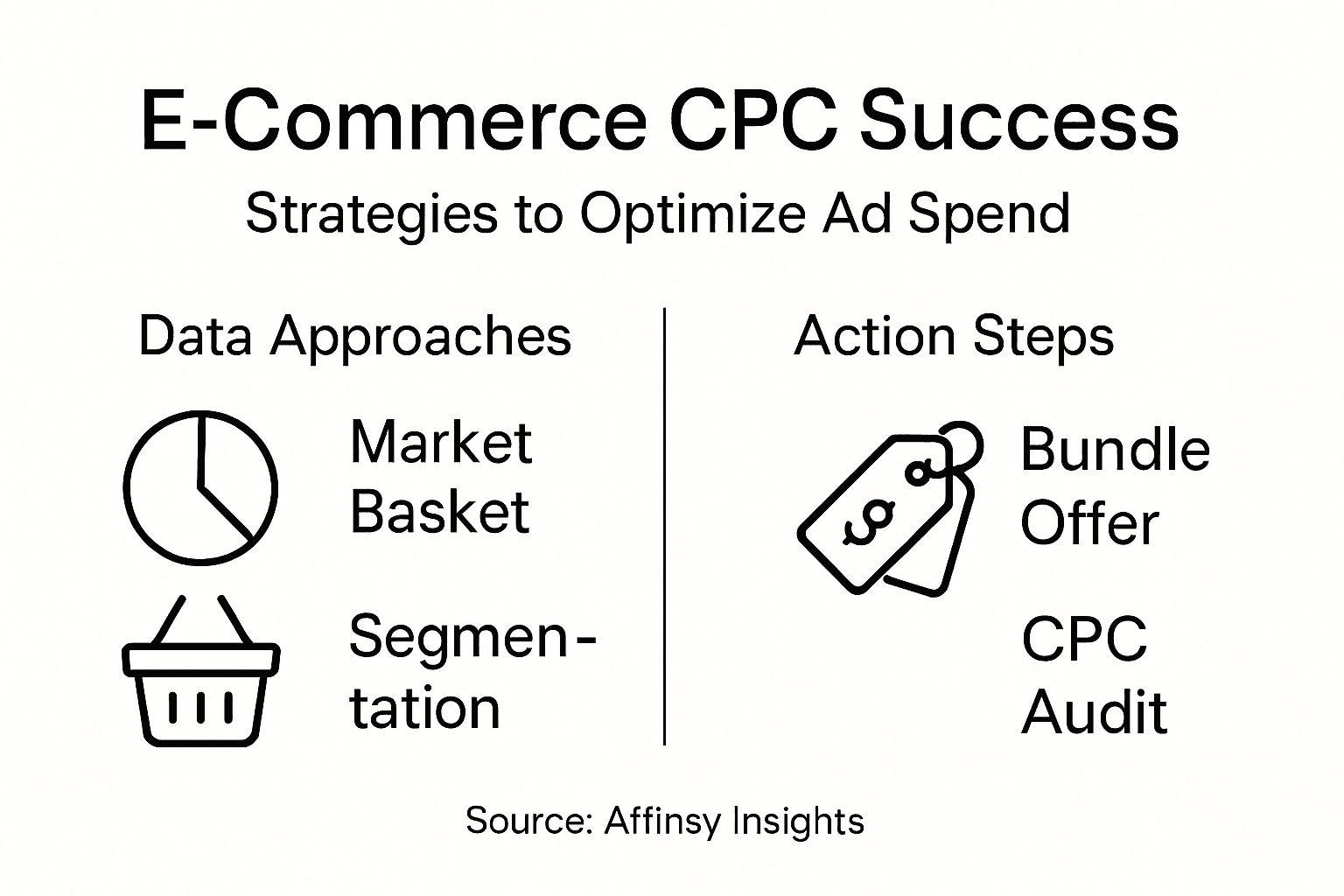
Customer segmentation represents a critical strategic approach for e-commerce businesses seeking to optimize marketing effectiveness and reduce cost per click (CPC). Advanced clustering techniques enable businesses to transform raw customer data into actionable insights that drive targeted marketing strategies.
Effective customer segmentation involves analyzing multiple dimensions of customer behavior, including:
- Purchase frequency
- Total monetary value
- Recency of transactions
- Product preferences
- Demographic characteristics
- Online engagement patterns
Sophisticated segmentation methods go beyond traditional demographic analysis, leveraging complex algorithms to identify nuanced customer groups. By understanding the unique characteristics of high-value buyers, businesses can develop precise targeting strategies that maximize marketing efficiency.
High-value customer segments represent the most critical revenue drivers for e-commerce businesses.
Advanced methodologies like RFM analysis and machine learning clustering enable businesses to quantify customer value with unprecedented precision. These techniques allow marketers to create highly personalized marketing approaches that significantly improve conversion rates and reduce unnecessary advertising expenditures.
Pro tip: Continuously update your customer segmentation models using machine learning algorithms to capture evolving customer behavior patterns and maintain targeting accuracy.
This reference shows how MBA and Segmentation support data-driven marketing:
| Technique | Key Benefit | Sample Application |
|---|---|---|
| Market Basket Analysis | Identifies product affinities | Building personalized bundles |
| Customer Segmentation | Uncovers valuable clusters | Customizing marketing messages |
Strategic Product Bundling Against Rising CPC
Product bundling emerges as a sophisticated strategy for e-commerce businesses confronting escalating cost per click (CPC) challenges. Consumer psychology and big data analysis reveal that strategic bundling can dramatically transform marketing economics by increasing perceived product value and customer engagement.
Effective product bundling strategies involve multiple sophisticated approaches:
- Creating complementary product sets
- Offering volume-based discounts
- Developing themed product collections
- Matching frequently co-purchased items
- Personalizing bundle recommendations
- Implementing dynamic pricing models
Advanced recommendation systems leverage machine learning to identify optimal product combinations that resonate with specific customer segments. By understanding intricate purchase patterns, businesses can craft bundles that not only reduce acquisition costs but also enhance overall customer satisfaction.
Strategic product bundling transforms marketing expenses into revenue-generating opportunities.
Bundle recommendation technologies now enable unprecedented levels of personalization, allowing e-commerce platforms to dynamically generate product sets that match individual customer preferences. These sophisticated approaches help businesses counter rising CPC by creating more attractive, value-driven purchasing options that increase average order values.
Pro tip: Implement AI-driven bundle recommendation algorithms that continuously learn and adapt to evolving customer purchase behaviors to maximize bundling effectiveness.
Avoiding Common Mistakes with Affinsy Insights
E-commerce strategy requires precise navigation through complex digital landscapes where seemingly minor missteps can dramatically impact marketing performance. Strategic operational integration represents the foundational approach to preventing costly mistakes that undermine business growth and efficiency.
Common e-commerce mistakes that businesses must actively avoid include:
- Blindly mimicking competitor strategies
- Neglecting cross-channel operational consistency
- Underinvesting in data-driven optimization
- Ignoring customer experience nuances
- Failing to implement continuous performance testing
- Overlooking granular performance metrics
Sophisticated analytics platforms enable businesses to transcend traditional reactive approaches, transforming potential weaknesses into strategic opportunities. By implementing comprehensive monitoring and adaptive strategies, e-commerce teams can proactively identify and mitigate performance challenges before they escalate.
Data-driven insights are the most powerful defense against strategic vulnerabilities.
Successful e-commerce organizations recognize that mistake prevention is an ongoing process requiring continuous learning, technological adaptation, and cross-functional collaboration. Leveraging advanced analytics tools allows businesses to develop resilient, responsive strategies that evolve with changing market dynamics.
Pro tip: Implement a quarterly strategic review process that systematically analyzes performance data and identifies potential optimization opportunities across all marketing channels.
Here’s how core e-commerce analytics approaches differ in focus and outcome:
| Approach | Main Goal | Primary Data Used | Typical Business Outcome |
|---|---|---|---|
| CPC Analysis | Optimize ad spend | Click and cost data | Lower campaign costs |
| Market Basket Analysis | Uncover product links | Transaction records | Higher cross-sell rates |
| Customer Segmentation | Target high-value users | Behavioral and demographic | Improved campaign targeting |
| Product Bundling | Boost order values | Purchase correlations | Increased average revenue |
| Mistake Prevention | Minimize strategic errors | Performance metrics | Better long-term efficiency |
Transform Rising CPC Challenges into Growth Opportunities with Affinsy
E-commerce businesses today face the pressing challenge of increasing cost per click affecting their marketing ROI. The article highlights key pain points such as optimizing ad spend, improving customer segmentation, and leveraging market basket analysis to create effective product bundles. If you want to reduce wasted advertising dollars and boost average order values by uncovering hidden product relationships and high-value customer segments, data-driven solutions are essential.
Affinsy is designed specifically for retailers looking to conquer these challenges. By analyzing your historical transaction data with AI-powered analytics, Affinsy provides actionable insights like market basket analysis and RFM customer segmentation that help you optimize product bundling, cross-selling, and customer retention strategies. With seamless integration to platforms like Shopify, WooCommerce, and Google Analytics, Affinsy empowers you to make smarter marketing decisions without needing advanced data science skills.
Start turning rising CPC into strategic advantage today.
Discover how your store can optimize ad spend and increase revenue with AI-driven analytics from Affinsy. Visit Affinsy’s homepage now to unlock the full potential of your e-commerce data and stop letting costly clicks hold your growth back.
Frequently Asked Questions
What is Cost Per Click (CPC) in e-commerce?
Cost Per Click (CPC) is a critical metric in digital marketing that indicates the amount an advertiser pays for each click on their online advertisement. In e-commerce, it helps businesses understand their advertising expenditures and optimize their budget allocation.
How can I effectively manage CPC in my e-commerce campaigns?
Effective CPC management involves continuous monitoring of advertisements, adjusting targeting parameters, and analyzing performance data to minimize wasted ad spend and maximize customer acquisition.
What is Market Basket Analysis and how does it optimize revenue?
Market Basket Analysis (MBA) is a data mining technique used to discover product relationships in customer purchases. It helps e-commerce businesses create targeted recommendations, optimize product bundling, and improve inventory management based on purchasing patterns.
How can customer segmentation improve marketing effectiveness in e-commerce?
Customer segmentation allows e-commerce businesses to analyze customer behaviors and characteristics, enabling them to target high-value buyers with tailored marketing strategies. This approach maximizes conversion rates and reduces unnecessary advertising expenditures.
Recommended
- Understanding Data-Driven Campaign Optimization for E-Commerce - Affinsy Blog | Affinsy
- E Commerce Advertising Guide: Strategies for Success in 2025 - Affinsy Blog | Affinsy
- 8 Top Ecommerce Ads Examples to Boost Sales in 2025 - Affinsy Blog | Affinsy
- Marketing Campaigns Step by Step for E-commerce Success - Affinsy Blog | Affinsy
- How To Download Historical Data On MT4: A Simple Guide For EA Traders | FxShop24 Marketplace