
Navigating digital retail has become exponentially more complex as we enter the era of Agentic Commerce—a paradigm where autonomous AI agents, not just humans, browse, negotiate, and transact. For technical leaders and e-commerce managers, the challenge is no longer just about having a website; it is about having an operating system that speaks the language of AI. Legacy ERPs, built for human clicks and manual data entry, are becoming the bottleneck.
Enter Open Mercato. This article unpacks why Open Mercato is the first true AI-Ready ERP, designed to be the foundational infrastructure for this new reality. We will explore how its unique Open-Closed architecture creates the stable, type-safe environment necessary for advanced concepts like Bundle Discovery and Customer Segmentation to thrive, paving the way for intelligence layers like Affinsy to unlock deep value.
Table of Contents
- Understanding Open Mercato in the Agentic Era
- The Architecture of Stability: Open-Closed Principle
- Enabling Intelligence: Bundle Discovery & Segmentation
- Technical Deep Dive: MCP and Vector Search
- Risks, Compliance, and Best Practices
Key Takeaways
| Point | Details |
|---|---|
| The Infrastructure Gap | Legacy ERPs lack the structure for AI agents. Open Mercato fills this gap as a headless, type-safe, API-first foundation. |
| Open-Closed Principle | The core system is "Closed for Modification" to prevent AI errors, but "Open for Extension" to allow custom business logic. |
| Conceptual Synergy | Open Mercato provides the structured data lake; tools like Affinsy provide the analytical intelligence to interpret it. |
| Future-Proofing | Features like Model Context Protocol (MCP) and vector embeddings prepare your business for autonomous B2B negotiation and discovery. |
Understanding Open Mercato in the Agentic Era
Agentic commerce represents a revolutionary approach to digital retail, where autonomous AI agents dynamically interact with marketplaces. This transforms traditional e-commerce by enabling intelligent systems to anticipate needs and navigate complex purchasing decisions independently.
However, for an AI agent to function, it needs a predictable environment. Open Mercato solves this by replacing the "black box" of traditional software with a transparent, structured framework. It allows AI agents to:
- Query inventory with semantic precision (knowing that "stock" is a number, not a text string).
- Access real-time pricing logic without crashing the system.
- Interact with a deterministic backend that guarantees data integrity.
Unlike traditional models where human intervention is required at every step, Open Mercato is built to be "read" by machines. Emerging research demonstrates varied agent behaviors within programmable marketplaces, highlighting that the stability of the underlying ERP is the single biggest factor in the success of autonomous transactions.
The global potential for agentic commerce is substantial, projected to reach trillions by 2030. To capture this, retailers must transition from legacy monolithic suites to flexible, AI-compatible platforms like Open Mercato.
The Architecture of Stability: Open-Closed Principle
A common misconception is that "Open Source" means "unstable." Open Mercato is fully open source (MIT License), giving you complete ownership. However, its architectural philosophy is based on the Open-Closed Principle (OCP).
This principle dictates that the software entities (classes, modules, functions) should be:
- Open for Extension: You can add new functionality (like a custom pricing algorithm or a specific shipping rule).
- Closed for Modification: The core source code (how an order is processed, how security is handled) remains unchanged.
Why is this critical for AI?
If you modify the core kernel of your ERP, you introduce unpredictability. An AI agent relying on standard API responses might fail if the underlying logic has been tweaked manually. By keeping the core "Closed," Open Mercato ensures that the ERP acts as a stable "Source of Truth." This stability is what allows external intelligence layers to trust the data they are analyzing.

Enabling Intelligence: Bundle Discovery & Segmentation
While Open Mercato provides the Infrastructure (the structured data), the true value is unlocked by the Intelligence Layer. This is where the synergy with advanced analytics tools like Affinsy becomes conceptually powerful.
The Concept of Bundle Discovery
In legacy systems, "bundling" is manual: a manager guesses that a camera sells well with a tripod. In the Agentic Era, this process becomes Bundle Discovery.
Imagine a workflow where:
- Open Mercato holds the structured transaction data and vector embeddings of product attributes (e.g., "Lens Mount Type A").
- The Intelligence Layer (Affinsy) analyzes this data to find non-obvious correlations. It might discover that 80% of customers buying "Industrial Motor X" also search for "Lubricant Y" within 48 hours.
- The Outcome: The system suggests a dynamic bundle to the merchant, potentially increasing Average Order Value (AOV) without human guesswork.
AI agents utilize sophisticated autonomous decision-making processes to execute these discoveries, but they rely entirely on the quality of the underlying data structure provided by the ERP.
Precision Customer Segmentation
Similarly, Open Mercato’s granular data structure allows for segmentation far beyond basic demographics. By capturing every interaction state in a type-safe manner, it creates a rich dataset that analytics tools can mine to identify micro-segments—such as "high-value churn risks" or "seasonal bulk buyers"—enabling hyper-personalized marketing strategies.
Technical Deep Dive: MCP and Vector Search
Successful agentic commerce adoption demands comprehensive technological infrastructure. Open Mercato differentiates itself with two specific technical capabilities:
1. Model Context Protocol (MCP)
Open Mercato is designed to support the Model Context Protocol. This is a standard that allows Large Language Models (LLMs) to "read" the state of a software system without custom API wrappers.
- The Benefit: An AI agent (e.g., a B2B Buyer Agent) can connect to an Open Mercato instance and immediately understand the schema of products, prices, and stock levels.
- The Result: Zero-shot interoperability between your ERP and the growing ecosystem of AI tools.
2. Vector Search Capabilities
Traditional ERPs use keyword search. Open Mercato supports Vector Search via integrations like Meilisearch. This allows for semantic understanding of inventory. An agent searching for "warm winter clothing" can find "thermal insulated jacket" even if the keywords don't match exactly. This semantic layer is the bedrock of effective Bundle Discovery.
Risks, Compliance, and Best Practices
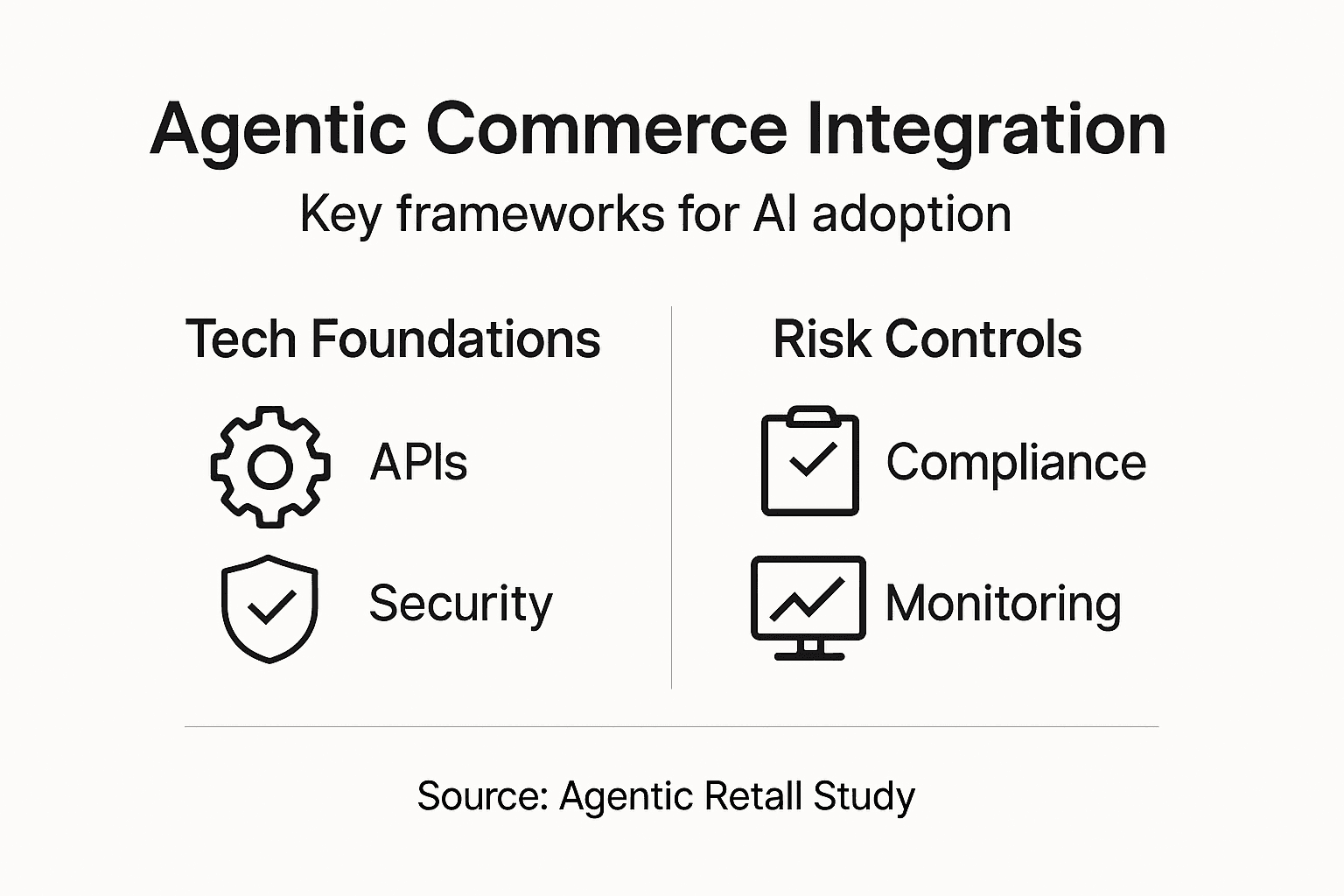
Deploying an AI-ready ERP introduces new governance challenges. Emerging standards facilitate sophisticated agent coordination, but they also require strict security protocols.
Tenant-Scoped Encryption:
Open Mercato mitigates data leakage risks through tenant-scoped encryption. This ensures that even in a multi-tenant environment, data is mathematically isolated. This is critical for regulated industries (healthcare, defense) where an AI agent must not inadvertently cross-reference data between clients.
Best Practices for Implementation:
- Start with Structure: Ensure your product catalog is clean and fully attributed before turning on any AI agents.
- Use the Sandbox: Leverage the Open-Closed architecture to test new pricing plugins in a sandbox environment.
- Monitor the Agents: Implement logging to track every API call made by external agents to ensure they are operating within guardrails.
Unlock the Power of AI with Affinsy
The transition to Agentic Commerce requires a dual approach: a robust foundation and a sharp intelligence layer. Open Mercato provides the infrastructure—the type-safe, structured ERP that holds the truth. Affinsy provides the conceptual intelligence—the analytics and insight engine designed to interpret that truth.
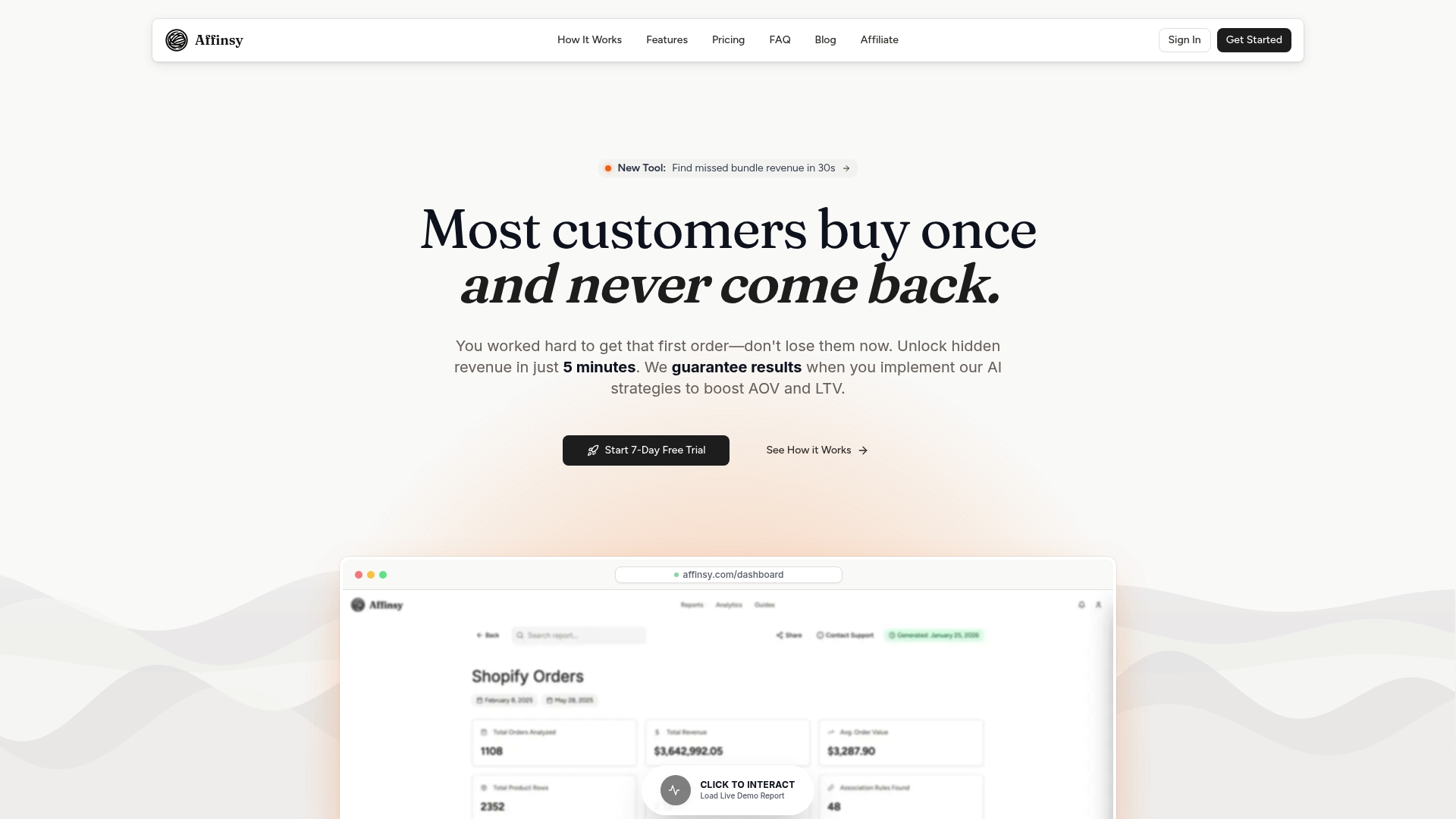
While Open Mercato structures your data for the future, Affinsy is the tool that helps you visualize the complex relationships within it. From conceptualizing powerful Bundle Discovery strategies to defining precise Customer Segmentation models, Affinsy is your partner in navigating the intelligence layer of modern commerce. Don’t just store your data; understand it. Explore how Affinsy can help you leverage the potential of AI-driven analytics today at Affinsy.
Frequently Asked Questions
What is Open Mercato?
Open Mercato is a fully open-source (MIT License) ERP framework designed to be the "operating system" for Agentic Commerce. It features a headless, API-first architecture that allows AI agents to interact with business data reliably.
How does Open Mercato differ from traditional ERPs?
Unlike legacy systems that rely on unstructured data and manual interfaces, Open Mercato uses strict Type Safety (TypeScript) and the Open-Closed Principle. This ensures that the system is stable, predictable, and machine-readable—essential qualities for AI interaction.
What is the role of Affinsy in this ecosystem?
Affinsy represents the Intelligence Layer. While Open Mercato acts as the infrastructure holding the data, Affinsy provides the advanced analytics concepts—like Product Associations and Customer Segmentation—that turn that data into actionable business strategy.
Is Bundle Discovery automatic?
Conceptually, Bundle Discovery is the process of using AI to find hidden product relationships. Open Mercato enables this by providing vector-ready structured data, which external intelligence tools can then analyze to propose dynamic bundles.
Recommended
- AI and Ecommerce Guide: Strategies for Success in 2025 - Affinsy Blog | Affinsy
- Understanding the Agentic Commerce Protocol in E-commerce - Affinsy Blog | Affinsy
- Why Use AI in E-commerce: Understanding Its Impact - Affinsy Blog | Affinsy
- Complete Guide to AI in Ecommerce Analytics - Affinsy Blog | Affinsy
- AI Advertising Strategies: Insights & Trends - Ads Daddy
- AI Tools for Small Business Growth in 2025 | AI and Digital Marketing Service by MCNM