
Finding actionable upsell opportunities often means facing scattered data from multiple commerce systems. E-commerce managers need a structured approach to transform raw sales information into meaningful insights for personalized campaigns. Drawing on strategies like affinity mapping and Market Basket Analysis, this guide reveals data-driven upsell techniques that tap AI analytics to optimize sales and strengthen customer loyalty. Explore how careful data integration, advanced product association discovery, and precise segmentation can help you design smarter upsell experiences for retail success.
Table of Contents
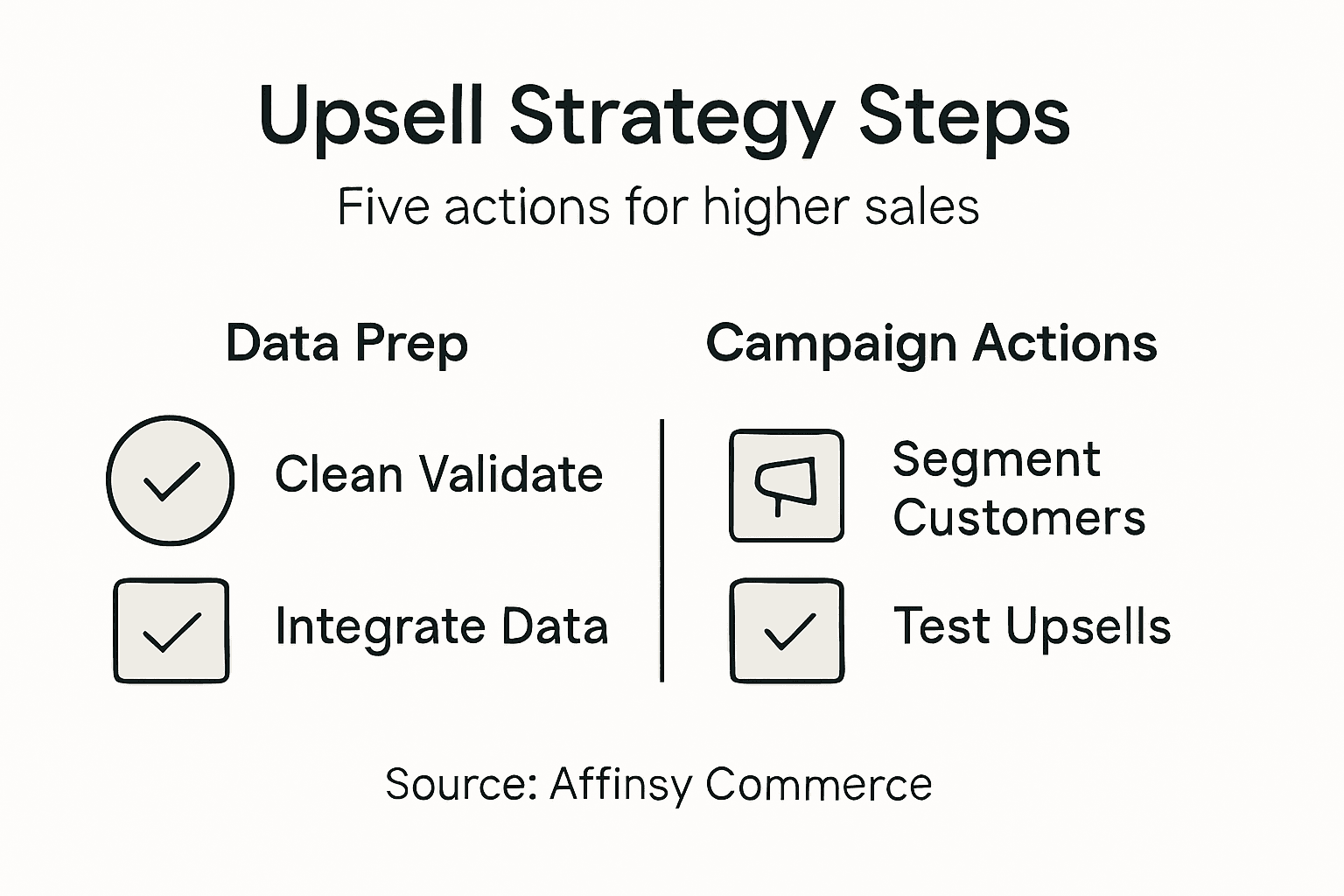
- Step 1: Prepare Affinsy Data Integration For Actionable Insights
- Step 2: Identify Hidden Product Associations To Target Upsells
- Step 3: Segment Customers With RFM Analytics For Personalized Offers
- Step 4: Design And Deploy Bundling And Upsell Campaigns Using AI
- Step 5: Test Upsell Performance And Refine Commerce Strategies
Quick Summary
| Key Point | Explanation |
|---|---|
| 1. Cleanse and Validate Data | Ensure data accuracy by removing duplicates and validating sources for reliable analysis. |
| 2. Identify Product Connections | Utilize Market Basket Analysis to recognize relationships between products for effective upselling. |
| 3. Implement RFM Segmentation | Classify customers based on recency, frequency, and monetary value to tailor marketing efforts. |
| 4. Utilize AI for Recommendations | Leverage AI-driven models for personalized product bundles that enhance customer experience. |
| 5. Measure and Adapt Strategies | Conduct performance testing to refine upsell campaigns and boost revenue through informed adjustments. |
Step 1: Prepare Affinsy Data Integration for Actionable Insights
Transforming raw sales data into strategic insights requires a systematic approach. Effective data integration strategies enable e-commerce managers to unlock powerful business intelligence through careful data preparation and analysis.
Preparing your Affinsy data integration involves several crucial steps:
- Clean incoming data: Remove duplicate entries, standardize formatting
- Validate data sources: Ensure all connected systems provide accurate information
- Map data relationships: Identify key connections between different transaction datasets
- Configure integration settings: Set up automated data transfer protocols
Successful data integration means transforming disconnected information streams into a cohesive analytical framework. By systematically organizing your sales data, you create a robust foundation for generating meaningful business insights that drive strategic decision-making.
Accurate data integration is the cornerstone of transforming raw information into strategic business intelligence.
Pro tip: Schedule regular data validation checks to maintain the integrity and reliability of your integrated datasets.
Step 2: Identify Hidden Product Associations to Target Upsells
Unlocking powerful upsell strategies requires diving deep into your product relationship data. Market Basket Analysis techniques enable e-commerce managers to uncover nuanced connections between products that drive strategic recommendations.
To effectively identify hidden product associations, follow these strategic steps:
- Collect comprehensive transaction data: Gather complete purchase history across all customer segments
- Analyze product co-occurrence: Identify which items are frequently purchased together
- Calculate statistical correlations: Determine the strength of product relationships
- Segment product clusters: Group related products based on purchase patterns
Advanced analytical techniques like machine learning models can help you discover complex product relationships beyond traditional correlation methods. By understanding these subtle connections, you can create highly targeted upsell recommendations that feel natural and relevant to your customers.
Product associations reveal the invisible threads connecting customer purchasing behaviors.
Pro tip: Regularly refresh your product association analysis to capture evolving customer preferences and emerging purchasing trends.
Step 3: Segment Customers with RFM Analytics for Personalized Offers
Customer segmentation transforms raw transaction data into strategic marketing opportunities. RFM analysis techniques enable precise customer categorization based on their purchasing behaviors and potential value.
Implement your RFM segmentation strategy through these systematic steps:
- Collect comprehensive customer data: Aggregate transaction history across all purchase channels
- Calculate recency metrics: Determine how recently customers have made purchases
- Analyze purchase frequency: Identify customers with consistent buying patterns
- Evaluate monetary value: Quantify total customer spending and lifetime value
- Create customer segments: Develop distinct groups based on RFM scores
Effective segmentation allows you to design targeted marketing campaigns that speak directly to each customer group’s unique characteristics. By understanding the nuanced differences between customer segments, you can craft personalized offers that dramatically improve conversion rates and customer loyalty.
Compare traditional segmentation methods to RFM analytics for customer insights:
| Method | Data Used | Granularity | Impact on Personalization |
|---|---|---|---|
| Demographic Segmentation | Age, geography | Low | Broad, less targeted |
| RFM Analytics | Purchase patterns | High | Highly personalized offers |
Strategic customer segmentation transforms data points into actionable marketing insights.
Pro tip: Continuously refine your RFM segments by updating your analysis quarterly to capture evolving customer behavior patterns.
Step 4: Design and Deploy Bundling and Upsell Campaigns Using AI
Transforming product recommendations requires advanced analytical capabilities. AI-driven upsell modeling enables businesses to develop sophisticated, personalized marketing strategies that dramatically increase revenue potential.
Execute your AI-powered bundling campaign through these strategic steps:
- Integrate comprehensive customer data: Consolidate transaction history, browsing behavior, and interaction logs
- Train machine learning models: Develop predictive algorithms that identify potential product associations
- Generate personalized bundle recommendations: Create targeted product combinations for specific customer segments
- Implement dynamic pricing strategies: Adjust bundle pricing based on predicted customer value
- Monitor and optimize campaign performance: Track conversion rates and continuously refine AI models
Successful AI-driven bundling goes beyond simple product matching. By leveraging advanced machine learning techniques, you can create intelligent recommendation systems that anticipate customer needs and seamlessly suggest complementary products.
Intelligent AI models transform raw data into precision-targeted marketing opportunities.
Pro tip: Regularly validate your AI model’s recommendations through A/B testing to ensure continuous improvement and accuracy.

Step 5: Test Upsell Performance and Refine Commerce Strategies
Measuring and improving upsell strategies requires systematic performance evaluation. AI-driven performance testing provides sophisticated analytical frameworks for continuously optimizing sales approaches and customer engagement metrics.
Implement a comprehensive upsell performance testing strategy through these critical steps:
- Define clear performance metrics: Establish specific conversion and revenue benchmarks
- Configure A/B testing protocols: Compare different upsell campaign variations
- Analyze customer response data: Track engagement levels and purchase behaviors
- Evaluate economic impact: Measure incremental revenue and customer lifetime value
- Iterate and refine strategies: Continuously adjust approaches based on empirical insights
Successful upsell performance testing transcends simple numerical analysis. By developing a nuanced understanding of customer interactions and purchasing patterns, you can create increasingly sophisticated and targeted marketing strategies that drive sustainable revenue growth.
Here’s a summary of how each advanced technique contributes to e-commerce upsell success:
| Technique | Core Benefit | Business Impact | Example Use Case |
|---|---|---|---|
| Data Integration | Unifies disparate data sources | Enables holistic sales analysis | Consolidating sales & inventory |
| Market Basket Analysis | Reveals product associations | Drives personalized recommendations | Identifying bundled purchase trends |
| RFM Segmentation | Categorizes customer behavior | Supports targeted marketing | Tailoring offers by loyalty |
| AI Bundling Models | Predicts upsell opportunities | Maximizes revenue per transaction | Dynamic personalized bundles |
| Performance Testing | Measures campaign results | Refines and improves strategies | A/B testing upsell offers |
Continuous measurement and adaptation are the cornerstones of effective upsell optimization.
Pro tip: Implement a quarterly review cycle to systematically assess and recalibrate your upsell performance testing methodologies.
Maximize Your Upsell Potential with Affinsy’s AI-Powered Commerce Solutions
The article highlights the challenge of transforming scattered sales data into actionable upsell strategies through techniques like market basket analysis and RFM customer segmentation. If you struggle to uncover hidden product associations or personalize offers effectively your goals of increasing average order values and customer loyalty can feel out of reach. Affinsy addresses these pain points by providing a seamless platform that integrates your e-commerce data and applies advanced AI analytics to reveal subtle product connections and detailed customer behavior patterns. This empowers you to design dynamic bundling campaigns and data-driven upsells that truly resonate with your customers.
Unlock the full power of your transaction data with features like automated product association discovery and precise customer segmentation. Affinsy integrates effortlessly with Shopify, WooCommerce, and Google Analytics so you can focus on strategic growth without the need for complex data science skills. Harnessing the insights from market basket analysis and RFM analytics transforms your upsell approach into a revenue-driving engine.
Ready to elevate your e-commerce sales with intelligent upsell strategies?
Explore how Affinsy’s AI-driven platform can optimize your product bundling and customer retention tactics. Visit Affinsy now to start turning your sales data into higher profits and stronger customer relationships.
Frequently Asked Questions
How can I prepare my data for effective upselling strategies?
To prepare your data for effective upselling, start by ensuring that you clean and validate incoming sales data. This helps in mapping data relationships and configuring integration settings to streamline your data flow within approximately 30 days.
What steps should I take to identify product associations for upselling?
To identify product associations for upselling, collect comprehensive transaction data and analyze which items are frequently purchased together. Implement this analysis regularly to uncover new relationships within your product offerings and adjust your strategies accordingly.
How can RFM analysis improve my customer segmentation for upselling?
RFM analysis improves customer segmentation by categorizing customers based on their purchasing patterns: recency, frequency, and monetary value. By implementing this analysis quarterly, you can tailor personalized offers that resonate with different customer groups, potentially increasing conversion rates by ~20%.
What role does AI play in designing upsell campaigns?
AI plays a crucial role in designing upsell campaigns by generating personalized product recommendations based on customer purchasing behaviors. By integrating customer data and continuously training your models, you can tailor these recommendations to meet customer needs, increasing overall sales efficiency.
How can I measure the performance of my upsell strategies?
To measure the performance of your upsell strategies, define clear performance metrics and set up A/B testing protocols to evaluate different campaign variations. Regularly analyze customer response data and adjust your tactics based on the insights gathered, aiming for a comprehensive review every quarter to ensure optimal performance.
Recommended
- Cross Sell Strategies Step by Step for E-Commerce Growth - Affinsy Blog | Affinsy
- Boost Your AOV: The Power of Market Basket Analysis for Upsells & Cross-sells - Affinsy Blog | Affinsy
- Cross Selling Strategies Guide to Boost Online Store Revenue - Affinsy Blog | Affinsy
- The Cross-Sell Is Not Just a Feature, It’s Your Masterpiece - Affinsy Blog | Affinsy
- DropPop | Depop Dropshipping