
Finding the right approach to suggest relevant products can feel challenging when every purchase counts for revenue and loyalty. E-commerce managers need strategic tools that identify genuine customer needs while increasing sales. This guide unpacks how data-driven cross-selling techniques, including Collaborative filtering and association rule mining, help online retailers worldwide recommend the perfect add-on, create personalized buyer journeys, and build repeat business without sacrificing trust.
Table of Contents
- Defining Cross-Selling in E-Commerce
- Major Types of Cross-Selling Techniques
- How AI Analytics Power Smart Cross-Selling
- Top Cross-Selling Mistakes and How to Avoid Them
- Maximizing Customer Value with Data Insights
Key Takeaways
| Point | Details |
|---|---|
| Cross-Selling Strategy | Cross-selling enhances customer experience by recommending complementary products during a purchase. It increases average order values by suggesting relevant items. |
| AI-Powered Recommendations | Utilizing AI analytics enables precise, personalized cross-selling through dynamic recommendation engines and behavioral pattern recognition. This shifts cross-selling from a generic to a customer-centric strategy. |
| Common Mistakes | E-commerce businesses often fail in cross-selling due to irrelevant recommendations and aggressive tactics. Avoiding these pitfalls requires understanding customer preferences and providing contextually relevant suggestions. |
| Data-Driven Insights | Implementing advanced data analytics allows for effective customer segmentation and predictive modeling, transforming raw data into meaningful insights that enhance cross-selling efforts. |
Defining Cross-Selling in E-Commerce
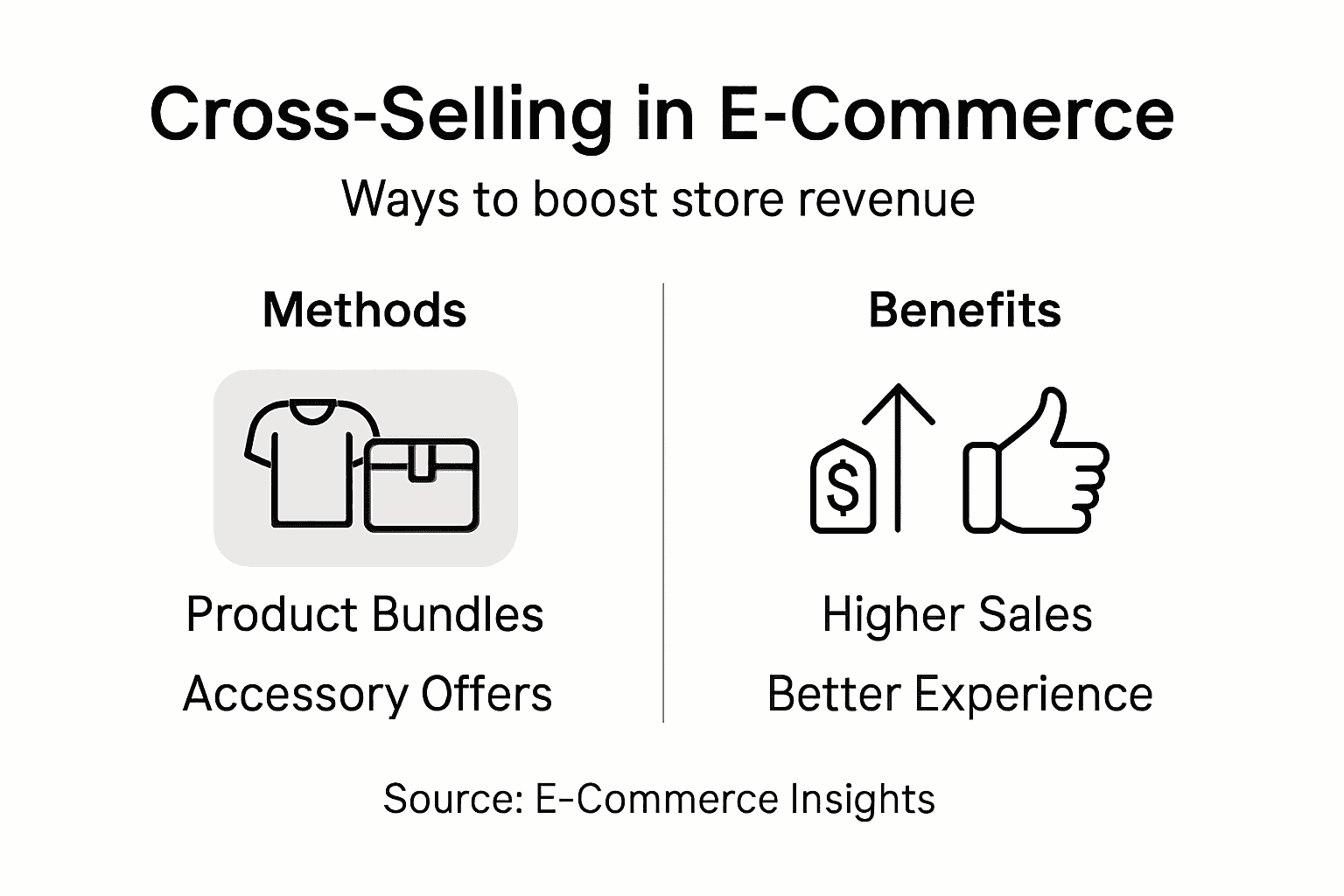
Cross-selling is a strategic sales approach where online retailers recommend complementary or additional products to customers who are already making a purchase. Unlike upselling, which encourages buying a higher-priced item, cross-selling focuses on expanding the current transaction’s value by suggesting relevant, related items.
In e-commerce, cross-selling leverages data-driven product recommendation strategies to enhance customer experience and increase average order values. These recommendations are typically generated through sophisticated techniques like:
- Collaborative filtering algorithms
- Association rule mining
- Customer purchase history analysis
- Real-time browsing behavior tracking
The primary goals of cross-selling in digital commerce include:
Here is a comparison of cross-selling and upselling to clarify their unique business impacts:
| Approach | Customer Focus | Objective | Resulting Value |
|---|---|---|---|
| Cross-Selling | Suggests related products | Increase average order value | Broader solution for customer |
| Upselling | Promotes higher-end versions | Encourage bigger single purchase | Higher-priced item sold |
- Increasing immediate transaction revenue
- Improving customer satisfaction
- Building long-term customer loyalty
- Providing personalized shopping experiences
Successful cross-selling requires understanding customer preferences and offering genuinely useful product recommendations. Retailers must balance strategic suggestions with customer trust, ensuring recommendations feel helpful rather than intrusive.
Cross-selling transforms a single product purchase into a more comprehensive customer solution, creating value for both the buyer and the seller.
Pro tip: Analyze your customers’ past purchase patterns and leverage machine learning algorithms to generate highly personalized cross-selling recommendations that feel authentic and valuable.
Major Types of Cross-Selling Techniques
Cross-selling techniques in e-commerce encompass a range of strategic approaches designed to maximize customer value and increase transaction revenues. Targeted promotional methods vary widely, allowing online retailers to create personalized recommendations that resonate with individual customer preferences.
The primary cross-selling techniques include:
- Complementary Product Recommendations
- Suggesting items that enhance the primary product
- Based on product compatibility and customer usage patterns
- Bundled Offerings
- Packaging related products at a slight discount
- Encouraging larger transaction values
- Loyalty-Based Recommendations
- Targeting repeat customers with personalized suggestions
- Leveraging historical purchase data
E-commerce platforms typically implement cross-selling through several sophisticated approaches:
- Machine learning algorithms that analyze purchase histories
- Real-time browsing behavior tracking
- Collaborative filtering techniques
- Contextual product placement strategies
The effectiveness of cross-selling depends on understanding nuanced customer behaviors and delivering recommendations that feel genuinely helpful rather than intrusive. Retailers must balance data-driven insights with a deep understanding of customer preferences and emotional purchasing triggers.
Successful cross-selling transforms transactional interactions into personalized shopping experiences that provide authentic value to customers.
Pro tip: Continuously refine your cross-selling algorithms by conducting A/B testing and analyzing customer response rates to improve recommendation accuracy and relevance.
How AI Analytics Power Smart Cross-Selling
Artificial intelligence has revolutionized cross-selling strategies by enabling advanced predictive recommendation systems that transform how e-commerce platforms understand and engage customers. These sophisticated technologies analyze vast amounts of customer data to generate highly personalized product recommendations with unprecedented accuracy.
Key AI-powered cross-selling capabilities include:
- Behavioral Pattern Recognition
- Tracking individual customer browsing and purchase histories
- Identifying subtle product relationship patterns
- Predicting potential customer interests
- Dynamic Recommendation Engines
- Real-time product suggestion algorithms
- Contextual recommendation generation
- Continuous learning and adaptation
- Personalization Technologies
- Segmenting customers based on complex behavioral attributes
- Generating micro-targeted product suggestions
- Adapting recommendations across different customer journey stages
The core mechanisms driving AI-enhanced cross-selling involve multiple sophisticated techniques:
- Machine learning algorithms that continuously refine recommendation accuracy
- Collaborative filtering techniques analyzing collective user behaviors
- Deep learning models identifying nonlinear product relationships
- Natural language processing for understanding product context
Unlike traditional recommendation systems, AI-driven analytics can uncover intricate connections between products that human analysts might overlook, creating more nuanced and compelling cross-selling opportunities.

To better understand where AI adds value, here’s a summary of how traditional and AI-driven cross-selling differ:
| Aspect | Traditional Cross-Selling | AI-Driven Cross-Selling |
|---|---|---|
| Recommendation Method | Manual, rule-based | Automated, data-driven |
| Personalization Level | Limited segmentation | Deep micro-targeting |
| Adaptability | Static, infrequent updates | Real-time, continuous learning |
| Discovery of Patterns | Surface-level associations | Complex, hidden correlations |
AI transforms cross-selling from a generic marketing tactic into a precision-driven, customer-centric strategy that delivers genuine value.
Pro tip: Implement multi-layered AI recommendation models that combine behavioral, demographic, and contextual data to create hyper-personalized cross-selling experiences.
Top Cross-Selling Mistakes and How to Avoid Them
E-commerce businesses frequently undermine their cross-selling potential by making critical strategic errors that can alienate customers and reduce overall sales effectiveness. Common cross-selling implementation failures reveal systemic challenges that require sophisticated understanding and strategic intervention.
Most prevalent cross-selling mistakes include:
- Irrelevant Product Recommendations
- Suggesting unrelated or low-value items
- Ignoring customer purchase context
- Failing to analyze true product relationships
- Aggressive Sales Tactics
- Overwhelming customers with too many suggestions
- Using pushy, non-personalized marketing approaches
- Disrupting natural customer browsing experience
- Poor Data Utilization
- Neglecting comprehensive customer behavior analysis
- Using outdated or incomplete customer information
- Lacking sophisticated recommendation algorithms
The most critical strategies for avoiding these mistakes involve:
- Implementing advanced AI-powered recommendation systems
- Developing granular customer segmentation approaches
- Creating contextually relevant product suggestions
- Continuously refining recommendation algorithms
Successful cross-selling requires a delicate balance between helpful suggestions and respecting customer autonomy. Retailers must develop nuanced strategies that feel intuitive and genuinely valuable to customers, rather than intrusive or manipulative.
Cross-selling should enhance the customer’s shopping experience, not compromise it through excessive or irrelevant recommendations.
Pro tip: Develop a robust feedback loop that tracks customer response to cross-selling recommendations, allowing continuous refinement of your suggestion algorithms.
Maximizing Customer Value with Data Insights
Data-driven strategies have revolutionized how e-commerce businesses approach cross-selling, transforming raw customer information into powerful insights that drive strategic decision-making. Advanced customer behavior analytics enable retailers to create highly personalized and targeted cross-selling approaches that significantly enhance customer value.
Key data-driven strategies for maximizing customer value include:
- Transaction Pattern Analysis
- Identifying recurring purchase behaviors
- Recognizing product relationship clusters
- Predicting future buying preferences
- Customer Segmentation
- Developing granular customer profiles
- Creating tailored recommendation strategies
- Matching products to specific customer segments
- Predictive Recommendation Modeling
- Utilizing machine learning algorithms
- Generating context-aware suggestions
- Continuously refining recommendation accuracy
Successful data-driven cross-selling requires a comprehensive approach that goes beyond simple transaction tracking:
- Integrate multiple data sources
- Implement advanced machine learning models
- Create dynamic customer profile updates
- Develop real-time recommendation engines
The ultimate goal is transforming raw data into meaningful insights that create genuine value for both customers and businesses. This approach requires sophisticated analytics that understand the nuanced relationships between customer behaviors and product recommendations.
Data insights are not just about collecting information, but about transforming that information into strategic, customer-centric opportunities.
Pro tip: Invest in robust data infrastructure that allows seamless integration of customer behavioral data across multiple touchpoints to create truly comprehensive customer profiles.
Unlock the Full Potential of Cross-Selling with Affinsy
Understanding how to effectively implement cross-selling strategies is a game changer for any e-commerce business. The article highlights common challenges like irrelevant product recommendations and poor data utilization that can undermine your sales growth. If your goal is to increase average order value and build loyal customers through personalized, data-driven insights, you need a solution that goes beyond manual guesswork. Affinsy specializes in uncovering hidden product associations and customer segments with advanced AI-powered analytics, helping you optimize every cross-selling opportunity. With features like market basket analysis and RFM customer segmentation, you gain a deeper understanding of transactional data to craft precise, relevant product bundles that boost immediate revenue and customer satisfaction.

Take control of your cross-selling success today by exploring how Affinsy’s SaaS platform integrates seamlessly with Shopify and WooCommerce. Discover the power of actionable insights through custom report generation and advanced dashboards that make complex data simple. Don’t let missed opportunities hold you back. Visit Affinsy now to transform your e-commerce sales with smarter analytics and start delivering personalized shopping experiences that truly resonate with your customers.
Frequently Asked Questions
What is cross-selling in e-commerce?
Cross-selling in e-commerce is a sales strategy where retailers recommend complementary or additional products to customers who are already making a purchase, enhancing transaction value by suggesting related items.
How does cross-selling differ from upselling?
Cross-selling focuses on suggesting related products that enhance a primary item, while upselling encourages customers to purchase a higher-priced version of a product. Both aim to increase sales but do so through different approaches.
What are some effective cross-selling techniques for online stores?
Effective cross-selling techniques include offering complementary product recommendations, creating bundled offerings, and leveraging loyalty-based recommendations to provide personalized suggestions to repeat customers.
How can artificial intelligence improve cross-selling strategies?
AI can enhance cross-selling strategies by analyzing vast amounts of customer data to generate highly personalized recommendations, recognizing behavioral patterns, and creating dynamic, real-time suggestion engines that adapt to customer interactions.
Recommended
- Cross-Selling — E-Commerce Glossary | Affinsy | Affinsy
- Cross-Selling Strategy Process for E-Commerce Success - Affinsy Blog | Affinsy
- Cross Sell Strategies Step by Step for E-Commerce Growth - Affinsy Blog | Affinsy
- Cross Selling Strategies Guide to Boost Online Store Revenue - Affinsy Blog | Affinsy
- Top 8 Unique Business Card Solutions for 2026 – BcardsCreation