
Every online retailer hits a wall when juggling data scattered across platforms like Shopify, Google Analytics, and email tools. Connecting these sources builds the groundwork for meaningful analysis, turning siloed numbers into a single, holistic view. With a unified data infrastructure across every touchpoint, you can pinpoint which product bundles actually drive repeat purchases and shape marketing strategies that keep customers coming back.
Table of Contents
- Step 1: Connect and Configure Data Sources
- Step 2: Analyze Product Associations and Customer Segments
- Step 3: Generate and Interpret Actionable Reports
- Step 4: Implement Recommendations to Optimize Sales
- Step 5: Monitor Results and Refine Strategies
Quick Summary
| Key Point | Explanation |
|---|---|
| 1. Connect Data Sources First | Start by linking your e-commerce platform and analytics tools to ensure comprehensive and accurate data gathering from the beginning. |
| 2. Analyze Product Associations | Identify which products are often bought together to improve bundling strategies and enhance marketing efforts. |
| 3. Implement Tailored Marketing | Use customer segments to deliver personalized marketing messages that cater to the specific needs of each group. |
| 4. Create Actionable Reports | Design reports that highlight essential metrics and recommend actions, making it clear how to improve performance. |
| 5. Monitor and Adjust Strategies | Regularly review performance metrics to refine strategies based on data insights, enabling responsive adjustments to optimize sales. |
Step 1: Connect and Configure Data Sources
You’re about to build the foundation for all your actionable insights. This step involves connecting your e-commerce platform to data sources that track customer behavior across your entire business. Getting this right means you’ll have accurate, comprehensive data flowing into your analytics system from day one.
Start by identifying which platforms and tools already collect your customer data. Most online retailers use multiple systems that don’t naturally talk to each other. Your Shopify store, Google Analytics account, email marketing platform, and customer database all hold valuable information. The challenge is bringing them together.
Begin with your primary e-commerce platform. Whether you’re on Shopify, WooCommerce, or another system, connect it first. This is where your transaction data lives, and it’s critical for understanding sales patterns and customer purchases.
Next, add your analytics sources. Google Analytics 4 and tag management systems provide granular tracking of customer behavior at every funnel stage. These tools capture product impressions, add-to-cart actions, and completed transactions. Without this layer, you’re missing how customers actually interact with your store.
Then consider adding customer data platforms and email marketing tools. These sources reveal customer demographics, purchase frequency, and engagement patterns. When combined with your transaction data, they create a unified view across every touchpoint, from acquisition through retention.
Here’s what to configure for each connection:
- Authentication credentials: Retrieve API keys or access tokens from each platform
- Data permissions: Set which data fields can be accessed and synced
- Sync frequency: Choose how often data updates (daily, hourly, or real-time)
- Data mapping: Align field names so customer records match across systems
- Historical data: Decide whether to import past data or start fresh
After connecting each source, run a test sync to verify data is flowing correctly. Check that transaction counts match, customer IDs align, and no fields are missing. Small configuration issues now prevent larger problems later.
Here’s a quick reference for commonly used e-commerce data sources and their business benefits:
| Data Source | Key Insight Unlocked | Typical Business Benefit |
|---|---|---|
| E-commerce Platform | Sales trends, purchase history | Improved merchandising decisions |
| Analytics Tool | Customer behavior tracking | Optimized user experience |
| Email Service | Engagement rates, segments | Increased retention and conversions |
| Customer Database | Demographics, purchase frequency | Personalized marketing campaigns |
A unified data infrastructure across all touchpoints is what enables actionable insights for 2026 and beyond.
Pro tip: Start with your three most critical data sources rather than trying to connect everything at once, which can create confusion and sync errors; add additional sources after you’ve validated the core setup is working correctly.
Step 2: Analyze Product Associations and Customer Segments
Now that your data is connected, it’s time to uncover the patterns that drive revenue. This step focuses on two critical analyses: understanding which products customers buy together and segmenting your audience into actionable groups. These insights directly impact your bundling strategy and customer retention.
Start with product associations. Your data already contains clues about which items naturally pair together. A customer who buys running shoes often purchases athletic socks in the same order. Another buys kitchen mixers and mixer attachments as a set. These patterns aren’t random, and identifying them transforms how you market and merchandise.
Use your historical transaction data to identify which products frequently appear in the same order. Look for combinations that appear consistently across different customer types and time periods. Products with strong associations are prime candidates for bundling, cross-sell recommendations, and coordinated promotions.

Next, move to customer segmentation. Methods like RFM analysis and customer clustering group your audience based on purchasing behavior and demographics. RFM stands for Recency, Frequency, and Monetary value, and it reveals which customers are your most valuable, which are at risk of leaving, and which have potential for growth.
Approach segmentation in these stages:
- Identify variables: Use purchase history, frequency, spending amount, and demographic data
- Apply segmentation methods: Group customers by behavioral patterns and value tiers
- Create segment profiles: Document what each segment looks like (high-value repeat buyers, occasional browsers, dormant customers)
- Test against reality: Validate that segments behave differently and respond to different marketing approaches
With these segments identified, personalized marketing becomes possible. Your high-value customers might receive exclusive early access to new products, while at-risk customers get targeted discount offers. New customers in growth potential segments receive onboarding content and educational resources.
Here’s a summary of how segment-specific marketing can drive results:
| Customer Segment | Tailored Strategy | Expected Outcome |
|---|---|---|
| High-value buyers | Exclusive launches, loyalty rewards | Boosted lifetime value and loyalty |
| At-risk customers | Win-back offers, incentives | Reduced churn, regained sales |
| New customers | Onboarding, education | Increased trust and repeat orders |
Product associations reveal immediate sales opportunities, while customer segments enable you to tailor every interaction to what each group actually values.
Pro tip: Focus first on identifying your top three customer segments and the product associations within each segment separately; this reveals which bundles resonate with which audiences rather than applying one-size-fits-all bundling across your entire customer base.
Step 3: Generate and Interpret Actionable Reports
Your data is organized and your insights identified. Now you need to transform those insights into reports that drive decisions. This step teaches you how to create reports that stakeholders actually understand and act on. Bad reports sit in inboxes. Good reports change behavior.
Start by identifying which metrics matter most to your business. Traffic sources tell you where customers come from, but conversion rates tell you which sources produce actual sales. Average order value and customer lifetime value reveal profitability patterns that simple transaction counts miss. Cart abandonment rates expose friction points in your checkout process.
When generating your reports, focus on the customer journey perspective. Rather than throwing every metric at your team, organize data by funnel stage. Show acquisition metrics separately from engagement metrics, which are different from retention metrics. This structure helps stakeholders understand where problems exist.
Understanding key ecommerce metrics and their relationships enables you to diagnose why your sales are trending a certain direction. If conversion rates drop while traffic increases, your problem isn’t visibility, it’s user experience or product match.
Build your reports using these elements:
- Summary dashboard: Show top KPIs at a glance with trend indicators
- Detailed breakdowns: Segment performance by product category, traffic source, or customer segment
- Comparative analysis: Compare this month to last month, this year to last year
- Actionable insights: Highlight what changed and why it matters
- Recommended actions: Suggest specific next steps based on the data
Interpretation is where real value emerges. Numbers alone don’t change anything. Your job is to connect the data to business outcomes and explain what action each insight demands. When you see that customers from organic search have 40 percent higher lifetime value than paid search customers, that insight demands budget reallocation. When bundled products show 3.2 times higher repeat purchase rates, that insight demands merchandising strategy changes.
The most valuable report isn’t the most detailed. It’s the one that clearly shows what to do differently tomorrow.
Pro tip: Create a standard monthly report template that your entire team understands, then layer custom deep-dive reports on top of it; this keeps everyone aligned on core metrics while allowing flexibility for investigating emerging opportunities.
Step 4: Implement Recommendations to Optimize Sales
Insights mean nothing without action. This step is where you take what you’ve learned and deploy it into your store. Implementation transforms data into revenue. The difference between winners and competitors is execution speed.
Start with your highest-impact recommendations. Your analysis identified product bundles that sell together, customer segments with distinct needs, and checkout friction points. Prioritize implementing changes that affect the most customers or generate the biggest revenue opportunity first.
Begin by deploying AI-powered product recommendations at key touchpoints in your customer journey. Place bundle recommendations on product pages to capture intent early. Show personalized cross-sell suggestions in the cart to increase average order value. Send follow-up recommendations in post-purchase emails to drive repeat orders.
Next, segment your marketing efforts. Your high-value customer segment might receive exclusive product launches and loyalty rewards, while at-risk customers receive win-back campaigns with targeted incentives. New customer segments need onboarding sequences that educate them about your brand and build trust.
Optimization requires systematic testing and adjustment:
- Set baseline metrics: Document current performance before changes launch
- Implement changes: Deploy bundles, recommendations, and segment-specific campaigns
- Track results: Monitor how each change affects conversion rates and order value
- Test variations: Try different bundle combinations, messaging angles, and incentive levels
- Scale winners: Double down on what works, pivot away from what doesn’t
Implementation isn’t a one-time event. Your customers and market conditions change constantly. Review your data monthly to identify new patterns and emerging opportunities. A bundle that worked great in January might need refreshing by summer as inventory shifts.
The best recommendations mean nothing if they never reach your customers. Perfect your implementation process, then measure everything.
Pro tip: Start with one high-impact recommendation on one platform (like bundle suggestions on your top-performing product pages), measure results for two weeks, then expand to other areas once you’ve validated the approach and trained your team on the new workflow.
Step 5: Monitor Results and Refine Strategies
You’ve implemented your recommendations and deployed your strategies. Now comes the discipline of measurement and continuous improvement. Monitoring separates successful e-commerce managers from those who implement once and hope. Your goal is building a feedback loop where data constantly informs decisions.
Start by establishing clear key performance indicators before you measure anything. Define exactly what success looks like for each initiative you’ve launched. If you implemented product bundles, track bundle attach rate and average order value increase. If you launched segment-specific campaigns, measure conversion rates and customer acquisition cost by segment.
Set up regular review cadences. Weekly reviews catch acute problems quickly, monthly reviews identify trends, and quarterly reviews guide strategic adjustments. Most successful retailers review data every Monday morning to catch the weekend’s performance signals while momentum is fresh.
When analyzing results, look beyond topline numbers. Using A/B testing and regular data reviews reveals which specific changes drove results and which underperformed. Test different bundle messaging to see which language resonates. Experiment with email send times to optimize open rates. Track which customer segments respond to which offers.
Your monitoring process should include:
- Daily dashboards: Check critical metrics like revenue, conversion rate, and cart abandonment
- Weekly deep dives: Analyze which products, segments, and campaigns performed best
- Monthly experiments: Launch two to three A/B tests exploring new approaches
- Quarterly strategy review: Assess what worked, what didn’t, and how to adjust priorities
- Customer feedback integration: Combine quantitative data with qualitative insights from surveys and support conversations
Refinement means being willing to change course. A bundle that seemed logical based on association analysis might not resonate with customers in practice. A segment-specific campaign might underperform expectations. When this happens, don’t defend the original strategy. Pivot quickly toward what’s working.
Monitoring without action is just data collection. Real insight comes when you adjust strategy based on what the numbers reveal.
Pro tip: Create a simple scorecard with five to seven key metrics that you review every Monday; if any metric drops more than 10 percent from the previous week, investigate the cause immediately rather than waiting for monthly reviews to surface problems.
Unlock Actionable Ecommerce Insights with Affinsy Today
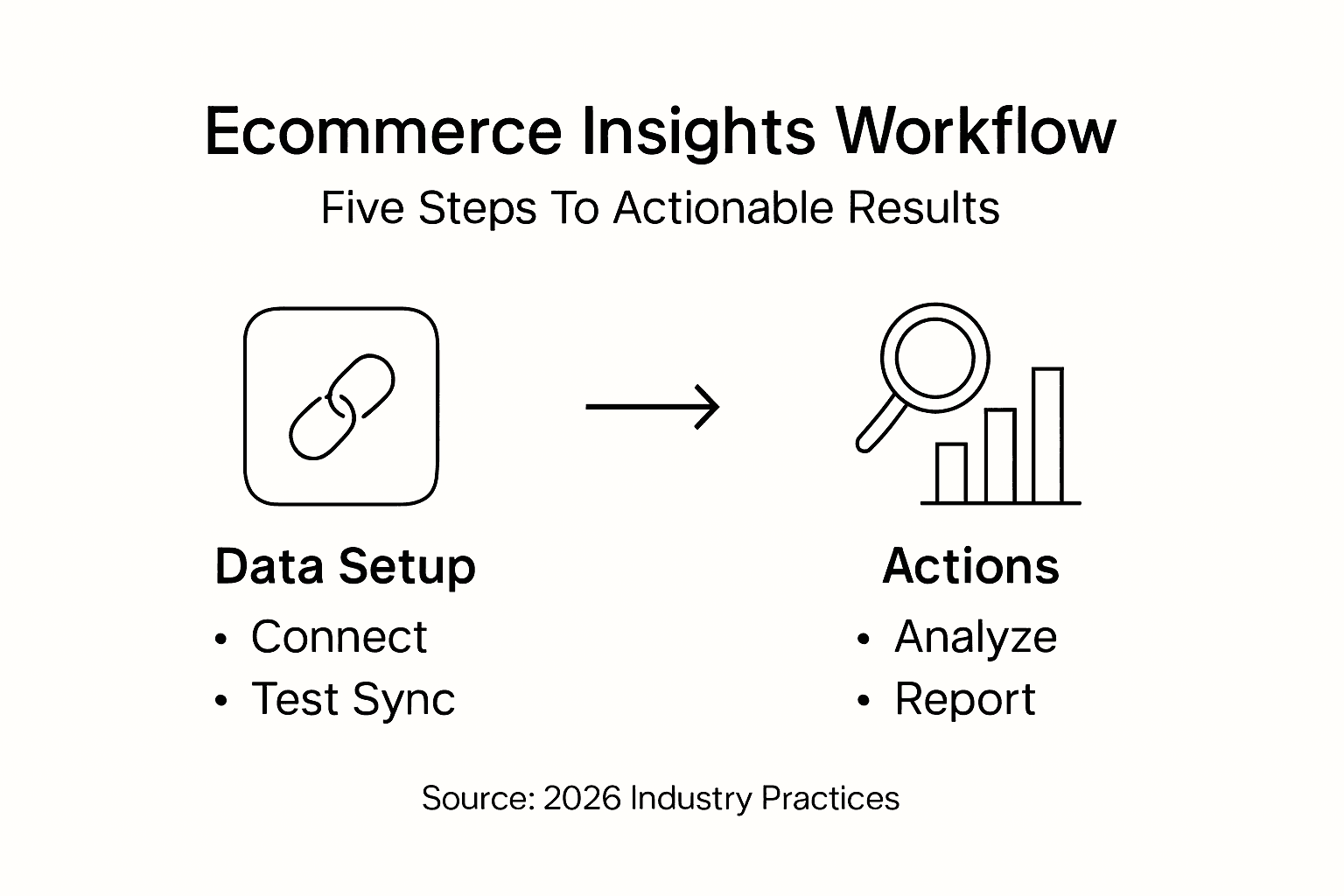
Building a solid data foundation and transforming complex customer behaviors into clear strategies is a challenge many ecommerce managers face as highlighted in the “Workflow for Actionable Ecommerce Insights in 2026.” You need a tool that effortlessly reveals hidden product associations and customer segments, enabling smarter product bundling and personalized marketing. Affinsy answers this need with AI-powered analytics designed specifically to simplify your journey from data connection to actionable reports without requiring data science expertise.
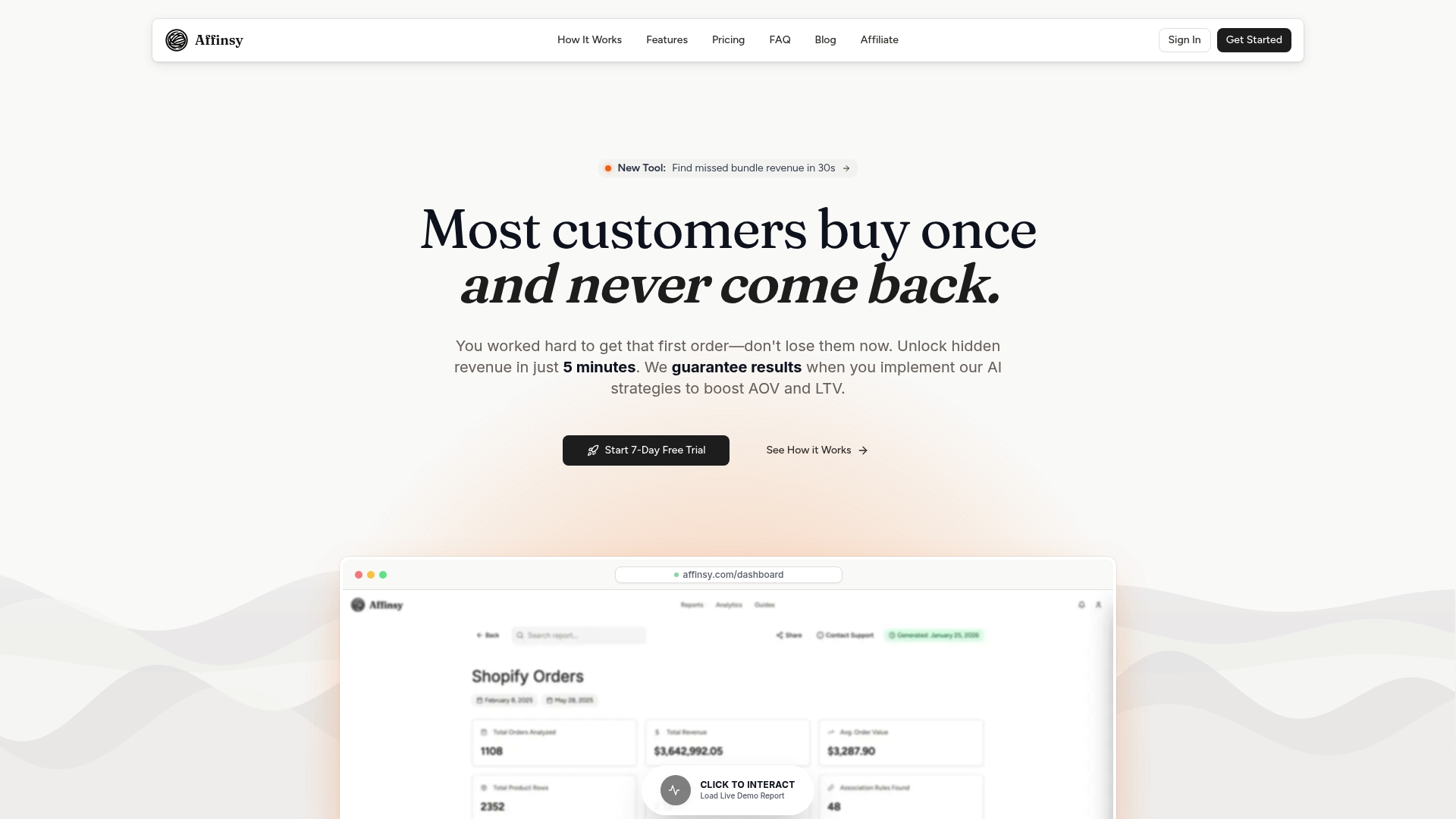
Discover how Affinsy integrates seamlessly with Shopify, WooCommerce, and Google Analytics to provide advanced dashboards, custom reporting, and market basket analysis that drives higher average order values and customer retention. Don’t let siloed data or slow manual analysis hold you back. Start unlocking precise, scalable insights now that empower you to optimize your ecommerce strategy and grow sales faster. Visit Affinsy and take control of your ecommerce success today.
Frequently Asked Questions
What are the first steps to connect my e-commerce data sources for actionable insights?
Start by identifying your primary e-commerce platform and connect it first, as it holds your transaction data. Then, link your analytics tools and customer data platforms to combine insights, ensuring data flows accurately.
How can I identify product associations to boost sales?
Analyze your historical transaction data to find patterns in which products customers frequently buy together. Look for strong associations and consider bundling these products to enhance your marketing strategies.
What metrics should I include in my reports for effective decision-making?
Focus on key performance indicators such as conversion rates, average order value, and cart abandonment rates, as these metrics reveal actionable insights. Organize the data by the customer journey stages to clarify where improvements are needed.
How do I prioritize recommendations to optimize sales?
Begin with the highest-impact recommendations that address checkout friction points or enhance product bundles. Implement changes that can positively affect the most customers or generate the biggest revenue opportunity first.
What is the best way to monitor the results of implemented strategies?
Establish clear key performance indicators to measure success for each initiative and set a regular review cadence. Use daily dashboards for critical metrics and conduct weekly deep dives to analyze performance, adjusting strategies based on findings.
How often should I review my data to refine strategies effectively?
Conduct monthly reviews to identify trends and implement regular A/B testing to experiment with new approaches. This continuous feedback loop helps you refine strategies and pivot quickly if certain elements aren’t performing as expected.
Recommended
- E Commerce Analysis Report Guide for 2025 Success - Affinsy Blog | Affinsy
- Actionable Ecommerce Analytics Explained: Boost Revenue - Affinsy Blog | Affinsy
- Customer Insights Analytics Guide: Unlocking Value in 2025 - Affinsy Blog | Affinsy
- 7 Essential Sales Analysis Report Insights for 2025 - Affinsy Blog | Affinsy
- Men’s Fashion Trends 2025 Guide for UK Style Success – Vellure Homme