
Choosing the right AI sales optimization strategy can unlock exponential e-commerce growth, yet many retailers struggle to find tools that balance accuracy, integration ease, and cost. With revenue at stake, selecting AI methods that deliver actionable insights without requiring extensive data science skills is critical. This guide walks you through a criteria-based framework to evaluate AI-driven segmentation, bundling, and cross-selling strategies, helping you maximize sales and retention in 2026.
Table of Contents
- How To Choose The Right AI Sales Optimization Strategy
- AI-Powered Customer Segmentation Techniques
- Market Basket Analysis (MBA) For Product Bundling
- Automated Cross-Selling And Product Bundling Strategies
- Integration Of AI Analytics With E-Commerce Platforms
- Metrics For Evaluating Sales Optimization Success
- Summary Comparison And Situational Recommendations
- Boost Your E-Commerce Growth With Affinsy AI Solutions
- Frequently Asked Questions
Key takeaways
| Point | Details |
|---|---|
| AI segmentation and bundling boost sales | AI-powered customer segmentation and product bundling can increase sales growth by up to 30% when combined effectively. |
| RFM segmentation increases ROI | RFM segmentation improves marketing ROI by up to 20% with higher retention and engagement. |
| Market Basket Analysis lifts order value | Market Basket Analysis reveals product pairings that increase average order value by 15–30%. |
| Platform integration accelerates results | Integration with Shopify and Google Analytics speeds analysis and campaign execution. |
| Balance accuracy, cost, and usability | Choosing the right AI tool requires evaluating insight accuracy, cost, integration, and ease of use. |
How to choose the right AI sales optimization strategy
Selecting an AI sales optimization tool begins with evaluating criteria that directly impact your bottom line. Accuracy and relevance of actionable insights are paramount because even the most sophisticated AI fails if recommendations don’t translate to measurable sales impact. Look for platforms that provide clear, data-backed suggestions on customer segments and product bundles.
Ease of integration with your existing e-commerce stack is equally critical. Seamless connections with platforms like Shopify, WooCommerce, and Google Analytics eliminate data silos and enable smooth workflows. You want AI that enhances your operations, not disrupts them with complex setup processes or compatibility issues.
Cost-effectiveness must balance expected sales uplift with investment. Calculate projected revenue gains from improved conversion rates and average order values against subscription fees or implementation costs. For example, top ecommerce analytics platforms comparison reviews show that mid-tier tools often deliver 80% of enterprise-level insights at a fraction of the price.
Support for essential AI techniques such as RFM customer segmentation and Market Basket Analysis maximizes value. These methods form the foundation of modern e-commerce optimization, enabling personalized marketing and intelligent product recommendations. User-friendly interfaces and customizable reporting speed decision-making and adoption across your team.
Pro Tip: Start with a pilot test on a single product category or customer segment to validate AI recommendations before full-scale rollout, reducing risk and building internal confidence.
- Prioritize platforms offering free trials or money-back guarantees to test fit
- Verify real-time data syncing capabilities to ensure insights remain current
- Assess vendor support quality through reviews and initial consultation responsiveness
- Check for pre-built templates and automation workflows to accelerate implementation
- Confirm data export options to maintain flexibility and avoid vendor lock-in
AI-powered customer segmentation techniques
RFM segmentation categorizes customers based on three dimensions: Recency (how recently they purchased), Frequency (how often they buy), and Monetary value (how much they spend). This framework identifies your most valuable customers and those at risk of churning, enabling targeted marketing that delivers up to 20% higher marketing ROI.

AI automates RFM analysis by continuously processing transaction data and updating segments in real time. Traditional manual segmentation takes days or weeks; AI does it instantly. This automation triggers personalized email campaigns that achieve 29% higher open rates and 41% higher click-through rates compared to generic messages.
Personalized marketing enabled by AI segments improves conversion rates and customer loyalty. When you know a customer recently purchased running shoes and frequently buys athletic gear, recommending workout apparel becomes highly relevant. Shopify stores implementing AI segmentation saw retention improvements up to 18%, directly boosting lifetime value.
Effective customer segmentation examples demonstrate how retailers identify “champions” (high recency, frequency, and monetary value) versus “at risk” customers (previously high value but declining engagement). Each segment receives tailored messaging, offers, and product recommendations that resonate with their behavior patterns.
Automated analytical workflows reduce time and manual effort dramatically. Instead of exporting CSV files and building pivot tables, AI platforms generate actionable segment reports with one click. Marketing managers spend less time crunching numbers and more time crafting compelling campaigns.
“RFM segmentation transforms raw transaction data into a strategic roadmap for customer engagement. AI makes this transformation instantaneous and continuously adaptive, ensuring your marketing stays relevant as customer behaviors evolve.”
- High-value segments receive exclusive early access to new products
- At-risk segments get win-back offers before they churn completely
- New customers enter onboarding sequences that build loyalty
- Dormant customers receive re-engagement campaigns with special incentives
Market basket analysis (MBA) for product bundling
Market Basket Analysis uncovers hidden product relationships by analyzing which items customers frequently purchase together. These insights reveal non-obvious pairings that increase cross-sell revenue by 15–30% when incorporated into bundling strategies. MBA goes beyond intuition, discovering associations you might never guess.
MBA-driven bundling strategies lift average order values by recommending relevant product combinations at checkout or through personalized emails. When data shows customers who buy camera lenses also purchase lens cleaning kits 68% of the time, you create bundles that feel natural and helpful rather than pushy.
Combining MBA with AI personalization enhances bundle relevance and customer satisfaction by an additional 25%. Instead of showing the same bundle to everyone, AI tailors recommendations based on individual browsing history, cart contents, and segment membership. A professional photographer sees different lens bundles than a hobbyist.
Quality transactional data is the foundation of effective MBA. Your system needs clean records of every purchase with product identifiers, timestamps, and customer IDs. Incomplete or inconsistent data produces unreliable recommendations that hurt rather than help sales.
Product bundling strategies and methods to improve average order value bundling provide frameworks for implementation. These resources outline how to structure bundle discounts, position offers throughout the customer journey, and measure performance.
| Bundle Type | Typical AOV Increase | Implementation Complexity |
|---|---|---|
| Manual product bundles | 5–10% | Low |
| MBA-optimized bundles | 15–25% | Medium |
| AI-personalized MBA bundles | 20–30% | Medium to High |
Pro Tip: Refresh your MBA models monthly to capture seasonal trends and new product launches, ensuring recommendations stay current and maximize relevance for shoppers.
- Run MBA separately for different customer segments to find group-specific patterns
- Test bundle pricing to find the sweet spot between discount and profitability
- Track bundle conversion rates and adjust recommendations based on performance
- Use visual merchandising to make bundled products feel cohesive and intentional
Automated cross-selling and product bundling strategies
AI-driven bundling increases average order value by 10–25% through intelligent product pairing that customers actually want. Automation removes guesswork, replacing manual bundle creation with data-backed recommendations that adapt as inventory and preferences change. This dynamic approach outperforms static bundles consistently.
Personalized bundles outperform manual offers by 25% in relevance because AI considers individual customer context. Someone buying baby products sees different cross-sells than someone shopping for office supplies, even if both items are in the same price range. Contextual relevance drives acceptance.
Automated cross-selling triggers based on purchase history improve conversion rates significantly. When a customer who bought a coffee maker six months ago receives a targeted offer for specialty coffee beans, the timing and relevance create a natural upsell opportunity. These triggers fire based on behavioral signals AI identifies.
Integration with marketing automation platforms amplifies efficiency and campaign results. AI recommendations feed directly into email sequences, on-site popups, and retargeting ads without manual data transfer. Your entire marketing stack works from the same intelligence, creating consistent customer experiences.
AI-enhanced cross-selling can boost user purchase rates by up to 30% by presenting the right products at the right moments throughout the customer journey.
Implementation steps include syncing your e-commerce platform with AI analytics tools, configuring recommendation rules based on MBA insights, and setting up automated workflows that deploy offers across channels. Average order value steps and data-driven marketing strategies provide detailed guidance.
- Configure cross-sell recommendations to appear at checkout for immediate impact
- Use post-purchase emails to suggest complementary products for future orders
- Implement on-site product recommendation widgets powered by real-time AI
- Test different discount structures on bundles to optimize margin and volume
- Monitor abandonment rates on bundled offers to refine product combinations
Ongoing optimization involves A/B testing recommendation placements, adjusting discount levels, and removing underperforming product pairs. AI learns from these results, continuously improving suggestion quality over time.
Integration of AI analytics with e-commerce platforms
Seamless integration reduces analysis time by 80%, enabling faster decision-making when market conditions or customer preferences shift. Direct connections between AI tools and platforms like Shopify, WooCommerce, and Google Analytics eliminate manual data exports and imports. Your insights are always current.
Cross-platform AI analytics improve data accuracy by pulling information from multiple sources into unified dashboards. Combining sales data from your store with traffic patterns from Google Analytics reveals the full customer journey. You see which marketing channels drive high-value segments and which need optimization.
Automated reporting allows timely marketing campaign adjustments and personalized offers based on up-to-the-minute performance metrics. Instead of waiting for weekly reports, you spot trends as they emerge and respond immediately. This agility gives you competitive advantage.
Seamless data exchange enhances workflow efficiency with customizable real-time dashboards showing KPIs that matter most to your business. Marketing managers, store owners, and analysts all access the same data through role-specific views. Decision-making becomes collaborative and informed.
Ecommerce integration ai analytics and best ai analytics tools for ecommerce explore platform-specific benefits and setup processes in detail.
| Platform | Integration Ease | Key Features | Typical Pricing |
|---|---|---|---|
| Affinsy | Very Easy | RFM, MBA, automated reports, Shopify/WooCommerce sync | $49–$199/month |
| Competitor A | Moderate | Advanced MBA, limited segmentation | $99–$299/month |
| Competitor B | Complex | Enterprise RFM, custom analytics | $500+/month |
Shopify users benefit from one-click app installations that begin analyzing data within minutes. WooCommerce integrations offer similar simplicity through plugin architecture. Both eliminate technical barriers that previously required developer resources.
- Verify API rate limits won’t throttle data syncing during peak traffic
- Confirm historical data import capabilities to leverage past transactions
- Test dashboard mobile responsiveness for on-the-go monitoring
- Check whether custom metric calculations are supported for unique KPIs
Metrics for evaluating sales optimization success
Important KPIs include conversion rate lift, average order value increases, customer lifetime value, and retention rate changes. Tracking these metrics reveals whether your AI investments deliver tangible business results. Without measurement, optimization becomes guesswork.
Conversion rate improvements of 5–10% indicate effective targeting and marketing optimization. When more visitors complete purchases, your AI recommendations are resonating. Track conversion rates by segment to identify which customer groups respond best to personalization.
AOV increases of 10–20% reflect successful bundling and cross-selling strategies. Higher order values mean customers find your product combinations compelling enough to add items beyond their initial intent. Monitor AOV trends weekly to catch performance dips early.
Customer lifetime value gains up to 15% show long-term retention benefits from personalized experiences. CLV captures the total revenue a customer generates over their relationship with your brand. AI that improves retention compounds value exponentially.
Retention rate improvements up to 18% correlate with personalized AI-driven segmentation that keeps customers engaged. Retained customers cost far less to serve than new acquisition, making retention gains highly profitable. Calculate retention cohorts monthly to track progress.
Continuous monitoring of combined KPIs enables strategic campaign adjustments and maximizes ROI. No single metric tells the complete story; view them holistically. A campaign that boosts AOV but tanks conversion rate needs refinement.
- Set baseline metrics before implementing AI to measure true impact
- Create custom dashboards showing KPI trends over time
- Segment metrics by customer type to identify optimization opportunities
- Compare AI-influenced transactions against control groups
- Review KPIs in monthly strategy sessions to guide next steps
Summary comparison and situational recommendations
Combined application of Market Basket Analysis and RFM segmentation delivers up to 30% higher sales growth versus single methods. This synergy occurs because MBA optimizes what you sell together while RFM optimizes who you target. Together, they create powerful revenue multiplication.
Affinsy offers a balanced solution with seamless integration, automation, and user-friendly interfaces ideal for small to mid-size stores. The platform combines robust analytics with approachable design, letting marketing managers generate insights without data science backgrounds. Pricing scales with business size, keeping costs manageable.
Competitor A specializes in MBA but lacks robust segmentation features, making it suitable for businesses focused exclusively on bundling optimization. Their deep MBA capabilities reveal intricate product relationships, but without strong RFM tools, customer targeting remains basic.
Competitor B excels in RFM for large enterprises but carries higher costs and complexity. Enterprise retailers with dedicated analytics teams benefit from advanced customization options, but smaller businesses find the learning curve steep and pricing prohibitive.
| Solution | Best For | MBA Strength | RFM Strength | Ease of Use | Monthly Cost |
|---|---|---|---|---|---|
| Affinsy | Small to mid-size stores | Strong | Strong | Very High | $49–$199 |
| Competitor A | Bundling-focused businesses | Very Strong | Moderate | Moderate | $99–$299 |
| Competitor B | Large enterprises | Strong | Very Strong | Low | $500+ |
Small businesses should prioritize ease of use and integration to get AI running quickly without extensive training. Larger enterprises can invest in advanced analytics that require specialist resources but deliver deeper insights. Match tool complexity to your team’s capabilities.
Pro Tip: Evaluate your data maturity, specific business goals, and available budget carefully when choosing your AI tool; a perfect-fit solution delivers better results than the most feature-rich platform that overwhelms your team.
- Start with platforms offering free trials to test workflow fit before committing
- Consider growth trajectory when selecting tools to avoid outgrowing capabilities quickly
- Factor in training time and support quality alongside feature sets
- Review the e-commerce analytics glossary to understand key concepts before demos
Boost your e-commerce growth with Affinsy AI solutions
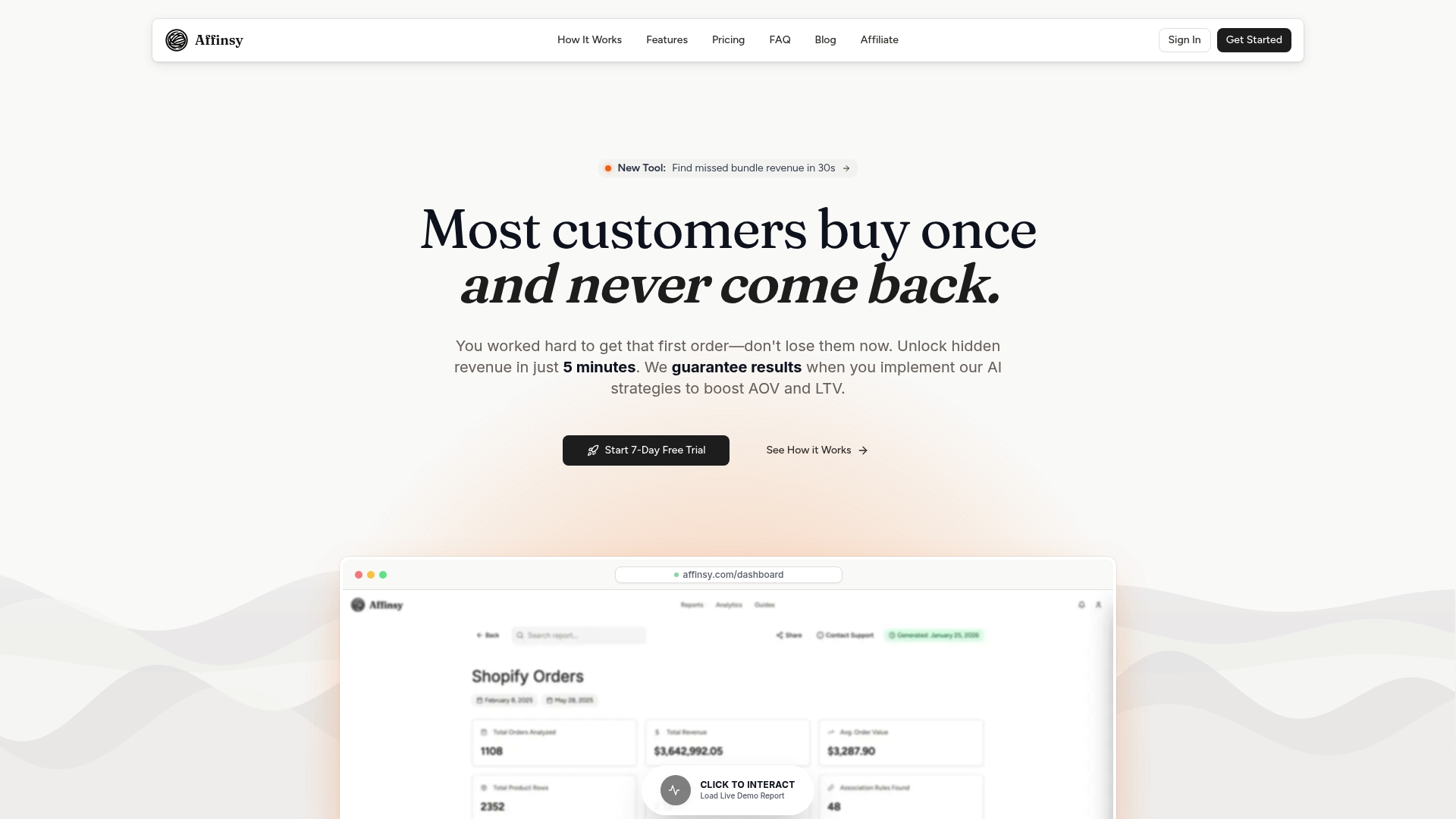
Affinsy integrates RFM segmentation and Market Basket Analysis into a single platform, delivering the combined power discussed throughout this guide. Our AI tools analyze your historical transaction data to reveal customer segments and product associations that drive measurable revenue growth.
Easy integration with Shopify, WooCommerce, and Google Analytics means you’re up and running in minutes, not weeks. No complex implementations or developer resources required. Your data flows automatically, keeping insights current as your business evolves.
Automate personalized bundling and cross-selling to increase average order values and retention without manual campaign management. Our platform handles the analytical heavy lifting while you focus on strategic decisions. Explore our customer segmentation glossary and product bundling glossary to deepen your understanding of core optimization concepts.
For WooCommerce users, our bulk upsell cross sell editor plugin streamlines product relationship management at scale. Apply MBA insights across your entire catalog with just a few clicks, implementing data-driven recommendations faster than ever.
Frequently asked questions
What is AI-driven sales optimization in e-commerce?
AI-driven sales optimization leverages artificial intelligence to analyze customer behavior and product data, identifying patterns that increase sales and retention. These systems automate complex tasks like customer segmentation and product recommendation that would take humans weeks to complete manually. By processing massive datasets quickly, AI uncovers opportunities invisible to traditional analysis methods.
How does RFM segmentation improve marketing ROI?
RFM segments customers by recency, frequency, and monetary value to target marketing effectively, resulting in up to 20% higher ROI and increased retention. AI automation adds further gains by triggering personalized campaigns based on segment membership changes. This precision targeting eliminates wasted ad spend on unlikely converters.
What results can I expect from AI-powered product bundling?
AI-optimized bundling increases average order value by 10–25% and improves customer satisfaction through personalized product pairings based on actual purchase data. Combining MBA with AI personalization enhances bundle relevance by 25% over generic recommendations. These gains compound over time as your AI learns from ongoing transactions.
Which sales metrics should I monitor to track AI optimization success?
Monitor conversion rate lift (5–10%), average order value increases (10–20%), customer lifetime value improvements (up to 15%), and retention rate changes (up to 18%) to measure success comprehensively. Regular KPI reviews help optimize campaigns continuously and identify underperforming strategies before they impact revenue significantly. Track metrics by customer segment for deeper insights into which groups drive the most value.
Recommended
- Analytics trends in 2026: AI boosts ecommerce sales 95% ROI - Affinsy Blog | Affinsy
- Ecommerce Analytics Trends 2026: Unlocking Growth Through AI - Affinsy Blog | Affinsy
- AI and Ecommerce Guide: Strategies for Success in 2025 - Affinsy Blog | Affinsy
- 8 Top Ecommerce Ads Examples to Boost Sales in 2025 - Affinsy Blog | Affinsy