
AI-generated traffic to retail sites skyrocketed 4700% year over year, reshaping how customers discover and buy online. Ecommerce managers now face a challenge: how to harness AI analytics tools effectively without getting lost in complexity. This guide breaks down the top AI-powered analytics trends driving measurable sales growth and customer retention in 2026, giving you practical strategies you can implement immediately.
Table of Contents
- The Role Of AI In Ecommerce Analytics For 2026
- Hyper-Personalization With AI
- Market Basket Analysis And RFM Segmentation
- Dynamic Pricing And Real-Time Optimization Techniques
- Common Misconceptions And Personalization Challenges
- Practical Steps To Leverage AI Analytics For Sales And Retention
- Explore Affinsy’s AI-Powered Ecommerce Analytics Solutions
- Frequently Asked Questions About Analytics Trends In 2026
Key takeaways
| Point | Details |
|---|---|
| AI adoption accelerates | 78% of businesses use AI, with 95% of ecommerce brands reporting positive ROI on AI investments. |
| Personalization drives revenue | AI personalization increases conversion rates by 40-60%, and brands excelling in it are 48% more likely to exceed revenue targets. |
| Advanced segmentation unlocks value | Market basket analysis and RFM segmentation reveal hidden product associations and customer patterns that boost cross-sell revenue by double digits. |
| Real-time optimization wins | Dynamic pricing and instant analytics enable agile responses to market shifts, protecting margins while improving conversion rates. |
| Implementation challenges persist | Despite high adoption, 74% of consumers feel frustrated by impersonal experiences, highlighting gaps in execution and skill requirements. |
The role of AI in ecommerce analytics for 2026
Artificial intelligence has moved from experimental to essential in ecommerce operations. 78% of businesses now use AI in at least one function, with 95% of ecommerce brands reporting positive ROI from their AI investments. This widespread adoption signals a fundamental shift in how online retailers approach data analytics and customer engagement.
Machine learning algorithms have matured enough to deliver predictive sales forecasts and inventory optimization that actually work. These systems analyze millions of transaction records in seconds, spotting patterns that would take human analysts weeks to uncover. The result is actionable intelligence that directly impacts your bottom line.
Key AI applications transforming ecommerce analytics include:
- Predictive demand forecasting that reduces overstock and stockouts
- Customer lifetime value predictions guiding acquisition spend
- Automated product recommendation engines
- Sentiment analysis from reviews and social media
- Fraud detection protecting revenue and reputation
The generative AI boom deserves special attention. Traffic from AI systems to retail sites jumped 4700% compared to the previous year, fundamentally changing how customers discover products. This surge means your analytics must account for AI-driven browsing behaviors that differ from traditional search patterns.
“AI is no longer a nice-to-have feature. It’s the engine driving competitive advantage in modern ecommerce. Retailers who master AI analytics gain insights their competitors simply can’t match.”
Understanding AI analytics trends in ecommerce requires recognizing that AI tools now integrate seamlessly with platforms like Shopify and WooCommerce. This accessibility means even mid-sized retailers can leverage enterprise-grade analytics without massive IT investments.
Hyper-personalization with AI
Generic shopping experiences no longer cut it. Customers expect tailored recommendations, personalized content, and offers that match their specific needs and purchase history. AI personalization increases conversion rates by 40-60%, and brands with advanced personalization are 48% more likely to exceed revenue targets.
These aren’t small improvements. A 60% conversion lift can transform struggling campaigns into profitable growth engines. AI achieves this by processing behavioral signals in real time: browsing patterns, cart additions, time on page, previous purchases, and dozens of other data points that paint a complete picture of each customer’s intent.
Yet 71% of consumers still feel shopping experiences are impersonal. This gap reveals a crucial truth: implementing AI tools alone doesn’t guarantee personalization success. You need thoughtful execution that balances automation with human marketing creativity.
Effective AI-driven personalization strategies include:
- Dynamic homepage content that adapts to visitor segments
- Email campaigns triggered by specific behavioral milestones
- Product bundles created from individual purchase histories
- Pricing offers calibrated to customer lifetime value
- Content recommendations based on engagement patterns
The magic happens when AI insights inform creative decisions rather than replacing them entirely. Your marketing team brings context, brand voice, and strategic thinking that algorithms can’t replicate. Combining both creates experiences that feel genuinely personal rather than mechanically targeted.
Pro Tip: Start with one personalization element, measure its impact, then expand. Trying to personalize everything at once often leads to inconsistent experiences that confuse rather than delight customers.
Explore proven customer segmentation examples to see how leading brands structure their personalization strategies. The key is matching your approach to your specific customer base and product catalog rather than copying generic templates.
Market basket analysis and RFM segmentation
Two AI-powered techniques stand out for their direct impact on sales optimization: market basket analysis (MBA) and recency-frequency-monetary (RFM) segmentation. Both uncover hidden patterns in transaction data that translate directly into revenue growth.
Market basket analysis identifies products frequently purchased together. This reveals natural product affinities your merchandising team might miss. When you know that customers who buy running shoes also purchase moisture-wicking socks 68% of the time, you can create bundled offers or strategic cross-sell placements that feel helpful rather than pushy.
RFM segmentation divides customers into groups based on how recently they purchased, how often they buy, and how much they spend. This creates actionable segments: loyal high-value customers who deserve VIP treatment, at-risk customers who need win-back campaigns, and new customers requiring nurturing sequences.
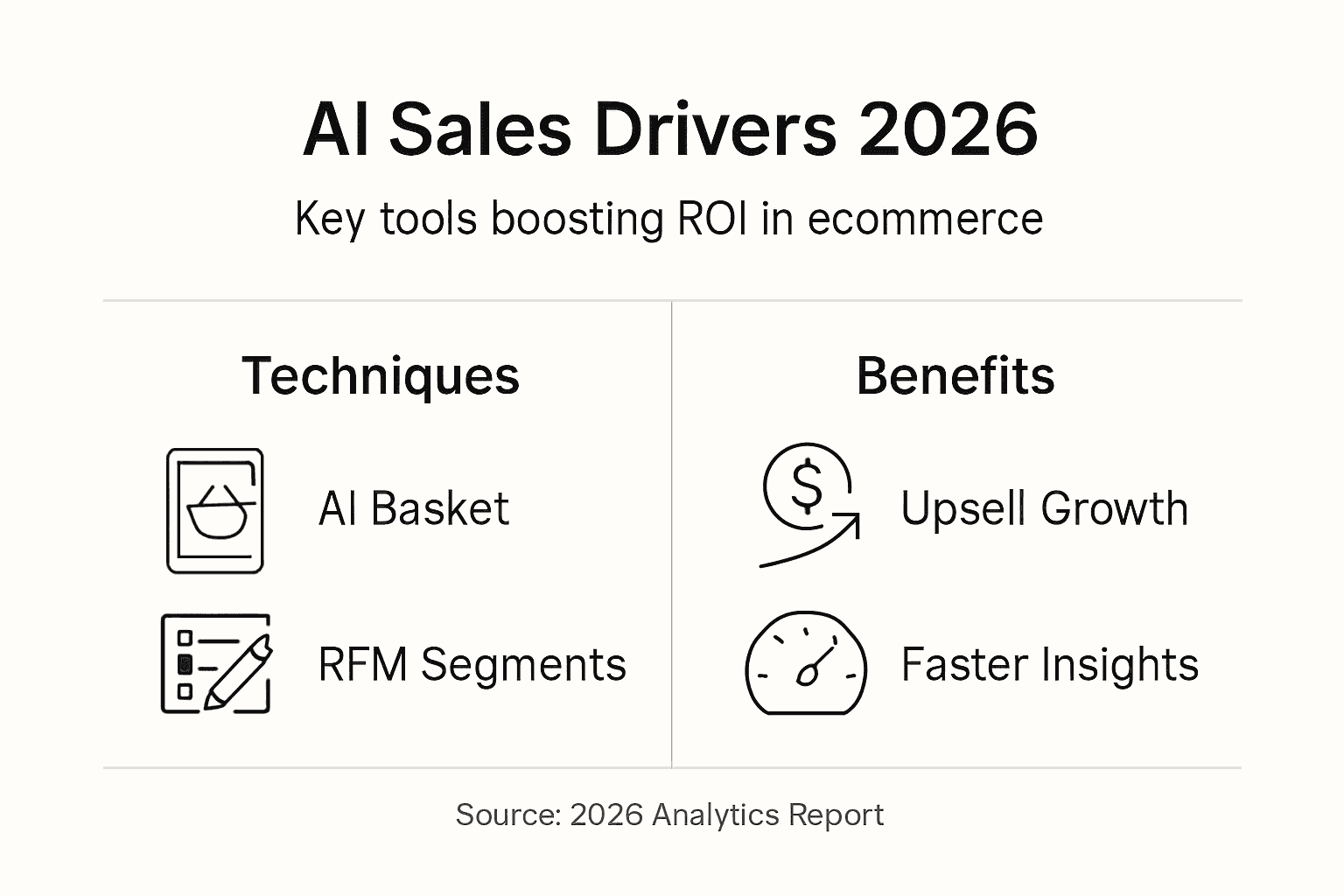
MBA and RFM increase upsell revenue by double digits by focusing resources on the opportunities with highest probability of conversion. Instead of generic promotions sent to everyone, you deliver targeted offers to specific segments at optimal timing.
Here’s how MBA and RFM compare in practical application:
| Technique | Primary Use | Data Required | Implementation Complexity | Revenue Impact Timeline |
|---|---|---|---|---|
| Market Basket Analysis | Product bundling and cross-sell | Transaction line items | Medium | 2-4 weeks |
| RFM Segmentation | Customer targeting and retention | Purchase dates and amounts | Low | 1-2 weeks |
Implementing these techniques follows a structured process:
- Clean and organize your historical transaction data going back at least 6 months
- Choose AI analytics tools compatible with your ecommerce platform (Shopify, WooCommerce, etc.)
- Run initial MBA reports to identify top product associations with statistical confidence
- Segment customers using RFM scoring and validate segments against known customer behaviors
- Create targeted campaigns for each segment with personalized product recommendations
- Monitor performance metrics and refine segmentation rules based on results
AI automates the heavy computational work, processing thousands of transactions to surface insights in minutes. What once required data scientists and weeks of manual analysis now happens at the click of a button. Review a detailed market basket analysis example to see real results from ecommerce implementations.
For comprehensive guidance on customer grouping strategies, consult this RFM segmentation guide that walks through scoring methodologies and campaign applications.
Dynamic pricing and real-time optimization techniques
Static pricing leaves money on the table. Amazon executes 2.5 million daily price changes using AI, adjusting to inventory levels, competitor moves, and demand signals in real time. This approach improves conversion rates while protecting profit margins through intelligent automation.

Dynamic pricing sounds complex, but the concept is straightforward: adjust prices based on current market conditions rather than setting them once and forgetting. AI makes this practical by monitoring multiple factors simultaneously and calculating optimal price points that maximize revenue.
Real-time analytics enable immediate responses to market shifts. When a competitor drops prices, your system detects it and adjusts accordingly. When inventory runs low on a hot product, prices rise to capture additional margin. When demand softens, strategic discounts move merchandise before it becomes dead stock.
Key benefits of AI-driven pricing include:
- Higher conversion rates from competitively positioned prices
- Protected margins through demand-based adjustments
- Reduced overstock and clearance losses
- Faster response to competitor actions
- Automated testing of price sensitivity
Traditional versus AI-driven pricing shows dramatic differences:
| Metric | Traditional Pricing | AI Dynamic Pricing |
|---|---|---|
| Price updates per month | 1-4 | Continuous (hourly or real-time) |
| Factors considered | Cost plus margin | 10+ including demand, competition, inventory |
| Response time to market changes | Days to weeks | Minutes to hours |
| Margin optimization | Manual calculation | Automated profit maximization |
| Testing capability | Limited A/B tests | Continuous multivariate testing |
Implementing dynamic pricing requires careful strategy. Aggressive price changes can erode customer trust if shoppers feel they’re being manipulated. The goal is strategic optimization, not maximum extraction.
Pro Tip: Set clear boundaries for your pricing algorithms. Define acceptable price ranges, change velocity limits, and competitor benchmarks to prevent algorithm decisions that damage brand perception or customer relationships.
Explore top AI analytics tools that include dynamic pricing capabilities compatible with major ecommerce platforms. The right tool integrates seamlessly with your existing systems while providing the control and transparency you need.
Common misconceptions and personalization challenges
AI personalization promises transformative results, but myths about its capabilities create unrealistic expectations. Understanding what AI can and can’t do helps you implement it effectively rather than chasing impossible outcomes.
Myth: AI personalization automatically solves customer engagement problems. Reality: 74% of consumers still feel frustrated with impersonal AI experiences. Technology alone doesn’t create connection. You need thoughtful implementation that puts customer needs first.
Myth: AI adoption guarantees immediate ROI. Reality: Only 26% of companies realize the full potential value from their AI investments. Success requires proper data infrastructure, skilled teams, and ongoing optimization.
Myth: More data always means better personalization. Reality: Data quality matters more than quantity. Dirty data produces flawed insights that lead to poor decisions.
Several challenges limit AI effectiveness in ecommerce:
- Data privacy concerns make customers hesitant to share information needed for personalization
- Skill gaps prevent teams from fully utilizing AI capabilities
- Algorithmic biases can perpetuate unfair treatment of customer segments
- Integration complexity slows deployment across legacy systems
- Over-reliance on automation reduces the human creativity that makes marketing memorable
The personalization paradox is real: customers want tailored experiences but feel uneasy about the data collection required to deliver them. Transparency about data usage and clear privacy controls help build the trust needed for effective personalization.
Skill development deserves special attention. AI tools democratize advanced analytics, but someone still needs to interpret results and translate insights into marketing strategies. Investing in training pays dividends by helping teams ask better questions and spot flawed recommendations before they reach customers.
Customization separates successful AI implementations from disappointing ones. Out-of-the-box algorithms trained on generic datasets won’t understand your unique product catalog, customer base, and brand positioning. Tuning models to your specific context dramatically improves results.
Ethical AI practices protect both customers and your brand reputation. Regular audits of algorithmic decisions help identify unintended biases. Clear human oversight ensures AI recommendations align with your values and customer expectations.
Learn from common AI analytics pitfalls that trip up ecommerce teams. Avoiding these mistakes accelerates your path to meaningful results.
Practical steps to leverage AI analytics for sales and retention
Moving from understanding to action requires a structured implementation approach. These steps guide ecommerce managers through successful AI analytics deployment:
-
Assess your data foundation by auditing transaction records, customer profiles, and product catalogs for completeness and accuracy. Clean data is non-negotiable for reliable AI insights.
-
Choose AI analytics tools compatible with your ecommerce platform, whether Shopify, WooCommerce, or custom solutions. Integration ease directly impacts adoption and time to value.
-
Implement market basket analysis to identify high-probability product combinations for bundling and cross-sell campaigns. Start with your top 20% of products by revenue.
-
Deploy RFM segmentation to group customers by purchase patterns, then create tailored marketing campaigns for each segment with personalized messaging and offers.
-
Build hyper-personalized campaigns using AI insights about customer preferences, browsing behavior, and purchase history. Test one element at a time to isolate what drives results.
-
Monitor real-time dashboards tracking key metrics like conversion rate, average order value, and customer lifetime value. Set up alerts for significant changes requiring immediate attention.
-
Iterate based on performance data, refining segmentation rules, adjusting personalization elements, and expanding successful tactics to new customer groups.
Success depends on cross-functional collaboration. Your AI analytics initiative needs buy-in and active participation from IT teams managing data infrastructure, marketing teams creating campaigns, and executive leadership providing resources and strategic direction.
Pro Tip: Engage cross-functional teams including IT and marketing early in the planning process. Technical teams understand data constraints and integration challenges, while marketing teams bring customer insights that shape how you use AI recommendations.
Start small with focused pilots that demonstrate value quickly. A successful market basket analysis showing 15% higher cross-sell revenue builds organizational confidence for larger investments. Momentum matters more than perfection in early stages.
Explore top AI analytics tools for ecommerce to compare platforms based on your specific requirements. Consider factors like ease of use, integration capabilities, pricing structure, and vendor support quality.
For detailed implementation guidance, review this comprehensive market basket analysis guide covering everything from data preparation through campaign execution.
Explore Affinsy’s AI-powered ecommerce analytics solutions
Affinsy specializes in translating complex AI analytics into actionable ecommerce insights. Our platform focuses specifically on the techniques that drive measurable sales growth and customer retention: market basket analysis, RFM segmentation, and predictive analytics.
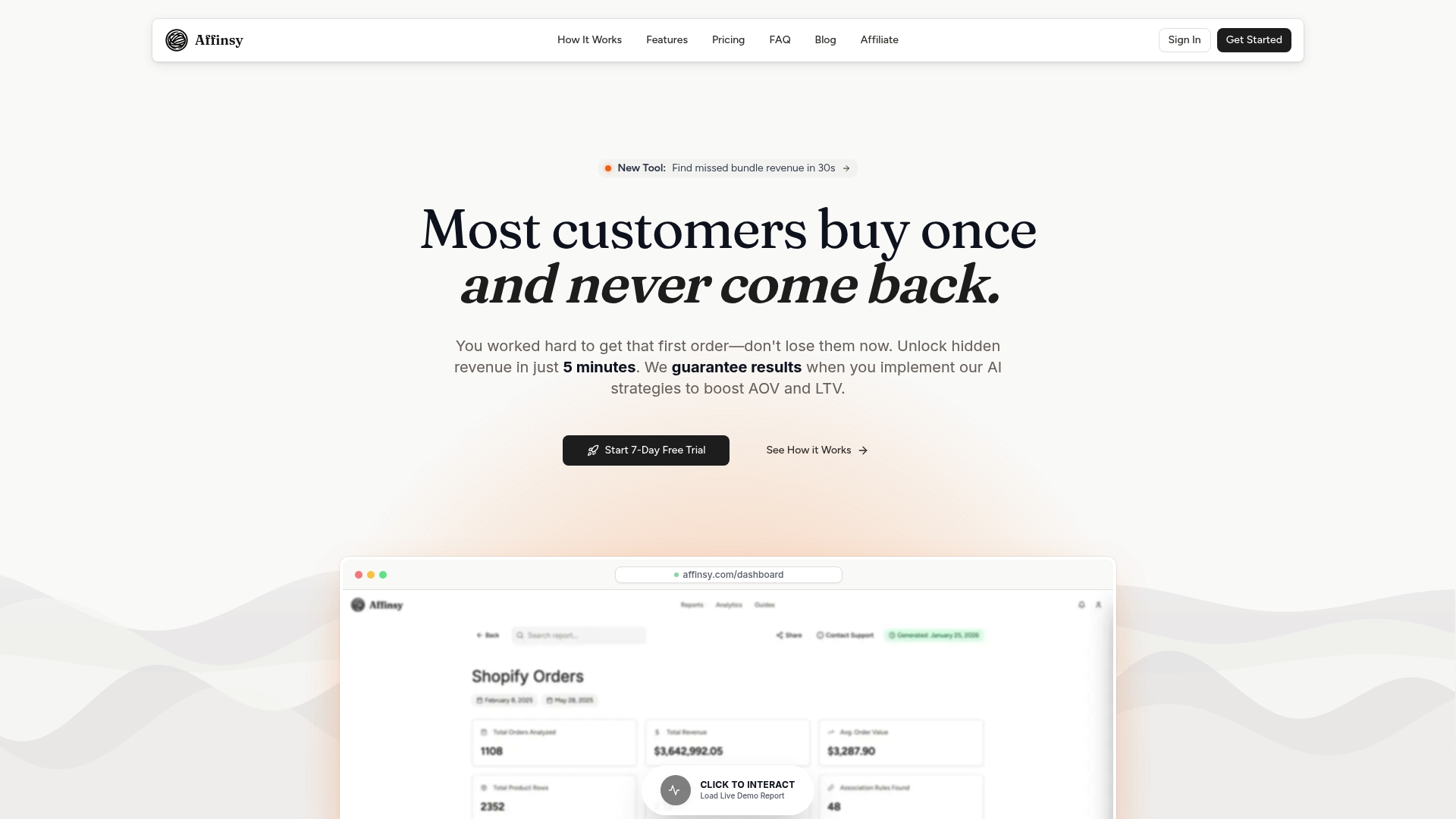
Seamless integration with Shopify and WooCommerce means you’re up and running quickly without extensive IT projects. Connect your store, and our AI immediately begins analyzing transaction patterns to surface hidden opportunities.
Key platform benefits include:
- Automated market basket analysis revealing profitable product bundling opportunities
- RFM customer segmentation with pre-built campaign templates
- Real-time dashboards tracking the metrics that matter most to ecommerce managers
- Export capabilities for integrating insights into your existing marketing workflows
- Privacy-first architecture ensuring customer data protection and regulatory compliance
We designed Affinsy for ecommerce managers and marketing professionals who need powerful analytics without requiring data science expertise. The interface guides you through analysis with clear explanations and actionable recommendations at each step.
Understand why ecommerce analytics matter for competitive advantage in 2026’s crowded online retail landscape. Our market basket analysis guide shows how leading brands use these techniques to boost average order value. Compare our capabilities against other best AI analytics tools to see how Affinsy delivers focused functionality where it counts most.
Frequently asked questions about analytics trends in 2026
What is the biggest AI analytics trend in ecommerce for 2026?
Hyper-personalization powered by real-time AI analysis represents the most impactful trend, with conversion rate improvements ranging from 40-60% for brands executing it well. The ability to tailor every touchpoint to individual customer preferences separates winning retailers from struggling competitors.
How can I start implementing AI analytics on Shopify?
Begin by connecting an AI analytics platform designed for Shopify integration, which typically requires just installing an app from the Shopify App Store. Focus first on market basket analysis to identify quick cross-sell wins, then expand to customer segmentation and personalized campaigns as you build confidence.
What are common pitfalls to avoid with AI personalization?
Over-automation without human oversight creates robotic experiences that alienate customers rather than engaging them. Additionally, using dirty or incomplete data produces flawed recommendations that damage credibility, while ignoring privacy concerns erodes the trust needed for customers to share information that enables personalization.
How does dynamic pricing affect customer loyalty?
When implemented transparently with reasonable price ranges, dynamic pricing is generally accepted by customers who understand that prices fluctuate based on market conditions. However, aggressive or erratic price changes perceived as unfair can damage loyalty and encourage customers to shop elsewhere or wait for better deals.
Is mobile commerce analytics different from desktop analytics?
Yes, mobile shoppers exhibit distinct browsing patterns including shorter session times, higher bounce rates, and different conversion paths that require separate analysis and optimization strategies. Mobile analytics must account for smaller screens, touch interfaces, and often interrupted shopping sessions that differ fundamentally from desktop behaviors.
Recommended
- Ecommerce Analytics Trends 2026: Unlocking Growth Through AI - Affinsy Blog | Affinsy
- AI and Ecommerce Guide: Strategies for Success in 2025 - Affinsy Blog | Affinsy
- Why Use AI Analytics? 20% Sales Boost & Retention - Affinsy Blog | Affinsy
- Role of AI in E-Commerce: Boosting Sales and Retention - Affinsy Blog | Affinsy