
AI analytics can increase your average order value by up to 20%. If you run an e-commerce store and struggle with manual data analysis for bundling and retention, you’re leaving money on the table. This guide explains how AI unlocks hidden insights to optimize sales and loyalty.
Table of Contents
- Understanding AI Analytics In E-commerce
- How AI Enhances Product Bundling
- How AI Improves Customer Retention
- Quantifying AI Impact On Sales Metrics
- Common Misconceptions About AI Analytics
- Practical Application Of AI Analytics
- Bridging Understanding To Action: Choosing The Right AI Analytics Tool
- Discover AI Analytics Solutions Tailored For E-Commerce
- Frequently Asked Questions About Using AI Analytics In E-Commerce
Key Takeaways
| Point | Details |
|---|---|
| AI boosts sales metrics | AI-powered bundling increases average order value by 10-20% and retention by 25-35%. |
| Time savings | AI reduces manual data analysis time by up to 70%, freeing teams for strategy. |
| Better customer insights | AI uncovers hidden customer segments and product relationships traditional analytics miss. |
| Strategic support tool | AI enhances human decision making rather than replacing marketing teams. |
Understanding AI Analytics in E-commerce
AI analytics uses machine learning algorithms to automatically process and interpret your store’s transaction data. Unlike traditional analytics that require manual configuration and analysis, AI analytics automates complex pattern discovery across millions of data points.
The key difference lies in scale and speed. Traditional analytics tools show you what happened. AI analytics shows you what happened, why it happened, and what will likely happen next. When you’re processing thousands of transactions daily, traditional spreadsheet methods become impractical.
Here’s what sets AI analytics apart:
- Automated pattern recognition: AI uncovers product correlations and customer segments invisible to manual analysis
- Real-time processing: Analyzes data as transactions occur, not hours or days later
- Predictive capabilities: Forecasts trends based on historical patterns and seasonal behaviors
- Scalability: Handles growing data volumes without additional manual effort
Traditional analytics struggle with high-volume e-commerce data because they rely on predefined rules and manual interpretation. You might spend hours setting up reports only to miss the subtle patterns that drive real revenue growth. Understanding the importance of product bundles becomes easier when AI handles the heavy lifting.
The role of AI in e-commerce extends beyond simple reporting. It transforms raw transaction data into actionable strategies for bundling, pricing, and retention. This foundation is similar to why AI works in advertising, pattern recognition at scale.
How AI Enhances Product Bundling
Market basket analysis is the core technique AI uses to discover which products customers buy together. Instead of guessing which items to bundle, AI scans your entire transaction history to find statistically significant associations.
AI-powered MBA works continuously in the background. It identifies product pairs or groups that appear together more frequently than random chance would suggest. This automation means you discover profitable bundles you’d never spot manually.
The revenue impact is substantial. Product bundling with AI can increase average order value by 10-20% because recommendations are based on actual buying behavior, not intuition.
Here’s how AI bundling drives results:
- Hidden associations: Discovers non-obvious product relationships across different categories
- Dynamic updates: Adjusts bundle recommendations as customer preferences shift seasonally
- Cross-sell optimization: Identifies the right moment and product to suggest based on cart contents
- Revenue maximization: Prioritizes bundles with highest profit margins and conversion rates
| Bundle Discovery Method | Time Required | Products Analyzed | Revenue Lift |
|---|---|---|---|
| Manual analysis | 20+ hours/week | 50-100 products | 3-5% |
| AI-powered analysis | Automated | Entire catalog | 10-20% |
Pro Tip: Regularly update your AI models with fresh transaction data to capture evolving trends. Customer preferences shift with seasons, holidays, and market conditions. Monthly model refreshes ensure your product bundling strategies stay relevant.
The market basket analysis guide shows detailed implementation steps. Using basket analysis in e-commerce effectively means treating it as an ongoing process, not a one-time project.
How AI Improves Customer Retention
RFM segmentation stands for Recency, Frequency, Monetary value. It’s a proven framework for grouping customers based on purchase behavior. AI-driven RFM analysis goes beyond basic segmentation to uncover nuanced customer groups.

Traditional RFM creates broad categories like “high value” or “at risk.” AI identifies micro-segments within these groups, revealing customers who respond to different messaging, offers, or product types. This precision targeting improves retention campaign effectiveness by 25-35%.
The retention advantage comes from personalization at scale. When you know a customer segment prefers email over SMS, or responds better to discount codes than free shipping, you optimize every touchpoint.
AI segmentation reveals:
- Behavioral patterns: Identifies when customers typically make repeat purchases
- Churn signals: Detects early warning signs before customers stop buying
- Lifetime value prediction: Forecasts which customers will generate most long-term revenue
- Channel preferences: Determines optimal communication methods per segment
Pro Tip: Combine AI segmentation with personalized content for best retention results. The customer segmentation guide provides frameworks for matching content to segments. Generic mass emails fail because they ignore these behavioral differences.
Study effective customer segmentation examples to see how leading retailers apply these principles. Using analytics for customer retention means continuously refining your approach based on results.
Quantifying AI Impact on Sales Metrics
The numbers tell a compelling story. AI analytics reduces manual data analysis time by up to 70%, freeing your team to focus on strategy instead of spreadsheets.
Average order value increases of 10-20% come from smarter bundling recommendations. These aren’t marginal gains. For a store generating $500,000 monthly, a 15% AOV increase means an extra $75,000 in revenue.
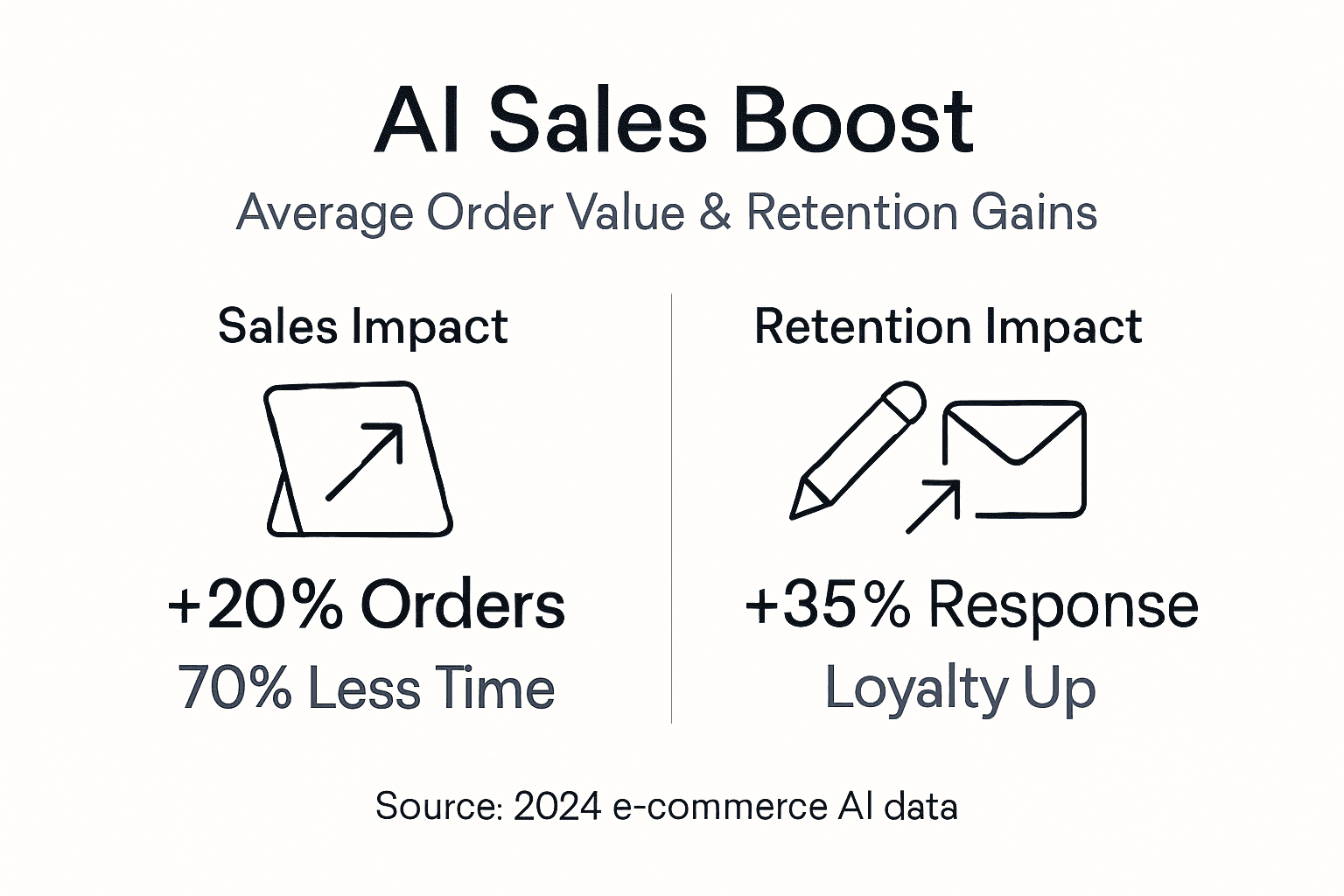
Retention improvements are equally impressive. When AI segmentation increases campaign response rates by 25-35%, you spend less acquiring new customers and earn more from existing ones. The ROI compounds over time.
| Metric | Traditional Approach | AI-Powered Approach | Improvement |
|---|---|---|---|
| Average order value | Baseline | 10-20% increase | $50-100 per order |
| Retention campaign response | 5-8% | 8-12% | 25-35% lift |
| Data analysis time | 15-20 hours/week | 5-8 hours/week | 60-70% reduction |
| Segment accuracy | 70-75% | 85-92% | 15-20 point gain |
These efficiency gains create a competitive advantage. While competitors manually analyze last month’s data, you’re acting on real-time insights. The speed difference matters in fast-moving e-commerce markets.
AI analytics transforms data processing from a bottleneck into a competitive advantage. The time saved on manual analysis allows teams to test more strategies, iterate faster, and respond to market changes in days instead of weeks.
Review data-driven bundling results from real implementations. The AI benefits on sales metrics extend beyond direct revenue to operational efficiency and team productivity.
Common Misconceptions About AI Analytics
Let’s clear up myths that prevent businesses from adopting AI analytics effectively.
Myth 1: AI guarantees automatic sales increases without strategy. False. AI is a decision support tool, not a magic solution. You still need solid product selection, pricing strategy, and customer service. AI amplifies good decisions but won’t fix fundamental business problems.
Myth 2: AI replaces human marketing teams. Wrong. AI handles data processing and pattern recognition. Humans provide strategic direction, creative execution, and customer empathy. The best results come from combining AI insights with human expertise. Your team interprets AI findings and decides which opportunities to pursue.
Myth 3: Traditional analytics are sufficient compared to AI. This underestimates scale challenges. Traditional analytics work for small catalogs with limited SKUs. Once you exceed 1,000 products or 10,000 monthly transactions, manual methods become impractical. You miss patterns simply because there’s too much data to analyze effectively.
Myth 4: AI requires data science expertise. Modern AI platforms are designed for business users, not data scientists. The AI analytics role guide shows how user-friendly interfaces make insights accessible to anyone comfortable with basic analytics.
The reality is nuanced. AI accelerates your existing capabilities and reveals blind spots in your data. It works best when integrated into a broader strategy that includes customer research, competitive analysis, and market positioning.
Practical Application of AI Analytics
Implementing AI analytics follows a straightforward framework. Here’s your step-by-step roadmap:
-
Connect your data sources: Integration with Shopify and WooCommerce typically takes 15-30 minutes. Link your store platform, payment processor, and any existing analytics tools.
-
Allow initial data processing: AI needs historical transaction data to identify patterns. Most platforms require 3-6 months of history for reliable insights. The system will analyze purchase patterns, customer behaviors, and seasonal trends.
-
Review automated insights: Start with AI-generated bundle recommendations and customer segments. Don’t implement everything at once. Pick 2-3 high-confidence suggestions to test first.
-
Launch targeted campaigns: Create specific promotions based on AI insights. Test bundle offers with different customer segments. Use A/B testing to validate AI recommendations against your current approach.
-
Monitor performance metrics: Track average order value, conversion rates, and retention metrics weekly. Compare AI-driven campaigns against baseline performance. Look for statistically significant improvements over 4-6 weeks.
-
Iterate based on results: Refine your approach based on what works. AI learns from new data, so feed results back into the system. Double down on successful strategies and eliminate underperformers.
The top ecommerce analytics platforms offer varying implementation complexity. Choose based on your technical resources and immediate needs. Some platforms provide managed onboarding, while others offer self-service setup.
Start with one use case, either bundling or retention, and expand after seeing results. This focused approach builds confidence and demonstrates ROI before full commitment. The e-commerce data analysis tutorial provides detailed guidance for each implementation stage.
Bridging Understanding to Action: Choosing the Right AI Analytics Tool
Selecting an AI analytics platform requires evaluating several critical factors. Your choice impacts both immediate results and long-term scalability.
Integration capabilities matter most. The platform must connect seamlessly with your existing e-commerce system, whether Shopify, WooCommerce, or custom-built. Integration capabilities with popular platforms and user-friendly dashboards are top priorities. Poor integration means manual data exports and delayed insights.
Ease of use determines adoption rates. If your marketing team can’t navigate the interface without constant IT support, the platform fails regardless of analytical power. Look for intuitive dashboards, clear visualizations, and plain-language recommendations.
Feature set should match your specific needs. Do you prioritize bundling optimization, customer segmentation, or predictive analytics? Some platforms excel at market basket analysis while others focus on retention modeling. Identify your primary use case before comparing features.
| Platform Type | Integration | Learning Curve | Key Strength | Best For |
|---|---|---|---|---|
| All-in-one suite | Broad | Moderate | Comprehensive analytics | Large catalogs |
| Bundling specialist | E-commerce focused | Low | Product recommendations | Growing stores |
| Segmentation expert | CRM-centric | Moderate | Customer insights | Retention focus |
| Custom solution | Variable | High | Tailored features | Unique requirements |
Support and training resources accelerate time to value. Evaluate documentation quality, onboarding programs, and ongoing customer success support. The best platforms offer implementation guidance, not just software access.
Pro Tip: Prioritize platforms with seamless e-commerce platform integration. Data sync issues create more problems than they solve. A slightly less sophisticated tool that integrates perfectly beats a powerful platform with connection headaches.
Cost matters but shouldn’t drive the decision alone. Calculate potential revenue lift from better bundling and retention. A platform costing $500 monthly that generates an extra $5,000 in sales is obviously worthwhile. Compare the ecommerce analytics platform comparison to understand pricing models and ROI expectations.
Discover AI Analytics Solutions Tailored for E-Commerce
Ready to transform your e-commerce performance with AI? The strategies covered here work when you have the right tools and guidance.
Explore comprehensive resources on implementing AI in Ecommerce Analytics to accelerate your results. Understanding predictive analytics fundamentals helps you ask better questions and interpret insights effectively. Compare leading ecommerce analytics platforms to find the solution that matches your business needs and technical capabilities.
Frequently Asked Questions About Using AI Analytics in E-Commerce
Is AI analytics cost-effective for small to mid-sized e-commerce stores?
Yes, most AI platforms use subscription pricing that scales with store size. When a tool increases your average order value by even 10%, it typically pays for itself within the first month. Calculate potential revenue lift against platform costs to assess ROI for your specific situation.
How much historical data do I need before AI analytics becomes useful?
Most AI platforms require 3-6 months of transaction history to identify reliable patterns. Stores with higher transaction volumes can start with less time because they accumulate sufficient data points faster. If you process 500+ orders monthly, three months provides adequate training data.
How long until I see results from AI-driven bundling and retention strategies?
Initial insights appear within days of connecting your data. Measurable revenue impact typically emerges after 4-6 weeks of testing AI recommendations. Retention improvements take longer, usually 2-3 months, because you need time to observe repeat purchase behavior changes.
Does AI analytics work alongside my existing marketing team?
Absolutely. AI handles data processing and pattern identification while your team provides strategic direction and creative execution. The combination of AI insights and human marketing expertise produces better results than either approach alone. Teams spend less time on manual analysis and more time on high-value activities.
What’s the first step to integrate AI analytics into my store?
Start by auditing your current data sources and identifying your primary business challenge, either improving average order value through bundling or increasing customer retention. Choose one focus area, select an AI platform with strong integration for your e-commerce system, and begin with a pilot test on a product subset or customer segment.
Recommended
- Role of AI in E-Commerce: Boosting Sales and Retention - Affinsy Blog | Affinsy
- Data-Driven Decision Making in Retail – Impact on Sales Growth - Affinsy Blog | Affinsy
- Ecommerce Analytics Trends 2026: Unlocking Growth Through AI - Affinsy Blog | Affinsy
- Complete Guide to AI in Ecommerce Analytics - Affinsy Blog | Affinsy
- Anniversary Gift Tips: 68% More Engagement Through Personalization | Amorlune