
Guesswork can lead even the most experienced retail teams down the wrong path. For E-commerce managers navigating complex sales cycles, choosing evidence over instinct is the difference between missed targets and measurable growth. By embracing data-driven decision making in retail, you gain clarity from real sales, inventory, and customer behavior data—empowering your operation to anticipate trends, optimize pricing, and create tailored experiences customers will remember.
Table of Contents
- Defining Data-Driven Decision Making In Retail
- Types Of Retail Data And Analytics Used
- How AI Tools Drive Better Retail Outcomes
- Applying Insights To Enhance Customer Retention
- Common Pitfalls In Retail Data Strategies
Key Takeaways
| Point | Details |
|---|---|
| Embrace Data-Driven Decision Making | Use data from sales, inventory, and customer behavior to inform decisions rather than relying on instinct. |
| Leverage Various Analytics Types | Employ descriptive, diagnostic, predictive, and prescriptive analytics to gain full insights into customer behavior and market trends. |
| Integrate Data Across Teams | Ensure clear ownership and accountability for data usage to create a cohesive strategy that informs decision-making at all levels. |
| Utilize AI for Efficiency | Implement AI tools to automate tasks like inventory management and customer segmentation, allowing teams to focus on strategy rather than analysis. |
Defining Data-Driven Decision Making in Retail
Data-driven decision making in retail means using concrete information from your sales, inventory, and customer behavior instead of relying on gut feelings or assumptions.
It’s the difference between guessing what customers want and knowing exactly what they buy, when they buy it, and why.
At its core, data-driven decision making involves three essential components:
- Collecting relevant data from your transactions, customer interactions, and inventory systems
- Analyzing patterns to uncover relationships between products, customer segments, and purchasing behaviors
- Taking action based on insights to optimize pricing, inventory, product placement, and customer experiences
Why does this matter for your e-commerce business?
Retailers who leverage analytics to guide decisions improve accuracy in predictions, quantify clear objectives, and measure actual outcomes rather than hoping strategies will work.
This isn’t complicated analysis reserved for data scientists. You already have the data sitting in your systems right now—transaction history, customer purchase patterns, product relationships, and seasonal trends.
The challenge is transforming that raw data into actionable insights you can implement tomorrow.
What Changes When You Go Data-Driven
Think about three common retail challenges and how data solves them:
- Inventory management: Balance demand and supply by analyzing what products sell together and when peaks occur
- Pricing strategy: Understand customer price sensitivity and competitor pricing instead of guessing what margins work
- Customer retention: Segment customers by purchase behavior to tailor experiences instead of one-size-fits-all approaches
The real shift happens when top management commits to using data in decision-making and teams trust the quality of the information they’re working with.
Successful data-driven organizations share a critical trait: they build a culture where decisions backed by evidence are the default, not the exception.
Your team stops asking “What do you think?” and starts asking “What does the data show?”
This doesn’t replace human judgment—it strengthens it. Your experience and intuition still matter, but now they’re informed by facts.
Pro tip: Start by identifying one recurring business decision you make each month (like which products to bundle or how to allocate marketing budget), then gather the data that actually impacts that decision. This creates quick wins that build momentum for a broader data-driven approach.
Types of Retail Data and Analytics Used
You’re swimming in data right now. Every customer transaction, page view, product review, and inventory movement generates information that reveals how your business actually works.
The challenge isn’t collecting data—it’s knowing which types matter and how to use them.
The Four Types of Analytics That Drive Decisions
Retailers typically work with four distinct approaches to analyzing data, each answering different questions:
- Descriptive analytics: What happened? Summarizes historical performance like sales totals, customer counts, and product popularity
- Diagnostic analytics: Why did it happen? Explains the causes behind trends, like why a product underperformed or which promotions drove traffic
- Predictive analytics: What will happen? Forecasts future outcomes using patterns from historical data
- Prescriptive analytics: What should we do? Recommends specific actions based on the analysis
Most e-commerce managers start with descriptive analytics because it’s intuitive. You look at last month’s sales and spot trends immediately.
But the real power emerges when you layer in the other three—especially predictive analytics, which lets you stay ahead of customer demand instead of reacting to it.
Here’s a comparison of the four main analytics types and how they support retail decisions:
| Analytics Type | Key Question Answered | Example in Retail | Typical Business Impact |
|---|---|---|---|
| Descriptive | What happened? | Monthly sales summaries | Highlights trends and outliers |
| Diagnostic | Why did it happen? | Analyzing causes behind sales drops | Identifies root causes of issues |
| Predictive | What will happen? | Forecasting next month’s top sellers | Supports inventory & planning |
| Prescriptive | What should we do? | Recommending optimal discount strategies | Improves decision-making precision |
Data Sources You’re Already Collecting
Your systems generate multiple data streams without any extra effort:
- Transaction data: Every purchase, including what items sold, quantities, prices, and customer information
- Inventory data: Stock levels, movement patterns, turnover rates, and warehouse locations
- Customer behavior: Browsing history, cart abandonment, purchase frequency, and lifetime value
- Market data: Competitor pricing, seasonal trends, and social media signals about customer sentiment
- Product data: Descriptions, categories, reviews, and ratings that influence purchase decisions
The most successful e-commerce operations don’t just collect more data—they connect different data sources to see the complete customer picture.
Your transaction history paired with customer behavior creates product association patterns. Your inventory data combined with seasonal trends predicts what to stock.
Separate, these datasets are useful. Connected, they’re transformative.
Below is a summary of typical retail data sources and their business uses:
| Data Source | Example Metric | Main Business Use |
|---|---|---|
| Transaction data | Units sold per day | Revenue & demand tracking |
| Inventory data | Real-time stock levels | Supply chain & restocking |
| Customer behavior | Cart abandonments | Personalization & retention |
| Market data | Competitor price comparison | Competitive strategy & pricing |
| Product data | Average rating per product | Merchandising & marketing |
Machine Learning and Advanced Techniques
As you mature, machine learning automates pattern recognition across massive datasets.
Instead of manually analyzing which products customers buy together, algorithms discover these relationships instantly—and can personalize recommendations for each visitor.
Advanced techniques handle demand forecasting, pricing optimization, and churn prediction without requiring a data science team.
Pro tip: Start by identifying one decision you make repeatedly using incomplete information—like how much inventory to order or which customers need retention offers. Then consolidate the relevant data sources you already have, even if they’re in separate systems. This creates your first quick win before investing in advanced analytics.
How AI Tools Drive Better Retail Outcomes
AI isn’t some distant future technology anymore. It’s actively reshaping how the most successful e-commerce operations run today.
The shift is simple but profound: AI automates the pattern recognition that used to require teams of analysts, freeing your team to focus on strategy instead of spreadsheets.
Real-World AI Applications in Retail
Here’s what AI actually does in operating e-commerce businesses right now:
- Dynamic inventory management: AI predicts demand and triggers automatic stock replenishment before you run out, reducing both stockouts and overstock situations
- Personalized recommendations: Algorithms analyze customer behavior to surface products each visitor is most likely to buy, increasing conversion rates
- Pricing optimization: AI adjusts prices based on demand, competitor pricing, and inventory levels in real time
- Customer segmentation: Machine learning identifies your most valuable customers and those at risk of leaving, enabling targeted retention strategies
- Supply chain visibility: AI maps the entire journey from warehouse to doorstep, catching delays before they impact customers
Each of these capabilities would require manual analysis if done traditionally. AI compresses what took weeks into instant insights.
Blending Online and Offline Experiences
The modern retail winner combines digital and physical touchpoints seamlessly. AI technology maps customer journeys across channels, understanding that a customer might research on mobile, compare in-store, and purchase online.

This omnichannel view reveals your true customer behavior—not fragmented across silos.
AI handles the complexity of managing this orchestrated experience at scale, personalizing offerings based on each customer’s complete history.
From Insight to Action
The real power emerges when AI moves beyond reporting to actual decision-making.
Instead of “here’s what happened last month,” AI systems answer “here’s what should happen next.”
AI transforms retail from reactive (responding to yesterday’s data) to predictive (acting on tomorrow’s opportunities).
Your team sets business objectives. AI figures out the best path to achieve them across thousands of products and customer interactions simultaneously.
This speed and scale separate data-driven leaders from competitors still analyzing historical performance.
Pro tip: Start with one high-impact use case where AI can demonstrate quick ROI—like identifying which existing customers are most likely to buy your best-margin products. This proves value to stakeholders before expanding to more complex applications across your operation.
Applying Insights to Enhance Customer Retention
Retaining a customer costs a fraction of acquiring one. Yet most e-commerce managers spend more energy on new customer campaigns than on keeping the ones they already have.
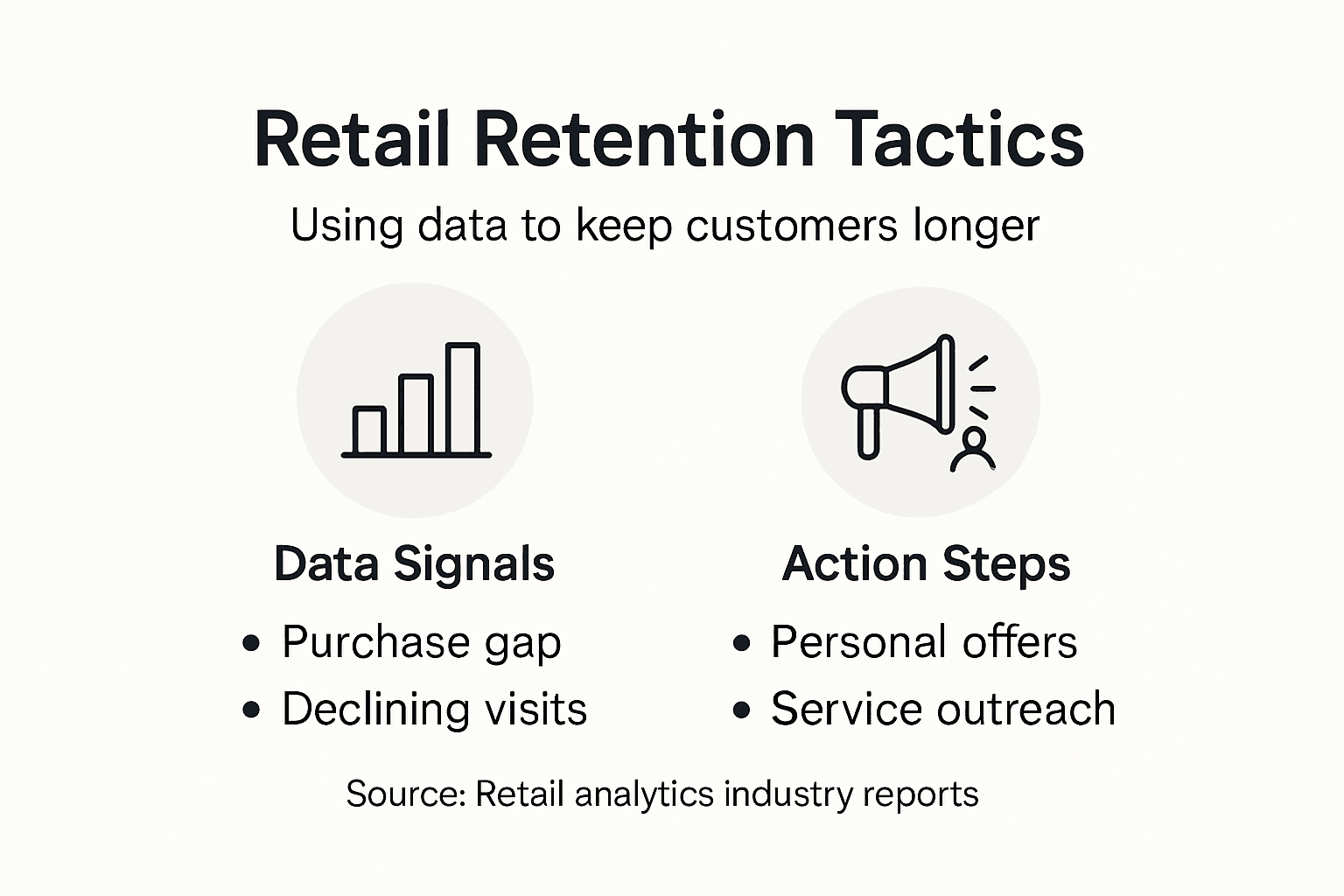
Data changes that calculation dramatically. When you know which customers are at risk of leaving, you can intervene before they do.
Identifying At-Risk Customers Before They Leave
The first step is spotting customers who show warning signs.
Advanced machine learning models predict churn by analyzing purchase patterns, frequency changes, and engagement metrics.
You don’t need to guess anymore. The data tells you:
- Declining purchase frequency: Customers buying less often than their historical pattern
- Longer gaps between orders: Extended periods without activity compared to their baseline
- Reduced order values: Lower spending on recent purchases signals disengagement
- Cart abandonment spikes: More items left unpurchased than usual
- Support complaints or returns: Increased friction points correlate with churn risk
Once identified, you target these customers with retention tactics before they switch to competitors.
Personalized Retention Strategies
Generic “come back” offers don’t work. Customers leave because something specific happened—they found a competitor, prices seemed high, or product quality disappointed.
Your data reveals the reason for each customer’s behavior.
Data-driven retention means matching the right intervention to each customer’s specific situation, not blasting everyone with the same discount.
You might offer a loyalty reward to frequent buyers showing slight decline, but send a product recommendation to customers who stopped browsing your bestsellers.
For high-value customers at risk, personalized service outreach creates more impact than any discount.
Turning Insights Into Action
Segment your customer base using behavioral data and purchase patterns to identify groups with distinct needs:
- VIP customers: Highest lifetime value requiring premium service and exclusive offers
- Growth potential: Mid-tier customers showing growth patterns who respond to upsell recommendations
- At-risk segments: Declining engagement requiring immediate, targeted interventions
- Dormant customers: Inactive for extended periods needing reactivation campaigns
Each segment receives different messaging, timing, and offers based on what your data shows works for them.
This isn’t theoretical. When you match retention efforts to actual customer behavior, response rates increase and costs decrease.
Pro tip: Pick your single highest-value customer segment and analyze what your top 10 percent of retained customers in that group have in common. Use those patterns to create a targeted retention playbook you can deploy immediately, then measure the impact before expanding to other segments.
Common Pitfalls in Retail Data Strategies
You’ve invested in analytics tools. Your team has access to data. Yet decisions still feel like guesses, and insights collect dust in dashboards.
You’re not alone. Many retailers have analytics capabilities but fail to actually use them.
The Disconnect Between Data and Action
Having data and using data are completely different things.
Many retailers underutilize advanced analytics due to fragmented team structures, unclear data ownership, and lack of integration between analytics and actual business decisions.
Your marketing team has one view of customer behavior. Your operations team has another. Your inventory team operates in isolation. Nobody owns the complete picture.
When ownership is unclear, accountability disappears. Analytics becomes something “someone else” is responsible for, not a core business function.
Common Mistakes That Waste Investment
These barriers stop even well-intentioned teams from succeeding:
- Siloed data systems: Information scattered across multiple platforms with no connection between them
- Lack of skilled personnel: Tools installed but no one trained to interpret results or build strategies
- No leadership commitment: Analytics treated as a department project instead of a business priority
- Unclear metrics: Running reports without knowing what question they’re actually supposed to answer
- Delayed action: Taking weeks to implement insights, by which time they’re already stale
- Wrong metrics: Optimizing for vanity metrics instead of decisions that move revenue
Each mistake alone slows progress. Combined, they create organizations drowning in data but starving for insight.
Building a Data-Driven Culture
The solution isn’t better tools. It’s organizational structure and accountability.
The highest-performing retailers integrate data analysis directly into how they make decisions, not as a separate analysis step.
When the person deciding on pricing has real-time data on competitor rates and inventory levels, they make better choices immediately.
When the retention marketing manager can see which customer segments respond to which offers, campaign performance improves.
This requires three things:
- Leadership buys in: Executives prioritize data-driven decisions in their own choices
- Clear ownership: One team or person accountable for connecting insights to action
- Integrated processes: Analytics sits inside decision workflows, not outside reporting to them
Small changes compound. Start by fixing one broken decision process instead of trying to transform everything at once.
Pro tip: Audit one recurring monthly decision your team makes—like promotional strategy or product ordering. Track what information you’re currently using versus what data you actually have available. The gap shows your immediate opportunity to create impact without building new infrastructure.
Unlock Sales Growth with Data-Driven Decisions Using Affinsy
Struggling to transform your e-commerce data into clear actions that boost sales and customer retention You are not alone Many online retailers face challenges like balancing inventory, personalizing customer offers, and optimizing pricing strategies without the right insights that predictive analytics and customer segmentation provide Affinsy makes it simple to move beyond guesswork by uncovering hidden product associations and actionable customer segments from your existing data
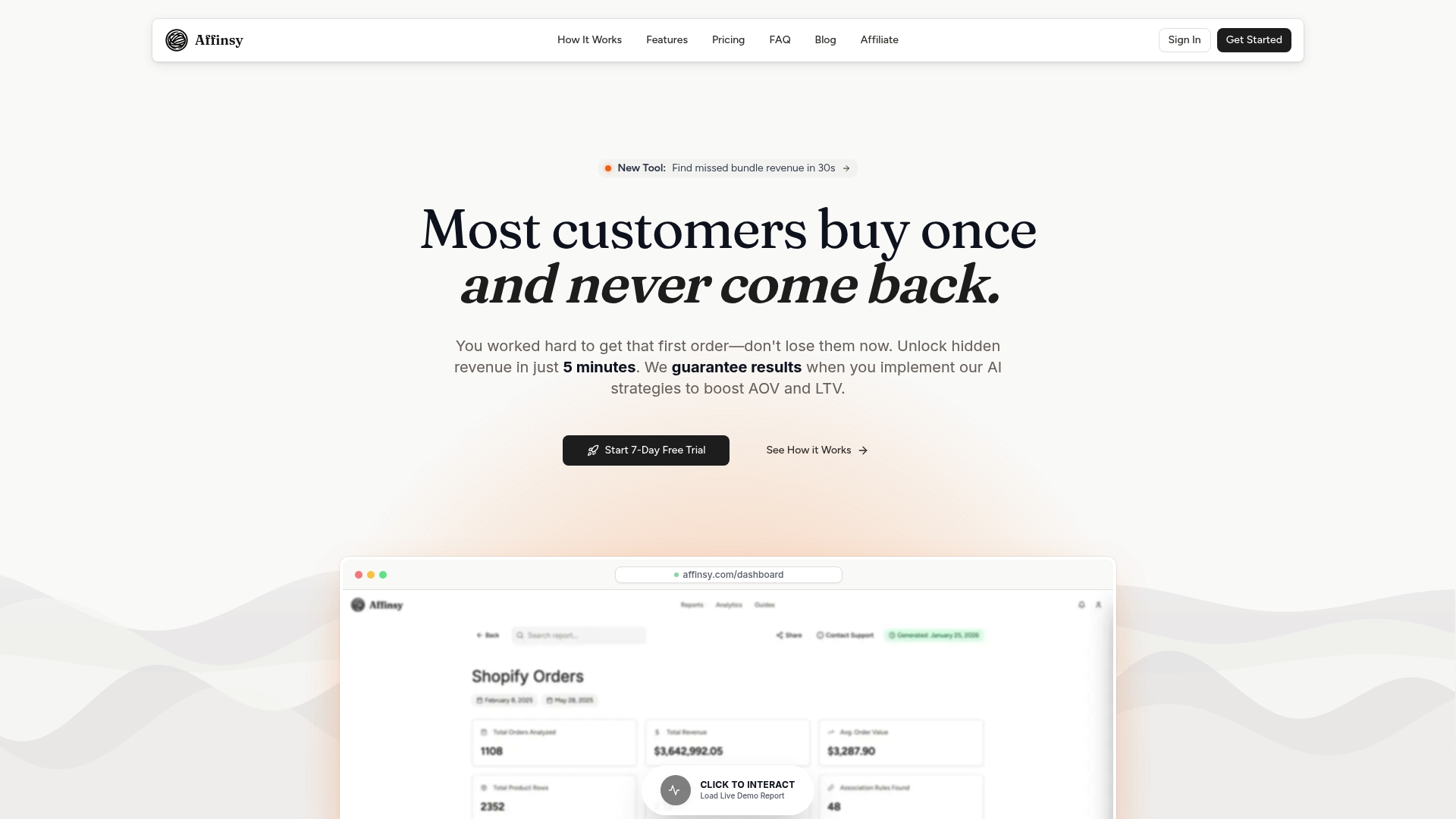
Discover how Affinsy’s AI-powered platform integrates seamlessly with your Shopify or WooCommerce store to deliver real-time analysis that supports smarter product bundling and targeted retention campaigns Act now to turn your data into increased average order values and loyal customers Start making data-driven decisions today by exploring Affinsy and unlock the full potential of your e-commerce sales growth strategy
Frequently Asked Questions
What is data-driven decision making in retail?
Data-driven decision making in retail involves using concrete data from sales, inventory, and customer behavior to inform business decisions rather than relying on gut feelings or assumptions.
How can data-driven decision making improve inventory management?
By analyzing sales patterns and peak demand times, retailers can balance supply and demand more effectively, optimizing their inventory levels and reducing stockouts or overstock situations.
What types of analytics are most commonly used in retail?
Retailers commonly use four types of analytics: descriptive analytics (what happened), diagnostic analytics (why it happened), predictive analytics (what will happen), and prescriptive analytics (what should be done).
How can AI tools enhance sales growth in retail?
AI tools automate pattern recognition and decision-making by predicting demand, personalizing customer recommendations, and optimizing pricing strategies, thereby improving overall efficiency and sales performance.
Recommended
- Data-Driven Decision Making — E-Commerce Glossary | Affinsy | Affinsy
- Data-Driven Decision Making in Ecommerce: Maximizing Sales and Retention - Affinsy Blog | Affinsy
- Predictive Analytics in Retail: Driving Ecommerce Growth - Affinsy Blog | Affinsy
- The Ultimate Guide to In Store Analytics for 2025 - Affinsy Blog | Affinsy
- Increasing In-Store Consumer Spending: Key Strategies for Success in 2024 - Omnichannel payments at the Point Of Sale | Sensepass