
Finding the right product mix and keeping customers engaged can feel like a moving target for many e-commerce managers. As the online retail world grows more competitive, using predictive analytics is the key to gaining an edge and understanding what drives your buyers. You will learn how advanced machine learning algorithms transform raw data into practical insights that help you build stronger product associations and keep shoppers coming back.
Table of Contents
- Defining Predictive Analytics in Retail
- Key Types and Retail Applications
- How Predictive Models Operate
- Product Association and Customer Segmentation
- Risks and Common Implementation Pitfalls
Key Takeaways
| Point | Details |
|---|---|
| Transformative Role of Predictive Analytics | Predictive analytics significantly enhances retailers’ ability to anticipate customer behavior and market trends, leading to more strategic decision-making. |
| Applications of Predictive Analytics | Key applications include demand forecasting, inventory management, and personalized marketing, which improve operational efficiency and customer engagement. |
| Implementation Challenges | Common pitfalls like data quality issues, algorithmic bias, and privacy concerns must be managed through robust governance and cross-functional collaboration. |
| Actionable Insights | Start small by identifying specific business challenges where predictive analytics can deliver immediate value, ensuring a focused implementation approach. |
Defining Predictive Analytics in Retail
Predictive analytics represents a transformative approach to understanding and anticipating customer behavior in the retail landscape. At its core, predictive analytics uses statistical algorithms to analyze historical data and forecast future trends, enabling retailers to make more strategic decisions.
This sophisticated data science technique goes beyond traditional reporting by transforming raw transactional information into actionable insights. Retailers can leverage predictive analytics across multiple dimensions:
- Demand Forecasting: Accurately predict product demand
- Inventory Management: Optimize stock levels and reduce waste
- Customer Segmentation: Understand unique consumer behavior patterns
- Personalized Marketing: Develop targeted promotional strategies
Machine learning algorithms power these predictive models, processing massive datasets from sources like point-of-sale systems, customer loyalty programs, and digital interactions. By analyzing complex patterns, retailers can anticipate customer preferences with remarkable precision.
Predictive analytics transforms raw data into strategic foresight, enabling retailers to stay ahead of market trends and customer expectations.
Retail businesses using advanced predictive analytics techniques can achieve significant competitive advantages. These techniques enable real-time decision-making, helping businesses respond quickly to emerging market dynamics and individual customer needs.
Pro tip: Start small by identifying one specific business challenge where predictive analytics can provide immediate value, such as reducing inventory carrying costs or improving customer retention rates.
Key Types and Retail Applications
Predictive analytics offers retailers a powerful toolkit for transforming raw data into strategic insights. Retailers can leverage multiple predictive analytics types to address complex business challenges and optimize performance across various operational dimensions.
The key types of predictive analytics in retail include:
- Demand Forecasting: Predicting future product demand with statistical precision
- Inventory Optimization: Balancing stock levels to minimize waste and maximize availability
- Price Optimization: Dynamically adjusting pricing strategies based on market conditions
- Customer Segmentation: Identifying and targeting specific consumer groups
- Promotional Forecasting: Estimating campaign effectiveness and potential revenue impact
Machine learning models play a critical role in processing complex datasets and generating actionable predictions. By analyzing historical transaction patterns, seasonal trends, and customer behaviors, these advanced algorithms help retailers make data-driven decisions with unprecedented accuracy.
Predictive analytics transforms raw retail data into strategic insights, enabling businesses to anticipate market shifts and customer preferences with remarkable precision.
Retail businesses can apply predictive analytics across multiple strategic domains, including omni-channel optimization, dynamic pricing, and personalized marketing. These techniques enable real-time decision-making that can significantly improve operational efficiency and customer engagement.

Here’s a summary of how key predictive analytics functions impact retail operations:
| Function | Business Impact | Example Application |
|---|---|---|
| Demand Forecasting | Reduces stockouts and excess | Aligns inventory to sales trends |
| Inventory Optimization | Minimizes waste, boosts margins | Keeps shelves stocked efficiently |
| Price Optimization | Increases revenue and margins | Real-time pricing adjustments |
| Customer Segmentation | Enhances targeting and loyalty | Custom offers by customer group |
| Promotional Forecasting | Improves campaign ROI | Predicts most effective promos |
Pro tip: Start by identifying one specific business challenge where predictive analytics can deliver immediate value, such as reducing inventory carrying costs or improving customer retention rates.
How Predictive Models Operate
Predictive models in retail leverage complex machine learning techniques to transform raw data into actionable business intelligence. These sophisticated algorithms analyze historical and current datasets to generate forward-looking insights that drive strategic decision-making.
The core operational components of predictive models include:
- Data Collection: Gathering information from multiple sources
- Data Preprocessing: Cleaning and organizing raw data
- Feature Selection: Identifying most relevant variables
- Algorithm Training: Teaching models to recognize patterns
- Prediction Generation: Creating actionable forecasts
Statistical algorithms form the backbone of these predictive systems, continuously learning and adapting as new data becomes available. The models utilize advanced techniques such as regression analysis, decision trees, and neural networks to extract meaningful patterns from complex retail datasets.
Predictive models are not static tools, but dynamic systems that continuously refine their accuracy through ongoing data processing and analysis.
Retail businesses can apply sophisticated data mining techniques to unlock deeper insights into customer behavior, market trends, and operational efficiency. These models enable real-time decision-making by providing rapid, data-driven predictions that help businesses stay ahead of market changes.
Pro tip: Invest in high-quality data collection and preprocessing to ensure your predictive models generate the most accurate and reliable insights possible.
Product Association and Customer Segmentation
AI-driven predictive analytics revolutionizes how retailers understand product relationships and customer behaviors. By analyzing complex transaction patterns, businesses can uncover hidden connections between products and develop more targeted marketing strategies.
Product association techniques help retailers understand key insights:
- Basket Correlation: Identifying frequently purchased item combinations
- Cross-Selling Opportunities: Recommending complementary products
- Purchase Pattern Analysis: Understanding sequential buying behaviors
- Contextual Recommendations: Personalizing product suggestions
- Seasonal Trend Detection: Recognizing temporal purchasing patterns
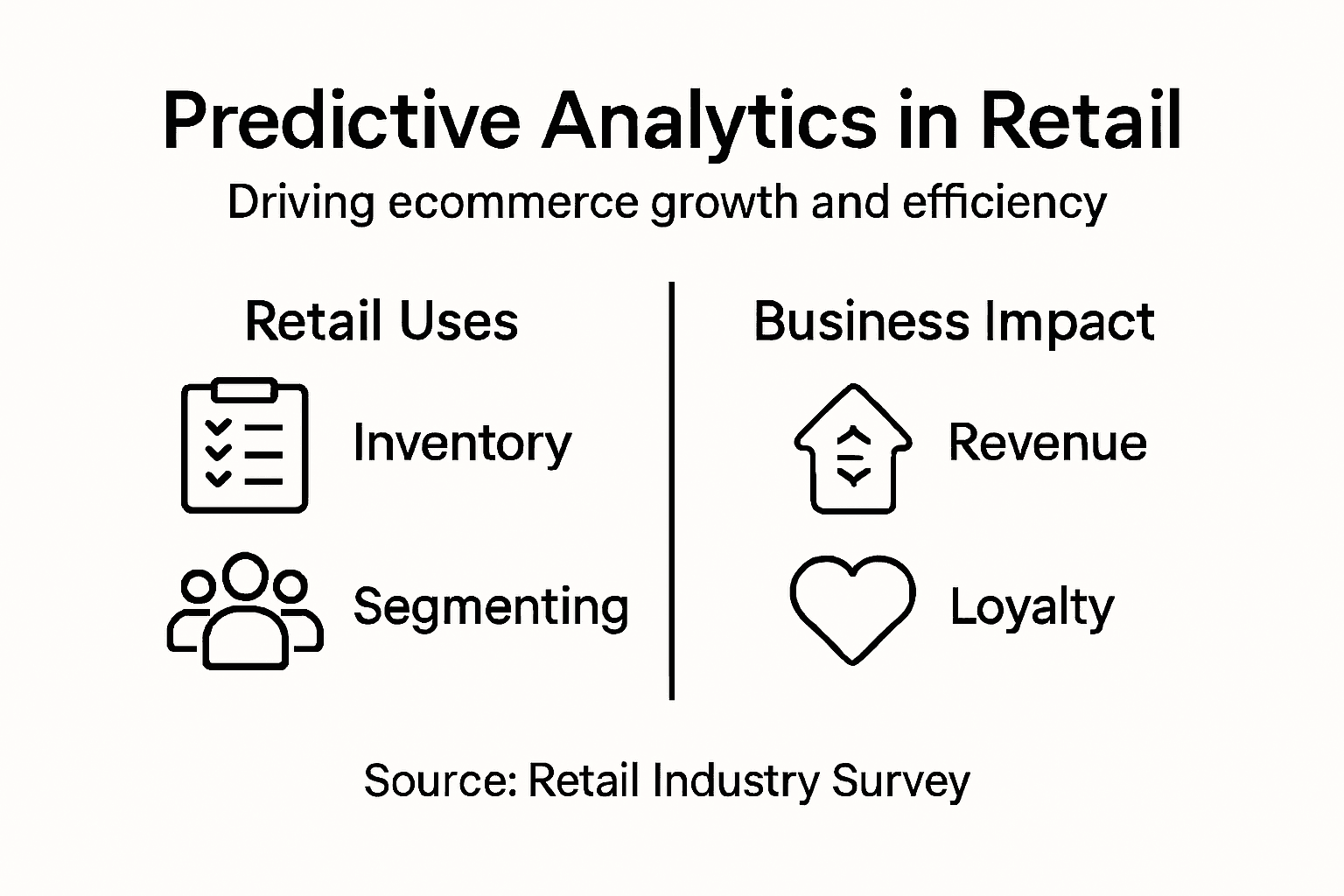
Customer segmentation algorithms break down consumer groups into precise categories based on multiple dimensions. These sophisticated models analyze demographic information, purchase history, browsing behavior, and engagement levels to create nuanced customer profiles.
Effective product association and customer segmentation transform raw data into actionable marketing intelligence that drives revenue and customer loyalty.
Retail businesses can leverage predictive algorithms to optimize customer experiences by delivering personalized recommendations and targeted marketing campaigns. These advanced techniques enable businesses to anticipate customer needs, improve engagement, and create more meaningful interactions.
Pro tip: Continuously validate and refine your segmentation models by regularly cross-referencing predictive insights with actual customer behavior to maintain accuracy and relevance.
Risks and Common Implementation Pitfalls
Predictive analytics implementation presents significant challenges for retail businesses. Organizations must navigate complex technological and ethical landscapes to successfully deploy these advanced analytical tools while minimizing potential risks.
The most critical implementation pitfalls include:
- Data Quality Issues: Incomplete or inaccurate datasets
- Algorithmic Bias: Unintended discrimination in predictive models
- Privacy Concerns: Potential misuse of customer information
- Integration Challenges: Incompatibility with existing systems
- Skill Gap: Lack of specialized analytics expertise
Technical complexity often undermines predictive analytics efforts. Many retailers underestimate the sophisticated infrastructure required to develop, deploy, and maintain advanced machine learning models that can generate reliable insights.
Successful predictive analytics implementation demands a holistic approach that balances technological capabilities with ethical considerations and robust governance.
Retail businesses can mitigate risks through comprehensive analytics strategies that prioritize data integrity, model transparency, and continuous monitoring. Developing a comprehensive risk management framework helps organizations navigate the complex landscape of predictive analytics.
To help avoid common pitfalls, compare risk factors and mitigation strategies in predictive analytics implementation:
| Risk Factor | Potential Impact | Mitigation Strategy |
|---|---|---|
| Data Quality Issues | Inaccurate predictions | Rigorous data validation |
| Algorithmic Bias | Unfair outcomes | Diverse training datasets |
| Privacy Concerns | Loss of customer trust | Strong data governance |
| Integration Challenges | Workflow disruptions | System compatibility planning |
| Skill Gap | Project delays | Targeted staff training |
Pro tip: Establish a cross-functional team with data scientists, domain experts, and compliance professionals to develop a balanced approach to predictive analytics implementation.
Unlock Your Ecommerce Growth with AI-Powered Predictive Analytics
The article highlights how predictive analytics transforms retail by revealing hidden product associations and driving smarter customer segmentation. If you are looking to overcome challenges like optimizing product bundling, maximizing cross-selling opportunities, and boosting customer retention without needing a deep data science background this is your moment to act. Affinsy specializes in turning historical transaction data into actionable insights that empower online retailers to increase sales and average order value.
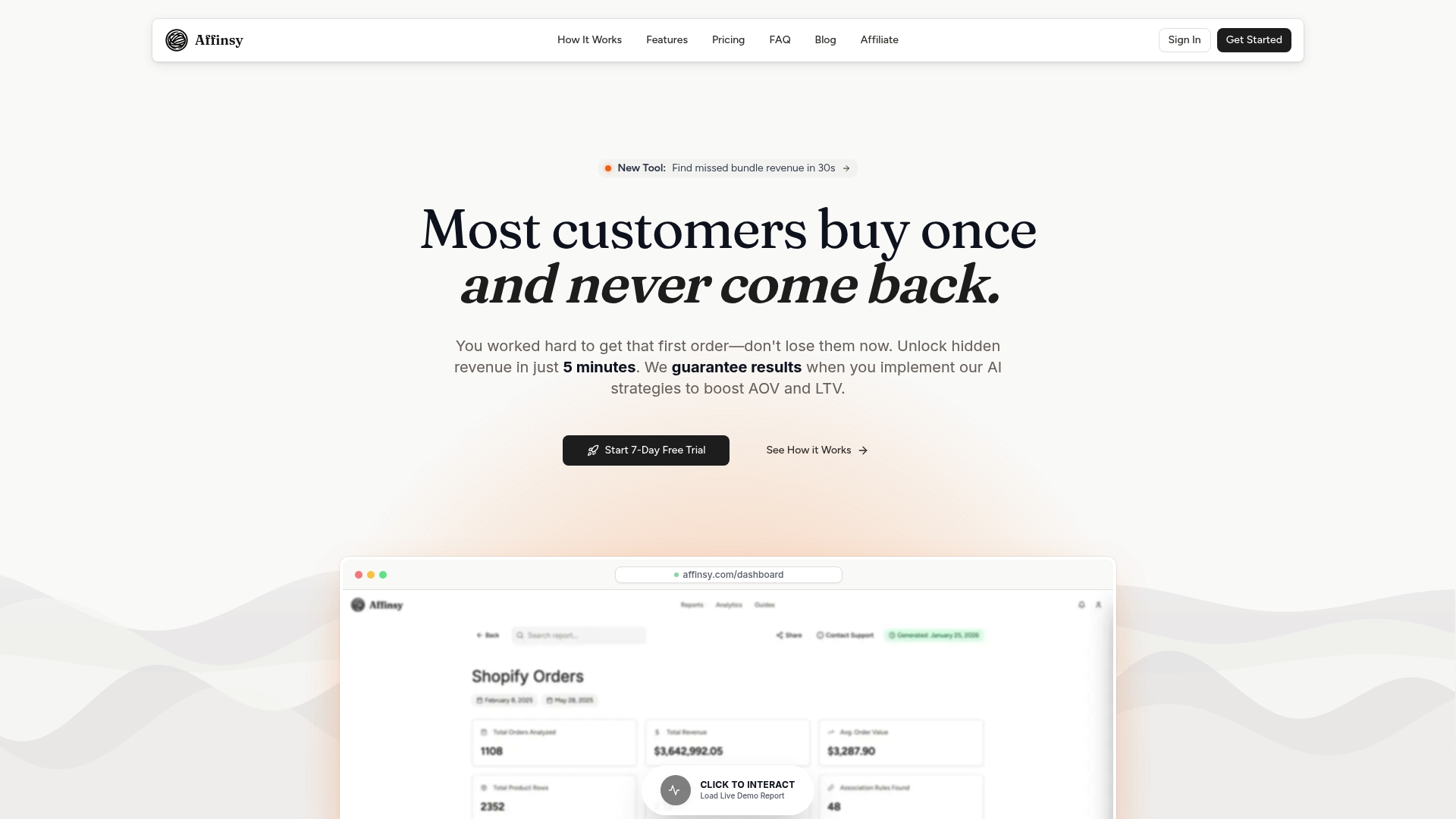
Discover how Affinsy’s seamless integration with top platforms like Shopify and WooCommerce can elevate your ecommerce strategy today. Start leveraging advanced market basket analysis and RFM customer segmentation to make faster, smarter decisions that fuel growth. Visit Affinsy now to unlock the powerful predictive analytics that your online store deserves and turn data into profit.
Frequently Asked Questions
What is predictive analytics in retail?
Predictive analytics in retail uses statistical algorithms to analyze historical data and forecast future trends, helping retailers understand and anticipate customer behavior for more informed decision-making.
How can predictive analytics improve inventory management?
Predictive analytics helps optimize stock levels, reduces waste, and aligns inventory with demand forecasts, ensuring that products are available when customers want them and preventing stockouts or overstock situations.
What are some applications of predictive analytics for personalized marketing?
Retailers can use predictive analytics to segment customers based on behaviors and preferences, allowing for targeted marketing strategies, personalized promotions, and improved customer engagement, which can lead to increased loyalty and sales.
What are the risks associated with implementing predictive analytics?
Common risks include data quality issues, algorithmic bias, privacy concerns, integration challenges with existing systems, and a skill gap in analytics expertise. Mitigating these risks requires a comprehensive strategy focusing on data integrity, model transparency, and ongoing monitoring.
Recommended
- Understanding Retail Analytics Guide 2025 for E-Commerce Success - Affinsy Blog | Affinsy
- Understanding Top Retail Analytics Terms for E-Commerce Success - Affinsy Blog | Affinsy
- Data-Driven Decision Making in Ecommerce: Maximizing Sales and Retention - Affinsy Blog | Affinsy
- E Commerce Analysis Report Guide for 2025 Success - Affinsy Blog | Affinsy