
Finding the perfect mix of products to drive customer loyalty and increase order value can feel like an ongoing challenge for every American and European e-commerce manager. As shoppers expect more tailored experiences, ordinary product bundles often fall short. The rise of agentic commerce powered by artificial intelligence opens new doors for creating intent-driven, dynamic bundle strategies. Discover how advanced data insights and adaptable algorithms are changing the way mid-sized online retailers attract and keep customers.
Table of Contents
- Defining Bundles In Agentic Commerce
- Types Of Product Bundles And Strategies
- How Ai Analytics Enhance Bundle Effectiveness
- Boosting Average Order Value And Retention
- Common Pitfalls And How To Avoid Them
Key Takeaways
| Point | Details |
|---|---|
| Intelligent Product Bundles | Agentic commerce utilizes AI to create dynamic, personalized transaction packages that adapt to consumer needs in real-time. |
| AI-Driven Optimization | Advanced algorithms analyze consumer behavior to enhance product pairing, pricing, and overall shopping experience. |
| Continuous Learning Capabilities | Agentic systems evolve through data analytics, ensuring bundles remain relevant and appealing based on emerging trends and individual preferences. |
| Strategic Customer Engagement | Thoughtful bundling can significantly boost average order value and customer loyalty by offering compelling value propositions. |
Defining Bundles in Agentic Commerce
Agentic commerce represents a transformative approach to digital shopping experiences, where artificial intelligence autonomously navigates complex transaction landscapes on behalf of consumers. At the core of this emerging paradigm lies the concept of intelligent product bundles - dynamic, personalized transaction packages that transcend traditional static product combinations.
In the context of agentic commerce systems, bundles are not merely predetermined product groupings, but sophisticated, intent-driven aggregations that adapt in real-time to individual consumer needs. These intelligent bundles leverage advanced algorithms to:
- Analyze individual consumer preferences
- Predict complementary product combinations
- Negotiate optimal pricing structures
- Create seamless, personalized transaction flows
- Minimize friction in purchasing decisions
Traditional e-commerce approaches viewed bundles as static marketing tactics. Agentic commerce transforms this model by introducing autonomous negotiation capabilities that dynamically assemble product combinations. An AI agent can now instantaneously evaluate multiple variables - consumer intent, historical purchase patterns, real-time pricing, and contextual relevance - to craft precisely targeted bundle offerings.
The fundamental difference between traditional and agentic bundle strategies lies in their operational intelligence. Where human-managed bundles rely on manual configuration, agentic systems continuously learn and adapt, creating increasingly sophisticated and personalized transaction experiences that align perfectly with individual consumer expectations.
Here’s a side-by-side guide to traditional versus agentic bundle strategies:
| Aspect | Traditional Bundling | Agentic Commerce Bundling |
|---|---|---|
| Bundle Creation | Manual, fixed combinations | AI-driven, adaptive groupings |
| Customer Personalization | Generic offers | Individualized recommendations |
| Pricing Approach | Static pricing | Optimized, dynamic pricing |
| Data Utilization | Limited, basic analytics | Advanced, real-time insights |
| Competitive Advantage | Conventional, slow to adapt | Rapid, intelligent market response |
Pro tip: Implement machine learning algorithms that track individual consumer interaction patterns to develop increasingly precise and appealing product bundle recommendations.
Types of Product Bundles and Strategies
Product bundling has evolved far beyond simple pricing tactics, transforming into a sophisticated strategy for enhancing customer value and driving sales. Product bundle strategies represent a nuanced approach to combining products that goes well beyond traditional marketing techniques.
The landscape of product bundling encompasses several distinct strategies:
- Pure Bundles: Products exclusively sold as a complete package
- Mixed Bundles: Items available both individually and as a package
- Cross-Selling Bundles: Complementary products strategically paired to increase purchase likelihood
- New Product Bundles: Combining popular items with new product introductions
- Mix-and-Match Bundles: Offering customer flexibility in bundle composition
- Inventory Clearance Bundles: Strategically reducing stock through attractive package deals
Each bundle type serves a unique strategic purpose. Pure bundles create a comprehensive product experience by requiring customers to purchase multiple items together, while mixed bundles provide flexibility. Cross-selling bundles leverage complementary product relationships to enhance perceived value and encourage additional purchases.
Advanced bundling strategies go beyond simple product combinations. They involve sophisticated algorithms that analyze customer preferences, purchase history, and contextual relevance to create dynamic personalized offerings. These intelligent bundles can adapt in real-time, presenting customers with precisely targeted product combinations that maximize both consumer satisfaction and business revenue.
For quick reference, here are the major bundle types and their optimal use cases:
| Bundle Type | Best Use Case | Business Benefit |
|---|---|---|
| Pure Bundle | Selling entire sets | Increases average ticket size |
| Mixed Bundle | Reaching diverse needs | Boosts cross-category purchasing |
| Cross-Selling Bundle | Encouraging add-ons | Enhances product discovery |
| New Product Bundle | Launching innovative items | Accelerates adoption of new products |
| Mix-and-Match Bundle | Empowering customer choice | Improves engagement and retention |
| Inventory Clearance Bundle | Moving excess stock | Reduces storage and operational costs |
Pro tip: Develop flexible bundling algorithms that continuously learn from customer interaction data to create increasingly personalized and appealing product packages.
How AI Analytics Enhance Bundle Effectiveness
AI-powered analytics have revolutionized product bundling by transforming how businesses understand and predict consumer behavior. AI agents in commerce leverage sophisticated algorithms to decode complex purchasing patterns and create hyper-personalized product combinations that dramatically improve sales performance.
Key capabilities of AI-driven bundle analytics include:
- Predictive consumer preference modeling
- Real-time bundle optimization
- Personalization at individual customer levels
- Dynamic pricing strategy development
- Automated product pairing identification
- Behavioral pattern recognition
These advanced analytics go beyond traditional segmentation by creating granular consumer insights. AI systems analyze multiple data points simultaneously - including purchase history, browsing behavior, demographic information, and contextual preferences - to construct bundles that feel uniquely tailored to each customer’s specific needs and desires.
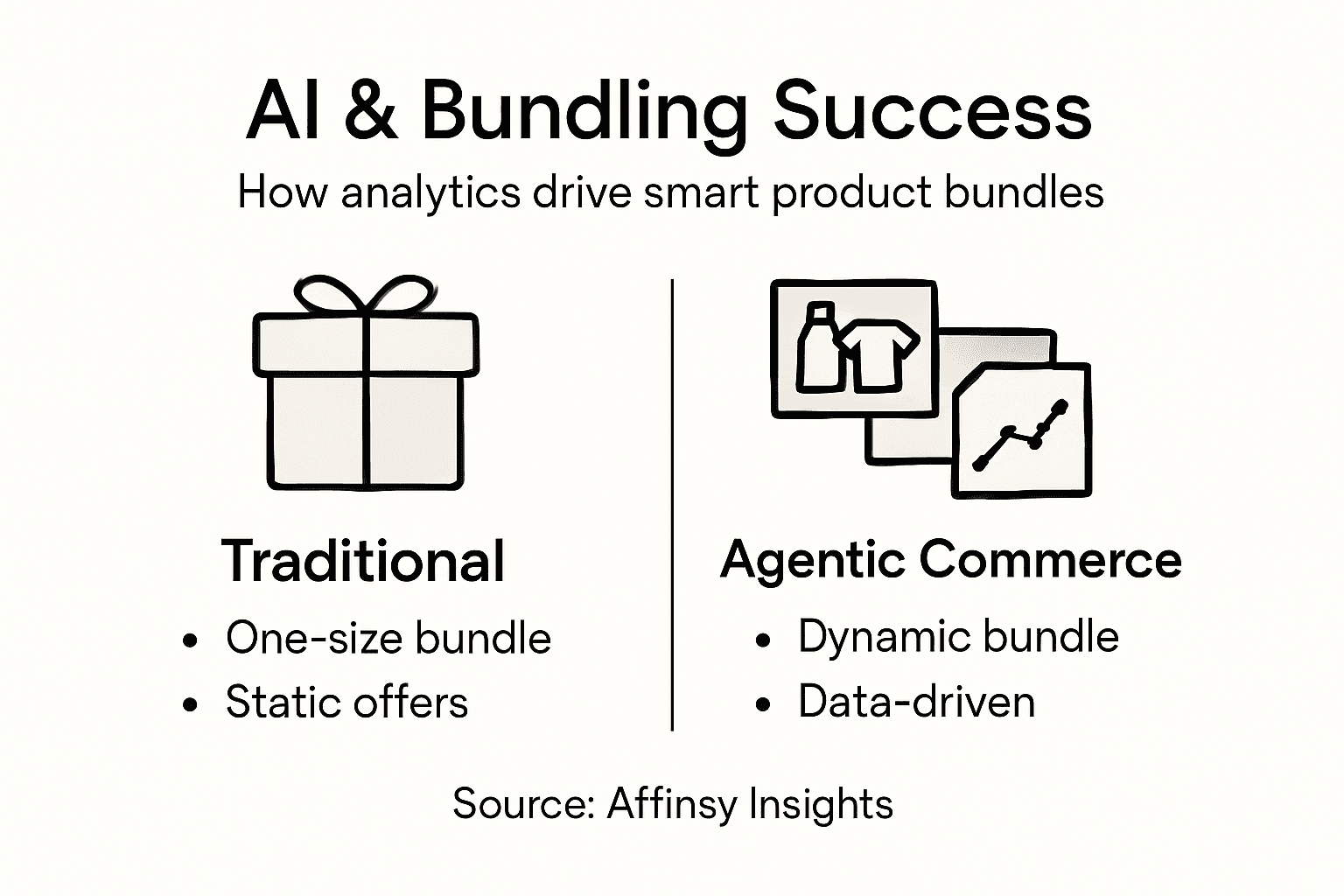
The most powerful aspect of AI-enhanced bundling is its ability to continuously learn and adapt. Unlike static marketing approaches, these intelligent systems can instantly recalibrate bundle recommendations based on emerging trends, seasonal variations, and individual customer interactions. This dynamic approach ensures that product packages remain relevant, appealing, and precisely aligned with evolving consumer expectations.
Pro tip: Implement machine learning models that track individual customer interaction patterns to develop increasingly sophisticated and personalized product bundle recommendations.
Boosting Average Order Value and Retention
Product bundling has emerged as a sophisticated strategy for improving customer retention by creating compelling value propositions that extend beyond traditional sales tactics. By strategically packaging complementary products, businesses can simultaneously increase average order value and foster deeper customer loyalty.
Key strategies for maximizing bundle effectiveness include:
- Creating tiered bundle options
- Offering targeted product combinations
- Highlighting clear cost savings
- Developing themed bundle collections
- Personalizing bundle recommendations
- Implementing dynamic pricing structures
The most powerful bundles transcend simple product groupings by delivering comprehensive customer experiences. These intelligent packages solve multiple customer needs simultaneously, reducing purchase friction and providing perceived additional value. When customers recognize they are receiving more for less, they become more likely to complete purchases and return for future transactions.

Successful bundle strategies require continuous refinement through data-driven insights. Businesses must analyze customer interaction patterns, purchase histories, and contextual preferences to develop increasingly sophisticated bundle offerings. By treating bundles as dynamic, evolving solutions rather than static product sets, companies can create more engaging and personalized shopping experiences that directly address individual customer requirements.
Pro tip: Develop a systematic approach to bundle optimization by regularly tracking customer engagement metrics and iteratively adjusting product combinations based on real-time performance data.
Common Pitfalls and How to Avoid Them
Product bundling strategies can quickly unravel when businesses fail to implement thoughtful approaches. Avoiding common bundling pitfalls requires strategic planning and a nuanced understanding of customer expectations and market dynamics.
The most critical challenges in product bundling include:
- Creating artificially low-value combinations
- Sacrificing product quality for volume
- Misaligning bundle pricing strategies
- Neglecting customer preferences
- Overcomplicating bundle structures
- Failing to communicate bundle benefits clearly
Successful bundle strategies demand meticulous product selection and a deep understanding of customer value perception. Businesses must resist the temptation to simply reduce prices or combine random products. Instead, they should focus on creating meaningful combinations that solve genuine customer problems and provide demonstrable economic advantages.
The key to avoiding bundling pitfalls lies in continuous optimization and customer-centric design. By leveraging data analytics, businesses can develop bundle strategies that adapt to changing market conditions, customer preferences, and individual purchasing behaviors. This dynamic approach prevents stagnation and ensures that product packages remain relevant, attractive, and genuinely valuable to consumers.
Pro tip: Conduct regular customer surveys and analyze purchasing data to validate and refine your bundle offerings, ensuring they consistently meet evolving market needs.
Unlock the Power of Intelligent Product Bundles with Affinsy
The article highlights the critical role of dynamic, AI-driven bundles in agentic commerce success. If you are struggling to create personalized and adaptive bundles that increase average order value and improve customer retention you are not alone. Many retailers face challenges in analyzing complex transaction data and identifying meaningful product associations that drive smarter bundling and cross-selling strategies. Concepts like predictive consumer preference modeling and real-time bundle optimization are key but require advanced analytics that can seem out of reach.
Affinsy offers a seamless solution that uses AI-powered analytics to transform your historical sales data into actionable insights. By leveraging tools such as market basket analysis (MBA) and RFM customer segmentation Affinsy helps you uncover hidden product relationships and tailor bundles to your customers’ unique needs. Our platform integrates easily with popular e-commerce systems like Shopify and WooCommerce making it simple to enhance your product bundling strategies and boost revenue through data-driven decisions.
Take control of your bundle optimization now and elevate your e-commerce performance with Affinsy.
Discover how advanced analytics can revolutionize your product bundling. Visit Affinsy today to start maximizing your sales potential and create personalized bundles that truly resonate with your customers.
Frequently Asked Questions
What are intelligent product bundles in agentic commerce?
Intelligent product bundles are dynamic, personalized combinations of products that adapt in real-time to individual consumer needs, leveraging artificial intelligence to create tailored transaction experiences.
How does AI enhance the effectiveness of product bundling?
AI enhances product bundling by using advanced algorithms to analyze consumer behavior, predict preferences, and optimize bundle pricing, allowing for hyper-personalized product combinations that increase sales performance.
What strategies can businesses use to maximize the benefits of product bundles?
Businesses can maximize bundle effectiveness by creating tiered options, offering targeted product combinations, highlighting cost savings, personalizing recommendations, and implementing dynamic pricing structures.
What common pitfalls should businesses avoid in product bundling?
Businesses should avoid creating low-value combinations, sacrificing product quality, misaligning pricing strategies, neglecting customer preferences, overcomplicating structures, and failing to communicate the benefits of bundles clearly.
Recommended
- 7 Smart Bundle Pricing Strategies for E-commerce Success - Affinsy Blog | Affinsy
- Master Product Bundling Strategies for E-Commerce Success - Affinsy Blog | Affinsy
- How to Improve Average Order Value with Data-Driven Bundling - Affinsy Blog | Affinsy
- Master Product Bundling on Shopify for Increased Sales - Affinsy Blog | Affinsy
- DropPop | Depop Dropshipping