
Many marketing managers believe demographic data alone is enough for effective customer segmentation. This misconception cuts campaign effectiveness by 30%, according to customer segmentation research. When you rely solely on age, gender, or location without examining purchase behavior, you miss critical insights that drive retention and sales. Mastering multi-dimensional segmentation transforms how you connect with customers, personalize campaigns, and build lasting loyalty in ecommerce.
Table of Contents
- What Is Customer Segmentation And Why It Matters
- Types Of Customer Segmentation Relevant To Ecommerce
- Benefits Of Customer Segmentation For Retention And Sales
- Common Misconceptions About Customer Segmentation
- Advanced Segmentation Techniques Using Ai And Analytics
- Tools And Integration For Customer Segmentation
- Using Segmentation For Sales Optimization
- Conclusion And Next Steps For Implementation
- Unlock Ecommerce Growth With Affinsy’s Ai Analytics Solutions
- Frequently Asked Questions About Customer Segmentation Explained
Key takeaways
| Point | Details |
|---|---|
| Customer segmentation groups shoppers by shared traits | Enables tailored marketing that resonates with specific customer needs and preferences. |
| Multiple segmentation types improve targeting precision | Combining demographic, behavioral, RFM, and lifecycle data increases campaign effectiveness by 30%. |
| AI-powered analytics enable dynamic segmentation | Real-time updates adapt to behavior changes, boosting engagement significantly over static methods. |
| Segmentation drives measurable business outcomes | Increases retention rates, average order value, and lifetime customer value by 20 to 30%. |
| Ongoing refinement is essential for success | Treating segmentation as a one-time task leads to 15% lower engagement rates over time. |
What is customer segmentation and why it matters
Customer segmentation divides your shoppers into distinct groups based on shared characteristics like demographics, behavior, or purchase patterns. This approach transforms generic marketing into personalized strategies that speak directly to each group’s unique needs and preferences. When you understand what drives different segments, you create campaigns that resonate deeply rather than fall flat.
The power of segmentation lies in its ability to improve customer satisfaction and loyalty. Personalized experiences make shoppers feel understood and valued, which directly impacts their willingness to return and recommend your store. By targeting the right message to the right people at the right time, you reduce wasted marketing spend and maximize return on investment.
Customer segmentation is the foundation of effective ecommerce marketing. Without it, you’re shooting arrows in the dark and hoping something hits the target.
Segmentation enables you to allocate resources efficiently. Instead of spreading your budget thin across all customers equally, you can prioritize high-value segments that drive the most revenue. This strategic focus helps smaller teams compete with larger competitors by working smarter, not harder.
- Identify which customer groups generate the most profit
- Tailor product recommendations to specific segment preferences
- Create targeted retention campaigns for at-risk customers
- Optimize marketing spend by focusing on segments with highest conversion potential
Types of customer segmentation relevant to ecommerce
Demographic segmentation groups customers by age, gender, income, location, and education level. This serves as a baseline for understanding your audience, but relying on demographics alone leaves significant value on the table. A 25-year-old shopper in New York might have completely different purchase behavior than another 25-year-old in the same city.

Behavioral segmentation focuses on how customers interact with your store. This includes browsing patterns, purchase frequency, cart abandonment, email engagement, and product preferences. Behavioral data reveals what customers actually do rather than what demographics suggest they might do, making it far more actionable for campaign targeting.
RFM analysis segments customers based on Recency, Frequency, and Monetary value. This method identifies your most valuable customers who purchased recently, buy often, and spend significantly. RFM enables you to prioritize retention efforts on customers who matter most to your bottom line, rather than treating all shoppers equally.
| Segmentation Type | Primary Use Case | Key Metric |
|---|---|---|
| Demographic | Baseline audience understanding | Age, location, income |
| Behavioral | Campaign targeting and personalization | Purchase frequency, browsing history |
| RFM | High-value customer retention | Recency, frequency, monetary value |
| Lifecycle | Stage-based engagement | New, active, at-risk, dormant |
| Value-based | Resource allocation decisions | Customer lifetime value |
Lifecycle segmentation targets customers at different engagement stages, from new visitors to loyal advocates. Lifecycle targeting improves re-engagement rates by 25% in ecommerce campaigns. You can create specific messages for customers who just made their first purchase versus those who haven’t ordered in six months, addressing their unique mindsets and needs.
Value-based segmentation groups customers by profitability and lifetime value potential. This approach helps you decide where to invest marketing dollars for maximum return. High-value customers might receive VIP treatment and exclusive offers, while lower-value segments get automated nurture campaigns that require minimal resources.
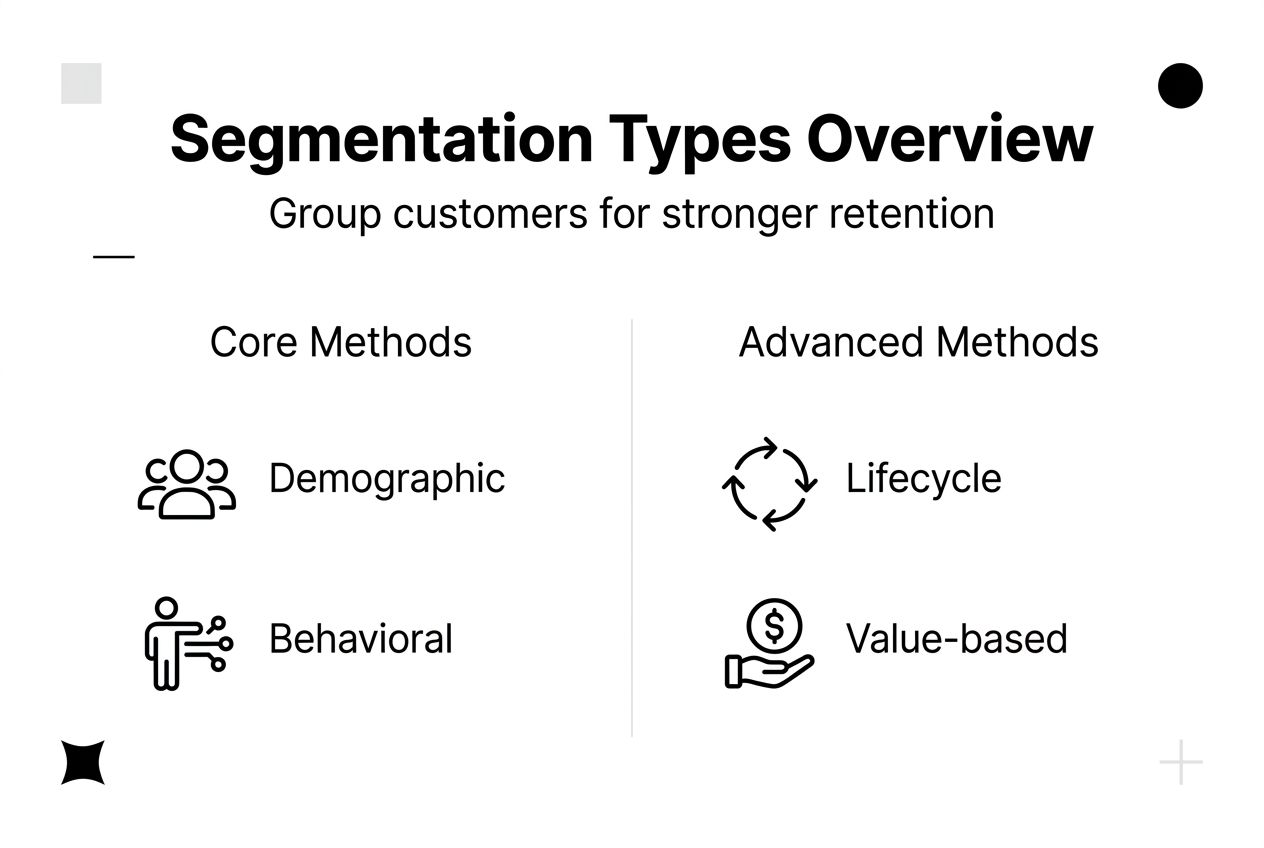
Pro Tip: Combine multiple segmentation types for precision targeting. A high-RFM customer in the “at-risk” lifecycle stage needs a different campaign than a high-RFM customer who purchases regularly. Layering segmentation dimensions reveals opportunities that single-dimension analysis misses entirely.
Benefits of customer segmentation for retention and sales
Segmented marketing campaigns see dramatically higher engagement and conversion rates compared to generic approaches. Personalized campaigns achieve 101% more clicks, and 80% of segmented campaigns report increased sales. When you speak directly to a customer’s specific interests and needs, they respond far more positively than to one-size-fits-all messaging.
Segmentation helps increase average order value through targeted cross-sell and bundling offers. By understanding which products different segments prefer, you can recommend complementary items that genuinely add value. A customer who regularly buys athletic wear responds better to performance accessories than to unrelated product suggestions, making your recommendations feel helpful rather than pushy.
The difference between generic marketing and segmented campaigns is the difference between shouting at a crowd and having a conversation with a friend. One gets ignored, the other builds relationships.
Improved retention through segmentation leads to substantial growth in customer lifetime value. When you identify at-risk customers early and intervene with targeted win-back campaigns, you recover revenue that would otherwise disappear. Similarly, nurturing high-value customers with exclusive experiences and recognition strengthens their loyalty and advocacy.
Personalization reduces marketing waste by focusing resources on segments with the highest purchase likelihood. Instead of sending every promotion to your entire list, you can target offers to customers whose behavior suggests interest. This precision improves both customer experience and campaign ROI simultaneously.
- Increase email open rates by 20 to 40% with segment-specific subject lines
- Reduce unsubscribe rates by sending relevant content to interested segments
- Improve customer satisfaction scores through personalized experiences
- Boost repeat purchase rates with tailored retention campaigns
Common misconceptions about customer segmentation
Many marketing managers believe demographic segmentation alone provides adequate targeting precision. This misconception undermines effectiveness significantly. Demographic-only strategies deliver 30% lower campaign performance compared to multi-dimensional approaches. Age and location tell you who someone is, not what they need or how they prefer to shop.
Another widespread mistake treats segmentation as a one-time setup task. Customer behavior changes constantly based on life events, seasonal patterns, and market trends. Stale segmentation reduces engagement rates by 15% because your targeting becomes disconnected from current customer reality. What worked six months ago may completely miss the mark today.
The assumption that one message fits all segment members ignores the diversity within customer groups. Even well-defined segments contain individuals with varying preferences and needs. Effective segmentation requires testing different messages and offers within segments to find what resonates best, then iterating based on results.
- Update segments monthly at minimum to capture behavior changes and trends
- Layer multiple segmentation types rather than relying on a single dimension
- Test different messages within segments to optimize engagement and conversion
- Monitor segment performance metrics to identify when refinement is needed
- Integrate fresh data continuously to keep segments accurate and actionable
Pro Tip: Set up automated alerts when segment behavior shifts significantly. If your high-value customers suddenly reduce purchase frequency, you want to know immediately so you can investigate causes and respond proactively before they churn completely.
Advanced segmentation techniques using AI and analytics
AI-powered segmentation algorithms analyze continuous customer data streams to identify patterns humans would miss. These systems update segments in real time as behavior changes, ensuring your targeting stays current and relevant. AI enables 30% higher engagement compared to traditional static segmentation by adapting to shifts in customer preferences and market conditions instantly.
Dynamic segmentation adjusts automatically based on the latest customer actions. When someone moves from browsing to purchasing, or from active to dormant, AI systems immediately update their segment assignment and trigger appropriate campaigns. This responsiveness means you engage customers at exactly the right moment with the right message, maximizing conversion opportunities.
| Approach | Update Frequency | Personalization Level | Resource Requirements |
|---|---|---|---|
| Traditional Fixed | Quarterly or annual | Low to medium | High manual effort |
| Rule-based Dynamic | Weekly or monthly | Medium | Moderate setup time |
| AI-driven Dynamic | Real-time continuous | High | Low ongoing effort |
Integrations with platforms like Shopify and Google Analytics streamline automated targeting without technical complexity. Modern AI analytics tools connect directly to your existing systems, pulling behavioral data, transaction history, and engagement metrics automatically. This eliminates manual data exports and ensures segmentation always reflects your most current information.
Machine learning models identify micro-segments within broader categories, revealing niche opportunities for hyper-targeted campaigns. You might discover a small but highly profitable segment of customers who purchase specific product combinations at predictable intervals. These insights enable precision marketing that feels almost prescient to recipients.
- Predict which customers are most likely to churn in the next 30 days
- Identify optimal timing for re-engagement campaigns based on individual patterns
- Discover hidden product affinities that inform cross-sell strategies
- Automate segment assignments as customer behavior evolves
AI doesn’t replace marketing judgment. It amplifies your ability to act on insights at scale, freeing you to focus on strategy rather than data manipulation.
Pro Tip: Start with AI-powered analytics platforms that offer pre-built segmentation models. You can implement sophisticated targeting quickly, then customize models as you learn what drives results for your specific business and audience.
Tools and integration for customer segmentation
CRM and ecommerce platform integrations centralize customer data for unified segmentation views. When your order history, browsing behavior, email engagement, and support interactions live in one system, you can create segments based on the complete customer journey. Integrated platforms eliminate data silos that fragment understanding and limit targeting precision.
Tools like Affinsy provide AI-driven analytics that reveal hidden associations between customer attributes and purchase patterns. These insights go beyond obvious correlations to uncover opportunities you wouldn’t find through manual analysis. Understanding which product combinations specific segments prefer enables targeted bundling and cross-sell campaigns that feel natural rather than forced.
Exportable reports and dashboards facilitate data-driven decisions without requiring technical expertise. Modern segmentation platforms translate complex analytics into visual insights that marketing managers can act on immediately. You don’t need data science skills to identify your most valuable segments or understand which campaigns drive the best results.
| Platform | Key Features | Integration Ease | Best For |
|---|---|---|---|
| Affinsy | AI-powered RFM, product associations, automated insights | Seamless Shopify/WooCommerce | Ecommerce retention and bundling |
| Klaviyo | Email segmentation, behavioral triggers, A/B testing | Native ecommerce integrations | Email marketing automation |
| Segment | Customer data platform, multi-channel tracking | API-based flexibility | Enterprise data consolidation |
| Google Analytics 4 | Audience building, predictive metrics | Universal web integration | Website behavior analysis |
- Connect segmentation tools to your ecommerce platform for automatic data sync
- Set up dashboards that track segment performance metrics in real time
- Export segmentation insights to inform product development and inventory decisions
- Leverage pre-built integration templates to reduce implementation time
The right tools make sophisticated segmentation accessible to teams without dedicated data scientists. Look for platforms that offer guided setup, pre-configured segment templates, and clear documentation. Product optimization becomes significantly easier when segmentation insights inform which items to feature prominently and which product combinations to promote.
Using segmentation for sales optimization
Segmentation analytics identify complementary products for targeted bundling offers that increase average order size. When you understand which items different segments purchase together, you can create bundles that feel curated rather than random. Product bundling based on segmentation increased average order value by 15% in documented cases, proving the financial impact of data-driven bundling strategies.
Personalized promotions driven by segment-specific data improve customer re-engagement and repeat purchases. A discount on products a customer has shown interest in but not purchased carries far more weight than a generic store-wide sale. You demonstrate that you understand their preferences and care about providing value, which strengthens the relationship beyond the immediate transaction.
Cross-sell and upsell marketing campaigns become significantly more effective when informed by detailed customer segments. Instead of promoting premium versions to price-sensitive customers or basic options to high-value shoppers, you match offers to segment characteristics. This alignment improves conversion rates while enhancing customer satisfaction because recommendations genuinely serve their needs.
- Create segment-specific landing pages that feature products matching group preferences
- Time promotions based on when different segments typically purchase
- Adjust messaging tone and emphasis to align with segment values and priorities
- Test different incentive types across segments to optimize response rates
Case studies demonstrate measurable sales uplifts from segmentation-based tactics. Retailers who implement data-driven bundling and cross-sell strategies consistently report double-digit increases in both average order value and customer lifetime value. The key lies in continuous testing and refinement based on segment response data.
Pro Tip: Monitor which segments respond best to different promotion types. Some groups prefer percentage discounts while others respond better to free shipping or buy-one-get-one offers. Matching incentive format to segment preferences maximizes promotion effectiveness and protects margin.
Conclusion and next steps for implementation
Customer segmentation is essential for tailoring marketing, improving retention, and boosting sales in competitive ecommerce markets. The difference between businesses that thrive and those that struggle often comes down to how well they understand and serve different customer groups. Generic approaches no longer cut through the noise in crowded digital channels.
View segmentation as an ongoing process that evolves with your business and customers. Markets shift, customer preferences change, and new opportunities emerge constantly. Continuous refinement based on fresh data keeps your targeting relevant and effective, preventing the staleness that undermines campaign performance.
Integrating AI-powered analytics tools maximizes segmentation accuracy and campaign effectiveness with minimal manual effort. Modern platforms handle the complex data analysis while you focus on strategic decisions and creative execution. This combination of technology and human judgment delivers results neither could achieve alone.
- Consolidate customer data from all touchpoints into a unified system
- Define initial segments based on RFM, lifecycle stage, and behavioral patterns
- Leverage AI analytics to uncover hidden segments and product associations
- Integrate segmentation insights with your email, advertising, and ecommerce platforms
- Commit to monthly segment reviews and updates based on performance data
Successful segmentation requires commitment to iterative refinement as customer behaviors and market conditions evolve. Start with foundational segments, test campaigns, measure results, and adjust based on what you learn. This cycle of continuous improvement keeps your marketing aligned with customer reality and competitive dynamics.
Unlock ecommerce growth with Affinsy’s AI analytics solutions
Implementing effective customer segmentation doesn’t require a data science team when you have the right tools. Affinsy offers AI-powered analytics specifically designed for ecommerce marketers who want to leverage sophisticated segmentation without technical complexity. Our platform analyzes your transaction history to reveal hidden patterns in customer behavior and product associations.
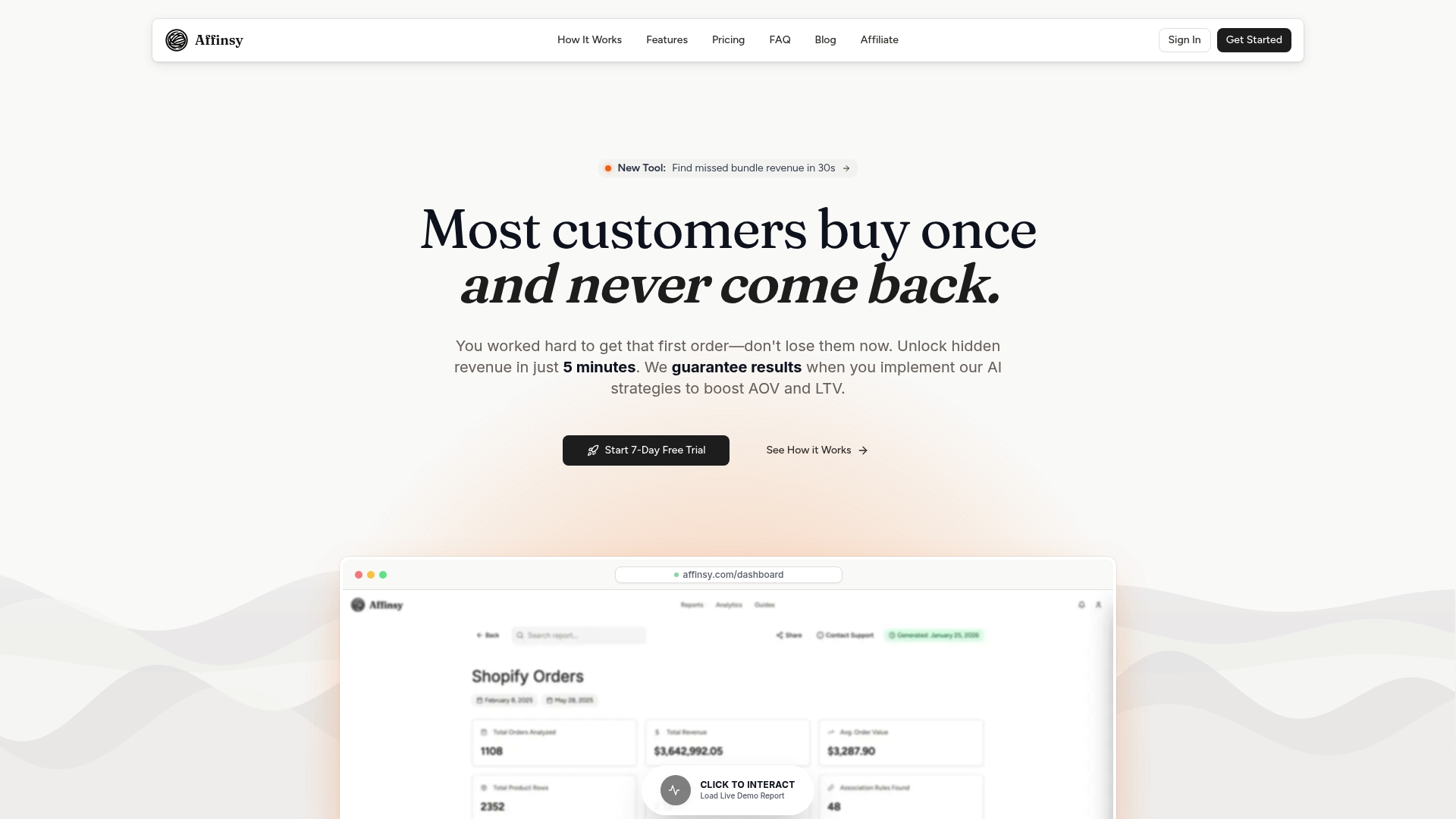
Our solutions integrate seamlessly with Shopify, WooCommerce, and Google Analytics, pulling data automatically to keep segments current and actionable. You get clear insights into customer segmentation, product bundling opportunities, and retention strategies without wrestling with spreadsheets or learning complex analytics software. Start boosting your retention and sales by leveraging data-driven segmentation strategies with Affinsy today.
Frequently asked questions about customer segmentation explained
How often should I update customer segments?
Update segments monthly at minimum to capture meaningful behavior changes and seasonal patterns. High-velocity businesses with frequent purchases may benefit from weekly or even real-time updates using AI-powered tools. The key is balancing freshness with practical implementation capacity.
Which ecommerce platforms support dynamic segmentation best?
Shopify, WooCommerce, and BigCommerce all support robust segmentation through native features and third-party integrations. Platforms with open APIs enable the most flexibility for connecting advanced analytics tools. Look for solutions that offer pre-built integrations with your specific platform to minimize setup complexity.
What are beginner-friendly first steps for segmentation?
Start with RFM analysis to identify your most valuable customers and those at risk of churning. This approach requires only transaction data you already have and delivers immediate actionable insights. Once comfortable with RFM, layer in behavioral data from email engagement and browsing patterns to refine your segmentation types further.
Which metrics indicate segmentation success?
Track segment-specific conversion rates, average order value, customer lifetime value, and retention rates. Compare these metrics between segments and against your overall averages to identify which groups drive the most value. Also monitor engagement metrics like email open rates and click-through rates by segment to gauge message relevance.
How do privacy regulations affect customer segmentation?
GDPR, CCPA, and similar laws require transparent data collection practices and customer consent for tracking. Focus segmentation on first-party data customers explicitly share through purchases and account creation. Anonymize individual data in analytics systems and ensure your privacy policy clearly explains how you use customer information for personalization.
Recommended
- Customer Segmentation — E-Commerce Glossary | Affinsy | Affinsy
- 7 Customer Segmentation Ideas to Boost Your Sales - Affinsy Blog | Affinsy
- Behavioral Analytics: 95% Churn Prediction Boosts Sales - Affinsy Blog | Affinsy
- 7 Effective Customer Segmentation Examples for E-commerce - Affinsy Blog | Affinsy
- Creative Student - Devrika