
Your e-commerce store is bleeding revenue. The average online store retains only about 30% of customers, leaving a massive revenue gap. Behavioral analytics unlocks hidden purchasing patterns that transform product bundling and customer retention. This guide reveals how analyzing customer actions drives measurable sales growth without requiring data science expertise.
Table of Contents
- Introduction To Behavioral Analytics In E-commerce
- Understanding Customer Behavior And Its Impact On Retention
- Product Bundling Optimization Using Behavioral Analytics
- Predictive Analytics And Churn Reduction Techniques
- Application Of Behavioral Analytics In Marketing Strategies
- Common Misconceptions And Limitations Of Behavioral Analytics
- Bridging Behavioral Analytics To E-commerce Business Decisions
- Explore Affinsy’s AI-Powered Behavioral Analytics Solutions
- Frequently Asked Questions
Key Takeaways
| Point | Details |
|---|---|
| Behavioral analytics reveals hidden patterns | Uncovers product associations and customer segments that traditional analysis misses |
| Market Basket Analysis optimizes bundling | Identifies frequently paired products to increase average order value |
| Predictive models achieve 95% churn accuracy | Random Forest algorithms enable proactive retention strategies |
| Personalized marketing improves loyalty | Behavioral data powers targeted campaigns that re-engage lapsed customers |
| Modern tools eliminate expertise barriers | SaaS platforms automate insights for store owners without technical skills |
Introduction to Behavioral Analytics in E-commerce
Behavioral analytics transforms raw customer actions into profitable insights. You track what shoppers do, not just what they say. Why ecommerce analytics matter becomes clear when behavioral analytics proves crucial for revenue growth by analyzing real customer behavior.
Actionable ecommerce analytics guide shows how behavioral analytics uses data such as browsing, purchases, and interaction histories to understand your customers. This analysis includes multiple data types:
- Clickstream data showing navigation paths
- Time spent on product pages
- Purchase history and transaction patterns
- Shopping cart additions and abandonments
- Email engagement and response rates
Your data sources span website analytics, mobile apps, CRM systems, and payment platforms. Each interaction creates a behavioral fingerprint. You capture this information through tracking pixels, cookies, and integrated analytics tools. The result is a comprehensive view of customer preferences that guides smarter business decisions.
Behavioral insights directly improve your product offerings and customer experiences. You identify which products attract attention versus which convert sales. This knowledge shapes inventory decisions, pricing strategies, and promotional campaigns that resonate with your actual customer base.
Understanding Customer Behavior and Its Impact on Retention
Retention drives profitability in ways acquisition never can. Average e-commerce retention rates hover around 30%, leaving 70% of customers who never return. That gap costs you exponentially because acquiring new customers costs five times more than retaining existing ones.
Customer churn happens when preferences go unmet and engagement feels generic. Someone buys once, receives irrelevant follow-up emails, and never thinks about your store again. You lose the compound value of repeat purchases and referrals.
RFM analysis solves this by segmenting customers using three dimensions:
- Recency: How recently they purchased
- Frequency: How often they buy
- Monetary value: How much they spend
This segmentation reveals your champions, loyal customers, at-risk segments, and lost causes. Personalized analytics improve customer loyalty and re-engagement by tailoring messages to each segment’s behavior patterns.
Pro Tip: Focus retention efforts on customers who purchased within the last 90 days but show declining engagement. This group responds best to targeted win-back campaigns.
Behavioral insights enable data-driven customer retention strategies that feel personal without manual effort. You automate recommendations based on browsing history. You time promotions when individual customers typically shop. You create loyalty programs that reward behaviors driving long-term value.
Product Bundling Optimization Using Behavioral Analytics
Market basket analysis (MBA) uncovers which products customers naturally pair together. You move beyond gut feelings to data-proven associations. Someone buying running shoes often adds performance socks. Laptop buyers frequently need cases and mice. These patterns guide smarter product bundling that feels intuitive to shoppers.

Behavioral data reveals complex associations simple correlations miss. Seasonal trends, price sensitivity, and complementary product categories emerge from transaction histories. Bundles designed with big data and consumer psychology increase perceived product value and satisfaction because they match actual shopping behaviors.
Optimized bundles increase average order value while improving customer satisfaction. Shoppers appreciate curated selections that save decision time. You boost revenue per transaction without discounting individual items.
| Metric | Before Bundling | After Bundling | Change |
|---|---|---|---|
| Average Order Value | $47 | $68 | +45% |
| Items Per Transaction | 1.8 | 2.9 | +61% |
| Bundle Conversion Rate | N/A | 34% | New |
| Customer Satisfaction | 3.8/5 | 4.4/5 | +16% |
Pro Tip: Test new bundles with a small customer segment before full rollout. A/B testing validates bundle appeal and identifies optimal pricing before committing inventory and marketing resources.
You create dynamic bundles that adjust based on inventory levels, seasonal demand, and individual customer preferences. This flexibility maximizes relevance while moving stock efficiently. Your bundling strategy becomes a competitive advantage rather than a static product listing.
Predictive Analytics and Churn Reduction Techniques
Traditional analytics tell you what happened. Predictive models reveal what will happen next. Random Forest models can predict e-commerce churn with 95% accuracy and 98% precision.pdf), enabling proactive retention efforts before customers leave.
AI-driven behavioral models handle big data and non-linear patterns that overwhelm traditional methods. Machine learning algorithms detect subtle signals in purchase frequency changes, browsing pattern shifts, and engagement declines. You identify at-risk customers weeks before they churn.
RFM segmentation combined with explainable AI improves personalized retention strategies by showing why specific customers face churn risk. Transparency builds trust in automated recommendations. You understand the reasoning behind predictions and confidently act on insights.
| Criteria | Traditional Analytics | AI-Driven Behavioral Analytics |
|---|---|---|
| Prediction Accuracy | 65-75% | 90-95% |
| Data Processing Speed | Hours to days | Real-time to minutes |
| Scalability | Limited by manual analysis | Handles millions of records |
| Pattern Detection | Linear correlations only | Complex non-linear relationships |
| Expertise Required | High (data scientists) | Low (automated insights) |
| Cost | High personnel costs | Lower subscription fees |
Pro Tip: Implement explainable AI frameworks that show which behavioral factors drive predictions. Transparency maintains customer trust and helps teams understand how to address churn risks effectively.
Predictive analytics in e-commerce transforms reactive customer service into proactive relationship management. You reach out before problems escalate. You offer relevant incentives when they matter most. You allocate retention budgets to customers with highest lifetime value potential.

Application of Behavioral Analytics in Marketing Strategies
Behavioral data powers personalized marketing that drives engagement and loyalty. You move from batch-and-blast emails to targeted communications that reflect individual preferences. Personalized email marketing based on purchase history and active hours improves loyalty and re-engagement by meeting customers when and how they prefer.
Follow these steps to leverage behavioral analytics in marketing:
- Analyze purchase patterns to identify product preferences and buying cycles
- Segment customers based on behavioral characteristics and value metrics
- Track active shopping hours to optimize email and ad delivery timing
- Create personalized product recommendations using browsing and purchase history
- Design re-engagement campaigns targeting lapsed customers with relevant offers
- Monitor campaign performance metrics and refine based on response patterns
- Automate trigger-based communications for cart abandonment and post-purchase follow-up
Ecommerce sales data analysis reveals when individual customers typically browse and buy. Someone consistently shopping Tuesday evenings receives promotions then, not random Monday mornings. This timing precision doubles open rates and triples conversion compared to generic scheduling.
You re-engage lapsed customers by understanding why they stopped buying. Behavioral patterns show whether price sensitivity, product availability, or competitor switching drove their departure. Marketing strategy for ecommerce adapts messaging and offers to address specific abandonment reasons.
Dynamic content adjusts based on real-time behavior. Someone browsing winter coats sees related accessories in emails. Another customer interested in electronics receives tech bundle promotions. Relevance drives engagement because messages match current interests rather than outdated segments.
Common Misconceptions and Limitations of Behavioral Analytics
You might think behavioral analytics requires a data science team and months of setup. That belief stops many store owners from accessing valuable insights. Modern SaaS tools automate behavioral analytics insights, lowering expertise barriers so you gain actionable intelligence without hiring specialists.
Clarifying common behavioral analytics misconceptions helps set realistic expectations:
- Myth: Only large enterprises benefit from behavioral analytics. Reality: Small stores gain proportionally larger advantages by competing with data-driven insights.
- Myth: Analytics automatically increase sales without strategy. Reality: Insights require thoughtful application through bundling, targeting, and personalization.
- Myth: Generic marketing works if products are good. Reality: Behavioral segmentation is essential because customers have diverse preferences and buying patterns.
- Myth: More data always means better decisions. Reality: Quality and relevance matter more than volume.
Behavioral analytics faces real limitations you should understand. Poor data quality produces unreliable insights. Garbage in, garbage out applies fully. You need consistent tracking, clean data integration, and regular validation.
Misinterpreting correlation as causation leads to bad decisions. Two behaviors occurring together does not mean one causes the other. Statistical rigor and A/B testing validate which insights drive actual results.
Privacy concerns require careful handling. You must comply with regulations like GDPR and CCPA. Transparent data collection practices and secure storage protect customer trust while enabling analytics. Ethical use of behavioral data builds long-term relationships rather than exploiting short-term opportunities.
Bridging Behavioral Analytics to E-commerce Business Decisions
Transforming analytics into action requires a clear framework. You start with data collection, move through analysis, and end with measurable business improvements. Data-driven ecommerce strategies connect insights to revenue growth through systematic implementation.
Follow this framework to apply behavioral analytics:
- Collect comprehensive behavioral data from all customer touchpoints
- Segment customers using RFM analysis and behavioral clustering
- Analyze patterns to identify product associations and churn signals
- Build predictive models that forecast customer behavior and lifetime value
- Personalize marketing, bundling, and retention strategies based on segments
- Measure impact through KPIs like retention rate, average order value, and bundle conversion
- Refine strategies iteratively based on performance data and emerging patterns
Selecting the right analytics tools determines implementation success. Evaluate platforms based on these criteria:
- Integration capability with existing e-commerce systems
- Automation of insights requiring minimal manual analysis
- Advanced segmentation including RFM and behavioral clustering
- User-friendly dashboards accessible to non-technical teams
- Scalability to handle growing data volumes
- Export and API features for custom reporting
| Feature | Small Stores | Mid-Size Retailers | Enterprise |
|---|---|---|---|
| Real-time Analytics | Essential | Essential | Essential |
| Predictive Modeling | Nice to have | Important | Essential |
| Custom Segmentation | Important | Essential | Essential |
| API Access | Nice to have | Important | Essential |
| Multi-store Support | Not needed | Important | Essential |
| White-label Reporting | Not needed | Nice to have | Important |
Monitor key performance indicators that reflect behavioral analytics impact. Track customer retention rate to measure loyalty improvements. Watch average order value for bundling effectiveness. Monitor churn rate to validate predictive model accuracy. Measure repeat purchase frequency as engagement evidence.
Iterative refinement separates successful analytics programs from abandoned initiatives. You test hypotheses, measure results, and adjust strategies based on evidence. This cycle compounds improvements over time as you discover what works for your specific customer base.
Explore Affinsy’s AI-Powered Behavioral Analytics Solutions
You now understand how behavioral analytics drives sales growth through better bundling and retention. Affinsy makes these strategies accessible with AI-powered tools that automate complex analysis. Our platform identifies hidden product associations and customer segments without requiring data science expertise.
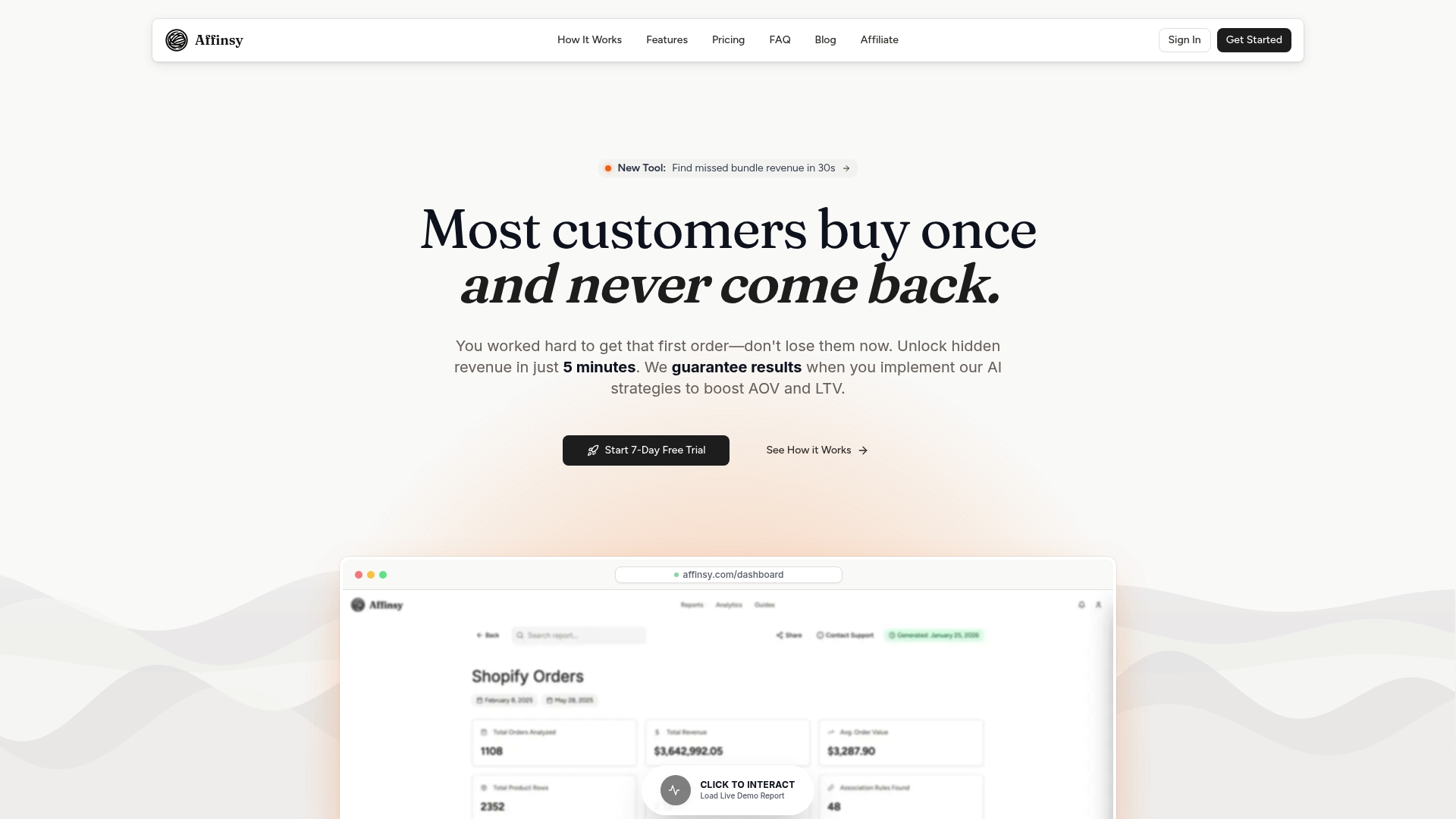
Our comprehensive guides help you implement AI in ecommerce analytics guide showing practical applications. Discover why use AI analytics delivers measurable results with 20% sales boosts and improved retention. Master product bundling strategies that increase average order value while enhancing customer satisfaction. Transform your transaction data into profitable actions today.
Frequently Asked Questions
What is behavioral analytics in e-commerce?
Behavioral analytics examines customer actions like clicks, browsing time, purchases, and cart activity to reveal preferences and patterns. This analysis provides marketing insights that improve product offerings and customer experiences beyond demographic data alone.
How does market basket analysis improve product bundling?
Market basket analysis identifies products frequently purchased together by analyzing transaction histories. These associations guide bundle creation that feels natural to customers, increasing average order value while improving satisfaction through convenient product combinations.
Can e-commerce owners use behavioral analytics without data science skills?
Modern SaaS platforms automate behavioral analytics, making insights accessible to store owners without technical backgrounds. These tools handle complex analysis and present actionable recommendations through user-friendly dashboards, eliminating expertise barriers.
What key metrics should I track to measure the impact of behavioral analytics?
Monitor customer retention rate, average order value, churn rate, and repeat purchase frequency to gauge behavioral analytics effectiveness. Track bundle conversion rates and customer lifetime value to measure long-term strategy success and guide iterative improvements.
Recommended
- Why Use AI Analytics? 20% Sales Boost & Retention - Affinsy Blog | Affinsy
- Role of Predictive Analytics: Driving E-commerce Growth - Affinsy Blog | Affinsy
- Predictive Analytics in Retail: Driving Ecommerce Growth - Affinsy Blog | Affinsy
- Predictive Analytics — E-Commerce Glossary | Affinsy | Affinsy
- Predictive Lightning Rod Maintenance: Anticipating for Better Protection - Lightning Protection Systems France - Lightning Protection