
Every online retailer has faced the frustration of guessing which products to bundle or why loyal customers suddenly disappear. With competition intensifying across global markets, these pain points are more than just minor setbacks. Predictive analytics turns your store’s historical data into actionable insights, helping you proactively identify high-value product combinations and at-risk buyers. Get practical strategies for smarter bundling and retention that give your business a clear edge over larger competitors.
Table of Contents
- What Predictive Analytics Means In E-commerce
- Core Predictive Analytics Methods And Models
- Key Applications: Product Bundling And Retention
- Benefits, Challenges, And Common Pitfalls
Key Takeaways
| Point | Details |
|---|---|
| Leverage Predictive Analytics | Use historical sales data and machine learning to anticipate customer needs, making proactive inventory and marketing decisions. |
| Enhance Customer Retention | Identify at-risk customers early to implement targeted retention strategies, increasing customer lifetime value. |
| Optimize Product Bundling | Analyze purchasing patterns to create product bundles that appeal to customer preferences, boosting average order value. |
| Address Data Quality Issues | Prioritize cleaning and validating data sources to improve the reliability of predictive insights and recommendations. |
What Predictive Analytics Means in E-commerce
Predictive analytics uses your historical sales data and machine learning to forecast what customers will buy next. Instead of guessing trends, you’re making decisions based on patterns hidden in months or years of transaction records. For your e-commerce business, this means moving from reactive to proactive decision-making.
Here’s what predictive analytics actually does for online retailers:
- Forecast demand before inventory decisions need to be made
- Identify which products customers will purchase together
- Predict customer churn so you can intervene with at-risk buyers
- Personalize recommendations based on individual behavior patterns
- Optimize pricing by understanding price sensitivity across segments
How It Works in Your Store
Machine learning algorithms analyzing customer behavior learn from your existing transaction data. The system spots patterns you’d never catch manually—like how customers who buy winter jackets in September also tend to purchase thermal socks within two weeks.
Your e-commerce business generates massive amounts of data every single day. Customer browsing behavior, purchase history, cart abandonment, return patterns, seasonal fluctuations. Predictive analytics turns that raw data into actionable intelligence.
Why This Matters Right Now
You’re competing against retailers with bigger budgets and more resources. Predictive analytics levels the playing field. A small online store using data-driven insights can outperform larger competitors who rely on intuition.
Consider the pressure you face:
- Inventory sitting unsold while other products stock out
- Customers leaving without purchasing due to poor recommendations
- Marketing spend wasted on audiences unlikely to convert
- Losing repeat customers without knowing why they left
Predictive analytics solves these problems by letting you anticipate rather than react.
Real Impact for Your Business
Predictive analytics transforms historical transaction data into actionable forecasts that improve inventory decisions, customer retention, and average order value simultaneously.
When you know which products your customers will likely purchase together, you can bundle them strategically. When you predict which customers are about to leave, you can send targeted retention offers. When you forecast demand accurately, you reduce both stockouts and overstock situations.

This isn’t theoretical. The data shows that real-time predictive models optimize inventory and enable dynamic pricing strategies that improve both productivity and customer satisfaction across global e-commerce operations.
The key difference between successful online retailers and struggling ones? The successful ones use their data intentionally. They don’t just collect information—they extract insights and act on them.
Pro tip: Start by mapping your biggest pain point—whether that’s inventory management, cart abandonment, or customer retention—then focus your predictive analytics efforts there first for fastest ROI.
Core Predictive Analytics Methods and Models
Predictive analytics relies on specific mathematical techniques and algorithms to extract patterns from your customer data. These methods transform raw information into forecasts you can act on immediately. Understanding which methods work best for your business helps you choose the right tools.
Your e-commerce store generates different types of data—purchase history, browsing behavior, customer demographics, seasonal trends. Each data type requires different analytical approaches. The most effective predictive systems use multiple methods together.
Key Methods Your Store Can Use
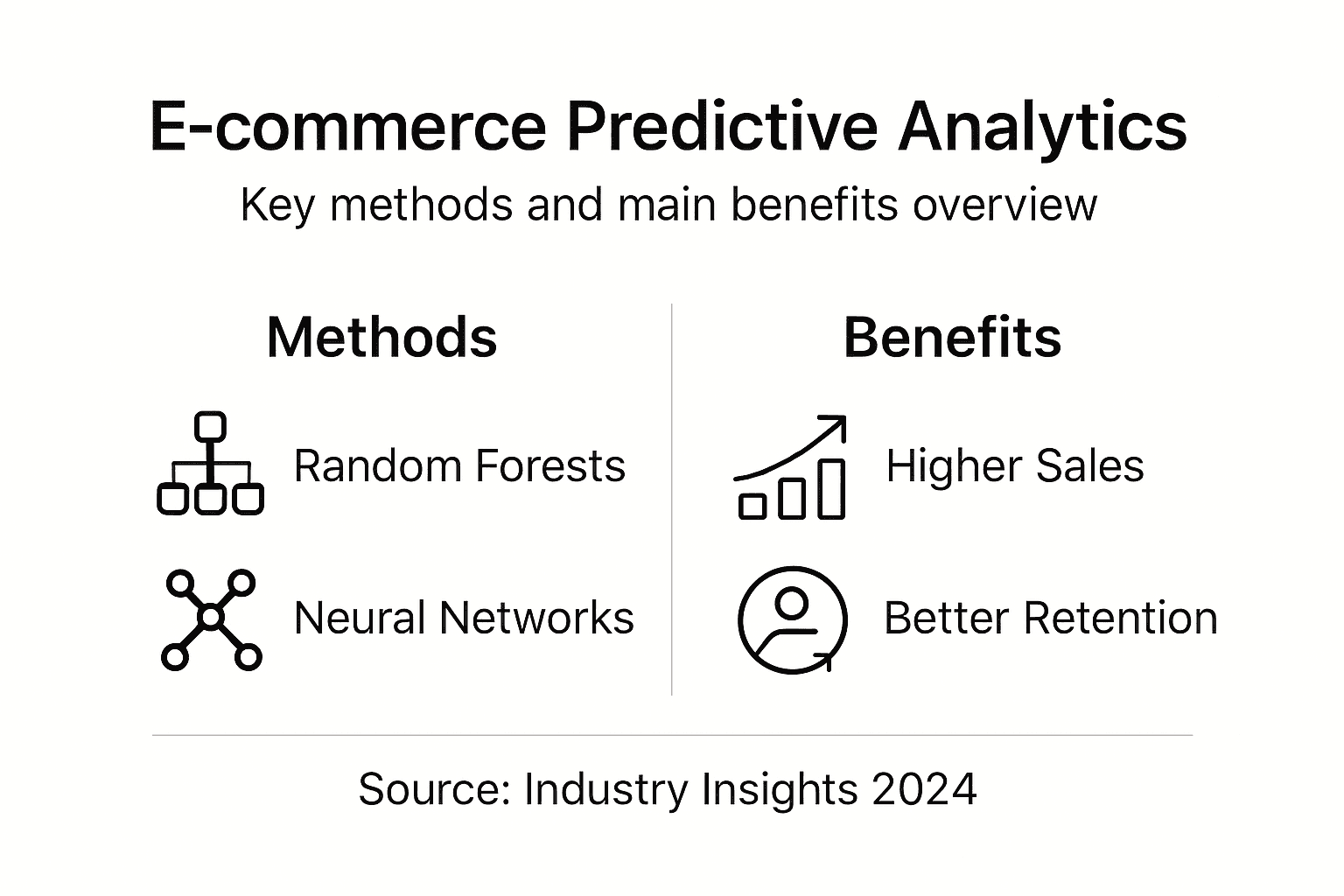
Advanced machine learning techniques including random forests and neural networks analyze both structured and unstructured customer data to forecast sales accurately. Random forests work by building multiple decision trees and combining their predictions—think of it like surveying 100 smart analysts and trusting their majority vote.
Here are the core methods working in successful e-commerce operations:
Here is a comparison of core predictive analytics methods and their ideal business uses:
| Method | Best For | Data Needed | Typical Outcome |
|---|---|---|---|
| Random Forests | Customer behavior prediction | Large, varied purchase data | Accurate behavior forecasts |
| Time Series Analysis | Sales and demand forecasting | Historical sales over time | Seasonal demand projections |
| Clustering Models | Customer segmentation | Demographics, behavior | Targeted marketing groups |
| Neural Networks | Identifying complex patterns | Both structured, unstructured | Uncovering hidden opportunities |
| Market Basket Analysis | Product bundling strategies | Transaction item records | Better product bundle offerings |
- Random Forests analyze purchase patterns and predict customer behavior across multiple variables simultaneously
- Time Series Analysis forecasts future demand based on historical sales seasonality and trends
- Clustering Models segment customers into groups with similar behaviors for targeted strategies
- Neural Networks identify complex, non-obvious patterns humans would never spot manually
- Market Basket Analysis reveals which products customers buy together, informing bundling strategies
How These Methods Work Together
No single method works perfectly alone. The best approach combines multiple techniques in what’s called ensemble learning. One model might forecast demand, another predicts churn risk, and a third identifies product associations.
Real-time data analysis and machine learning techniques enhance prediction precision for inventory decisions, dynamic pricing, and customer personalization. Your system needs to capture relationships between multiple variables—price sensitivity, seasonal factors, customer segment preferences, inventory levels—to make truly data-driven decisions.
Why Method Selection Matters
Choosing the wrong method wastes time and money. Some methods require massive datasets; others work with limited data. Some need constant updating; others remain stable over time.
The most effective predictive systems combine multiple methods to address different business challenges—demand forecasting, customer segmentation, and product recommendations all require different analytical approaches.
When evaluating methods for your store, consider what data you have available right now. You don’t need perfect datasets to start. Even incomplete data can reveal valuable patterns through the right analytical approach.
Practical Application for Your Business
You likely don’t need to understand all the mathematical details. What matters is knowing that successful e-commerce stores use predictive methods to tackle specific problems: reducing stockouts, increasing average order value, improving customer retention, and optimizing pricing.
Start with simpler methods if you’re new to analytics. Market basket analytics reveals product associations that drive immediate bundling improvements. Build confidence with proven techniques before advancing to more complex neural network approaches.
Pro tip: Begin with methods addressing your highest-impact problem—if inventory costs are bleeding your margins, start with demand forecasting; if customer retention is weak, prioritize churn prediction models.
Key Applications: Product Bundling and Retention
Predictive analytics shines in two areas that directly impact your bottom line: bundling products strategically and keeping customers from leaving. These applications work because they’re based on actual customer behavior patterns, not guesses.
Your store has two main revenue leaks. First, customers buy single items when they’d actually purchase complementary products together. Second, at-risk customers slip away without intervention. Predictive analytics plugs both leaks simultaneously.
Product Bundling That Customers Actually Want
Bundling works when it’s based on real purchase patterns. Predictive analytics reveals which products customers buy together naturally, then helps you package them strategically.
Here’s what effective bundling accomplishes:
- Increases average order value by 20-40% when bundles match customer preferences
- Reduces inventory of slow-moving items by pairing them with bestsellers
- Creates perceived value that justifies higher prices
- Simplifies purchase decisions for customers overwhelmed by choice
- Improves margins by moving stuck stock alongside profitable items
The magic happens when bundling is data-driven. Effective bundle strategies reveal which product combinations resonate with specific customer segments. A bundle that works for budget-conscious buyers won’t work for premium-focused shoppers.
Identifying At-Risk Customers Before They Leave
Customer retention is cheaper than acquisition. Predictive analytics identifies which customers are likely to churn so you can intervene with targeted offers before they’re gone.
Real-time behavioral tracking enables identification of at-risk customers through analysis of browsing patterns and purchase frequency changes. When customers suddenly browse less, take longer between purchases, or stop opening emails, these signals predict churn risk.
Retention actions based on predictive insights include:
- Win-back discounts sent before customers defect completely
- Personalized product recommendations matching their past behavior
- Loyalty rewards triggered when churn risk increases
- Proactive customer service reaching out with solutions
- Exclusive early access to new products matching their preferences
Why These Two Applications Matter Most
Bundling and retention address your highest-impact challenges. Bundling increases revenue per customer immediately. Retention maintains that revenue over time.
Predictive analytics transforms customer data into actionable strategies: bundling increases immediate transaction value while retention strategies sustain long-term customer lifetime value.
Think about your current situation. Some customers leave because they don’t realize you sell complementary products. Others leave because they feel undervalued. Both problems solve through predictive analytics applied correctly.
Data-driven retention strategies including personalized campaigns and targeted recommendations reduce churn while improving customer lifetime value. The key is moving from reactive (responding when customers complain) to proactive (intervening before they consider leaving).
Pro tip: Start with product bundling if you have inventory challenges, or begin with churn prediction if customer retention rates are declining—choose based on your most urgent business pain.
Benefits, Challenges, and Common Pitfalls
Predictive analytics delivers real benefits, but implementation isn’t friction-free. Understanding both sides helps you prepare for success and avoid costly mistakes.
The good news: businesses using predictive analytics see measurable improvements in decision-making, operational efficiency, and customer satisfaction. The reality: getting there requires overcoming data quality issues, model complexity, and continuous adaptation to changing market conditions.
The Real Benefits Your Store Can Expect
When implemented properly, predictive analytics delivers concrete results:
- Improved decisions based on data patterns instead of guesswork
- Faster response times to market changes and customer behavior shifts
- Better inventory management reducing both stockouts and overstock situations
- Higher customer lifetime value through retention and personalization
- Increased average order value via strategic bundling and recommendations
- Operational efficiency automating insights you’d spend hours discovering manually
Predictive analytics enhances operational efficiency and customer satisfaction through personalized customer experiences. The compound effect: happier customers, lower churn, and sustainable growth.
Challenges You’ll Actually Face
Don’t underestimate these obstacles. They’re real, and they trip up stores that aren’t prepared.
Data quality issues are the biggest culprit. Incomplete records, duplicate customers, inconsistent tracking—garbage data produces garbage insights. Your historical data might have gaps or errors that skew predictions.
Model interpretation complexity means you might not understand why the system recommends something. This creates trust issues with your team and hesitation to act on recommendations.
Constant model updating is necessary because customer behavior changes. What worked last quarter might fail this quarter. Your system needs continuous refinement, not set-it-and-forget-it operation.
Data privacy and algorithmic bias require careful management. Integrating diverse data sources while addressing privacy concerns means balancing personalization with customer trust and regulatory compliance.
To help prioritize efforts, here is a summary of typical challenges and practical solutions for e-commerce predictive analytics:
| Challenge | Practical Solution | Business Benefit |
|---|---|---|
| Low data quality | Start cleaning highest impact areas | More reliable predictions |
| Model interpretation issues | Use simple models, clear reports | Better team trust and adoption |
| Changing customer behavior | Regularly retrain/update models | Sustained prediction accuracy |
| Privacy & bias concerns | Use transparent, compliant processes | Maintain regulatory trust |
Common Pitfalls to Avoid
These mistakes waste time, money, and destroy team confidence in analytics:
- Starting with perfect data instead of working with what you have
- Implementing without clear business goals—analytics needs direction
- Trusting recommendations blindly instead of validating results
- Ignoring changing customer preferences and market dynamics
- Overcomplicating models when simpler approaches would work
- Failing to explain predictions to non-technical team members
Success requires balancing ambition with realism: start small with clear goals, validate early results, and scale what works while continuously monitoring for model drift and changing conditions.
Starting Smart Reduces Failures
You don’t need perfect conditions to begin. Start with one high-impact use case—bundling or churn prediction. Validate results over 2-3 months before expanding. Build team confidence through small wins.
Address data quality issues gradually. Your first month will reveal gaps. Fix the most impactful problems first. Accept that 80% clean data is often better than waiting indefinitely for perfection.
Transparency matters. When recommending actions, explain the reasoning. Your team needs to trust the system, and customers appreciate knowing why products are suggested.
Pro tip: Begin with your cleanest, most reliable data source and most straightforward business problem—this builds organizational confidence before tackling complex scenarios requiring perfect data integration.
Unlock Your E-commerce Growth with Predictive Analytics and Affinsy
The article highlights the challenge online retailers face when struggling with inventory management, cart abandonment, and customer retention. Predictive analytics offers real solutions by uncovering hidden product relationships and predicting customer behavior before issues occur. If increasing average order value and sustaining customer loyalty are your goals, leveraging precise insights from historical transaction data is essential.
Affinsy directly addresses these exact pain points by providing AI-powered tools that transform your sales data into actionable market basket analysis and customer segmentation insights. With easy integration into platforms like Shopify and WooCommerce, Affinsy empowers you to optimize product bundling and create personalized retention strategies without needing deep data science expertise. This means smarter decisions that lead to higher revenue and happier customers.
Experience how predictive analytics can revolutionize your store today.
Explore how Affinsy drives smarter retail decisions
Get started with actionable product bundling insights
Learn more about our AI-powered analytics platform
See how Affinsy can elevate your e-commerce business now by turning complex data into simple growth strategies. Visit https://www.affinsy.com/ and start transforming your customer data into measurable success.
Frequently Asked Questions
What is predictive analytics in e-commerce?
Predictive analytics in e-commerce involves using historical sales data and machine learning algorithms to forecast customer purchasing behavior and trends, allowing businesses to make informed decisions instead of relying on guesswork.
How can predictive analytics benefit my online store?
Predictive analytics can enhance inventory management, improve customer retention, optimize product recommendations, and increase average order value through data-driven insights based on customer behavior patterns.
What key methods are used in predictive analytics?
Common methods include Random Forests for customer behavior prediction, Time Series Analysis for sales forecasting, Clustering Models for customer segmentation, Neural Networks for pattern detection, and Market Basket Analysis for identifying product associations.
How does predictive analytics improve product bundling strategies?
Predictive analytics helps identify which products are often purchased together, allowing e-commerce businesses to create targeted bundles that enhance customer value, increase average order value, and reduce inventory of slow-moving items.
Recommended
- Predictive Analytics in Retail: Driving Ecommerce Growth - Affinsy Blog | Affinsy
- Predictive Analytics — E-Commerce Glossary | Affinsy | Affinsy
- Role of Analytics in Marketing for E-Commerce Growth - Affinsy Blog | Affinsy
- Understanding Retail Analytics Guide 2025 for E-Commerce Success - Affinsy Blog | Affinsy