
Many e-commerce managers collect mountains of sales data but struggle to transform it into merchandising decisions that actually move the needle. Data-driven merchandising leverages AI analytics to turn transaction history into optimized product placement, bundling, and personalization strategies. Companies embracing this approach are 23 times more likely to outperform competitors in customer acquisition and profitability. This guide walks you through a proven workflow that delivers measurable sales and retention gains.
Table of Contents
- Introduction To Data-Driven Merchandising Workflow
- Prerequisites And Tools Needed For Data-Driven Merchandising
- Step-By-Step Implementation Process
Key Takeaways
| Point | Details | |-------|---------|| | Competitive Advantage | Data-driven e-commerce companies acquire customers 23x more effectively than competitors. | | Revenue Impact | Structured merchandising workflows improve average order value by 10-30% through intelligent bundling. | | Core Workflow Steps | Success requires data integration, customer segmentation, AI recommendations, and continuous optimization. | | Common Pitfalls | Relying on intuition over data and lacking automation derail most merchandising efforts. | | Success Timeline | Measurable KPI improvements typically appear within 3-6 months of implementation. |
Introduction to Data-Driven Merchandising Workflow
Data-driven merchandising means using analytics and AI to guide every decision about what products to display, how to bundle them, and which offers to present to specific customer segments. Rather than relying on gut instinct or manual observation, you let transaction patterns and customer behavior data dictate your strategy.
The numbers speak volumes. Data-driven e-commerce companies are 23 times more likely to acquire customers, 19 times more likely to maintain profitability, and nearly 7 times more likely to retain customers compared to competitors who ignore their data. These aren’t marginal improvements. They represent fundamental competitive advantages.
AI plays a central role by processing transaction volumes no human could analyze manually. Modern platforms identify hidden product associations, predict which bundles will resonate with specific segments, and automate personalization at scale. This transforms data-driven ecommerce approaches from theoretical concepts into practical, real-time merchandising actions.
Many managers mistakenly believe merchandising is purely about visual design or homepage placement. In reality, the most impactful decisions happen at the data layer:
- Which products naturally sell together based on purchase history
- Which customer segments respond to specific bundle offers
- When to trigger cross-selling strategies based on browsing behavior
- How to adjust inventory priorities based on emerging demand patterns
Understanding ecommerce merchandising principles provides the foundation, but execution requires systematic data integration and analysis. The workflow approach we outline eliminates guesswork and creates repeatable processes your team can refine over time.
Prerequisites and Tools Needed for Data-Driven Merchandising
Before implementing any workflow, you need the right foundation. Missing pieces at this stage cause cascading problems later.
Your essential requirements include:
- Clean Transaction Data: Historical sales records with product details, timestamps, customer identifiers, and order values. Gaps or errors in this data produce unreliable recommendations.
- Platform Integration: Direct connections to your e-commerce system, whether Shopify, WooCommerce, or similar platforms. Manual CSV uploads create delays and version control issues.
- AI Analytics Capability: Tools that perform market basket analysis and customer segmentation automatically. Building these algorithms in-house requires data science resources most growing retailers lack.
- Segmentation Knowledge: Basic familiarity with approaches like RFM (Recency, Frequency, Monetary) analysis helps you interpret and act on insights effectively.
- Reporting Infrastructure: Dashboards that translate raw analytics into actionable merchandising recommendations your team can execute.
The customer segmentation guide covers foundational concepts, but practical implementation requires platforms designed for retailers without extensive technical teams.
Data Requirements by Category
| Category | Minimum Requirement | Optimal State |
|---|---|---|
| Transaction History | 6 months of sales data | 12+ months for seasonal patterns |
| Customer Records | Email and purchase dates | Full behavioral tracking including browsing |
| Product Catalog | SKU and category data | Detailed attributes and inventory levels |
| Platform Access | Read-only API connection | Full read/write for automated updates |
Market basket analysis basics demonstrate how transaction-level data reveals hidden product relationships. The key is ensuring your data pipeline feeds clean, complete information to your analytics tools without manual intervention.
Most retailers already possess the necessary data scattered across systems. The challenge lies in centralizing and structuring it for analysis. Choose tools that handle integration complexity so your team focuses on merchandising strategy rather than data wrangling.
Step-by-Step Implementation Process
Executing a data-driven merchandising workflow follows five core phases. Each builds on the previous, creating compounding benefits.

1. Integrate and Cleanse Your Data
Connect your e-commerce platform, payment processor, and any existing analytics tools to create a unified data repository. Run validation checks to identify missing fields, duplicate records, or formatting inconsistencies. Clean data establishes the accuracy of every downstream recommendation.
Focus on transaction completeness first. Every order should include product identifiers, customer information, timestamps, and values. Address gaps before proceeding to analysis.
2. Segment Customers Using RFM Analysis
RFM analysis groups customers by how recently they purchased, how frequently they buy, and how much they spend. This creates distinct segments requiring different merchandising approaches.
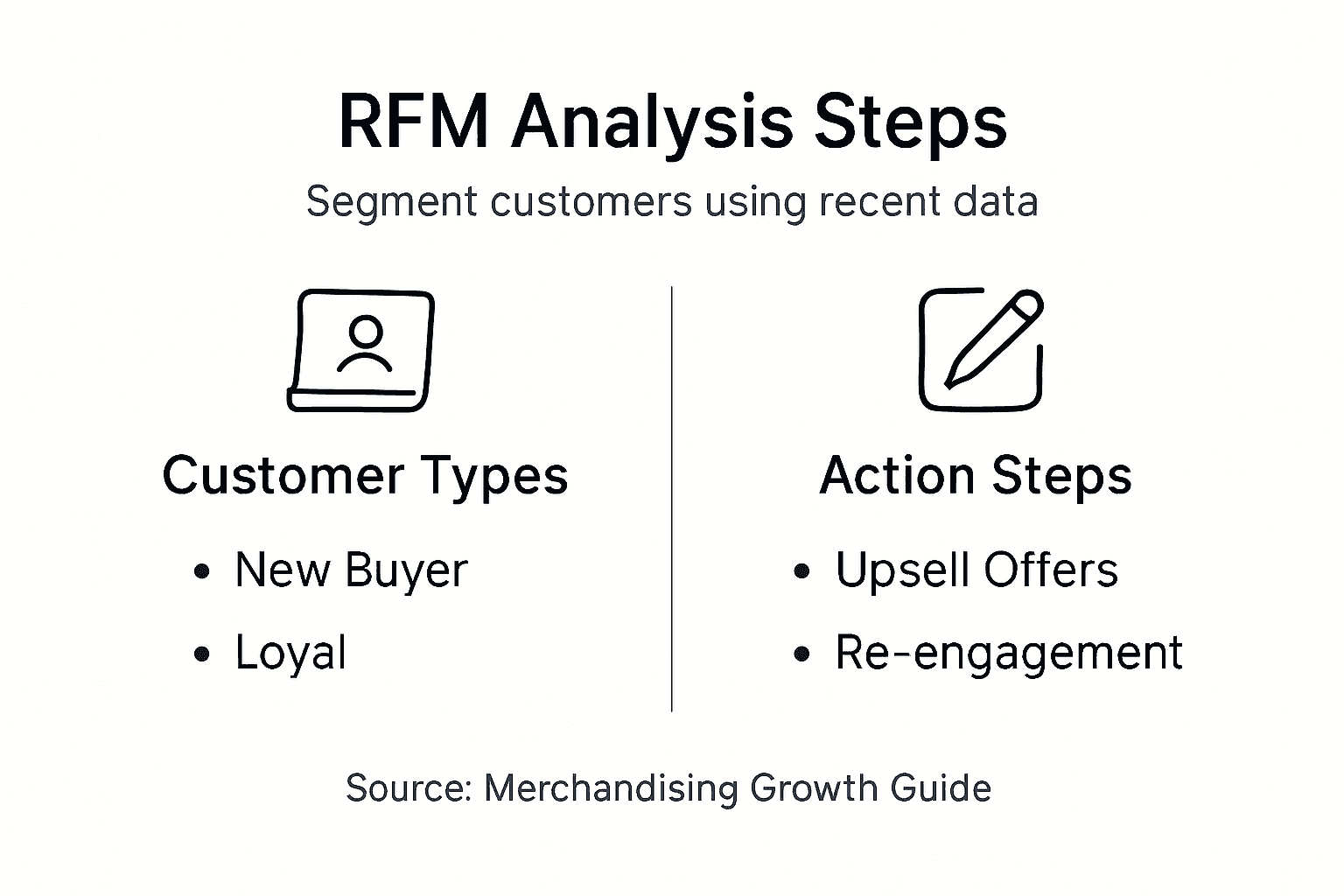
High-value frequent buyers see premium bundles and loyalty offers. Recent one-time purchasers receive re-engagement campaigns. Lapsed customers get win-back promotions. Segmentation ensures you present relevant offers to each group.
Pro Tip: Start with three to five broad segments rather than attempting hyper-granular targeting initially. You can refine as you gather performance data.
3. Apply Market Basket Analysis for Bundling
Identify which products customers frequently purchase together. Product bundling based on market basket analysis can increase average order values by 10-30%.
Analyze association rules like
Recommended
- Data-Driven Marketing Strategies Guide to Boost AOV - Affinsy Blog | Affinsy
- Data-Driven Ecommerce Strategies for Smarter Growth - Affinsy Blog | Affinsy
- Cross Sell Strategies Step by Step for E-Commerce Growth - Affinsy Blog | Affinsy
- 7-Step Ecommerce Growth Checklist for Smarter Sales - Affinsy Blog | Affinsy
- Role of Analytics in WordPress: Driving WooCommerce Success - WPCTO
- Digital Marketing for Cannabis Farms | Dope SEO - Cannabiz Marketing Solutions