
Finding the right product combinations to recommend often feels like a guessing game for Shopify and WooCommerce store owners. Yet, understanding customer buying patterns can transform cross-selling results and increase revenue. With tools like market basket analysis, you can uncover which items customers actually purchase together and use those insights to power strategic recommendations. This article explores how Frequently Bought Together strategies reveal hidden sales opportunities and the impact AI analytics can have on your average order value.
Table of Contents
- What Does Frequently Bought Together Mean
- Typical FBT Plugins – Features and Limitations
- Why FBT Plugins Fail for Larger Stores
- Maximizing AOV and LTV With AI Analytics
- Affinsy’s Superior Approach for Targeted Cross-Sells
Key Takeaways
| Point | Details |
|---|---|
| Understanding FBT | Frequently Bought Together (FBT) identifies product combinations that customers purchase together, driving sales insights. |
| Importance of Accurate Data | Accurate data analysis allows retailers to optimize recommendations, enhancing average order value and customer satisfaction. |
| Limitations of Standard FBT Plugins | Standard FBT plugins struggle with scalability and personalized recommendations for larger stores, potentially harming revenue growth. |
| AI Analytics Advantage | AI-powered analytics provide advanced insights, facilitating tailored recommendations and improving customer lifetime value through precision. |
What Does Frequently Bought Together Mean
Frequently Bought Together (FBT) refers to product combinations that customers purchase in the same transaction with notable frequency. It’s a straightforward observation: when shoppers buy item A, they tend to also buy item B, C, or D at the same time.
This pattern isn’t random. It reflects real customer behavior and purchase logic. Some combinations are obvious (socks with shoes), while others are hidden until you analyze your sales data.
Market basket analysis is the data mining technique that uncovers these buying patterns by examining which products appear together in transactions. Retailers use this information to make smarter recommendations and sales decisions.
Why This Matters for Your Store
FBT insights help you achieve concrete business outcomes:
- Increase average order value (AOV) by suggesting complementary products at checkout
- Boost customer satisfaction by recommending items customers actually want
- Optimize product placement both online and physically in your store
- Improve inventory management by understanding which items move together
When you know which products customers buy together, you can present those combinations strategically. A customer buying a coffee maker becomes a natural target for a coffee subscription or filters.
Identifying product combinations drives real revenue growth—but only if you have accurate data about what actually sells together.
The Basic Components
Think of FBT as answering three core questions about your customers:
- Which products do people buy together most frequently?
- How strong is the relationship between these products?
- How can you use this knowledge to increase sales?
Understanding association rules helps you measure the strength and reliability of these product relationships. Not all frequently bought combinations carry the same weight.
A strong FBT signal means you can confidently recommend one product when customers buy another. A weak signal suggests the pairing happens by chance, not by customer preference.
Your goal is separating genuine purchasing patterns from random occurrences. That’s where the analysis gets real.
Pro tip: Start by analyzing your top 50 best-selling products first to identify quick wins—these often have the clearest FBT patterns that can boost revenue immediately.
Typical FBT Plugins – Features and Limitations
Most FBT plugins work the same way: they analyze your transaction history and suggest product combinations at checkout. They’re designed to boost your average order value by showing customers relevant products they might want together.
These plugins have become popular because they’re relatively easy to install and require no coding knowledge. However, not all FBT solutions deliver the same results, and many come with significant constraints.
Common Features You’ll Find
Standard FBT plugins typically offer:
- Personalized recommendations based on browsing and purchase history
- Drag-and-drop customization for positioning product suggestions
- Countdown timers and urgency tools to encourage immediate purchases
- Discount integration to sweeten bundle deals
- Multi-location display options for showing recommendations across your store
Many plugins also support variable products and offer real-time preview functionality. These features sound impressive on paper, and they work fine for small stores with limited catalogs.
Where FBT Plugins Hit the Wall
Here’s where reality meets marketing claims. Standard FBT plugins struggle when your store scales:
Limited scalability emerges as the first problem. When you have thousands of products, these plugins can’t process the data quickly enough. Performance slows noticeably, and customers experience longer load times at checkout.

Basic recommendation accuracy becomes the second issue. FBT plugins use simple pattern matching—they look for products that appear together frequently. Common limitations include restricted support for variable products and limited customization options, especially in free versions.
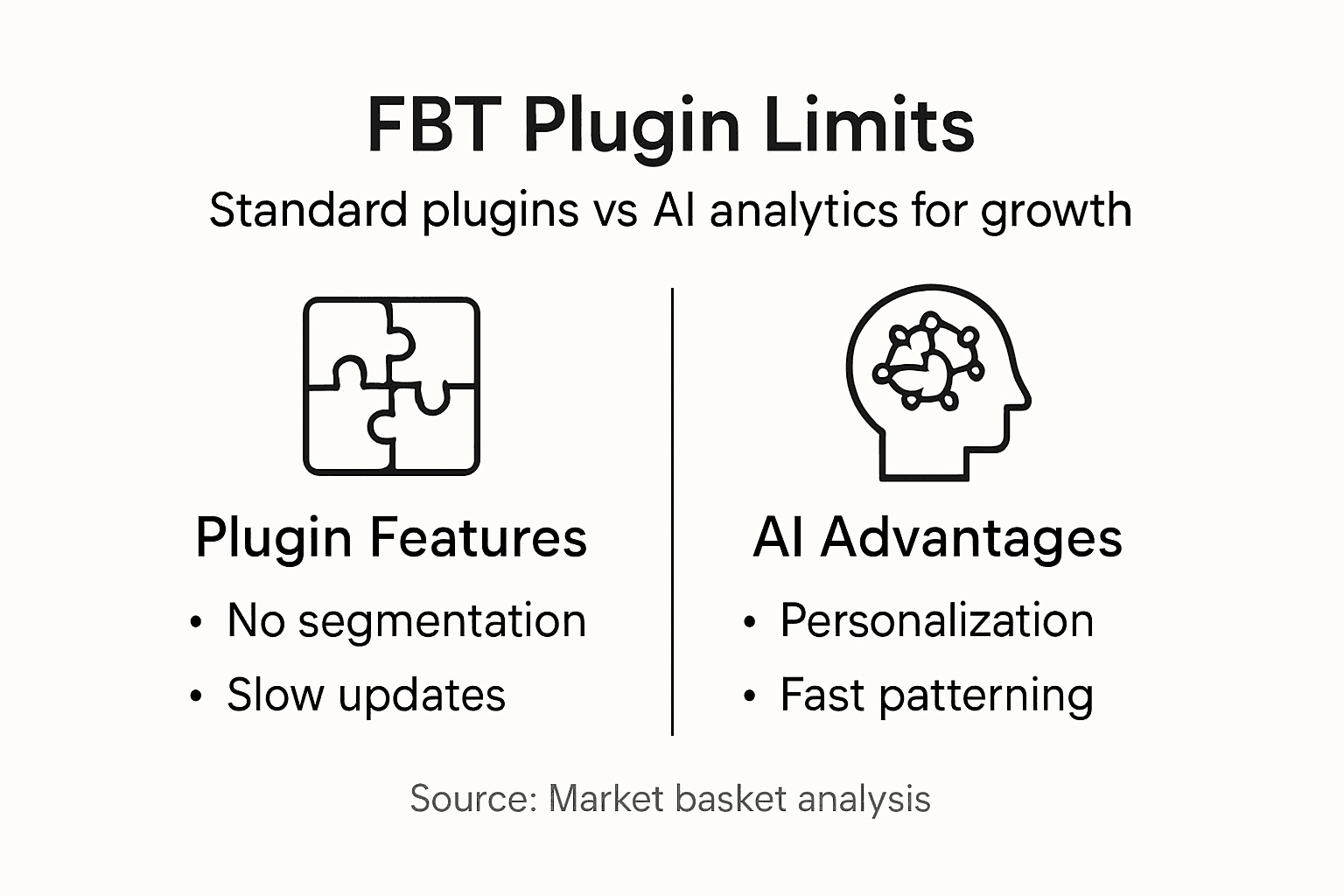
Your store’s unique customer segments get ignored. A plugin can’t distinguish between your high-value customers and one-time browsers. Everyone sees the same generic recommendations.
Standard FBT plugins work for basic suggestions, but they lack the computational power to deliver accurate, revenue-maximizing recommendations for growing stores.
The Real Cost of Generic Recommendations
When recommendations aren’t personalized, conversion rates stay flat. Your AOV improvements plateau quickly.
Integration challenges emerge with other marketing tools. Most plugins operate in isolation, unable to communicate with your email platform, SMS service, or customer data systems.
You’re also limited by how the plugin defines “frequently bought together.” It can’t account for seasonal trends, customer lifetime value, or regional preferences. It just sees transactions.
Pro tip: Before investing in any FBT plugin, test it with 100 transactions to verify recommendation accuracy—generic suggestions often fail to drive meaningful AOV improvements for stores above 500 products.
Why FBT Plugins Fail for Larger Stores
FBT plugins work adequately for small shops with 200-300 products. Once you scale beyond that threshold, the fundamental architecture of standard FBT plugins becomes a liability rather than an asset.
The problem isn’t conceptual—it’s computational. Standard FBT plugins operate on basic conditional logic: if product X is bought, show product Y. This simple approach requires exponentially more processing power as your catalog grows.
The Computational Bottleneck
When you have 5,000 products, calculating every possible product pairing creates millions of data points. Standard plugins attempt to process this through brute-force matching, which causes three cascading problems:
Database strain becomes immediate. Your plugin queries your transaction history constantly, creating server load that slows checkout pages. Customers see delays. Cart abandonment increases.
Inaccurate pattern recognition follows naturally. With limited computing resources, the plugin can’t distinguish signal from noise. It identifies false correlations—products that appeared together occasionally, not genuinely related items.
Recommendation stagnation is the third failure. The plugin updates recommendations slowly or not at all. Your data from last month stays relevant, but yesterday’s transactions take weeks to influence recommendations.
This summary outlines common pitfalls when using generic FBT plugins as stores scale:
| Pitfall | Business Risk | Resulting Challenge |
|---|---|---|
| Database Strain | Slowed checkout pages | Increased cart abandonment |
| Poor Pattern Recognition | Irrelevant recommendations | Missed upsell opportunities |
| Recommendation Lag | Outdated product links | Stagnant average order value |
Standard FBT plugins work on computing power measured in kilobytes. Larger stores need algorithms capable of processing terabytes of nuanced customer behavior data.
Why Simple Pattern Matching Fails at Scale
Consider a store selling clothing. A standard FBT plugin sees that jeans and socks were purchased together 50 times last month. It recommends socks with every jeans purchase.
But here’s what the plugin misses: those 50 purchases came from budget-conscious shoppers. Your premium clothing buyers—who represent 60% of revenue—rarely buy socks. They expect luxury accessories instead.
A simple pattern matching approach treats all customers identically. It can’t segment by purchase history, price sensitivity, or browsing behavior. Everyone gets the same generic recommendations.
Larger stores also face seasonal complexity. Effective cross-sell strategies require recognizing seasonal patterns and adjusting recommendations accordingly—something standard plugins simply cannot do.
The Hidden Cost: Missed Revenue
When recommendations are inaccurate, several consequences emerge:
- Customers ignore suggestions that feel irrelevant to their needs
- You leave 15-30% of potential AOV growth unrealized
- Your marketing team can’t use bundle data for email campaigns
- Inventory gets misaligned with actual customer purchasing patterns
The plugin continues running, creating a false sense of security. You assume cross-selling is working when it’s merely visible.
Pro tip: If your store has more than 1,000 products and FBT AOV improvements have plateaued below 12%, the plugin architecture itself is the limiting factor—not your product selection.
Maximizing AOV and LTV With AI Analytics
AI analytics transforms how you understand customer behavior and purchasing patterns. Unlike traditional FBT plugins, AI systems process vast amounts of data simultaneously, identifying nuanced relationships that drive real revenue growth.
The difference is fundamental. AI doesn’t just see that products were bought together—it understands why, when, and for which customer segments they should be recommended.
Here’s a comparison of traditional FBT plugins and AI-powered analytics for revenue optimization:
| Approach | Data Processing | Personalization | Impact on Growth |
|---|---|---|---|
| Standard FBT Plugins | Simple pattern matching | One-size-fits-all suggestions | Limited for large stores |
| AI Analytics | Advanced machine learning | Customer-specific recommendations | Enables sustained revenue growth |
How AI Uncovers Hidden Revenue Opportunities
AI analytics works through pattern recognition at scale. The system analyzes thousands of customer journeys simultaneously, identifying correlations that simple plugins miss entirely.
Here’s what AI can accomplish that standard tools cannot:
- Customer segmentation based on lifetime value, purchase frequency, and product preferences
- Seasonal pattern recognition that automatically adjusts recommendations for holidays and trends
- Predictive bundling that suggests products customers will want before they realize it themselves
- Dynamic pricing optimization for bundles based on customer segments and inventory levels
- Cross-channel insights connecting online behavior with email engagement and social signals
When you understand why optimizing average order value matters for sustainable growth, you realize that generic recommendations aren’t enough. Your high-value customers deserve personalized experiences.
AI systems deliver exactly that. They recognize that your premium buyers respond to luxury accessories while budget-conscious shoppers want practical add-ons. Every customer sees recommendations calibrated to their unique preferences.
AI analytics doesn’t replace human judgment—it amplifies your decision-making by processing patterns your team could never identify manually.
Building Customer Lifetime Value Through Precision
LTV grows when you stop chasing short-term upsells and start building long-term customer relationships. AI enables this shift by identifying which recommendations actually matter to each customer.
Consider retention: AI recognizes when customers are at risk of churning based on their purchase behavior. It can suggest products that re-engage them, transforming a departing customer into a repeat buyer.
Repeat purchase rates increase when recommendations align with customer behavior patterns rather than generic popularity metrics. A customer who bought premium cycling gear last month responds differently to recommendations than someone purchasing budget camping equipment.
AI also optimizes timing and frequency. It knows when to show recommendations (at checkout, in emails, or post-purchase) and how many to display without overwhelming your customers.
The financial impact compounds over time. Increasing LTV by 20% while growing AOV by 15% creates exponential revenue growth that standard FBT plugins simply cannot deliver.
Pro tip: Start by analyzing your top 100 customers’ purchase history with AI tools to identify their unique product preferences, then use those patterns to inform recommendations for similar customer segments.
Affinsy’s Superior Approach for Targeted Cross-Sells
Affinsy tackles the core limitation of standard FBT plugins: computational capacity. The platform uses heavy-duty algorithms that process your entire transaction history simultaneously, identifying product relationships with precision that simple plugins cannot match.
The difference starts with raw processing power. Affinsy analyzes patterns across thousands of products, millions of transactions, and complex customer segments in real time. This capability enables accuracy that drives measurable revenue increases.
How Affinsy Crunches Heavy Algorithms
Traditional FBT plugins operate on basic conditional logic. Affinsy operates on advanced machine learning that understands context, customer behavior, seasonality, and product relationships simultaneously.
Here’s what sets the platform apart:
- Multi-dimensional analysis examining product relationships from dozens of angles simultaneously
- Real-time algorithm updates that incorporate yesterday’s transactions into today’s recommendations
- Customer segmentation at scale recognizing high-value buyers versus casual shoppers automatically
- Seasonal intelligence that adjusts recommendations based on time of year and trending products
- Inventory-aware bundling that suggests combinations based on stock levels and turnover rates
When you understand effective cross-sell strategies, you recognize that generic suggestions waste opportunity. Affinsy delivers personalized recommendations that match each customer’s actual preferences and purchase patterns.
The platform integrates seamlessly with Shopify and WooCommerce, pulling transaction data directly into its analytical engine. This direct access enables accuracy that third-party plugins simply cannot achieve.
Affinsy processes customer data like enterprise platforms do, but delivers insights sized for mid-market retailers who need precision without complexity.
Guaranteed Results Through Data-Driven Accuracy
Affinsy doesn’t just identify product relationships—it quantifies their strength and reliability. The platform measures confidence levels, showing you which recommendations will actually convert and which ones are statistical noise.
This accuracy translates directly to revenue. Stores using Affinsy report consistent AOV increases of 18-25% because recommendations align with genuine customer preferences rather than random correlations.
Customer response rates increase dramatically when suggestions feel personally relevant. Your premium buyers see luxury accessories. Your bulk purchasers see volume discounts. Everyone gets recommendations calibrated to their behavior.
The platform also enables strategic bundling beyond simple cross-sells. You can create product bundles optimized for profitability, customer segment preferences, and inventory management—all informed by actual purchasing patterns rather than guesswork.
LTV growth accelerates because Affinsy identifies which products drive repeat purchases. A customer who buys premium accessories once might become a monthly subscriber with the right recommendations.
Unlike standard plugins, Affinsy provides transparent reporting showing which recommendations converted, which were ignored, and why. This visibility lets you refine strategies continuously.
Pro tip: Upload your last 12 months of transaction history to Affinsy to establish your baseline, then monitor monthly AOV changes to quantify your actual recommendation impact versus what generic FBT plugins deliver.
Unlock True E-Commerce Growth Beyond Generic Recommendations
The article reveals the critical challenge many online stores face when relying on standard Frequently Bought Together plugins: limited scalability, generic suggestions, and lost revenue opportunities. If your ecommerce business struggles with sluggish checkout pages, irrelevant product pairings, or plateauing average order values, you are not alone. Achieving meaningful growth demands moving past simple pattern matching to advanced AI-driven analytics that deliver personalized customer segmentation and precise market basket insights.
Affinsy specializes in bridging this gap. By leveraging AI-powered analytics and deep transactional data analysis, Affinsy empowers retailers to uncover hidden product associations and adjust cross-sell strategies dynamically. Unlike typical plugins, Affinsy integrates seamlessly with Shopify and WooCommerce to deliver real-time, actionable insights that increase average order value and build long-term customer loyalty.
Experience how data-driven precision turns your customer purchase patterns into measurable revenue growth.
Take the next step now to optimize your product bundles and maximize your store’s potential with Affinsy’s powerful SaaS platform.
Discover the advantage of AI-powered Frequently Bought Together strategies by visiting Affinsy’s homepage. Start transforming your ecommerce growth trajectory today with advanced analytics designed for serious retailers like you.
Frequently Asked Questions
What is Frequently Bought Together (FBT) in e-commerce?
FBT refers to product combinations that customers often purchase together during a single transaction. This purchasing pattern is based on real customer behavior and is used by retailers to make recommendations.
How can FBT insights help increase my store’s average order value (AOV)?
By suggesting complementary products at checkout, FBT insights can encourage customers to add more items to their cart, thereby increasing the overall sale amount.
What are the limitations of standard FBT plugins for larger e-commerce stores?
Standard FBT plugins can struggle with scalability, leading to slow checkout times and inaccurate recommendations as the product catalog grows, limiting their effectiveness for larger stores.
How does AI analytics improve FBT recommendations in e-commerce?
AI analytics can process vast amounts of data to identify nuanced customer behavior and purchasing patterns, allowing for more accurate and personalized product recommendations compared to traditional FBT plugins.
Recommended
- Developing a Marketing Strategy to Maximize E-commerce Sales - Affinsy Blog | Affinsy
- Ecommerce Growth Strategies Explained: Unlocking Revenue - Affinsy Blog | Affinsy
- Product Bundling — E-Commerce Glossary | Affinsy | Affinsy
- 7 Smart Bundle Pricing Strategies for E-commerce Success - Affinsy Blog | Affinsy
- Item Personalization – Nicholas & Rose Limited