
Segmenting customers online can boost your average order value by up to 25%, yet many e-commerce managers struggle to leverage their customer data effectively. This guide explains why data-driven customer segmentation is critical for online retailers and how to implement strategies that enhance sales, increase customer loyalty, and optimize marketing efficiency. You’ll discover actionable insights on choosing the right segmentation methods and turning analytics into revenue growth.
Table of Contents
- Introduction To Online Customer Segmentation
- How Data Analytics Transforms Customer Segmentation
- Business Impact: Increased Sales And Customer Loyalty
- Common Misconceptions About Online Customer Segmentation
- Frameworks And Methods For Effective Segmentation
- Practical Implementation Strategies For E-Commerce Managers
- Boost Your E-Commerce Growth With AI-Powered Segmentation
- FAQ
Key takeaways
| Point | Details |
|---|---|
| Segmentation drives measurable sales growth | Targeted customer groups increase average order value by 10-25% through personalized offers and cross-sells. |
| Data analytics enables precise targeting | Transaction, behavioral, and psychographic data reveal actionable customer patterns beyond basic demographics. |
| Balance prevents over-segmentation costs | Too many segments dilute focus and can reduce campaign effectiveness by 20% while raising costs 15%. |
| AI automation scales segmentation efforts | Machine learning handles complexity in large datasets, making segmentation sustainable and adaptive. |
| Multiple methods suit different goals | RFM, psychographic, and AI-powered approaches each offer unique strengths based on data availability and objectives. |
Introduction to online customer segmentation
Customer segmentation in e-commerce means grouping shoppers by shared characteristics like purchase behavior, browsing patterns, or preferences. This practice is far more complex and critical online than in traditional retail due to the massive volume of interactions, the rich data available from every click, and the constantly changing nature of digital customer behavior.
The main goals of segmentation include precise targeting that reduces wasted ad spend, personalization that increases conversion rates, and improved customer retention that boosts lifetime value. When you understand distinct customer groups, you can tailor product recommendations, pricing strategies, and marketing messages to resonate with each segment’s unique needs.
Effective customer segmentation supports marketing efficiency by focusing resources on high-value audiences. It also optimizes the customer experience by ensuring shoppers see relevant content at the right time. For online retailers, segmentation transforms generic campaigns into targeted interactions that drive measurable results.
Key benefits of online customer segmentation include:
- Higher conversion rates through personalized messaging
- Increased average order value via targeted upsells
- Improved customer retention and repeat purchase rates
- More efficient marketing spend allocation
- Enhanced customer satisfaction through relevant experiences
Understanding customer segmentation types helps you select approaches that align with your business model. Different methods reveal different insights, from transactional patterns to psychological preferences. The key is matching your segmentation strategy to your specific goals, whether that’s boosting short-term revenue or building long-term loyalty through improved retention strategies.
How data analytics transforms customer segmentation
Modern data analytics enables segmentation that goes far beyond simple demographic categories. Transaction data forms the foundation, capturing purchase frequency, recency, and monetary value. These three dimensions power RFM models that quickly identify your most valuable customers and those at risk of churning.
Behavioral data adds critical context by tracking site visits, page views, cart abandonment, and product browsing patterns. This reveals customer interests, engagement levels, and purchase intent signals that demographics alone cannot capture. When you analyze which products customers view together or how long they spend on specific categories, you gain insights that inform personalized recommendations and targeted campaigns.
Psychographic segmentation, which focuses on customer attitudes and preferences, complements demographic data to refine targeted marketing strategies in online retail. This deeper layer considers values, lifestyle choices, and motivations that drive purchasing decisions. Combined with transactional and behavioral data, psychographics enable truly personalized experiences that resonate emotionally with customers.
AI and machine learning automate pattern detection in complex datasets, making segmentation scalable and adaptive. Algorithms can process millions of data points to identify hidden customer clusters that manual analysis would miss. These systems continuously learn and update segments as customer behavior evolves, ensuring your targeting remains accurate over time.
| Data Type | Primary Use | Strength | Limitation |
|---|---|---|---|
| Transaction (RFM) | Revenue optimization | Easy to implement, clear metrics | Misses behavioral context |
| Behavioral | Engagement tracking | Reveals intent signals | Requires integration setup |
| Psychographic | Deep personalization | Emotional resonance | Data collection intensive |
| AI-powered | Automated insights | Scales with complexity | Requires quality data input |
Pro Tip: Start with transactional RFM segmentation for quick wins, then layer in behavioral and psychographic data as your analytics capabilities mature. This phased approach builds momentum while managing implementation complexity.
The comparison of common data models shows each has distinct strengths suited to different e-commerce contexts. Small stores may thrive with simple RFM analysis, while larger retailers with diverse product catalogs benefit from AI-powered approaches that handle multidimensional data. The key is choosing models that match your current data infrastructure and customer segmentation maturity level.
Business impact: increased sales and customer loyalty
Segmentation can increase average order value by 10-25% through targeted upsells and cross-sells that match customer preferences. When you know which products specific segments prefer, you can create bundle offers and recommendations that feel personally curated rather than generic. This relevance drives higher cart values and reduces the friction that causes abandoned purchases.
Improved repeat purchase rates directly result from personalized marketing communications that speak to individual customer needs. Segment-based email campaigns achieve higher open rates and click-through rates because the content resonates with recipients. Customers who receive relevant offers are more likely to return, building the repeat purchase behavior that defines loyal, high-value relationships.
Targeted segmentation transforms one-time buyers into repeat customers by delivering experiences that feel custom-built for their needs, not mass-produced for everyone.
Segment-based bundling and cross-selling optimize your product mix by pairing items that genuinely complement each other for specific customer groups. Instead of showing every customer the same generic recommendations, you present combinations that match their browsing history and purchase patterns. This increases both conversion rates and the perceived value of your offerings.

Marketing cost efficiency improves dramatically when you focus budgets on high-value customer segments rather than broad, untargeted campaigns. By identifying which segments generate the most revenue and respond best to specific channels, you allocate spending where it delivers maximum return. This data-driven approach reduces waste and improves overall marketing ROI.
Key financial benefits include:
- 10-25% increase in average order value from targeted recommendations
- 15-30% improvement in email campaign performance through personalization
- 20-40% reduction in customer acquisition costs by focusing on lookalike audiences
- 25-50% higher customer lifetime value from improved retention
Effective retention strategies built on segmentation create sustainable competitive advantages. The insights you gain from analyzing segment behavior inform product development, pricing strategies, and customer service improvements. Master product bundling strategies become more effective when based on actual segment preferences rather than guesswork.
Common misconceptions about online customer segmentation
Many e-commerce managers rely solely on demographic data like age, gender, and location, assuming these categories sufficiently define customer groups. This approach misses the behavioral and psychographic dimensions that actually drive purchase decisions. Two customers of the same age and location may have completely different shopping motivations, product preferences, and price sensitivities.
Another widespread misconception is that more granular segmentation always produces better results. Over-segmentation can reduce campaign effectiveness by up to 20% and increase marketing costs by 15% by dividing focus too much and complicating campaigns. When you create dozens of micro-segments, you fragment your marketing efforts and struggle to maintain consistent messaging across channels.
Some managers distrust automated or AI-powered segmentation methods, preferring manual analysis they feel gives more control. Manual segmentation quickly becomes unsustainable as data volume grows and customer behavior evolves. Human analysts cannot process millions of interactions or update segments in real time the way machine learning algorithms can.
The goal is not to create the most segments possible, but to identify the meaningful distinctions that drive different marketing strategies and customer experiences.
Balancing segmentation granularity requires matching the number of segments to your operational capacity. If you cannot create distinct campaigns or experiences for each segment, you have over-segmented. The sweet spot typically ranges from 4 to 12 actionable segments that align with clear strategic priorities and available resources.
Common pitfalls to avoid:
- Treating all segments equally instead of prioritizing high-value groups
- Failing to update segments as customer behavior changes
- Ignoring cross-segment movement and customer lifecycle transitions
- Creating segments based on available data rather than strategic goals
- Neglecting to measure segment performance and refine criteria
Pro Tip: Test your segmentation strategy by ensuring each segment can answer yes to three questions: Does this group behave differently? Can we create distinct value for them? Do we have the resources to serve them uniquely? If any answer is no, simplify your approach.
Successful customer segmentation in e-commerce balances data richness with practical execution. Use automation to handle complexity while maintaining strategic oversight of which segments matter most for your business objectives.
Frameworks and methods for effective segmentation
RFM segmentation analyzes recency, frequency, and monetary value of customer transactions to identify high-value buyers and at-risk customers. This method is simple to implement, requires only transactional data, and delivers quick insights for revenue optimization. RFM works especially well for subscription businesses and retailers with repeat purchase patterns.

Psychographic segmentation dives deeper into customer attitudes, values, lifestyle preferences, and motivations that drive purchasing behavior. This approach enables profound personalization that resonates emotionally with customers, but it requires intensive data collection through surveys, social media analysis, or third-party enrichment services. Psychographic methods excel when brand differentiation and customer experience are competitive priorities.
AI-powered segmentation uses machine learning algorithms to automatically discover customer clusters based on complex patterns across multiple data dimensions. This method scales effortlessly with data volume, handles high-dimensional datasets that humans cannot visualize, and continuously adapts as customer behavior evolves. AI approaches require quality data input and some technical setup but deliver unmatched scalability for large e-commerce operations.
| Method | Best For | Data Required | Implementation Effort | Scalability |
|---|---|---|---|---|
| RFM | Revenue optimization | Transaction history | Low | Medium |
| Psychographic | Deep personalization | Surveys, preferences | High | Low |
| AI-powered | Large-scale automation | Multi-source integration | Medium | High |
| Behavioral | Engagement improvement | Clickstream, browsing | Medium | Medium |
Decision criteria for selecting your segmentation method:
- Align with strategic goals (revenue growth, retention, personalization)
- Assess available data quality and completeness
- Evaluate technical resources and integration capabilities
- Consider operational capacity to act on segment insights
- Balance automation needs with control preferences
- Factor in budget for tools, data collection, and implementation
Step-by-step framework to choose the right approach: Start by defining clear business objectives that segmentation should support. Next, inventory your current data sources and quality levels. Then evaluate your team’s technical capabilities and available budget. Match these factors against the requirements of each segmentation method. Finally, pilot your chosen approach with a small customer subset before full rollout.
Understanding customer segmentation types helps you make informed choices about which methods suit your business model and maturity stage. Many successful e-commerce operations use hybrid approaches that combine RFM for quick tactical wins with AI-powered methods for strategic insights. The key is starting with methods you can execute well rather than overreaching with complex approaches you cannot sustain.
Customer segmentation success depends on matching method complexity to your organizational readiness and clear strategic priorities.
Practical implementation strategies for e-commerce managers
Step 1: Collect and clean transactional and behavioral data to ensure quality input for segmentation models. Export order history from your e-commerce platform, integrate Google Analytics for behavioral tracking, and consolidate data into a central repository. Remove duplicates, correct formatting inconsistencies, and fill data gaps before analysis begins.
Step 2: Choose a segmentation model aligned to your marketing goals, whether that’s revenue optimization through RFM, deeper personalization via psychographic analysis, or scalable automation with AI. Match method complexity to your team’s capabilities and available data quality. Start simple if you’re new to segmentation, then evolve to more sophisticated approaches.
Step 3: Use AI platforms like Affinsy to automate segment discovery and keep segments updated as customer behavior changes. These tools handle the computational complexity of analyzing large datasets while providing intuitive dashboards for interpreting results. Automation ensures your segmentation remains current without constant manual recalculation.
Step 4: Integrate segmentation insights with your marketing platforms and Google Analytics to enable targeted campaign execution. Export segment definitions to your email service provider, ad platforms, and CRM system. Set up custom audiences that sync automatically as customers move between segments.
Step 5: Launch targeted campaigns based on segment characteristics and monitor performance through analytics dashboards. Create unique messaging, offers, and creative assets for each priority segment. Track metrics like conversion rate, average order value, and customer lifetime value by segment to measure impact.
Step 6: Continuously refine segments based on campaign results and A/B testing insights. Review segment performance monthly, adjusting criteria to improve predictive accuracy. Test new segmentation variables and retire segments that no longer drive distinct results.
Pro Tip: Start with your top 20% of customers by revenue and create 3-4 segments within this group based on purchase patterns. Perfect your targeting and measurement with high-value customers before expanding to broader segmentation across your entire base.
Implementation best practices:
- Document segment definitions clearly so teams understand targeting criteria
- Establish governance for when and how segments get updated
- Create segment-specific KPIs tied to business objectives
- Train marketing teams on interpreting and activating segment insights
- Build feedback loops between campaign results and segmentation refinement
- Maintain data quality standards as your primary data sources evolve
Successful customer segmentation implementation requires both technical execution and organizational alignment. Ensure stakeholders understand how segmentation supports broader business goals and invest in change management to drive adoption. The most sophisticated models fail if teams do not use insights to inform decisions and actions.
Leverage AI sales optimization strategies to enhance your segmentation efforts with predictive capabilities that forecast customer behavior and lifetime value.
Boost your e-commerce growth with AI-powered segmentation
Ready to transform customer data into revenue growth? Affinsy’s AI-powered analytics platform automates customer segmentation discovery, revealing high-value customer groups and actionable insights without requiring data science expertise.
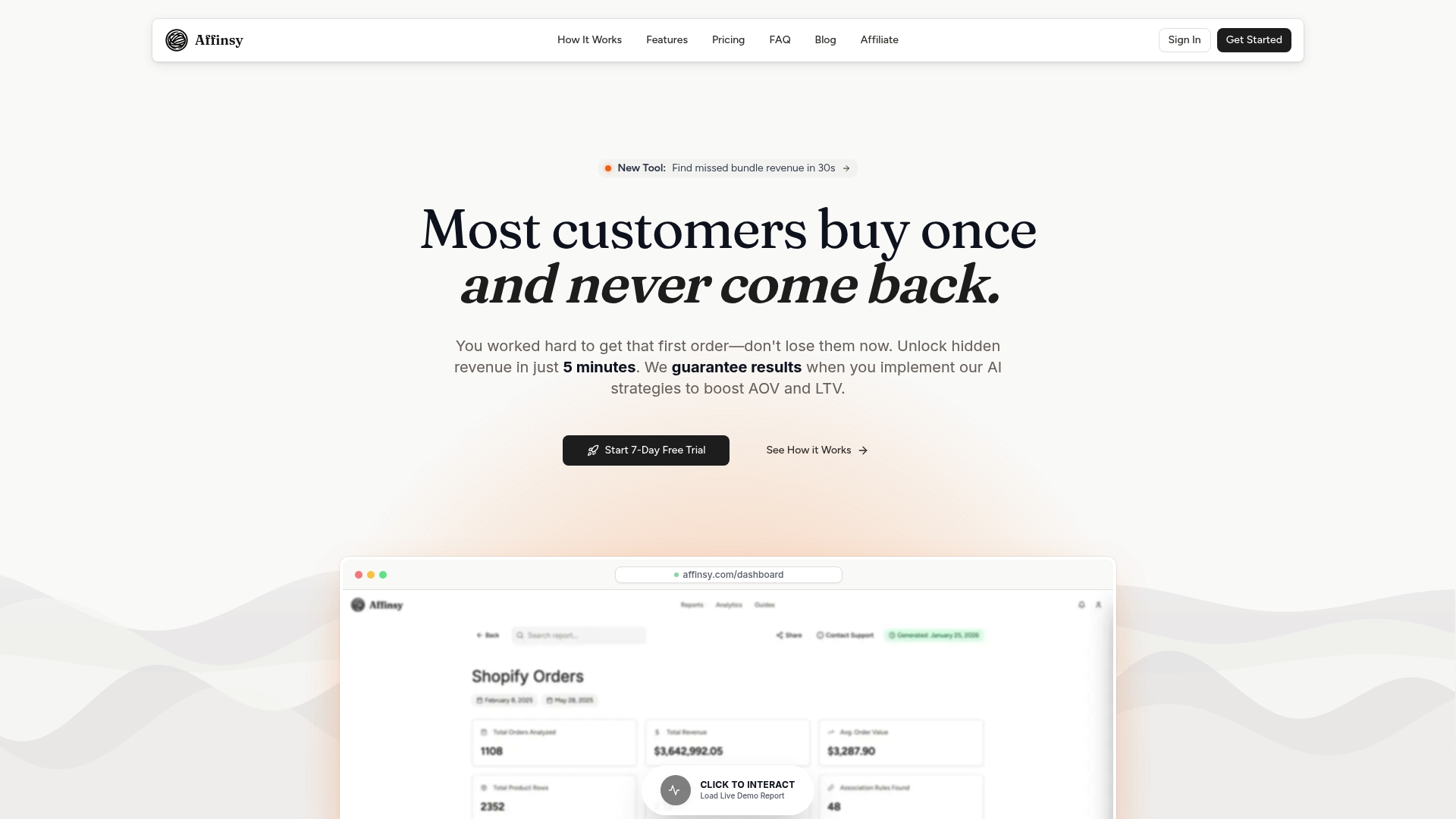
Combine segmentation with predictive analytics to forecast customer lifetime value and identify churn risks before they impact revenue. Use market basket analysis to uncover hidden product associations that inform targeted cross-sells for each segment. Optimize product bundling strategies based on actual purchase patterns within customer groups, increasing average order value through relevant offers. Affinsy integrates seamlessly with Shopify, WooCommerce, and Google Analytics, turning your existing data into competitive advantages that drive measurable results.
FAQ
Why is customer segmentation important for online stores?
Segmentation enables personalized marketing that dramatically improves engagement and conversion rates compared to generic campaigns. It allows efficient resource allocation by focusing marketing budgets on high-value customer groups that generate the most revenue. Data analytics reveals actionable customer patterns beyond surface-level demographics, uncovering behavioral and preference insights that drive strategy. Effective segmentation boosts repeat purchases and long-term loyalty by delivering relevant experiences that meet individual customer needs. Automation via AI reduces complexity and scales segmentation for large e-commerce sites without requiring manual analysis of millions of interactions.
What are the main types of customer segmentation used in e-commerce?
Transactional RFM segmentation, psychographic analysis, and AI-powered clustering represent the three primary approaches in online retail. Each method focuses on different data sources and suits particular business goals like immediate revenue optimization versus deep personalization. Understanding customer segmentation types helps you select approaches that match your data maturity and strategic priorities.
How can AI improve customer segmentation accuracy?
AI automates pattern recognition across massive datasets, identifying customer clusters that manual analysis would miss entirely. Machine learning algorithms continuously update segments as behavior evolves, maintaining accuracy without constant human intervention. This reduces manual effort dramatically, allowing marketing teams to focus on strategy and creative execution rather than data processing. AI and e-commerce integration delivers scalable segmentation that adapts to changing customer dynamics in real time.
What are common pitfalls to avoid when segmenting online customers?
Avoid creating too many granular segments, which dilutes marketing focus and can reduce campaign effectiveness by up to 20% while increasing costs by 15%. Do not rely solely on demographic data when behavioral and psychographic insights provide far richer targeting capabilities. Leverage AI tools to manage segmentation complexity and maintain accuracy as your customer base grows, rather than struggling with unsustainable manual processes.
Recommended
- Customer segmentation explained: boost retention 2026 - Affinsy Blog | Affinsy
- Customer Segmentation: Complete Guide for E-Commerce - Affinsy Blog | Affinsy
- Customer Segmentation Types: Complete Guide for E-commerce - Affinsy Blog | Affinsy
- 7 Effective Customer Segmentation Examples for E-commerce - Affinsy Blog | Affinsy