Getting actionable customer segments from sales and behavioral data is still tedious when most free segmentation software either caps your dataset size or forces you to churn through confusing exports and manual rule setup. Many tools lock real activation features like audience sync or dynamic updating behind paid plans, or require engineering time just to push segments into your marketing stack. This comparison reviews capabilities, free-plan limits, and integration details across six customer segmentation platforms so you can pick one that matches your store size and campaign workflow without waiting for budget approval.
Table of Contents
- Affinsy
- Orita
- Tresl Segments
- Divisio
- Untitled Audience Platform
- Dema
- Comparative Analysis: A Study of Leading Customer Segmentation Tools
Affinsy
At a Glance
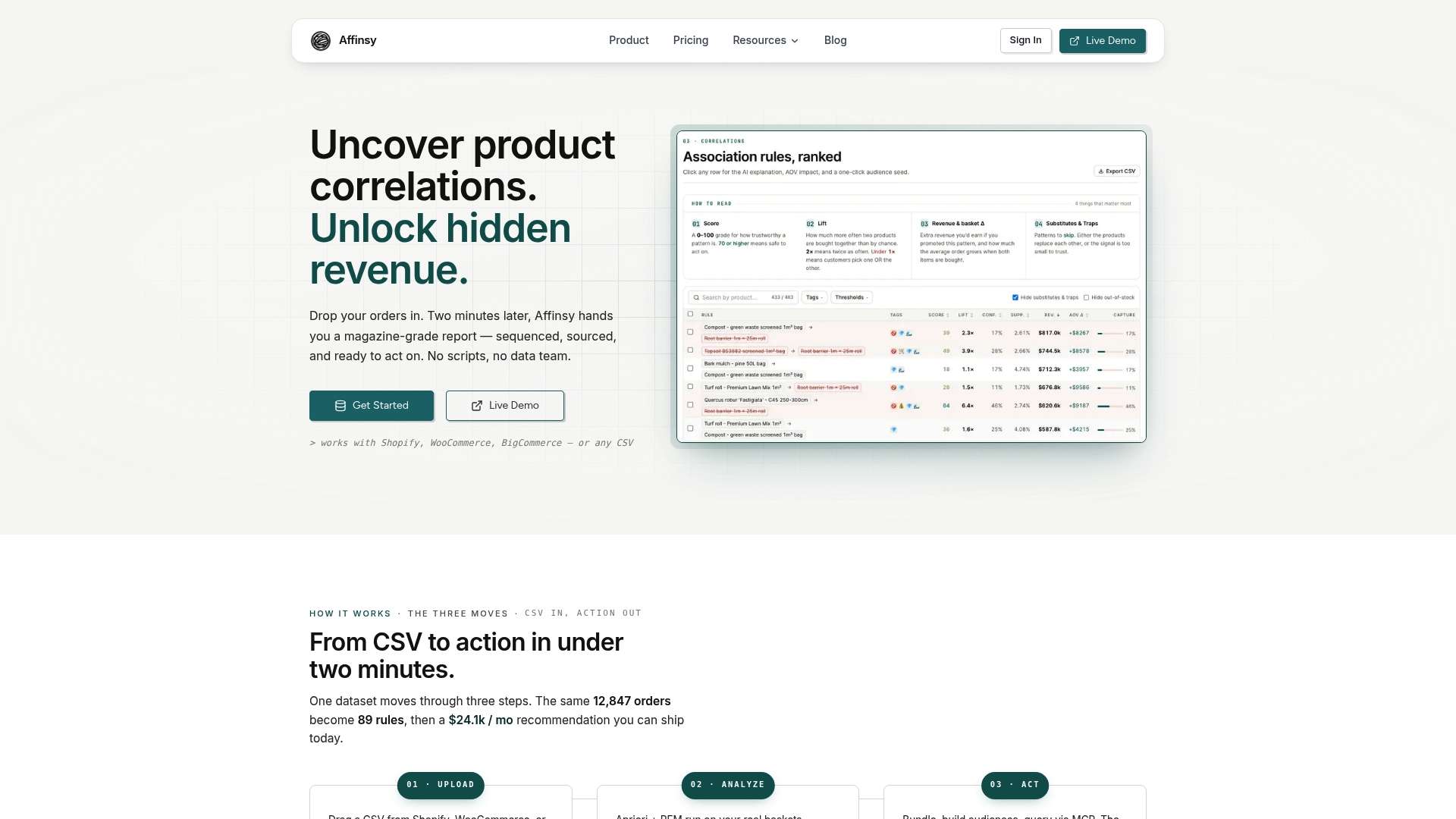
Affinsy advertises a permanent free tier that accepts up to 20K line items and requires no credit card. The platform analyzes historical transaction data to surface product associations, build RFM customer segments, and recommend prioritized bundles you can act on without hiring a data scientist.
Core Features
- Upload sales data via CSV or API with automatic schema detection and support for large datasets.
- Market Basket Analysis that ranks associations by confidence, lift, and revenue impact.
- Customer segmentation using RFM to separate high value buyers from churn risk.
- Sequenced, report-style recommendations for bundling, restocking, and cross-sell activation.
- Natural language querying, automated executive reports, and export-ready audiences for marketing activation.
Key Differentiator
Affinsy produces magazine-grade, sequenced, source-verified reports that turn correlation signals into top-priority, dependency-based strategic plans. Those reports don’t just list pairs; they show which bundles to promote first and why, with ranked impact estimates.
Pros
-
No heavy data engineering required. Upload a weekly CSV or connect an API and the platform handles schema detection and large row counts so you skip ETL work.
-
Platform-agnostic operation. It works with Shopify, WooCommerce, BigCommerce, Stripe, or any system that emits transactional CSVs so you can cover multiple stores without custom connectors.
-
Statistical ranking by lift, confidence, and projected revenue impact gives you defensible priorities for merchandising and promo planning rather than raw frequency lists.
-
Reports are exportable and sequenced for execution. Instead of a dashboard snapshot, you get stepwise recommendations you can hand to merchandising, demand planning, or your email marketer.
-
Built to handle mid-market scale. The system is designed to run on sizable datasets so agencies and multi-store operators won’t immediately hit limits.
Cons
- Requires importing or streaming sales data; this is not an embedded, realtime solution inside storefront platforms, so there is a delay between sales events and analysis.
Who It’s For
Mid-market e-commerce brands and digital agencies managing multiple stores or client accounts who want statistically grounded product associations and customer segments without building pipelines. Also useful for retailers that want prioritized bundling plans they can operationalize quickly.
Unique Value Proposition
Sequenced, source-verified reports convert statistical signals into an executable merchandising roadmap. That changes how you spend time: less arguing about which pairs are interesting and more executing the top three bundle moves that the report ties to revenue impact.
Real World Use Case
A multi-store operator uploads weekly sales CSVs and uses Affinsy to identify top bundles and build targeted audiences. The operator exports audiences to their email provider and implements the top three bundle promos, which raised average order value and produced measurable revenue lift across stores.
Pricing
According to the company, Affinsy offers a permanent free tier up to 20K line items with no credit card required. The vendor’s published tiers list Pro at $49 per month and Max at $199 per month. Enterprise pricing is available on request.
Website: https://affinsy.com
Orita
At a Glance
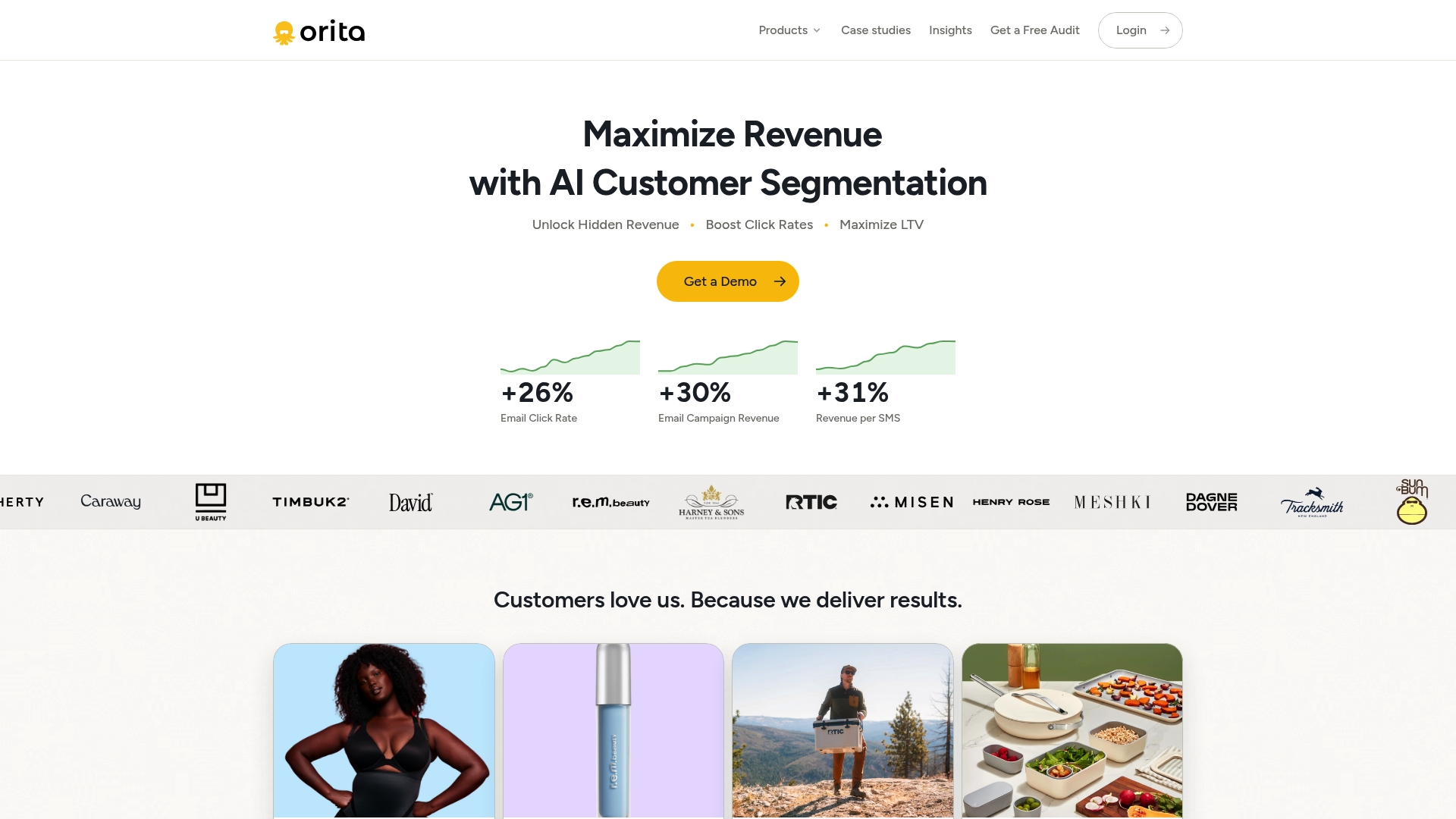
Builds a bespoke, continuously retrained machine learning model that writes segmentation rules directly into marketing platforms like Klaviyo. Orita emphasizes rapid, no-engineering onboarding via OAuth and advertises SOC 2 Type II compliance with GDPR readiness.
The vendor positions this for teams that want segments pushed into their stacks without a data science project.
Core Features
- Continuously learning model that adapts to your transactional and engagement data and refreshes segments over time.
- Cross-channel segmentation for email, direct mail, SMS, and remarketing ads so you can target the same audience across channels.
- One-click OAuth connections to sync without engineering, plus connectors for storefronts and payment platforms.
- SOC 2 Type II compliance and GDPR readiness called out for teams with security concerns.
These are delivered as ready-to-use segments that map into your marketing workflows.
Key Differentiator
Orita trains a unique ML model on each customer and keeps it retrained continuously, then populates segments into marketing tools you already use. That direct push into platforms like Klaviyo and PostPilot reduces the manual steps most teams face when moving predictions into campaigns.
Pros
- Fast setup removes the common bottleneck of developer time; marketing teams can connect and get segments without engineering tickets.
- Cross-channel focus means a single segmentation model can seed email, SMS, and remarketing audiences, avoiding inconsistent lists across channels.
- Security posture is explicit. The product materials reference SOC 2 Type II and GDPR readiness, which matters when you handle customer PII.
- Vendor materials highlight usage by larger brands, which suggests the company targets production-grade marketing use cases rather than experiments.
- Continuous retraining reduces model drift for teams that refresh campaigns frequently.
Cons
- There are few third-party reviews or independent user testimonials available, so real-world reliability and edge cases are not well documented.
- Public documentation is light on deep customization options; teams with bespoke feature engineering needs may find limits.
- Pricing and plan detail are not published in the product data, which makes procurement planning harder for smaller teams.
Notable Integrations
- Klaviyo
- PostPilot
- Braze
- Attentive
- Yotpo
- Listrak
- Mailchimp
- Shopify Connect
Integrations focus on marketing automation, storefronts, and customer data endpoints so segments can be consumed where campaigns run.
Who It’s For
Marketing teams at eCommerce brands using Klaviyo or similar stacks who want an AI-driven segmentation layer without hiring data scientists. Good for growth marketers aiming to reduce time between insight and campaign execution.
Real World Use Case
The vendor’s case study reports a retail brand that integrated Orita with Klaviyo and saw a 30% increase in campaign revenue and a 10% lift in customer lifetime value. In that example, segments were auto-populated and used for reactivation and VIP journeys.
Pricing
Pricing is not published in the product data and is listed as informational only. Expect vendor sales or a demo to be the path to obtain exact plan details and enterprise terms.
Website: https://orita.ai
Tresl Segments
At a Glance
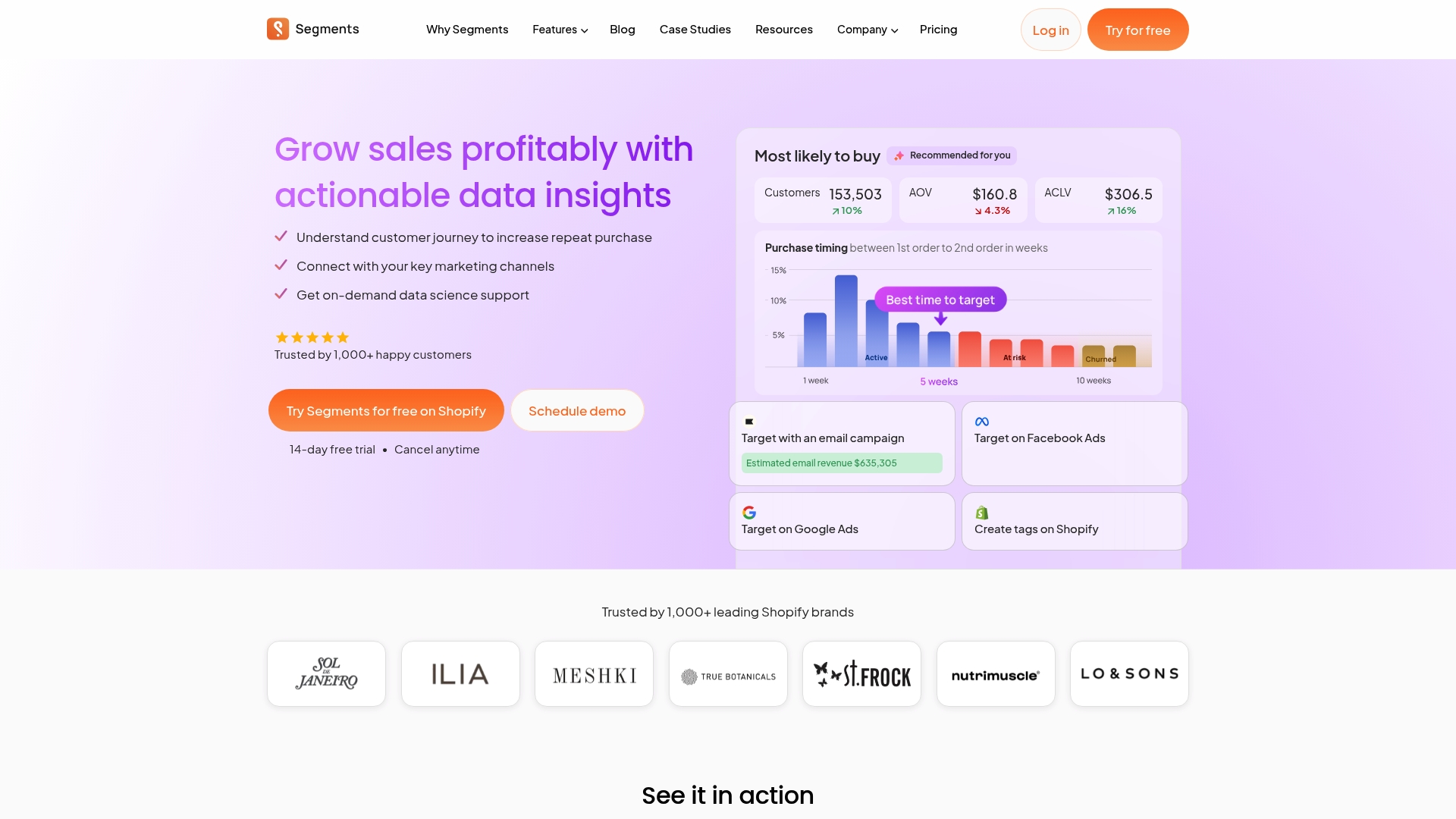
Automatic audience updates across 20+ channels with real-time sync keep lists current without manual exports. Tresl is Shopify Plus certified and the vendor’s marketing materials cite a 5/5 Shopify App Store rating and a case study reporting a 128% lift in subscription sales and a 10x ROAS.
Core Features
- AI-powered segmentation that creates precise cohorts from purchase and behavior data.
- Natural language segment building lets marketers write queries in plain English, no SQL required.
- Automatic audience sync across email, social, ad platforms, and SMS with real-time updates.
- Interactive shopper insights, cohort analytics, lifecycle analysis, and campaign performance tracking.
Key Differentiator
Built by data scientists, Tresl combines natural language segment building with cross-channel audience sync so teams launch targeted campaigns faster. Compared with Affinsy, which focuses on market basket analysis and RFM patterns, Tresl zeroes in on marketer-friendly, no-code segmentation and multi-channel execution for Shopify-centric stacks.
Pros
- Helpful onboarding and support teams are reported frequently by users; that personalized service shortens the learning curve for nontechnical staff.
- The interface is easy to navigate so marketing managers can build and iterate segments without developer time.
- Deep behavioral and cohort analytics surface upsell and retention opportunities that reduce manual cohort exports.
- Robust integrations remove CSV gymnastics by syncing audiences to Klaviyo, Meta, Google Ads, TikTok, Shopify, and SMS platforms.
- The vendor advertises strong case studies that show meaningful ROI for brands running lifecycle campaigns.
Cons
- Several third-party summaries flag onboarding delays and occasional communication lapses during busy periods.
- Document submission and verification processes are reported as cumbersome by some customers.
- Promised service timelines and rates have varied across external reviews, which raises expectations management issues.
When It May Not Fit
If your launch schedule is tight and you need instant hands-on onboarding, the reported setup delays make Tresl a risky choice. Large enterprises with bespoke ETL pipelines or those who require fully managed professional services may need a different vendor. Complex multi-store architectures will require planning.
Notable Integrations
- Shopify
- Klaviyo
- Google Ads
- Meta (Facebook)
- TikTok
- SMS platforms
Who It’s For
Shopify Plus merchants and marketing agencies that want advanced, no-code customer segmentation and cross-channel audience activation. Ideal for teams that prioritize fast campaign execution over building custom data science pipelines.
Real World Use Case
A Shopify brand used Tresl to identify highest lifetime value customers, sync audiences to email and social, and run targeted lifecycle campaigns. The vendor’s case study above reports a 128% increase in subscription sales and a 10x return on ad spend.
Pricing
Pricing starts at $99 per month. The vendor lists tiered options including Core at $166 per month billed yearly, Pro at $400 per month billed yearly, and custom enterprise plans for larger implementations.
Website: https://tresl.co
Divisio
At a Glance
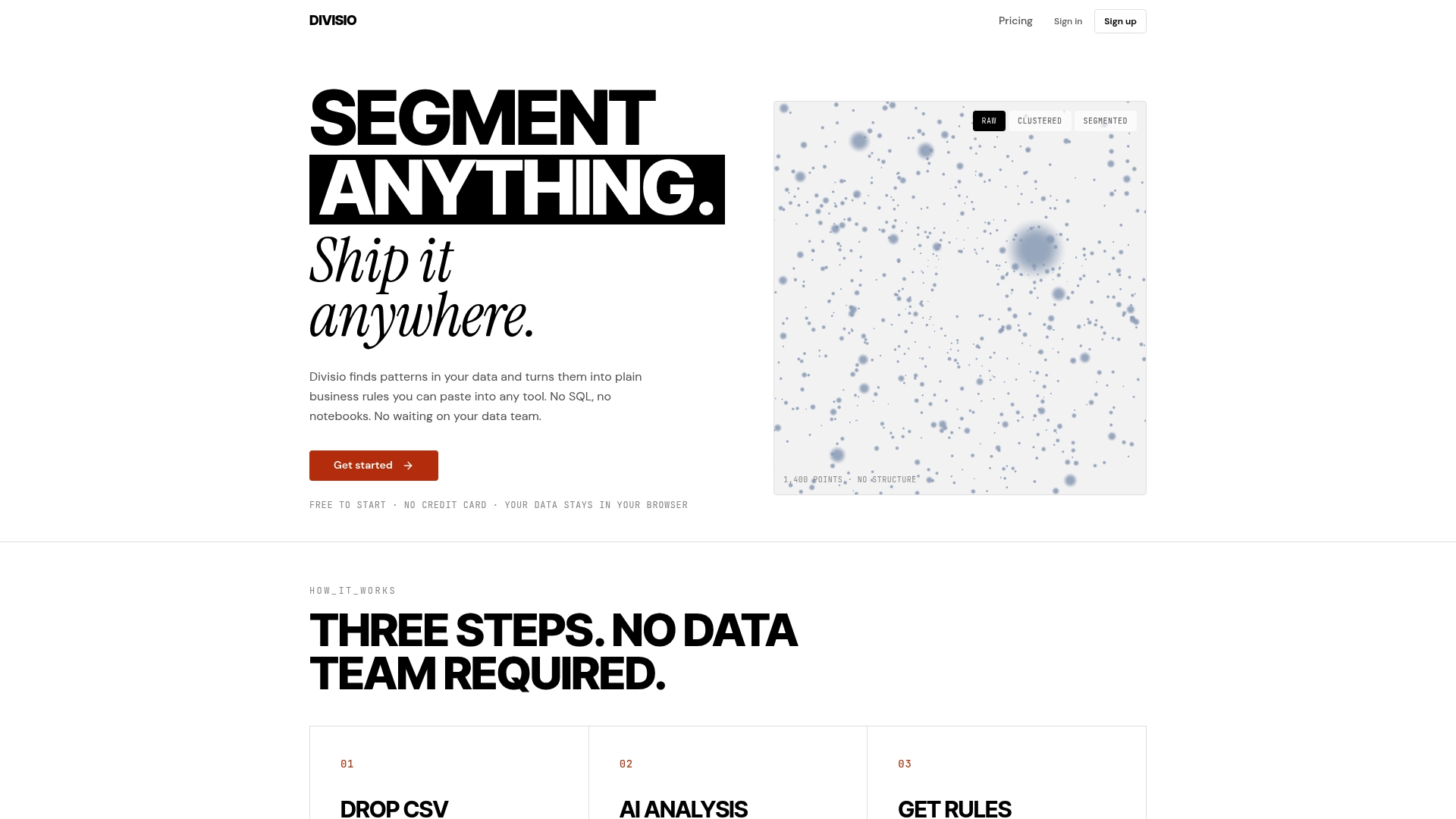
Generates human readable IF/THEN business rules and code snippets you can paste directly into marketing tools after uploading a CSV or Excel file. The vendor advertises rapid setup and analysis in under five minutes, which targets teams that need fast, no SQL segmentation.
Core Features
Divisio runs K-Means and density based DBSCAN clustering and surfaces patterns as clear segment rules. It includes scatter plots, box plots, histograms, and computed variables for transforming raw fields before analysis.
The interface also offers automatic rule export in human readable logic and code snippets so you can move segments into other systems without manual translation.
Key Differentiator
No coding is required to get usable segmentation rules. Divisio converts clusters into plain business rules you can copy into email, ad, or CRM platforms, which shortens the handoff between analysis and execution for marketing teams.
Pros
-
Quick nontechnical setup. Upload a CSV or Excel file and get segments without writing SQL, which helps small teams avoid hiring a data scientist.
-
Human readable rules make it simple to hand segments to campaign managers rather than passing around complex model outputs.
-
Dual clustering choices let you pick centroid based or density based approaches depending on whether segments are globular or irregular.
-
Visual diagnostics help you validate segments with charts rather than guessing from tables.
-
Built in exports for code and rules reduce manual translation work when pushing segments into tools you already use.
Cons
-
Free plan caps datasets at 5,000 rows and limits you to six segments, which restricts analysis of larger catalogs or enterprise order tables.
-
Advanced functionality and higher limits require a paid Pro plan, so growing teams will face upgrade friction.
-
There is no mention of API driven automation for continuous syncing in the provided data, so repeated manual uploads may be necessary for frequent refreshes.
When It May Not Fit
If your marketing stack requires large scale or hourly automated segmentation, Divisio’s free limits and manual upload workflow will slow you down. Teams that need thousands of rows or dozens of microsegments will likely outgrow the free plan and need Pro.
For modeling that depends on time series forecasting or advanced feature engineering pipelines, this product’s clustering focus may feel narrow.
Notable Integrations
- HubSpot
- Braze
- Klaviyo
- Mailchimp
- Segment
- Google Ads
Who It’s For
Marketing teams and analyst squads that need fast, code free customer segmentation and want rules they can hand to campaign managers. Small to mid sized e-commerce brands that export order data to CSV will get the most immediate value.
Real World Use Case
A marketing team uploads purchase history, lets Divisio detect clusters, and exports IF/THEN rules for email and ad targeting. The team deploys separate creative and offers for each rule set without waiting for engineering to rewrite logic.
Pricing
Free to start with a 5,000 row and six segment limit on the free tier. Paid Pro begins at €9.99 per month for larger datasets and advanced features.
Website: https://divisio.co
Untitled Audience Platform
At a Glance
The vendor advertises personalized direct mail fulfillment within 24–48 hours of a site visit, paired with cross-channel activation into streaming TV and major ad platforms. That single workflow—identify anonymous visitors, enrich profiles, then activate across digital and offline channels—defines the product pitch.
Core Features
- Build dynamic segments from first-party data using behavioral rules and demographic filters without SQL or spreadsheets.
- Connect and enrich sources like Shopify, HubSpot, and Klaviyo and push segments into Google Ads, Meta, and TikTok.
- Create high-intent audiences from contextual topics based on browsing behavior and automate retargeting across streaming TV and direct mail.
Key Differentiator
Untitled combines segmentation, enrichment, and activation in one interface and leans on AI models to automate tasks such as buyer intent scoring and ideal customer profile generation. The difference most teams will notice is that activation channels include both streaming TV and postal mail, not only social and search.
Pros
- Powerful activation: The platform lets you push the same segment into Meta, Google, and TikTok without manual exports, which reduces friction when running multichannel tests.
- AI-assisted segmentation: The vendor’s models help surface buyer intent and candidate segments so you spend less time writing rules and more time testing creative.
- Real-time updates: Segments reflect recent sessions and events, which helps retargeting windows and frequency controls remain relevant.
- Offline channel support: Built-in direct mail and streaming TV add options for audiences that respond poorly to only digital ads.
Cons
- Independent verification is scarce; the product’s strengths and limits are hard to confirm because third-party reviews are not widely available.
- Setup can be complex for teams without a data integration background; expect engineering or agency help for advanced enrichment and event wiring.
- Pricing is not transparent and likely requires enterprise engagement, which makes cost comparisons difficult during initial evaluation.
When It May Not Fit
If your team needs open, line-item pricing to budget campaigns quickly, Untitled’s custom pricing process will slow procurement. Also, if you lack any data infrastructure or a partner to handle integrations, the onboarding work may outweigh short-term gains.
Notable Integrations
Shopify, HubSpot, Klaviyo, Google Ads, Meta (Facebook/Instagram), TikTok, streaming TV platforms, and common CRM systems are listed as connectors. Those integrations enable export to ad platforms and enrichment from marketing stacks without inventing custom pipelines.
Who It’s For
Performance marketing teams, growth shops, and data-driven marketers that want to use first-party signals to build high-value audiences and run coordinated campaigns across digital and offline channels. Good for teams that can allocate some engineering time for setup.
Real World Use Case
A retail eCommerce brand identifies anonymous site visitors, enriches profiles with CRM and browsing signals, segments high-value shoppers, then runs synchronized ads and targeted direct mail to lift conversions and reduce cost per acquisition.
Pricing
Pricing is not publicly listed; the vendor offers trials and negotiates custom enterprise plans. Expect a sales conversation rather than a self-serve price card during evaluation.
Website: https://getuntitled.ai/product/segment-customers
Dema
At a Glance
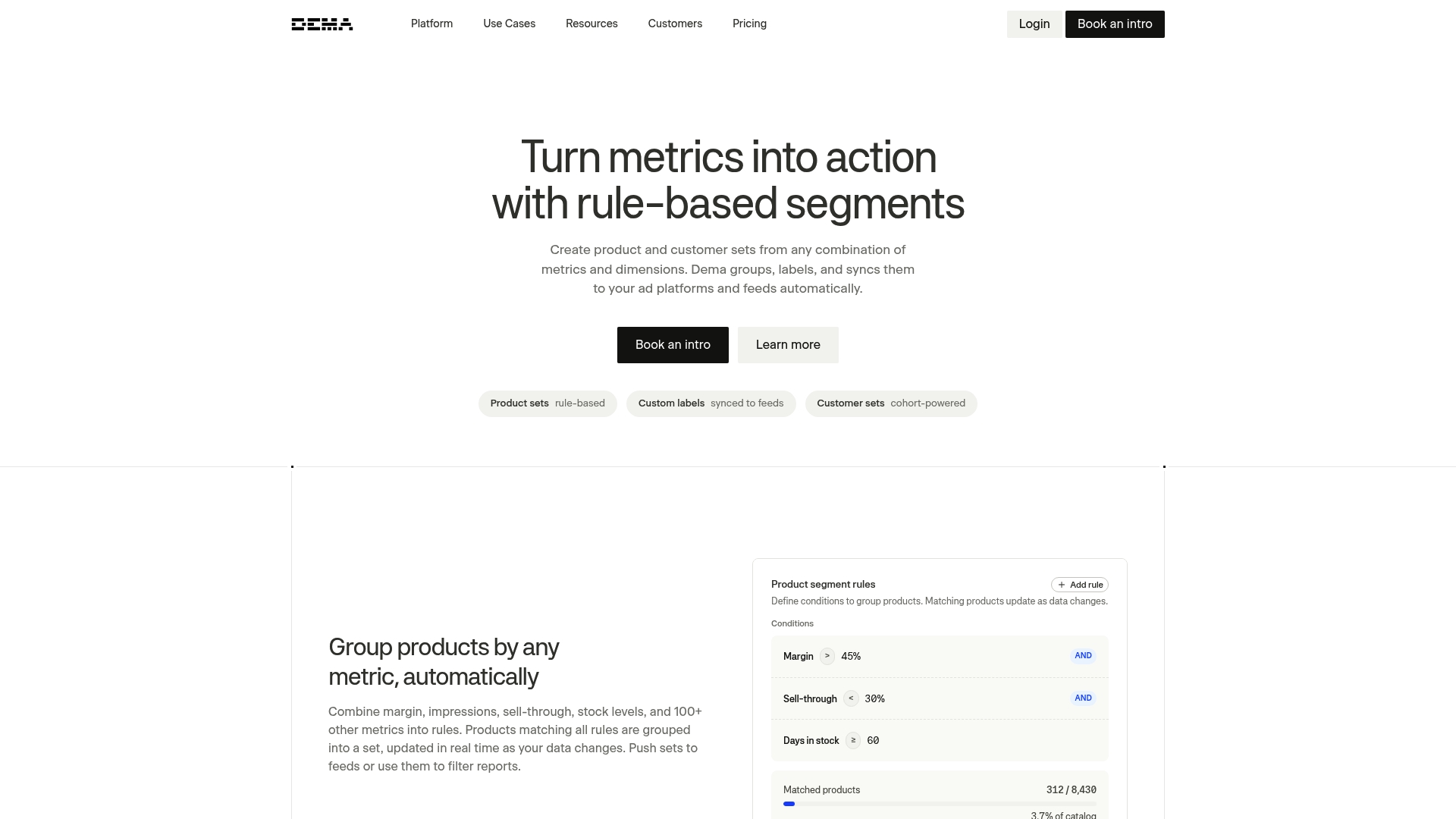
Real-time sync to ad platforms and feeds combined with a natural language segment builder is Dema’s most specific capability. That pairing lets marketing teams push rule-based customer and product segments live to advertising channels without waiting on engineering.
The vendor describes automated updates as data changes, which supports faster campaign testing and inventory-driven promotions.
Core Features
- Create product and customer segments from any combination of metrics and dimensions, using rule-based conditions for margin, sell-through, or stock levels.
- Real-time updates that keep segments current as transactional data changes.
- Sync segments automatically to ad platforms and product feeds for targeted campaigns.
- Build and refine segments using a natural language interface, turning questions into segments and reports.
These features target both marketing activation and inventory-driven product decisions.
Key Differentiator
Dema combines rule-based segmentation with live feed sync and a conversational UI. That means you can express a segment as a plain question, refine it with commands, and have the resulting group flow to Google or Meta feeds immediately.
This focus on live ad feed delivery separates it from tools that only prepare segments for export or batch uploads.
Pros
- Automated rules let segments evolve as business metrics change, so your ad audiences reflect current inventory and performance.
- Direct feed sync removes manual CSV exports. Pushes to platforms reduce latency between insight and campaign activation.
- The natural language builder speeds non-technical team members through segment creation without writing SQL.
- Strong product focus for retail teams: rules for margin, sell-through, and stock levels align segmentation with merchandising goals.
Each strength above shortens the path from data to targeted marketing.
Cons
- Public feedback is limited. There are few detailed third-party reviews to benchmark onboarding or long term reliability.
- The vendor does not publish pricing, which makes total cost of ownership unclear during evaluation.
- Rule-based systems can require careful rule maintenance; without governance that can lead to overlapping or conflicting segments.
When It May Not Fit
If your team has no regular ad feed usage, the live sync capability offers little advantage. Small stores that rely solely on platform-built audiences may not get value from Dema’s feed plumbing.
Also expect a learning curve for non-technical users; the product data flags potential onboarding complexity for teams without analysts.
Notable Integrations
- Google Shopping (feed labels and custom labels)
- Meta Catalog feeds for dynamic creative and product sets
- Shopify for product and inventory data
These integrations support direct tagging and feed management workflows rather than one-off exports.
Who It’s For
Dema fits marketing teams, inventory managers, and product strategists at e-commerce and retail brands that run feed-based advertising and need automated, data-driven segments. It suits teams that want to reduce manual feed edits and speed campaign refreshes.
Real World Use Case
A retail brand groups high-margin but slow-selling SKUs into a segment, pushes that group to Google Shopping as a custom label, and runs targeted promotions to clear inventory. The pipeline from rule definition to ad targeting completes without manual CSV work.
Pricing
Pricing is not specified publicly. Prospects will need to contact Dema for a demo and quote to understand seat counts, data volume limits, or enterprise terms.
Website: https://dema.ai/segmentations
Comparative Analysis: A Study of Leading Customer Segmentation Tools
Choosing a customer segmentation tool is crucial for organizations aiming to develop efficient marketing strategies. Here, we examine the unique traits, functional tradeoffs, and scenarios that make each solution analyzed in this article suitable for distinct needs.
Diverse Approaches to Data Integration and Segmentation
The reviewed platforms emphasize varying methods for integrating data and enabling customer segmentation, catering to distinct operational conditions and resource allotments. Affinsy prioritizes flexibility by allowing CSV and API integrations, facilitating large data volumes without the need for complicated engineering setups. Users benefit from statistical outputs and clear merchandising guidance directly transforming evaluated data into plans. Contrasting this, Orita shines in offering immediate, no-engineering-required onboarding through OAuth connections that enhance usability for marketers with limited technical support. Meanwhile, Tresl Segments and Divisio also cater to non-technical users but include dynamic audience synchronization to marketing platforms within Shopify-centric operations for Tresl Segments, and K-Means or DBSCAN clustering for flexible analysis through Divisio.
Scale and Analytical Depth: Insights for Strategic Decisions
When considering the scope and depth of analysis, Affinsy provides exceptional capabilities in processing mid-market scale datasets, making it suitable for digital agencies and multi-store ecosystems. However, Dema focuses on real-time data syncing and quick, inventory-specific segment creation suitable for dynamic digital advertising strategies. Yet, Untitled Audience Platform differentiates itself with distinct cross-channel activation, integrating segment data into streaming TV and physical direct mail alongside digital outputs, proving advantageous for teams engaged in diverse marketing channels.
Best Fit Scenarios
- Affinsy.com: Ideal for mid-market e-commerce brands and agencies managing extensive transactional and behavioral data, needing prioritized action plans for bundling and customer engagement strategies.
- Orita: Perfect for marketing teams seeking maximum automation with integrated segments for platforms such as Klaviyo and PostPilot accessible through simple OAuth setups.
- Tresl Segments: Best suited for Shopify Plus merchants requiring multichannel audience synchronization coupled with natural language query systems for segmentation queries.
- Divisio: Recommended for smaller retail operations needing straightforward IF/THEN rules directly exportable to marketing platforms, allowing immediate campaign execution.
Our Pick: Affinsy.com
Affinsy secures relevance for its distinctive use of sequenced, source-verified statistical reports which turn transaction signals into an integrated merchandising strategy, reflected in export-ready recommendations. Despite its capability stride, small-scale operations or those constrained by manual data imports might find segment-driven tools like Divisio more approachable due to simpler initial engagement.
Customer Segmentation Software Comparison
Choosing the right tool for customer segmentation involves considering which platform pairs analysis robustly with actionable recommendations.
| Product | Key Differentiator | Best For | Pricing | Notable Limitation |
|---|---|---|---|---|
| Affinsy | Sequenced, impact-ranked reports for execution | Mid-market e-commerce brands | Free (up to 20K rows); Pro $49/month; Max $199/month | Requires manual data uploads or API streaming for updates. |
| Orita | Continuous ML model with direct marketing integration | Marketing teams prioritizing automation | Not disclosed | Limited public user reviews for independent reliability assessment. |
| Tresl Segments | Natural language query segmentation with sync tools | Shopify Plus merchants | From $99/month | Onboarding and communication delays during peak times. |
| Divisio | Generates human-readable rules for manual campaigns | Small to mid-size e-commerce brands | Free tier; Paid at €9.99/month | Limited row and segment capacity on free tier. |
| Untitled Audience | Direct mail and streaming TV activation capabilities | Growth-focused e-commerce teams | Not disclosed | Custom pricing process complicates budget estimations. |
| Dema | Rule-based live feed sync for retail advertising | Inventory-driven retail campaigns | Not disclosed | Potential complexity during setup and rule maintenance. |
Unlock Actionable Customer Segmentation with Affinsy
Feeling overwhelmed by the search for a reliable customer segmentation free tool? Affinsy understands the challenge of turning raw transaction data into clear, actionable market basket insights and RFM customer segments without expert data science help. With Affinsy’s AI-powered analytics, you get prioritized product bundles and customer segments designed to boost your cross-sell and retention efforts without heavy data engineering.
See your data tell a story:
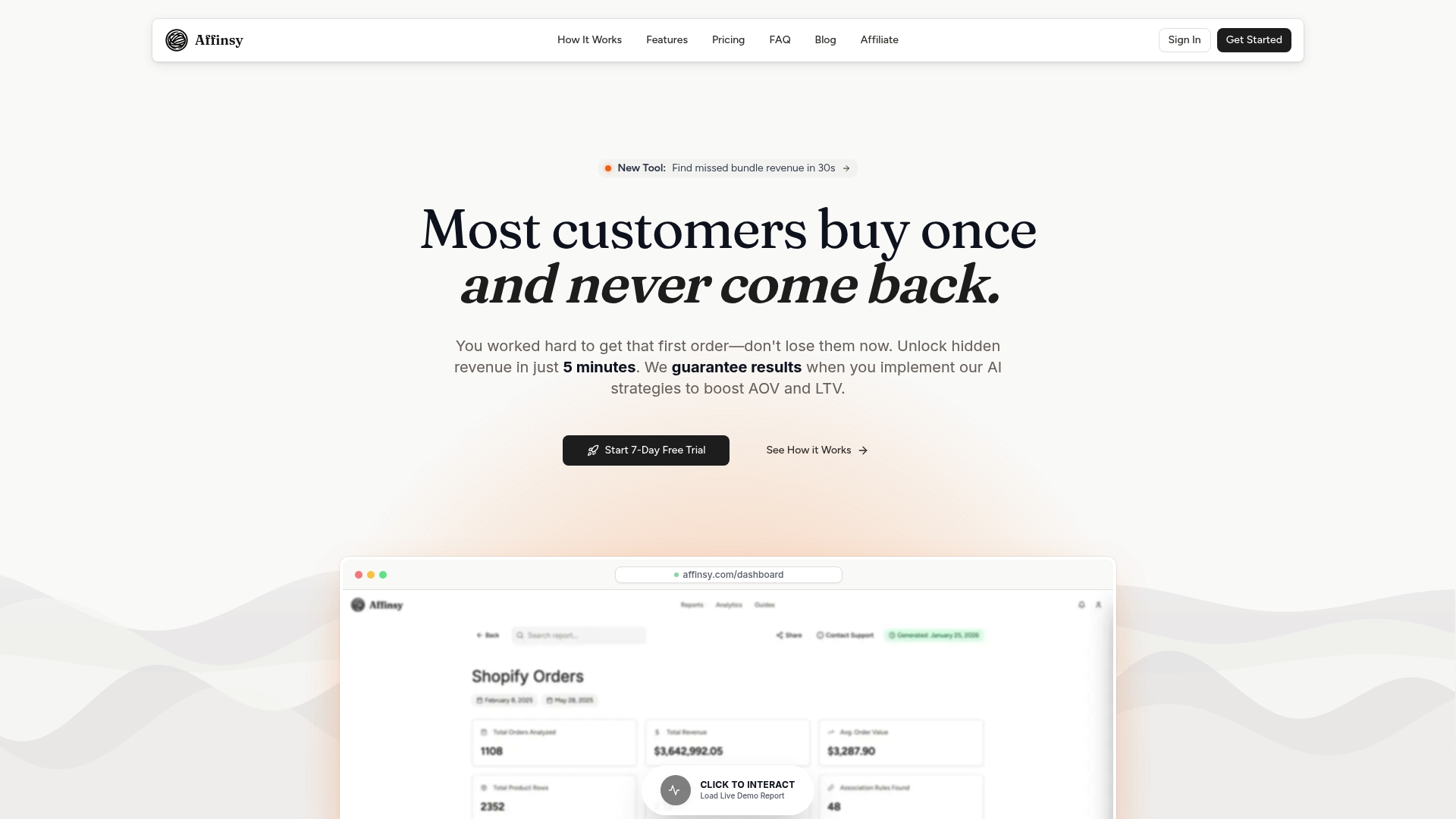
Experience a permanent free tier that accepts up to 20,000 line items and requires no credit card. Upload your CSV or connect via API from any platform like Shopify or WooCommerce. Get full access to reports that rank associations by revenue impact and confidence. Take control now by trying Affinsy’s platform and start exporting your smart segmentation to marketing or merchandising in minutes.
Frequently Asked Questions
What key feature does Affinsy offer for customer segmentation?
Affinsy provides market basket analysis, which ranks product associations by confidence, lift, and revenue impact. This feature enables users to prioritize which product bundles to promote based on statistical evidence. Consider using Affinsy if you need data-driven insights into product relationships to improve marketing strategies.
How does Affinsy compare to Orita in terms of setup time?
Orita allows for fast onboarding with one-click OAuth connections, making it easy for marketing teams to implement segmentation without relying on developers. In contrast, Affinsy requires importing sales data, which may introduce delays in analysis. If urgency and quick setup are your top priorities, Orita might be more suitable, while Affinsy excels in data analysis depth.
Which platform focuses on real-time audience sync for campaigns?
Tresl Segments automatically syncs audiences across multiple channels, including email and social media, ensuring lists are current without manual exports. Unlike Affinsy, which relies on periodic data uploads, Tresl enables ongoing, real-time updates. Consider Tresl if you prioritize immediate campaign activation based on the latest data.
Can I use Affinsy if my sales data requires frequent updates?
Affinsy analyzes historical sales data but does not provide real-time analysis as it requires importing or streaming data periodically. Users needing immediate insights might find this limiting and might consider platforms like Dema, which offers real-time sync features. Still, Affinsy provides valuable depth in its analysis when you can work with periodic data inputs.
What pricing tier does Affinsy offer, and how does it fit mid-market needs?
Affinsy has a permanent free tier that allows for up to 20K line items without requiring a credit card. This makes it an attractive option for mid-market brands that seek extensive data analytics without upfront costs. If you plan to analyze larger datasets frequently, looking into Affinsy’s paid plans starting at $49 per month may be beneficial.
Recommended
- Top 6 Magento Customer Segmentation Alternatives 2026 - Affinsy Blog | Affinsy
- 7 Effective Customer Segmentation Examples for E-commerce - Affinsy Blog | Affinsy
- 7 Customer Segmentation Ideas to Boost Your Sales - Affinsy Blog | Affinsy
- Customer Segmentation SaaS: Strategies That Drive Growth - Affinsy Blog | Affinsy