
TL;DR:
- Most SaaS and e-commerce teams rely on static customer segments, which quickly become outdated and ineffective. Dynamic segmentation using real-time behavioral, technographic, and financial data enables more relevant and timely retention efforts. Implementing scalable infrastructure, including cost attribution and targeted playbooks, is essential for sustainable growth and defensible customer relationships.
Most SaaS and e-commerce teams build their customer segments once, file them away, and then wonder why their retention campaigns stop working six months later. The problem is not the data. It is the assumption that customers stay in the same box you put them in. Customer segmentation SaaS has matured well beyond static lists and demographic buckets. Today, the platforms and frameworks that actually move the needle use real-time behavioral signals, RFM scoring, and per-customer cost data to keep segments alive and responsive. This article covers the models, frameworks, and data infrastructure decisions that separate teams winning on retention from those watching churn quietly compound.
Table of Contents
- Key takeaways
- Customer segmentation SaaS: core types and how they apply
- Advanced segmentation models: RFM and risk-based frameworks
- Layering real-time behavioral and technographic data
- Operationalizing segmentation: infrastructure and cost attribution
- My take on where SaaS segmentation actually breaks down
- Start applying these strategies with Affinsy
- FAQ
Key takeaways
| Point | Details |
|---|---|
| Static segments expire fast | Dynamic segmentation tied to behavioral signals keeps your outreach relevant and prevents stale targeting. |
| RFM works better with 11 segments | An 11-segment RFM model outperforms simpler 5-segment approaches by enabling specific, timely interventions per account. |
| Churn risk windows are narrow | Risk-based segmentation targets customers likely to churn within 7 to 30 days, when intervention still has impact. |
| Cost attribution changes pricing | Tracking per-customer infrastructure costs reveals that 10 to 15% of accounts may be unprofitable at current pricing. |
| Layering data creates live profiles | Combining firmographic, behavioral, and technographic data produces segments that update automatically on real intent signals. |
Customer segmentation SaaS: core types and how they apply
Before you can build a dynamic system, you need to understand the six foundational segmentation dimensions and what each one actually tells you in a SaaS or e-commerce context.
Demographic and firmographic segmentation covers the basics: company size, industry, revenue range, headcount, and geography. For B2B SaaS, firmographic data is usually the starting layer. A 10-person startup and a 500-person enterprise may use the same product, but they need completely different onboarding flows, support levels, and pricing conversations.
Technographic segmentation looks at the tools your customers already use. Knowing that a prospect runs Salesforce, Shopify, and Slack tells you what integrations matter, what vocabulary to use, and where your product fits in their existing stack.
Behavioral segmentation is where things get genuinely useful. It tracks what customers actually do inside your product: features activated, sessions per week, support tickets filed, and upgrade paths taken. For e-commerce brands, behavioral data maps to purchase frequency, product categories browsed, and cart patterns.
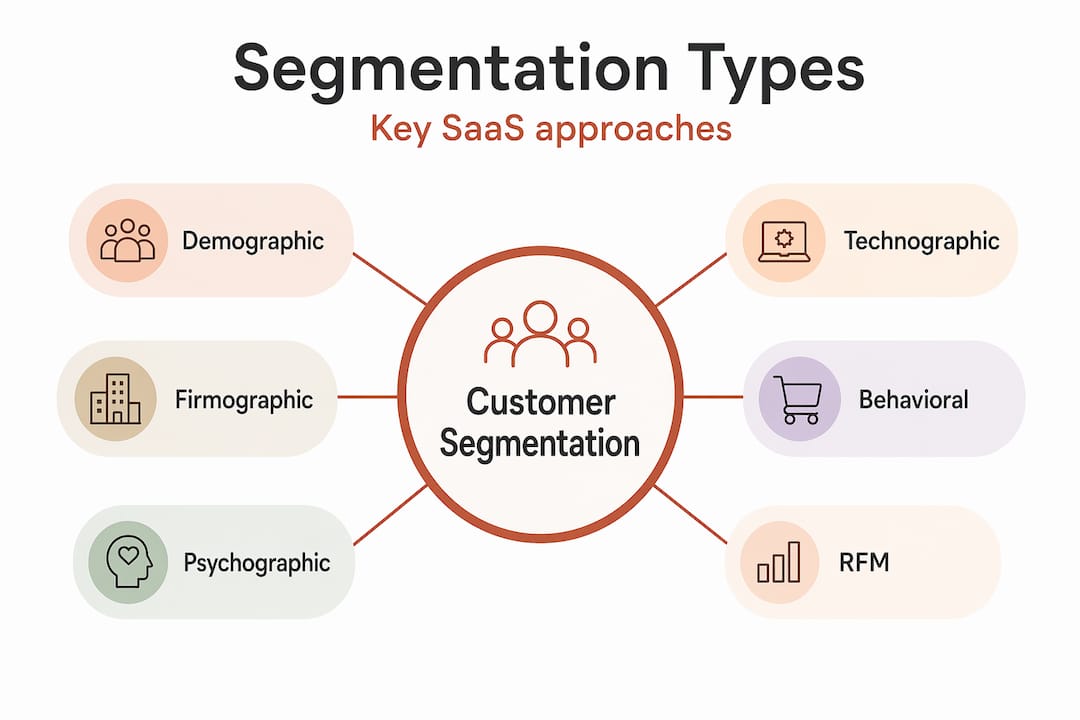
Psychographic segmentation focuses on motivations, values, and buying philosophy. It is harder to capture automatically but is worth layering in through survey data or NPS qualitative responses.
Here is how these dimensions compare in practice for SaaS teams:
| Segmentation type | Data source | Updates | Best use case |
|---|---|---|---|
| Firmographic | CRM, enrichment tools | Quarterly | ICP definition, sales routing |
| Technographic | Product telemetry, third-party data | Monthly | Integration marketing, competitive displacement |
| Behavioral | Product analytics, CRM events | Real-time | Lifecycle messaging, churn prediction |
| Psychographic | Surveys, NPS responses | Periodic | Messaging tone, content personalization |
| RFM (Recency, Frequency, Monetary) | Transaction and usage data | Continuous | Retention, upsell prioritization |
The core insight here is that most teams use one or two of these and call it done. The teams that consistently outperform on retention are layering three or more dimensions and letting the segments update themselves.
Advanced segmentation models: RFM and risk-based frameworks
Static segmentation is quickly becoming obsolete as real-time behavioral data becomes accessible to teams of every size. Two frameworks stand out as genuinely practical for SaaS professionals: RFM segmentation and risk-based churn segmentation.

RFM for B2B SaaS
RFM stands for Recency, Frequency, and Monetary value. In e-commerce, these metrics map directly to purchase data. In SaaS, the translation requires some adjustment. A standard RFM approach might count logins as Frequency, but effective B2B RFM scoring uses high-signal events instead: logged calls with your team, feature milestones reached, renewal completions, or integrations activated. Login counts are too easy to game and too noisy to be reliable.
The standard 5-segment RFM model (Champions, At Risk, Loyal, Dormant, Lost) is a starting point, not a destination. Research shows that an 11-segment model tailored for B2B SaaS outperforms simpler approaches by enabling distinct, targeted interventions for each group. The difference between “At Risk” and “Hibernating” is not just a label. It determines whether you send a reactivation campaign, schedule a success call, or begin the offboarding process to recover infrastructure costs.
To implement RFM for SaaS, follow these steps:
- Define your high-signal Recency metric (last logged call, last meaningful feature use, last renewal).
- Define Frequency as the number of those high-signal events in the past 90 days.
- Set Monetary value as MRR, contract value, or expansion revenue per account.
- Score each account 1 to 5 on each dimension and combine into segment labels.
- Build an intervention playbook for each of your 11 segments with specific messaging, owner, and timeline.
- Connect scoring to your CRM so segments update automatically when new signal events fire.
Pro Tip: Run your RFM model against live CRM data on a weekly cadence rather than monthly. Customer behavior in SaaS shifts faster than a monthly snapshot can capture, and the intervention window for at-risk accounts closes quickly.
Risk-based churn segmentation
This model takes a narrower view. Risk-based segmentation groups customers by their likelihood of churning within the next 7 to 30 days. That specific window matters because it is narrow enough to act on and broad enough to catch signals before the decision is final. If a customer has not logged in for 14 days, opened no emails, and has a renewal coming in 21 days, that is a risk signal that needs a human response now, not a drip campaign.
SaaS companies that maintain yearly churn rates at or below 5% are almost always running some form of proactive churn intervention. Risk-based segments are how you identify who gets that attention before it is too late. Learn more about how behavioral signals drive retention in both SaaS and retail contexts.
Layering real-time behavioral and technographic data
Once you have your foundational segments defined, the next step is making them smarter over time. Combining technographic, behavioral, and intent data on top of firmographics creates segments that update automatically based on what customers are actually doing right now, not what they looked like when they signed up.
Here is what this looks like in practice:
- A mid-market account that activated your Salesforce integration last week moves from “Potential Power User” to “Deeply Integrated” automatically. Your outreach shifts to expansion and case study requests.
- A previously engaged account that stopped using a core feature for 30 days triggers a move to “Declining Engagement.” Your CS team gets an alert. The drip sequence changes.
- A new customer who completes onboarding in under seven days and activates three features in week one gets flagged as “Fast Adopter.” They get a referral ask earlier than standard.
These transitions only happen when your data infrastructure is wired to push behavioral events into your segmentation system in real time. Static customer segments built from monthly CRM exports cannot do this. They reflect where customers were, not where they are.
Pro Tip: Do not try to track every possible signal. Start with three to five behavioral events that your best customers reliably perform in their first 60 days. Build your dynamic segments around those specific signals before expanding the model.
The same principle applies to e-commerce. Customers who browse a product category three times without purchasing are showing intent that static purchase history cannot capture. Real-time behavioral data surfaces that intent and lets you act on it while it is still warm. Clean, accurate e-commerce data is what makes this layer work in practice. Garbage input produces garbage segments.
You can see how data-driven customer segmentation translates to retention improvement when these layers are connected properly.
Operationalizing segmentation: infrastructure and cost attribution
Knowing your segments is not enough. You need the data infrastructure to keep them current, the cost data to prioritize them correctly, and the product decisions to make them defensible.
Per-customer cost attribution
This is the part most SaaS teams skip, and it is expensive. Research shows that 10 to 15% of customers may cost more to serve than they pay in MRR. High-usage customers who run intensive compute jobs, generate large volumes of support tickets, or require heavy onboarding support are often subsidized invisibly by your profitable mid-tier. Attaching cost metrics to each customer segment exposes this dynamic and forces better pricing decisions.
Implementing per-customer cost tracking typically requires 4 to 8 weeks of engineering work to propagate customer IDs through your data pipelines, but the margin recovery it enables is significant. Once you can see cost per account alongside MRR per account, you can segment by profitability, right-size your pricing tiers, and stop discounting accounts that are already unprofitable.
| Segment type | Margin signal | Recommended action |
|---|---|---|
| High MRR, low cost | Profitable, scalable | Prioritize for expansion and referral programs |
| High MRR, high cost | Margin squeeze | Renegotiate contract or optimize infrastructure usage |
| Low MRR, low cost | Acceptable risk | Automate support, focus on upgrade path |
| Low MRR, high cost | Actively losing money | Right-size pricing or begin offboarding |
Building structural retention moats
Here is something most retention playbooks miss: low churn alone is not a retention moat. A customer who stays because switching is painful is far more defensible than one who stays because they like you. Structural retention comes from integrations that embed your product into daily workflows, data that lives inside your platform, and switching costs that make leaving genuinely costly.
Segmentation plays a direct role here. Your most deeply integrated customers should be identified, measured, and treated as a distinct segment. They get different success plans, different feature roadmap input, and different renewal conversations than customers who use only your core features. Building these integration-driven moats requires knowing which customers are most embedded, and that requires segment-level data, not just account-level intuition.
My take on where SaaS segmentation actually breaks down
I have worked through enough SaaS and e-commerce data to know that the segmentation models themselves are rarely the problem. The problem is organizational. Teams build a beautiful RFM model, assign segments, and then do nothing differently for each group because the playbooks do not exist or nobody owns the intervention process.
The second failure mode is over-engineering. I have seen teams build 40-segment models that require three data engineers to maintain and produce zero incremental action. Dynamic segmentation needs to balance complexity with actability. If a segment does not trigger a distinct, repeatable response, it is not a segment. It is a label.
What actually works is starting with three to five segments that your team can act on immediately, each with a clear owner and a defined playbook. Then you expand the model as your data infrastructure matures and your team builds the muscle to respond. The Amazon Prime example is instructive here: Prime members churn at 6% compared to 34% for non-Prime customers. That is not a product miracle. That is the result of a deeply embedded behavioral segment tied to specific product and pricing decisions, executed consistently over years.
My advice: connect every segment you create to a specific business metric it is meant to move. If you cannot name the metric, you do not have a segment. You have a spreadsheet filter.
— Mateusz
Start applying these strategies with Affinsy
If you are ready to move from static lists to data-driven customer segmentation that actually updates with customer behavior, Affinsy is built for exactly that. The platform analyzes your historical transaction data to surface RFM segments, product associations, and customer patterns without requiring a data science team.
You can get started by uploading a CSV of your order data or connecting via API. No credit card is required on the free tier, which supports up to 20K line items with full access to all features. Explore what customer segmentation means in practice through Affinsy’s glossary, or see how predictive analytics extends your segmentation into forward-looking retention strategies. For teams running RFM analysis, the Affinsy blog covers how to master RFM frameworks for e-commerce in detail. Paid plans start at $49 per month, with enterprise pricing available on request.
FAQ
What is customer segmentation SaaS?
Customer segmentation SaaS refers to software platforms that help businesses group customers based on behavioral, demographic, firmographic, or transactional data to improve marketing precision and retention. These tools automate the process of identifying, updating, and acting on distinct customer groups in real time.
How does RFM segmentation work for SaaS companies?
RFM segmentation scores customers on Recency, Frequency, and Monetary value using high-signal engagement events rather than simple logins. An 11-segment B2B RFM model enables distinct retention and expansion actions for each group, outperforming simpler 5-segment approaches.
What is the ideal churn rate for SaaS businesses?
SaaS businesses should target a yearly churn rate at or below 5% to maintain healthy growth. Risk-based segmentation that identifies at-risk customers within a 7 to 30 day window helps teams intervene before churn decisions are finalized.
How is dynamic segmentation different from static segmentation?
Static segmentation groups customers based on fixed attributes and does not change until someone manually updates it. Dynamic segmentation automatically reassigns customers to new segments as their behavior, usage patterns, or engagement signals change in real time.
Why does per-customer cost attribution matter for segmentation?
Per-customer cost attribution reveals that a portion of your customer base may cost more to serve than they pay, which changes how you prioritize segments for marketing, support, and pricing decisions. Without this data, you risk investing retention resources in accounts that are actively reducing your margins.
Recommended
- Customer segmentation workflows that drive e-commerce growth - Affinsy Blog | Affinsy
- Drive profitable growth with AI customer segmentation - Affinsy Blog | Affinsy
- 7 Customer Segmentation Ideas to Boost Your Sales - Affinsy Blog | Affinsy
- Customer Segmentation — E-Commerce Glossary | Affinsy | Affinsy