
TL;DR:
- Demographic data alone often misrepresents actual customer behavior crucial for targeted marketing.
- Behavioral segmentation groups customers by actions like purchase frequency and engagement for better retention.
- Ongoing, dynamic updates of segments are essential to anticipate disengagement and reduce churn effectively.
Most e-commerce leaders assume they already know their customers because they have age brackets, ZIP codes, and gender splits on a dashboard. That assumption is expensive. Demographics describe who someone is, not what they actually do. Behavioral customer segmentation shifts the lens entirely, grouping customers by their real actions: what they buy, when they disengage, how often they return. The difference between these two approaches is the difference between sending the same discount email to everyone and sending a win-back offer only to customers who went quiet after their third order. This article breaks down what behavioral segmentation is, why it works, where it fails, and how to put it to work starting today.
Table of Contents
- What is behavioral customer segmentation?
- Why segmenting by behavior drives retention and sales
- Common pitfalls: Why RFM-only approaches can fail
- How to put behavioral segmentation into action
- What most businesses miss about behavioral segmentation
- Take your segmentation strategy further with Affinsy
- Frequently asked questions
Key Takeaways
| Point | Details |
|---|---|
| Behavioral segmentation drives growth | Segmenting customers by behavior enables targeted strategies that boost retention and sales. |
| Avoid RFM-only pitfalls | Relying solely on RFM overlooks changing engagement trends, so use dynamic and multi-source data. |
| Regular segment refreshes matter | Regularly updating segments ensures your campaigns stay relevant and effective. |
| Practical tools support segmentation | CDPs, analytics plugins, and CRM integrations make behavioral segmentation easy to implement. |
What is behavioral customer segmentation?
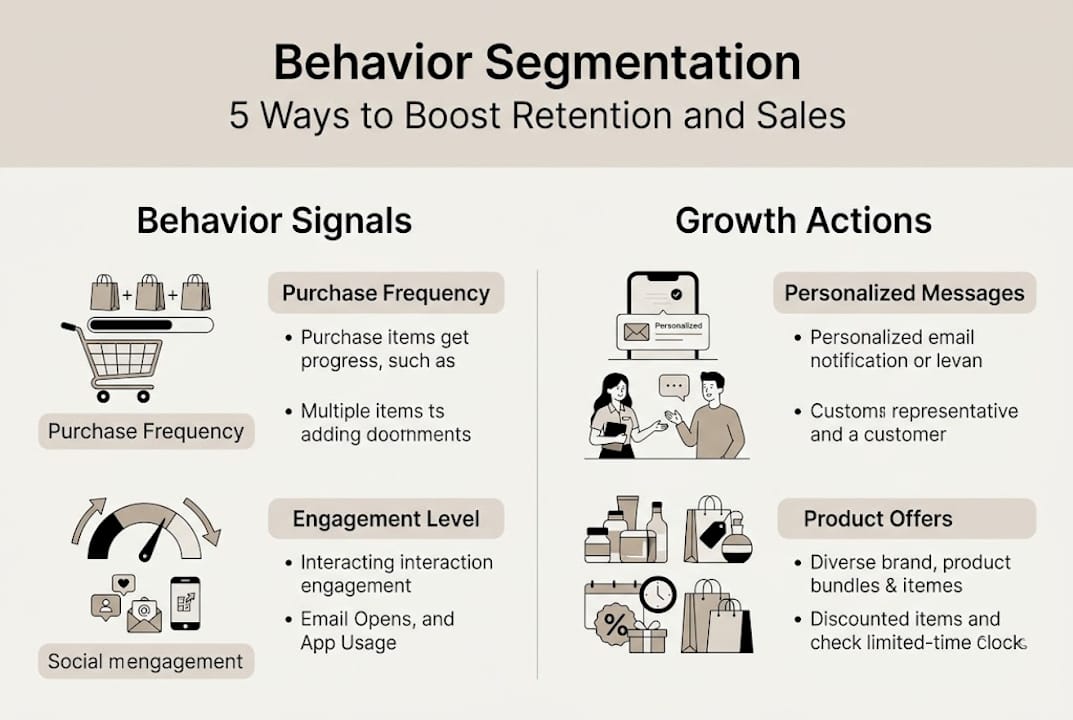
Behavioral customer segmentation is the practice of grouping customers based on what they actually do, rather than who they appear to be on paper. Where demographic segmentation sorts people by age or income, and geographic segmentation sorts by location, behavioral segmentation uses signals like purchase frequency, product browsing patterns, cart abandonment, coupon usage, and email click rates to build groups with shared habits.
Think of it this way: two customers can both be 34-year-old women living in Chicago with similar incomes. One buys every six weeks, never skips a loyalty reward, and always upgrades to premium SKUs. The other placed one order 11 months ago and never came back. Demographically identical. Behaviorally, they are completely different customers who need completely different messages.
Here is a quick comparison to make the distinction concrete:
| Segmentation type | Data used | Example segment | Best for |
|---|---|---|---|
| Demographic | Age, gender, income | Women 25-34 | Broad brand awareness |
| Geographic | Location, region | Northeast US shoppers | Local promotions |
| Behavioral | Purchase history, engagement | Lapsed high-spenders | Retention campaigns |
| Psychographic | Values, lifestyle | Eco-conscious buyers | Brand positioning |
Behavioral segments are the most actionable because the data is directly tied to revenue-generating events. You are not guessing at motivation; you are reading what customers already voted for with their wallets and their clicks.
Common behavioral data points that power strong segments include:
- Purchase history: total orders, average order value, product categories bought
- Browsing patterns: pages visited, time on site, search queries used
- Engagement metrics: email open rates, click-through rates, session frequency
- Loyalty behavior: reward redemption, referral activity, repeat purchase intervals
- Churn signals: days since last visit, cart abandonment streaks, declining open rates
As customer segmentation research confirms, segmentation enables targeted messaging and avoids wasted marketing effort. That is the core promise: stop broadcasting and start speaking directly to what each group actually needs. For a deeper grounding in segment types and strategy, the customer segmentation explained guide is worth reading before you build your first segments.
“The goal of segmentation is not to find groups that look alike. It is to find groups that act alike and respond alike to a given message.”
Why segmenting by behavior drives retention and sales
Understanding what behavioral segmentation is matters less than understanding what it does for your bottom line. The business case is direct: when you stop treating all customers as one audience, your messages get more relevant, your offers land better, and fewer customers quietly disappear.

The evidence is hard to ignore. Personalized, segment-specific campaigns consistently outperform generic blasts on every key metric. More critically, segmentation reduces churn by targeting relevant customer segments, and it lifts revenue by surfacing the right offer at the right moment in each customer’s lifecycle.
Here is how the impact typically breaks down across common behavioral segments:
| Segment | Behavior signal | Campaign action | Expected outcome |
|---|---|---|---|
| High-value loyalists | 5+ orders, high AOV | VIP early access | Increased LTV |
| At-risk customers | No purchase in 60 days | Win-back offer | Reduced churn |
| New buyers | First order only | Onboarding sequence | Second purchase |
| Discount-dependent buyers | Only buys on sale | Value-focused content | Margin protection |
The path to higher lifetime value (LTV) runs through relevance. When customers feel a brand understands them, they spend more and stay longer. Businesses that invest in retention strategies built around behavioral signals see compounding returns because loyal customers also refer others and cost less to serve over time.
Four concrete actions that behavioral segmentation makes possible:
- Intervene before churn happens: Flag customers whose purchase interval is stretching beyond their personal baseline and trigger a targeted re-engagement before they disappear.
- Reward the right people: Identify genuinely loyal customers by behavior, not just spend, and give them exclusive access that deepens the relationship.
- Protect margins on sale-seekers: Recognize customers who only convert on discounts and route them to value messaging instead of burning margin unnecessarily.
- Accelerate second purchases: Catch new buyers in the first 30 days with category-relevant follow-ups that match what they already bought.
Pro Tip: Track retention rate by segment separately, not just overall. A healthy aggregate number can hide a collapsing retention rate inside your most valuable cohort. Segment-level visibility is where the real signal lives. Pair this with customer loyalty insights to build a clearer picture of where loyalty is actually being built.
Common pitfalls: Why RFM-only approaches can fail
RFM segmentation, which stands for Recency, Frequency, and Monetary value, is one of the most widely used frameworks in e-commerce marketing. It is simple, intuitive, and gives you a fast read on who your best customers are. The problem is that many teams treat it as the whole answer when it is really just the starting point.
RFM scores a customer on three axes: how recently they purchased, how often they buy, and how much they spend. A customer who scores high on all three looks like a star. But here is what a snapshot score misses: the direction of travel. A customer with a strong RFM score six months ago who has gone completely quiet is not a star anymore. They are a churn risk dressed up in good historical data.
As academic research on segmentation has shown, RFM-only segmentation is often temporally myopic and misses at-risk customers with declining engagement. The framework looks backward, not forward, and engagement decline often predicts churn weeks before it shows up in purchase data.
Imagine a customer who bought eight times last year, always spent above your average order value, and was among your top 5% by revenue. Their RFM score still looks strong. But their last purchase was four months ago, they stopped opening emails three months ago, and their last site visit was two months back. An RFM-only view flags them as a VIP. A behavioral view flags them as a flight risk.
Pitfalls to avoid when building behavioral segments:
- Freezing segments: Building them once and never refreshing means you are always reacting to old behavior, not current reality.
- Ignoring engagement decay: A drop in email opens or site visits often precedes a purchase gap by weeks. Track it.
- Over-relying on spend: High monetary value can mask low engagement. Weight recency and engagement signals heavily.
- Skipping micro-segments: Treating all “at-risk” customers as one group ignores the difference between someone who lapsed after one purchase and someone who lapsed after 20.
- Not testing segment criteria: The thresholds you pick for recency (30 days? 60 days?) should be validated against actual churn data, not guessed.
Pro Tip: Set a calendar reminder to refresh your segments at least once a month. After major sales events like Black Friday or end-of-season clearances, refresh immediately. Behavior shifts fast around promotions, and stale segments will send the wrong message to customers who just changed their pattern. The RFM analysis guide and behavior analysis resources can help you build a more dynamic approach.
“RFM is a rearview mirror. You need a windshield to see where your customers are actually going.”
How to put behavioral segmentation into action
Knowing the theory is useful. Having a concrete workflow is what actually moves the needle. Here is a practical sequence for getting behavioral segmentation running in your business, even if you are starting from scratch.
Step-by-step implementation plan:
- Audit your data sources: Before you can segment, you need to know what behavioral data you actually have. Pull from your e-commerce platform order history, your email platform engagement data, your web analytics tool (session data, page views, conversions), and your CRM if you have one.
- Define your segment criteria: Based on your business goals, pick 3 to 5 behavioral segments to start. Common starter segments: new buyers, repeat buyers, lapsed customers, high-value loyalists, and discount-dependent shoppers. Set specific thresholds (for example, “lapsed” means no purchase in 75 days).
- Build and label your segments: Use your data to assign each customer to a segment. This can be done manually in a spreadsheet for smaller stores, or automatically via a CDP or analytics platform for larger operations.
- Design targeted campaigns per segment: Each segment needs its own message, offer, and timing. New buyers need onboarding. Lapsed customers need win-back. Loyalists need exclusivity. One-size messaging destroys the value of segmentation.
- Measure, adjust, and iterate: Track conversion rate, retention rate, and churn rate by segment, not just overall. Compare segment performance month over month and adjust thresholds or messages accordingly.
As e-commerce segmentation research shows, segmentation helps businesses acquire, retain, and reduce churn simultaneously when applied with consistency.
Tools that support behavioral segmentation well:
- Customer Data Platforms (CDPs): Centralize behavioral data across touchpoints and automate segment building
- E-commerce analytics plugins: Shopify, WooCommerce, and BigCommerce all offer native or third-party analytics with segment capabilities
- Email marketing platforms: Klaviyo, Mailchimp, and ActiveCampaign allow dynamic segments based on behavioral triggers
- Dedicated analytics platforms: Tools like Affinsy process transaction data to surface RFM-based and behavioral segment patterns without requiring a data science team
For a broader view of why segment customers at all, or how churn prediction analytics can sharpen your at-risk identification, both resources offer practical depth. Once your segments are live, retention optimization strategies will help you turn behavioral insight into measurable loyalty.
What most businesses miss about behavioral segmentation
Here is the uncomfortable truth most e-commerce teams do not want to hear: they built segments once, felt good about it, and moved on. Behavioral segmentation is not a setup task. It is an ongoing operating process.
The brands winning at retention are not just running better campaigns. They are treating segment membership as a live signal. A customer is not permanently a “loyal buyer” or a “lapsed user.” They move between states constantly based on life events, product fit, competitive offers, and seasonal patterns. Teams that refresh segments weekly or bi-weekly and act on those transitions in near-real time are the ones catching disengagement before it becomes permanent loss.
The other thing most teams miss is the power of combining behavioral signals. A drop in purchase frequency alone is a weak signal. Pair it with a decline in email opens and a reduction in site visits, and you have a strong early warning. Loyalty is won not by reacting to churn but by unlocking customer loyalty through anticipating disengagement before it ever shows up in your revenue numbers.
Take your segmentation strategy further with Affinsy
Behavioral segmentation delivers real results when it is powered by clean, current transaction data and the right analytical framework. Affinsy is built exactly for this: upload your order data via CSV or connect via API, and the platform surfaces RFM-based customer segments, purchase patterns, and product associations without requiring a data science background.
Whether you are just getting started or looking to sharpen an existing segmentation strategy, Affinsy’s free tier gives you full access with up to 20K line items and no credit card required. Explore the customer segmentation glossary to ground your strategy in the right terminology, learn how market basket analysis can complement your segments, or browse the full analytics glossary for deeper context. Your transaction data already holds the answers. Affinsy helps you read them.
Frequently asked questions
What behavioral data is most valuable for customer segmentation in e-commerce?
Purchase history, browsing behavior, and engagement metrics are the most valuable inputs for building actionable behavioral segments. These signals directly reflect buying intent and disengagement patterns.
How often should segments based on customer behavior be refreshed?
Refresh segments at least monthly, and immediately after major sales events. RFM-only segmentation becomes temporally myopic without regular updates, so dynamic refreshes keep your targeting accurate.
Can behavioral segmentation help reduce churn?
Yes. Segmentation reduces churn by aligning messaging to where each customer actually is in their lifecycle, making it possible to intervene before disengagement becomes a lost customer.
What tools can assist with behavioral customer segmentation?
Customer Data Platforms, e-commerce analytics plugins, and CRM systems are the most common tools. Platforms like Affinsy are specifically designed to process transactional data for RFM and behavioral segmentation without requiring technical expertise.
Recommended
- 5 customer segmentation types for e-commerce success - Affinsy Blog | Affinsy
- Customer segmentation explained: boost retention 2026 - Affinsy Blog | Affinsy
- Behavioral Analytics: 95% Churn Prediction Boosts Sales - Affinsy Blog | Affinsy
- Customer behavior analysis: boost e-commerce results - Affinsy Blog | Affinsy