
Every e-commerce store owner knows the struggle: pouring budget into ads, campaigns, and promotions to attract new customers, only to watch them disappear after a single purchase. Acquiring a new customer is 5 to 7 times more expensive than retaining an existing one, yet many stores still prioritize acquisition over retention. This guide will show you how to leverage data analytics and proven strategies to keep your customers coming back, reduce churn, and build sustainable growth through retention optimization.
Table of Contents
- Understanding The Cost And Benefits Of Customer Retention
- Preparing Your Data: Essential Analytics And Segmentation For Retention
- Executing Retention Tactics: Personalization, Predictive Analytics, And Engagement
- Measuring Success And Optimizing Retention Strategies Over Time
- Boost Your Retention With Affinsy’s Analytics Solutions
Key takeaways
| Point | Details |
|---|---|
| Retention saves money | Keeping existing customers costs 5 to 7 times less than acquiring new ones. |
| Data drives decisions | Customer segmentation and behavioral analytics reveal who to target and when. |
| Personalization builds loyalty | Tailored experiences and predictive insights reduce churn and increase repeat purchases. |
| Track and iterate | Regular KPI monitoring ensures your retention strategies deliver measurable results. |
Understanding the cost and benefits of customer retention
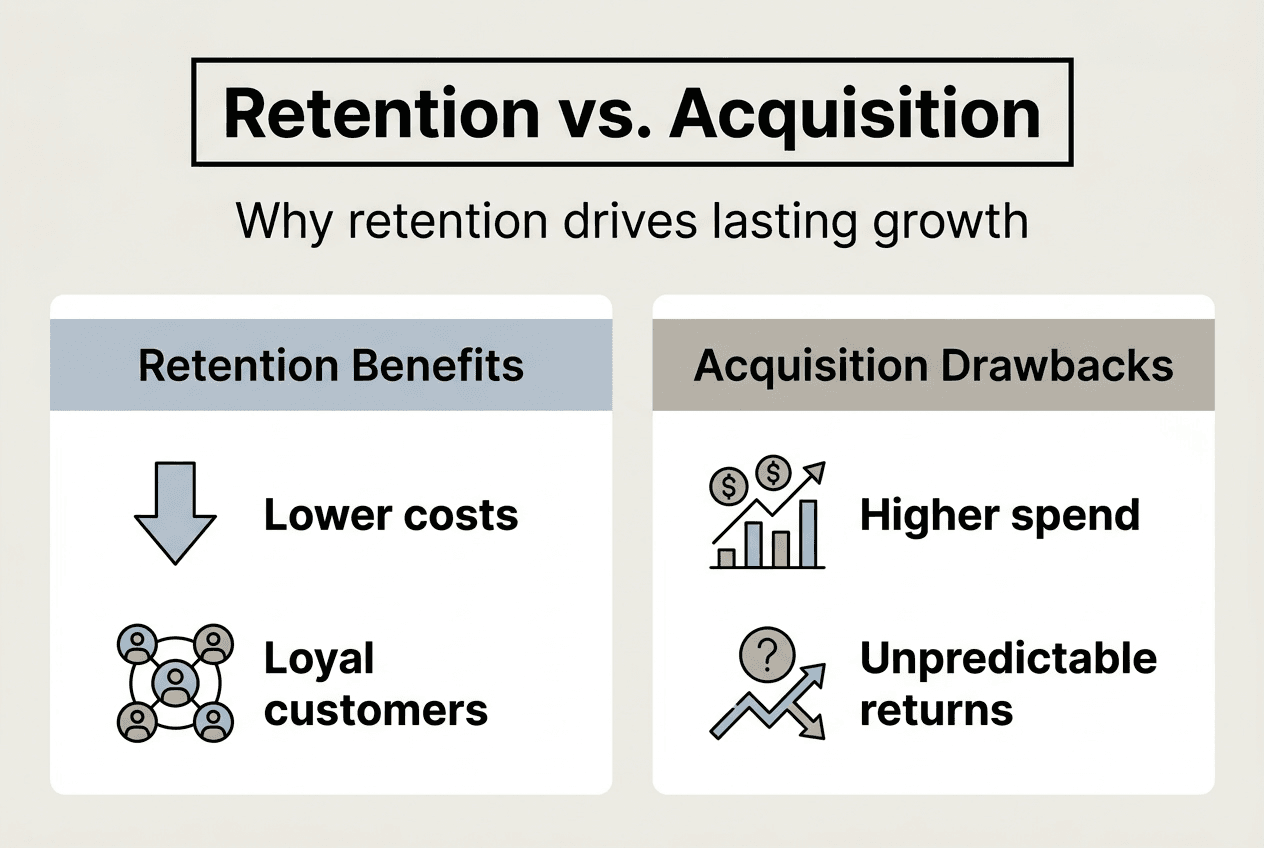
The math behind customer retention is compelling. While acquisition demands continuous investment in advertising, creative development, and conversion optimization, retention leverages relationships you’ve already built. Acquiring a new customer is 5 to 7 times more expensive than keeping an existing one, making retention the smarter financial play for sustainable growth.
Retention directly impacts customer lifetime value, the total revenue a customer generates throughout their relationship with your store. When customers return for second, third, and fourth purchases, their cumulative value compounds far beyond that initial transaction. Repeat customers also tend to spend more per order as trust deepens and they become familiar with your product range.
Focusing on retention transforms your business model from a leaky bucket requiring constant refills to a compounding asset that grows stronger over time.
Beyond the direct financial benefits, retention creates powerful secondary advantages. Loyal customers provide valuable feedback, refer friends and family, and act as brand ambassadors in their communities. They’re more forgiving when issues arise and more receptive to new product launches. The cumulative effect creates a stable revenue foundation that buffers your business against market fluctuations and competitive pressures.
The strategic shift from acquisition to retention requires a mindset change. Instead of viewing each sale as a transaction, you begin seeing it as the start of an ongoing relationship. This perspective influences everything from product development to customer service, creating a customer-centric culture that naturally improves retention rates and builds lasting competitive advantages in crowded e-commerce markets.
Preparing your data: essential analytics and segmentation for retention
Effective retention starts with understanding who your customers are and how they behave. You need clean, organized data that reveals patterns, preferences, and purchase cycles. Start by consolidating customer information from all touchpoints: transaction history, browsing behavior, email engagement, customer service interactions, and social media activity. This comprehensive view forms the foundation for targeted retention strategies.
Customer segmentation transforms raw data into actionable groups. Rather than treating all customers the same, segmentation identifies distinct groups based on shared characteristics and behaviors. The most powerful segmentation approaches for retention include:
- RFM analysis divides customers by recency, frequency, and monetary value to identify your most valuable segments and those at risk of churning.
- Behavioral segmentation groups customers by purchase patterns, product preferences, and engagement levels to enable targeted messaging.
- Lifecycle stage segmentation categorizes customers as new, active, at-risk, or dormant to deliver stage-appropriate retention tactics.
- Demographic and psychographic segmentation uses age, location, interests, and values to personalize experiences beyond purchase history.
Once you’ve segmented your customer base, create detailed profiles for each group. What products do they buy? How often do they purchase? What channels do they prefer? What motivates their buying decisions? These insights enable you to craft retention strategies that resonate with each segment’s unique needs and preferences.

Pro Tip: Start with simple segmentation using recency and frequency data, then layer in additional dimensions as you refine your approach. Overly complex segments early on can paralyze decision making rather than enable action.
Data quality matters as much as quantity. Regular audits ensure accuracy, completeness, and consistency across your systems. Remove duplicates, standardize formats, and fill gaps through progressive profiling. Clean data leads to reliable insights, while messy data produces flawed strategies that waste resources and frustrate customers with irrelevant communications.
Executing retention tactics: personalization, predictive analytics, and engagement
With segmented data in hand, you can deploy retention tactics that speak directly to customer needs and preferences. Personalization sits at the heart of modern retention strategies. Generic mass communications no longer cut through the noise. Customers expect experiences tailored to their interests, purchase history, and browsing behavior.
Effective personalization tactics include:
- Product recommendations based on past purchases and browsing patterns that surface relevant items customers actually want
- Dynamic email content that adapts messaging, offers, and imagery to match individual customer segments and preferences
- Customized landing pages that greet returning customers with personalized product collections and exclusive offers
- Behavioral triggers that send timely messages based on specific actions like cart abandonment or product views
Predictive analytics takes personalization further by anticipating customer needs before they arise. By analyzing historical patterns, predictive models identify customers likely to churn, predict optimal timing for re-engagement, and forecast which products individual customers will want next. This proactive approach allows you to intervene before customers drift away rather than reacting after they’ve already left.
Pro Tip: Focus predictive efforts on your most valuable customer segments first. The ROI of preventing churn among high-value customers far exceeds the cost of losing occasional buyers.
Engagement strategies keep your brand top of mind between purchases. Acquiring a new customer is 5 to 7 times more expensive than retention, so consistent touchpoints that add value without being pushy maintain relationships cost effectively. Email remains the workhorse of retention marketing, but diversify across SMS, push notifications, and social media to meet customers where they prefer to engage.
Loyalty programs formalize the retention relationship by rewarding repeat purchases with points, discounts, or exclusive perks. Structure programs to encourage incremental purchases while making redemption easy and valuable. Tiered systems that unlock additional benefits as customers spend more create aspirational goals that drive engagement.
| Tactic | Best For | Key Benefit |
|---|---|---|
| Email campaigns | All segments | Cost effective, measurable, scalable |
| Loyalty programs | Frequent buyers | Incentivizes repeat purchases |
| Product bundling | Cross-sell opportunities | Increases average order value |
| Win-back campaigns | Dormant customers | Reactivates lapsed relationships |
| Exclusive previews | VIP segments | Strengthens emotional connection |
Product bundling and cross-selling leverage purchase data to suggest complementary items that enhance customer satisfaction while boosting order values. When done well, these tactics feel helpful rather than pushy because recommendations align with genuine customer needs and preferences identified through behavioral analysis.
Measuring success and optimizing retention strategies over time
Retention strategies only deliver results when you measure performance and continuously refine your approach. Start by establishing baseline metrics before implementing new tactics, then track changes over time to validate what works and identify what needs adjustment.
Essential retention KPIs to monitor include:
- Repeat purchase rate measures the percentage of customers who return for additional purchases within a defined timeframe.
- Customer churn rate tracks how many customers stop buying from your store over a given period.
- Customer lifetime value calculates total revenue generated per customer across their entire relationship with your brand.
- Purchase frequency shows how often customers buy and helps identify optimal re-engagement timing.
- Retention rate by cohort reveals how well you retain customers acquired during specific periods or campaigns.
- Net promoter score gauges customer satisfaction and likelihood to recommend your store to others.
| Metric | Calculation | Target Benchmark |
|---|---|---|
| Repeat purchase rate | Customers with 2+ orders / Total customers | 25 to 30% |
| Churn rate | Lost customers / Total customers | Below 5% monthly |
| Purchase frequency | Total orders / Total customers | 2+ per year |
| Customer lifetime value | Average order value x Purchase frequency x Lifespan | 3x acquisition cost |
Analyze these metrics across customer segments to identify patterns and opportunities. Perhaps your VIP segment shows strong retention but low purchase frequency, suggesting opportunities to increase order cadence through targeted promotions. Or maybe your at-risk segment responds well to discount offers but ignores content-focused emails, indicating where to focus re-engagement efforts.
Pro Tip: Create a retention dashboard that displays key metrics in real time so you can spot trends and react quickly to changes in customer behavior.
A/B testing accelerates optimization by comparing different approaches systematically. Test email subject lines, offer structures, messaging angles, and send timing to identify what resonates most with each segment. Small improvements compound over time, turning marginal gains into significant revenue increases as you refine tactics based on data rather than assumptions.
Regular strategy reviews ensure your retention program evolves with your business and customer base. Schedule quarterly assessments to evaluate performance against goals, analyze competitive moves, incorporate new data sources, and adjust tactics based on seasonal patterns or market shifts. Retention isn’t a set-it-and-forget-it initiative but an ongoing optimization process that requires attention and adaptation.
Track key e-commerce metrics beyond retention to understand how customer loyalty impacts overall business performance. Connect retention rates to revenue growth, profit margins, and marketing efficiency to demonstrate the full value of your retention investments and secure ongoing resources for optimization efforts.
Boost your retention with Affinsy’s analytics solutions
Implementing the retention strategies outlined above requires robust analytics capabilities and data integration across your e-commerce ecosystem. Affinsy simplifies this process by automatically analyzing your transaction history to uncover hidden patterns in customer behavior and product relationships.
Our platform combines predictive analytics, market basket analysis, and customer segmentation to identify which customers are most likely to churn, which products to bundle for maximum appeal, and how to segment your audience for targeted retention campaigns. Affinsy integrates seamlessly with Shopify, WooCommerce, and Google Analytics, delivering actionable insights without requiring data science expertise. Explore how our AI-powered analytics can transform your retention strategy and drive sustainable growth for your online store.
FAQ
How can I measure the effectiveness of my retention strategies?
Track metrics like repeat purchase rate, churn rate, and customer lifetime value to gauge retention performance. Compare these KPIs before and after implementing new tactics to measure impact. Segment analysis reveals which customer groups respond best to specific strategies, allowing you to optimize resource allocation. Monitor key e-commerce metrics regularly and establish dashboards that surface trends in real time so you can react quickly to changes in customer behavior.
What role does personalization play in improving e-commerce retention?
Personalization creates relevant experiences that increase engagement and encourage repeat purchases. When customers receive product recommendations, offers, and content aligned with their interests and purchase history, they feel understood and valued. This emotional connection strengthens loyalty and reduces the appeal of competitor offerings. Effective personalization tactics range from simple email customization to sophisticated predictive models that anticipate customer needs before they arise.
How often should I update my retention strategies?
Review strategies quarterly or after major campaigns to ensure they remain effective as your business and customer base evolve. Use data analytics to continuously identify improvement areas between formal reviews. Seasonal patterns, competitive moves, and product launches may require tactical adjustments outside your regular review cycle. The key is balancing consistency with flexibility, maintaining core retention programs while adapting specific tactics based on performance data and market conditions.
Can small e-commerce stores benefit from advanced retention analytics?
Absolutely. Retention matters even more for smaller stores with limited acquisition budgets. Basic segmentation using recency and frequency data requires minimal technical skills but delivers significant impact. As your store grows, layer in additional analytics capabilities to refine targeting and personalization. Many modern analytics platforms offer affordable entry points that scale with your business, making sophisticated retention strategies accessible regardless of store size.
What’s the biggest mistake e-commerce stores make with retention?
Treating all customers the same represents the most common and costly retention mistake. A one-size-fits-all approach wastes resources on customers who need different messages, offers, and engagement frequencies. Segmentation allows you to prioritize high-value customers, re-engage at-risk buyers, and nurture new customers appropriately. Start with simple segments and refine over time rather than attempting complex personalization before you have the data and systems to support it effectively.
Recommended
- 7 Key E-Commerce Metrics to Track for Store Growth - Affinsy Blog | Affinsy
- Customer segmentation explained: boost retention 2026 - Affinsy Blog | Affinsy
- 7 Effective Ways to Maximize Revenue in E-commerce - Affinsy Blog | Affinsy
- Ecommerce Reporting Guide: Optimize Store Growth Easily - Affinsy Blog | Affinsy