
TL;DR:
- Improving customer retention can significantly increase profits, often more cost-effectively than acquiring new customers.
- Data-driven segmentation and personalization are crucial for creating relevant, high-impact retention strategies.
- A successful long-term approach requires continuous testing, measurement, and adaptation of retention tactics.
Acquiring a new customer costs five to seven times more than keeping an existing one, yet most online retailers still pour the majority of their budgets into acquisition. The math is clear: improving retention by even 5% can lift profits by 25% to 95%. But knowing retention matters is not the same as knowing which tactics to use. With loyalty programs, personalization engines, CX investments, and analytics platforms all competing for your attention and budget, the decision gets complicated fast. This article cuts through the noise, laying out evidence-based strategies, honest trade-offs, and a practical framework to help you build a retention mix that actually works for your business.
Table of Contents
- Establishing the criteria: What matters most in retention?
- Loyalty programs: Powerful but not always optimal
- Segmentation and personalization: The unlock for sustainable retention
- Customer experience and technology: The foundation for long-term loyalty
- Comparing strategies: Which retention approach wins?
- Why flexible retention strategies outperform one-size-fits-all approaches
- How Affinsy can help refine your retention strategy
- Frequently asked questions
Key Takeaways
| Point | Details |
|---|---|
| Focus on high-value segments | Retention strategies targeted at your best customers deliver stronger returns than blanket approaches. |
| Balance loyalty and experience | Loyalty programs can increase orders, but emotional customer experience and frictionless journeys ultimately build lasting loyalty. |
| Leverage data and technology | Real-time analytics, segmentation, and automated personalization are crucial to optimizing retention at scale. |
| No one-size-fits-all formula | Mix and adapt strategies based on segment needs, not just industry best practices. |
Establishing the criteria: What matters most in retention?
With the stakes set, the next step is to define clear criteria for evaluating any retention strategy. Not every tactic fits every business, and choosing the wrong one wastes budget and erodes customer trust. Before you invest, run each option through these five filters:
- Cost vs. ROI: Retention should be cheaper than acquisition, but some programs carry hidden costs. Calculate the full cost including technology, incentives, and staff time before committing.
- Customer lifetime value (CLV): The best retention strategies do not just bring customers back once. They increase how much each customer spends over their entire relationship with your brand. Prioritize tactics that measurably lift CLV.
- Experience and emotional loyalty: Transactional programs create transactional relationships. Customers who feel genuinely understood and valued are harder to poach than those who stay only for points.
- Technology and measurement: You cannot improve what you cannot measure. Any strategy you adopt needs clear KPIs and the analytics infrastructure to track them. Platforms that help you optimize ecommerce retention give you the feedback loops needed to keep improving.
- Segment-focused efforts: Blanket retention wastes money on customers who were never going to churn anyway. Concentrate resources on your highest-value segments.
Loyalty programs can increase repeat purchase frequency by 20 to 30% and average order value by 12 to 18%, making them attractive on paper. But those numbers only hold when the program is well-targeted. Data-driven strategies ensure you are measuring the right outcomes and adjusting in real time rather than hoping the program works.
Pro Tip: Before launching any retention initiative, audit your current customer data. Knowing your top 20% of customers by CLV gives you a benchmark to measure every tactic against.
Loyalty programs: Powerful but not always optimal
Now that you have the right evaluation lens, let’s look at one of the most recognized tactics: loyalty programs. They are everywhere in e-commerce, and for good reason. A well-designed program creates a reason to return, rewards high-value behavior, and builds habitual purchasing.
The most effective loyalty structures include:
- Points systems that reward every purchase and create a sense of accumulation
- Tiered memberships that unlock better benefits as customers spend more
- Exclusive offers and early access that make members feel genuinely special
- Experiential rewards that go beyond discounts and create memorable moments
| Loyalty feature | Primary benefit | Common pitfall |
|---|---|---|
| Points system | Drives repeat visits | Can feel transactional |
| Tiered tiers | Rewards high-value customers | Complex to manage |
| Exclusive offers | Builds perceived value | Margin erosion if overused |
| Early access | Creates emotional connection | Hard to scale |
Here is the uncomfortable truth, though. Brands without loyalty programs grew revenue 48% versus 14% for those with them. That is not an argument against loyalty programs. It is an argument against treating them as a shortcut.
“A loyalty program is only as strong as the experience surrounding it. Points without purpose just become noise.”
The brands winning without formal programs are investing heavily in CX and segmentation instead. Your RFM segmentation retention playbook should inform which customers get loyalty program invitations in the first place, so you are not rewarding low-value shoppers with the same benefits as your best ones.
Pro Tip: Run an RFM analysis before designing your loyalty tiers. Customers who already buy frequently and spend more need different incentives than occasional shoppers. Mixing them into one program dilutes the value for both groups.
Segmentation and personalization: The unlock for sustainable retention
Beyond loyalty programs, successful online retailers increasingly rely on segmentation and personalization. The logic is straightforward: a customer who receives an offer tailored to their actual purchase history is far more likely to respond than one who gets a generic email blast.

Focusing on high-value segments and creating personalized experiences are more effective than blanket retention initiatives. Here is how the two approaches stack up:
| Approach | Reach | Relevance | Cost efficiency | CLV impact |
|---|---|---|---|---|
| Blanket retention | High | Low | Poor | Minimal |
| Segment-focused | Targeted | High | Strong | Significant |
Effective segmentation starts with behavioral data. Purchase frequency, average order value, product categories, and recency all reveal patterns that generic demographic data misses. From there, you can build campaigns that speak directly to where each customer is in their lifecycle.
Personalization tactics worth prioritizing include:
- Product recommendations based on past purchases and browsing behavior
- Triggered email flows tied to specific customer actions or inaction
- Dynamic pricing or offers for customers showing churn signals
- Content personalization that reflects the customer’s category preferences
Automation makes this scalable. You can learn more about segmentation for retention and explore personalization tactics that work across different retail verticals. Understanding why segment customers matters is the first step toward building campaigns that feel personal at scale.
Pro Tip: Start with three to five segments rather than dozens. Champions, at-risk customers, and lapsed buyers each need a distinct message. Overcomplicating segmentation early leads to analysis paralysis and delayed execution.
Customer experience and technology: The foundation for long-term loyalty
Personalization thrives on a solid foundation of customer experience and the right technology. You can have the most sophisticated segmentation model in the world, but if your checkout is clunky or your support team is slow, customers will leave anyway.
Here are the five CX and technology priorities that underpin every effective retention strategy:
- Remove friction at every touchpoint. Audit your browsing, cart, and checkout flows regularly. Every extra click or confusing step is a churn risk.
- Use real-time analytics to spot churn early. Customers rarely disappear without warning. Drop in purchase frequency, declining email opens, and abandoned carts are all signals worth acting on.
- Connect technology to meaningful moments. Automation should feel human. A birthday offer or a restock alert for a previously purchased item creates genuine value.
- Build omnichannel consistency. Customers who interact with your brand across email, app, and in-store expect a seamless experience. Siloed data breaks that consistency.
- Invest in post-purchase experience. Delivery updates, easy returns, and proactive support communication all contribute to whether a customer comes back.
Stat: Leading retailers without loyalty programs grew revenue 48% versus 14% for those with them, suggesting that emotional CX excellence drives retention more reliably than incentive-based programs alone.
The role of analytics in this picture is not just measurement. It is prediction. Knowing which customers are likely to churn before they do gives you a window to intervene. Platforms that offer automated analytics remove the manual work of building these models from scratch, letting your team focus on acting on the insights rather than generating them.
Comparing strategies: Which retention approach wins?
To help you make an informed choice, let’s bring the main strategies together for direct comparison. The honest answer is that no single approach wins universally. Different strategies drive different outcomes for purchase frequency, average order value, and revenue growth. The right mix depends on your business model, customer base, and resources.
| Strategy | Purchase frequency impact | AOV impact | Revenue growth potential | Best for |
|---|---|---|---|---|
| Loyalty programs | High (20 to 30%) | Moderate (12 to 18%) | Moderate | High-volume, repeat-purchase brands |
| Segmentation | High | High | High | Brands with rich transaction data |
| CX investment | Moderate | Low to moderate | High (long-term) | All retailers |
| Predictive analytics | High | High | High | Data-mature brands |
Situational recommendations:
- Enterprise retailers with large customer bases and complex catalogs benefit most from combining segmentation, predictive analytics, and loyalty programs targeted at top-tier customers.
- DTC brands often see the fastest gains from CX investment and personalized email flows before layering in a formal loyalty structure.
- Niche retailers with highly engaged audiences can drive strong retention through community, content, and exclusive access without a points-based program at all.
The key insight for data-driven decision making is that you should test and measure each tactic against your specific customer segments before scaling. What works for a fashion brand may not work for a home goods retailer with a longer repurchase cycle.
Why flexible retention strategies outperform one-size-fits-all approaches
You now have the comparison, but what really separates top performers from the rest is their retention philosophy. Most online retailers make the same mistake: they find one tactic that works, scale it, and then wonder why results plateau after 12 to 18 months.
The brands that consistently outperform are not the ones with the most sophisticated loyalty program or the biggest personalization budget. They are the ones that treat retention as an ongoing experiment. They test new segments, retire underperforming campaigns, and adjust their technology stack as customer behavior shifts.
Emphasizing emotional customer experience and segment-focused retention delivers more sustainable results than relying solely on loyalty programs. That is not a knock on loyalty programs. It is a reminder that no single tactic survives market shifts, competitive pressure, or changing customer expectations on its own.
The brands we see winning long-term are the ones that segment online customers continuously, not just at campaign launch. They use analytics to ask hard questions: Which segments are growing? Which are quietly shrinking? What changed in the last quarter? Agility in retention is not a nice-to-have. It is the actual competitive advantage.
How Affinsy can help refine your retention strategy
Ready to act on your retention insights? Affinsy can help accelerate the process. If you are serious about building a retention strategy that adapts to your customers rather than guessing at what they want, the starting point is better data.
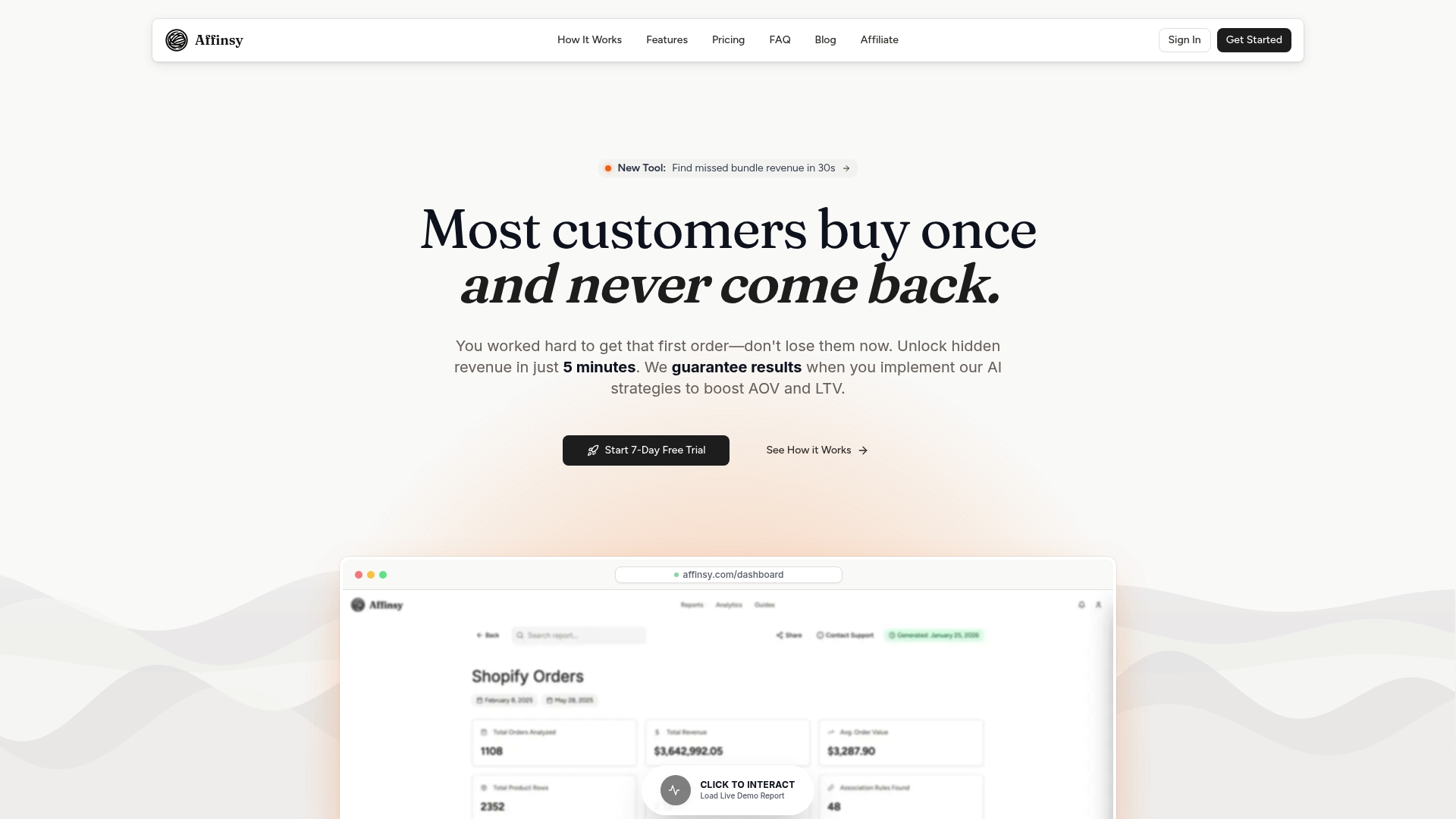
Affinsy uses AI-powered analytics to surface the customer segmentation patterns and predictive analytics signals hidden in your existing transaction data. No data science team required. You can export your order history from Shopify, WooCommerce, or any platform using the WooCommerce order exporter and upload it directly. The free tier covers up to 20,000 line items with no credit card needed, so you can start identifying your highest-value segments and churn risks today.
Frequently asked questions
What is the most effective retention strategy for online retailers?
The most effective strategy combines high-value segment focus with personalized experiences and strong emotional CX, rather than relying on loyalty programs alone. No single tactic outperforms a well-integrated, data-informed approach.
How do loyalty programs impact revenue growth?
Loyalty programs boost purchase frequency and AOV, but brands without them have grown revenue at 48% versus 14% for those with them, suggesting that CX and segmentation can drive stronger growth.
Why does segmentation matter in ecommerce retention?
Segmentation lets you direct retention spend toward customers who generate the most value. Targeting high-value segments consistently outperforms blanket retention strategies in both CLV and purchase frequency.
What role does technology play in customer retention?
Technology and analytics enable real-time churn detection, automated personalization, and seamless omnichannel experiences, making them essential infrastructure for any retention strategy that needs to scale.
Recommended
- How to optimize e-commerce retention for lasting growth - Affinsy Blog | Affinsy
- 10 Essential Tips for Boosting Online Sales - Affinsy Blog | Affinsy
- 7 Effective Ways to Maximize Revenue in E-commerce - Affinsy Blog | Affinsy
- The $10M–$50M DTC Growth Playbook: 5 Data-Driven Strategies to Offset Rising CAC on Shopify - Affinsy Blog | Affinsy
- Why fast shipping matters: boost retention, trust, and growth | ParcelPlanet