
Choosing the right AI personalization tactics is harder than it looks. With dozens of options promising better conversion rates and customer loyalty, marketing managers and data analysts face real decision paralysis. This article cuts through the noise with a clear framework for evaluating tactics, detailed comparisons of proven strategies, and actionable insights to help you select personalization methods that deliver measurable results in 2026.
Table of Contents
- Criteria To Evaluate Personalization Tactics In E-Commerce
- Top Personalization Tactics For E-Commerce In 2026
- Technical Architectures Powering Personalization
- Balancing Personalization Benefits With Privacy And Trust
- Comparing The Effectiveness Of Personalization Tactics
- How Affinsy Can Help You Implement Personalization Tactics
- Frequently Asked Questions
Key takeaways
| Point | Details |
|---|---|
| AI recommendations boost revenue by 30-50% | Product recommendation engines significantly increase conversion rates and average order values when properly implemented. |
| Serverless architectures reduce complexity | Cloud-based serverless systems enable scalable personalization without heavy infrastructure maintenance burdens. |
| Privacy and trust matter critically | Strong brand trust helps offset privacy concerns that arise from detailed personalization, protecting customer psychological well-being. |
| Market basket analysis drives cross-sells | Identifying product affinities through transaction analysis creates efficient upsell opportunities with manageable implementation complexity. |
Criteria to evaluate personalization tactics in e-commerce
Before diving into specific tactics, you need a framework to assess which approaches fit your business. Not every personalization method suits every retailer, and choosing poorly wastes resources while frustrating customers.
Start with scalability. Your chosen tactics must handle traffic spikes during promotions or seasonal rushes without degrading performance. Solutions that work for 1,000 daily visitors often collapse under 50,000. Evaluate whether the tactic requires constant manual tuning or scales automatically as your catalog and customer base grow.
Operational simplicity matters just as much. Complex implementations demand specialized talent you may not have. The guidance emphasizes operational excellence alongside security, reliability, performance efficiency, cost optimization, and sustainability as best practices. Choose tactics your team can deploy and maintain without hiring an army of data scientists.
Customer impact determines real-world success. Does the tactic reduce decision fatigue or add noise? Does it respect privacy boundaries or feel invasive? Personalization should enhance the shopping experience, not creep people out. Consider how each method affects customer psychological well-being and purchasing confidence.
Security and privacy requirements cannot be afterthoughts. Regulations like GDPR and CCPA impose strict data handling rules. More granular personalization typically requires collecting more customer data, increasing both privacy risks and compliance obligations. Factor these costs into your evaluation.
Pro Tip: Create a scorecard rating each tactic on scalability, operational burden, customer value, privacy risk, and cost. Weight criteria based on your business priorities, then calculate total scores to guide decisions systematically.
Key evaluation criteria include:
- Scalability under variable traffic loads
- Implementation and maintenance complexity
- Impact on customer experience and conversion
- Privacy and security compliance requirements
- Total cost of ownership including infrastructure and personnel
- Integration compatibility with existing AI in ecommerce analytics tools
Top personalization tactics for e-commerce in 2026
Three tactics stand out as foundational for effective ecommerce personalization: AI-driven product recommendations, market basket analysis, and customer segmentation. Each addresses different aspects of the shopping journey and delivers distinct business outcomes.
AI product recommendations are the heavyweight champion of personalization tactics. These systems analyze browsing behavior, purchase history, and product attributes to suggest items customers actually want. The results speak loudly: AI-powered recommendations increase conversion rates by 30-50% and boost average order value by 20-35%. Amazon pioneered this approach, and now retailers of all sizes can deploy similar capabilities.

The magic happens through collaborative filtering and deep learning models that spot patterns humans miss. When a customer views running shoes, the system does not just show more shoes. It considers what similar shoppers bought next, seasonal trends, and complementary products like moisture-wicking socks or fitness trackers. This contextual intelligence drives the conversion lift.
Market basket analysis uncovers hidden product affinities buried in transaction data. By examining which items customers purchase together, you identify natural bundles and cross-sell opportunities. This tactic excels at increasing average order value through strategic product placement and bundle pricing.
Unlike recommendations that personalize at the individual level, market basket analysis reveals broader patterns across your customer base. You might discover that customers who buy organic coffee also frequently purchase stainless steel travel mugs and artisan chocolates. Armed with this insight, you create targeted bundles or place these items near each other in your site navigation.
Customer segmentation divides your audience into groups sharing common characteristics or behaviors. Segmentation enables you to tailor messaging, offers, and product displays to specific customer types rather than treating everyone identically. RFM analysis (recency, frequency, monetary value) is particularly powerful, separating high-value loyal customers from at-risk churners and bargain hunters.
These tactics work best in combination. Recommendations personalize the browsing experience for individuals. Market basket analysis informs which products to recommend together. Segmentation determines which customer groups receive which promotional strategies. Together, they create a comprehensive personalization engine.
Pro Tip: Start with one tactic, master it, then layer in others. Trying to implement all three simultaneously often leads to half-baked execution across the board. Perfect your product recommendations first, then expand.
Core benefits of top tactics:
- Product recommendations deliver immediate conversion and revenue gains
- Market basket analysis optimizes catalog structure and promotion strategy
- Customer segmentation enables precision marketing with better ROI
- Combined deployment creates synergies exceeding individual tactic performance
Technical architectures powering personalization
Even brilliant personalization strategies fail without the right technical foundation. The architecture supporting your tactics determines whether they scale gracefully or crash during Black Friday traffic.
Serverless architectures improve scalability while reducing operational burdens. Services like AWS Lambda execute code in response to events without requiring you to provision or manage servers. AWS Step Functions orchestrate complex workflows, coordinating recommendation generation, inventory checks, and pricing calculations seamlessly. This approach eliminates the overhead of maintaining always-on servers that sit idle during slow periods.
Database performance makes or breaks real-time personalization. When a customer loads a product page, your system has milliseconds to fetch their profile, calculate recommendations, and render results. Traditional databases choke under this pressure during peak traffic. DynamoDB provides consistent single-digit millisecond response times at any scale. DynamoDB Accelerator (DAX) improves performance retrieving metadata during high-capacity events by caching frequently accessed data in memory.
Amazon Personalize offers managed machine learning for recommendation engines. Instead of building models from scratch, you feed it your interaction data and catalog information. The service trains models, tunes hyperparameters, and serves predictions through simple API calls. This dramatically reduces the data science expertise required while delivering enterprise-grade recommendation quality.
Choosing the right architecture supports the operational excellence principles discussed earlier. Serverless and managed services shift undifferentiated heavy lifting to cloud providers, letting your team focus on business logic and customer experience rather than infrastructure maintenance.
Pro Tip: Monitor cache hit rates and database query performance obsessively. A small degradation in response time during recommendations can cascade into significant conversion rate drops that cost serious revenue.
| Component | Purpose | Key Benefit |
|---|---|---|
| AWS Lambda | Event-driven compute | Auto-scales without server management |
| Step Functions | Workflow orchestration | Coordinates complex personalization logic |
| DynamoDB + DAX | Data storage and caching | Consistent microsecond latency |
| Amazon Personalize | Managed ML recommendations | Enterprise AI without data science team |
These architectural choices enable personalization tactics to operate efficiently at scale. They form the technical backbone supporting AI sales optimization strategies for modern ecommerce.
Balancing personalization benefits with privacy and trust
Personalization delivers clear business benefits, but aggressive implementation can backfire by eroding customer trust. Understanding the psychological dynamics helps you find the sweet spot between effectiveness and respect.
Effective personalization enhances perceived value by reducing cognitive overload. When customers face thousands of product options, decision paralysis sets in. Smart recommendations cut through the noise, presenting curated selections that match preferences. This feels helpful rather than manipulative, improving the shopping experience genuinely.
However, perceived relevance enhances psychological well-being but increases privacy concerns. The same detailed targeting that makes recommendations accurate also reveals how much data you collect about customers. When personalization feels too accurate, it crosses into creepy territory. Customers wonder what else you know and how you might use that information.
Brand trust moderates this tension. Research shows brand trust moderates the negative impact of privacy concerns on psychological well-being. Customers who trust your brand accept more personalization because they believe you will handle their data responsibly. Conversely, weak brand trust amplifies privacy fears, making personalization feel invasive regardless of actual practices.
This creates a strategic imperative: build trust before ramping up personalization intensity. Transparent privacy policies, clear opt-out mechanisms, and demonstrated data security create the foundation for effective personalization. Rushing to hyper-targeted tactics without establishing trust produces customer anxiety rather than loyalty.
“The relationship between personalization and customer well-being is not linear. Beyond a certain threshold, additional personalization triggers privacy concerns that undermine the psychological benefits. Brand trust shifts this threshold, allowing trusted retailers to personalize more deeply without negative effects.”
Balancing considerations:
- Start with broad segmentation before individual-level targeting
- Explain clearly why you are showing specific recommendations
- Provide easy controls for customers to adjust personalization levels
- Invest in brand trust through transparent data practices
- Monitor customer feedback for signs personalization feels invasive
Staying current with analytics trends helps you adapt personalization strategies as customer expectations evolve in 2026 and beyond.
Comparing the effectiveness of personalization tactics
With criteria established and tactics explained, direct comparison clarifies which approaches deliver the best results for different business situations. No single tactic wins across all dimensions, so understanding tradeoffs guides smart choices.
AI recommendations lead in revenue impact and conversion improvement. The 30-50% conversion lift and 20-35% order value increase represent substantial gains that justify significant investment. A fashion ecommerce case study demonstrated a 42% lifetime value increase and 65% conversion rise from AI personalization. However, recommendations require substantial data volumes to train models effectively and carry moderate privacy implications due to individual-level tracking.
Market basket analysis offers efficient upsell opportunities with lower implementation complexity than full recommendation engines. You can generate actionable insights from transaction data alone without tracking individual browsing behavior. This reduces privacy concerns while still boosting average order value through strategic bundling. The tradeoff is less personalization granularity, recommendations apply broadly rather than individually.
Customer segmentation supports targeted campaigns but effectiveness varies dramatically based on data availability and segment definition quality. Well-executed segmentation enables precision marketing with superior ROI compared to mass campaigns. Poor segmentation wastes resources targeting the wrong customers with irrelevant messages. Implementation complexity sits in the middle, segments require ongoing refinement as customer behavior evolves.
| Tactic | Revenue Impact | Scalability | Privacy Risk | Implementation Complexity | Best For |
|---|---|---|---|---|---|
| AI Recommendations | Very High | Excellent | Moderate | High | Large catalogs, mature data infrastructure |
| Market Basket Analysis | High | Good | Low | Moderate | Identifying natural bundles, upsells |
| Customer Segmentation | Moderate to High | Excellent | Low to Moderate | Moderate | Targeted campaigns, lifecycle marketing |
Key decision drivers:
- Choose AI recommendations when you have rich customer data and need maximum conversion lift
- Deploy market basket analysis for quick wins optimizing existing product relationships
- Implement segmentation when targeting precision matters more than individual personalization
- Combine tactics strategically rather than choosing just one
Exploring smart product recommendation ideas provides additional tactical options beyond these foundational approaches.
How Affinsy can help you implement personalization tactics
Implementing sophisticated personalization does not require building everything from scratch. Affinsy provides AI-powered analytics specifically designed for ecommerce, turning your transaction data into actionable insights for recommendations, segmentation, and market basket analysis.
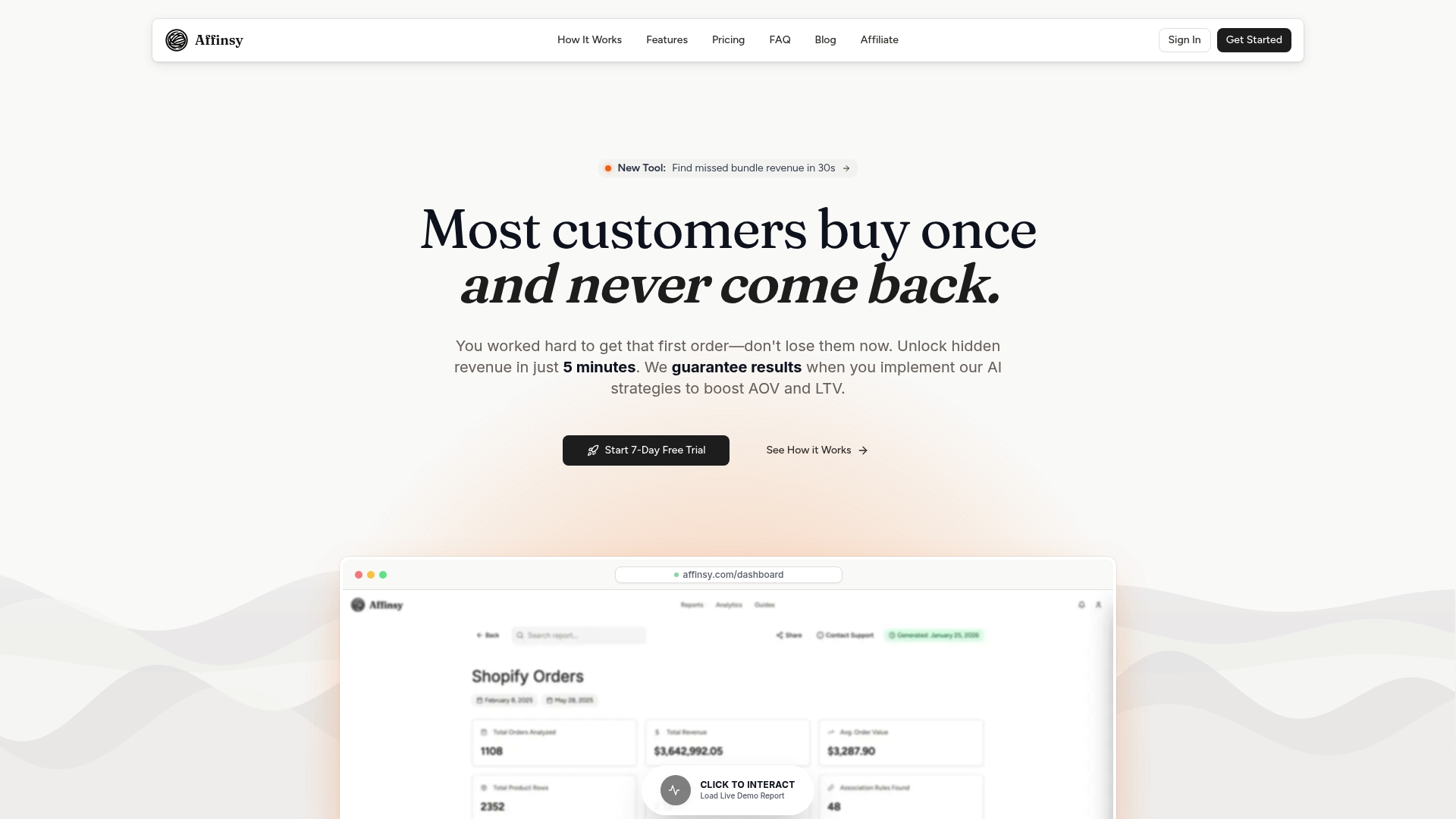
Our platform integrates seamlessly with Shopify, WooCommerce, and Google Analytics, analyzing historical data to uncover hidden product associations and customer patterns. You get market basket analysis, RFM segmentation, and custom reports without needing a data science team. Explore our comprehensive ecommerce analytics glossary to deepen your understanding, or dive into specific topics like product recommendations and customer segmentation to see how these tactics apply to your business.
Frequently asked questions
What are the key advantages of AI-powered personalization in e-commerce?
AI personalization significantly increases conversion rates, average order values, and customer lifetime value through intelligent product recommendations and targeted experiences. The technology reduces decision fatigue for customers while automating optimization tasks that would require massive manual effort.
How do I address customer privacy concerns with personalization?
Build brand trust through transparent data practices, clear privacy policies, and easy opt-out controls. Start with broader segmentation before individual-level targeting, and always explain why you are showing specific recommendations to maintain customer comfort.
What technical architecture works best for scalable personalization?
Serverless cloud architectures using services like AWS Lambda, Step Functions, and managed databases provide excellent scalability without heavy operational burdens. These systems automatically handle traffic spikes and reduce infrastructure maintenance compared to traditional server-based approaches.
Which personalization tactic should I implement first?
Start with AI product recommendations if you have sufficient customer data and want maximum revenue impact. If data is limited or you need faster implementation, begin with market basket analysis to identify natural product bundles and cross-sell opportunities.
How does market basket analysis differ from product recommendations?
Market basket analysis identifies patterns across all customers to reveal which products are frequently purchased together, informing bundle strategies and catalog organization. Product recommendations personalize suggestions for individual shoppers based on their specific behavior and preferences. Understanding the role of AI in ecommerce helps clarify how these tactics complement each other within a broader strategy.
What metrics should I track to measure personalization success?
Monitor conversion rate improvements, average order value changes, customer lifetime value growth, and recommendation click-through rates. Also track qualitative signals like customer feedback and privacy concern mentions to ensure personalization enhances rather than harms the shopping experience.
Recommended
- Analytics trends in 2026: AI boosts ecommerce sales 95% ROI - Affinsy Blog | Affinsy
- Ecommerce Analytics Trends 2026: Unlocking Growth Through AI - Affinsy Blog | Affinsy
- Marketing analytics trends 2026: optimize ecommerce sales - Affinsy Blog | Affinsy
- 10 Ecommerce Tips to Elevate Your Online Store in 2025 - Affinsy Blog | Affinsy