
E-commerce marketers face a relentless flood of data and rapidly evolving analytics technology in 2026. Mastering the latest marketing analytics trends is no longer optional; it’s essential for unlocking powerful sales optimization and customer retention strategies. This article covers critical selection criteria, the transformative impact of AI, real-time insights, omnichannel data integration, and top platform comparisons to help you make informed decisions.
Table of Contents
- How To Choose The Right Marketing Analytics Platform In 2026
- AI And Machine Learning Transforming E-Commerce Marketing Analytics
- Real-Time Analytics And Automation For Faster Decision-Making
- Omnichannel Data Integration: The Backbone Of Unified Insights
- Comparison Of Top Marketing Analytics Tools For Online Retail In 2026
- Situational Recommendations For E-Commerce Analytics
- Discover Advanced E-Commerce Analytics Solutions With Affinsy
Key takeaways
| Point | Details |
|---|---|
| AI-driven analytics boost performance | Machine learning segmentation can increase conversion rates by up to 25% and drive 12-25% revenue growth. |
| Real-time analytics accelerate decisions | Automated insights cut time to action by 60% and personalized experiences raise average order value by 18%. |
| Omnichannel integration is critical | Unified customer data across touchpoints eliminates silos and improves marketing effectiveness significantly. |
| Privacy compliance matters | Data protection regulations demand analytics platforms with robust security and consent management features. |
| Platform selection depends on context | Business size, technical resources, and specific goals determine the best marketing analytics tool for your needs. |
How to choose the right marketing analytics platform in 2026
Selecting the right marketing analytics platform requires evaluating several essential criteria that directly impact your e-commerce success. Top-rated marketing analytics tools for e-commerce in 2026 offer AI-driven prediction, real-time dashboards, and seamless integration with Shopify and WooCommerce.
First, prioritize seamless integration with your existing e-commerce platforms like Shopify, WooCommerce, or BigCommerce. Data flows automatically when systems connect effortlessly, eliminating manual imports and reducing errors. Your analytics platform should also sync with Google Analytics and advertising channels to create a unified view of customer interactions.
AI prediction capabilities have become table stakes rather than luxury features. Look for platforms that deliver automated customer segmentation, demand forecasting, and personalized recommendation engines. These features transform raw transaction data into actionable marketing strategies without requiring a data science team.
Real-time analytics separates leading platforms from outdated solutions. Your marketing team needs instant visibility into campaign performance, inventory movements, and customer behavior changes. Delayed insights mean missed opportunities and slower competitive responses.
Ease of use matters more than impressive feature lists. Marketing managers and analysts need intuitive dashboards that surface insights quickly rather than complex tools requiring weeks of training. Test the interface during trials to ensure your team can extract value immediately.
Data privacy compliance has shifted from optional to mandatory. Platforms must demonstrate GDPR, CCPA, and regional regulation adherence through encryption, consent management, and audit trails. Ignoring compliance creates legal risks that far outweigh any analytical benefits.
Pro Tip: Prioritize platforms offering robust AI automation features that reduce manual data work by at least 50%, freeing your team to focus on strategy rather than spreadsheet management.
Key selection criteria include:
- Native integration with major e-commerce platforms and marketing tools
- AI-powered predictive models for customer behavior and demand
- Real-time dashboard updates with customizable alerts
- Intuitive interface requiring minimal technical training
- Comprehensive data security meeting current regulatory standards
Understanding ecommerce analytics trends 2026 helps contextualize these criteria within broader industry shifts.
AI and machine learning transforming e-commerce marketing analytics
Artificial intelligence has fundamentally reshaped how retailers understand and engage customers. AI-driven segmentation techniques can boost conversion rates by up to 25% compared to traditional demographic grouping methods.

Machine learning algorithms analyze thousands of customer attributes simultaneously, identifying patterns invisible to human analysts. These systems create dynamic segments that update automatically as customer behavior evolves, ensuring marketing messages remain relevant.
Predictive analytics powered by machine learning drives revenue growth between 12% and 25% by forecasting which products customers will purchase next. Retailers use these predictions to optimize inventory allocation, personalize email campaigns, and time promotional offers for maximum impact.
RFM models have evolved through AI augmentation into sophisticated retention engines. Traditional recency, frequency, and monetary analysis now incorporates behavioral signals, browsing patterns, and external factors like seasonality. This enhanced approach identifies at-risk customers earlier and recommends precise interventions to prevent churn.
The ai in ecommerce analytics role extends beyond segmentation into operational optimization. Machine learning algorithms automatically adjust pricing strategies, allocate advertising budgets across channels, and predict fulfillment bottlenecks before they impact customer experience.
Key AI benefits transforming marketing analytics:
- Dynamic customer targeting that adapts to real-time behavior changes
- Trend forecasting identifying emerging product demand weeks ahead
- Personalized offer generation optimizing discount levels per customer
- Churn prediction models enabling proactive retention campaigns
- Automated A/B test analysis accelerating optimization cycles
The role of ai in ecommerce continues expanding as computational power increases and algorithms become more sophisticated. Retailers who adopt AI-driven analytics gain competitive advantages that compound over time through continuous learning and optimization.
AI transforms marketing analytics from reactive reporting into proactive strategy, enabling retailers to anticipate customer needs rather than simply respond to past behaviors.
Real-time analytics and automation for faster decision-making
Real-time data processing has become the competitive differentiator separating agile retailers from those stuck in batch reporting cycles. Personalized experiences enabled by instant analytics increase average order value by 18% as customers receive relevant recommendations at the exact moment of purchase intent.
AI-driven automation cuts time to insight by up to 60%, eliminating the lag between data collection and actionable recommendations. Marketing teams no longer wait for weekly reports to identify underperforming campaigns or inventory imbalances. Automated systems flag anomalies immediately, triggering alerts that prompt rapid responses.
Automated reporting speeds decision-making by 35%, freeing marketers from manual data compilation to focus on strategic initiatives. Dashboards update continuously, displaying current conversion rates, traffic sources, and customer engagement metrics without requiring analyst intervention.
Real-time inventory visibility prevents stockouts and overstock situations that erode profitability. When analytics platforms connect directly to fulfillment systems, marketing teams can pause promotions for low-stock items automatically and amplify campaigns for excess inventory.
The why use ai in ecommerce question finds its answer in automation’s ability to scale human decision-making. A single analyst can monitor hundreds of campaigns simultaneously when AI handles routine optimization tasks.
Pro Tip: Set up automated alerts triggering when key metrics deviate more than 15% from expected ranges, ensuring you catch performance changes or technical issues within minutes rather than days.
Automation advantages for e-commerce marketing:
- Instant campaign performance tracking across all channels simultaneously
- Automatic budget reallocation toward highest-performing ad sets
- Real-time customer journey mapping identifying friction points immediately
- Predictive inventory alerts preventing stockouts during traffic spikes
- Automated competitor price monitoring enabling dynamic pricing responses
Omnichannel data integration: the backbone of unified insights
Fragmented customer data remains the biggest obstacle to effective marketing analytics. 72% of marketers are increasing investment in integration platforms to consolidate information from websites, mobile apps, social media, email, and physical stores.
Customer data platforms overcome the challenges of inconsistent data formats and siloed systems that plague traditional analytics setups. CDPs create unified customer profiles by matching identifiers across touchpoints, revealing complete purchase journeys rather than disconnected interactions.
The technical challenges of omnichannel integration include data latency between systems, conflicting customer identifiers, and varying data quality standards. Real-time APIs have largely solved latency issues, but identity resolution requires sophisticated matching algorithms that account for multiple devices and channels.
Unified dashboards provide marketing teams with single-pane-of-glass visibility across all customer touchpoints. Rather than logging into separate platforms for email metrics, social engagement, and website analytics, integrated systems display holistic performance in one interface.
The ecommerce analytics trends 2026 emphasize seamless data flow as foundational to advanced capabilities like predictive modeling and automated optimization.
| Integration aspect | Benefits | Challenges | Mitigation approach |
|---|---|---|---|
| Customer identity resolution | Complete purchase history visibility | Multiple email addresses and devices | AI-powered probabilistic matching algorithms |
| Real-time data sync | Instant campaign performance updates | API rate limits and latency | Event-driven architecture with caching layers |
| Cross-channel attribution | Accurate marketing ROI calculation | Complex customer journeys | Multi-touch attribution modeling |
| Data quality consistency | Reliable insights and forecasts | Varying formats across sources | Automated data cleansing and validation rules |
Key integration capabilities to prioritize:
- Native connectors for major e-commerce platforms and marketing tools
- Customer identity graph technology matching users across devices
- Bidirectional data flows enabling both reporting and activation
- Real-time event streaming rather than batch updates
- Flexible data warehouse integration for custom analysis
Comparison of top marketing analytics tools for online retail in 2026
Understanding how leading platforms compare helps narrow your selection based on specific business requirements. Top-rated marketing analytics tools for e-commerce in 2026 offer varying strengths that align with different organizational needs.
Affinsy specializes in AI-powered product association analysis and customer segmentation for small to mid-sized online retailers. The platform excels at market basket analysis, revealing hidden product relationships that inform bundling and cross-selling strategies. Integration with Shopify and WooCommerce happens in minutes, and the interface requires no technical training.
Google Analytics 4 provides comprehensive free analytics with robust real-time reporting and event tracking. The platform suits businesses of all sizes needing website and app analytics, though advanced e-commerce features require technical configuration. GA4’s machine learning insights have improved significantly, offering predictive metrics and anomaly detection.
Tableau CRM delivers powerful data visualization and executive dashboards for Salesforce users. The platform shines in creating custom reports and combining e-commerce data with CRM information. Complex setup and higher pricing make it best suited for enterprises with dedicated analytics teams.
Adobe Analytics offers enterprise-grade attribution modeling and customer journey analysis across all digital touchpoints. Advanced segmentation capabilities and real-time personalization integration justify the premium pricing for large retailers managing complex omnichannel operations.
| Platform | Key strengths | Best for | Pricing estimate | AI capabilities | Setup complexity |
|---|---|---|---|---|---|
| Affinsy | Product associations, RFM segmentation | Small/mid retailers | $99-$299/month | High | Low |
| Google Analytics 4 | Free tier, real-time tracking | All business sizes | Free-$150k+/year | Medium | Medium |
| Tableau CRM | Visualization, Salesforce integration | Salesforce users | $75-$300+/user/month | Medium | High |
| Adobe Analytics | Attribution, journey analysis | Large enterprises | $100k+/year | High | High |
The ai sales optimization strategies ecommerce 2026 landscape shows clear differentiation between platforms targeting different market segments. Small retailers gain more value from specialized tools like Affinsy, while enterprises need Adobe’s comprehensive capabilities.
Situational recommendations for e-commerce analytics
Choosing the right platform depends heavily on your specific business context, resources, and growth trajectory. Small to mid-sized retailers generating under $5 million annually should prioritize Affinsy for its AI-powered insights, minimal setup requirements, and affordable pricing. The platform delivers immediate value through product bundling recommendations and customer retention strategies without requiring data science expertise.
Large enterprises managing multiple brands across international markets need Adobe Analytics’ sophisticated attribution modeling and omnichannel customer journey tracking. The investment makes sense when marketing budgets exceed $1 million annually and complex stakeholder reporting demands justify the implementation effort.
Salesforce Commerce Cloud users should strongly consider Tableau CRM for its native integration and ability to combine e-commerce analytics with sales pipeline data. The unified view of customer interactions from first touch through post-purchase support creates powerful insights for B2B and high-value B2C retailers.
Google Analytics 4 serves as the cost-effective foundation for businesses needing real-time website and app analytics without specialized e-commerce features. Pair GA4 with focused tools like Affinsy to gain both broad traffic insights and deep product association analysis.
Startups and new online stores should begin with Google Analytics 4’s free tier while implementing Affinsy’s entry-level plan. This combination provides comprehensive coverage without overwhelming limited resources or requiring dedicated analysts.
Key selection criteria summary:
- Business size and revenue determine appropriate platform sophistication
- Existing technology stack influences integration ease and total cost
- Team technical skills affect setup time and ongoing maintenance needs
- Specific analytics goals like product optimization versus journey mapping
- Budget constraints including both licensing and implementation costs
The ecommerce success metrics you prioritize should directly influence platform selection, ensuring the tools you choose excel at measuring what matters most to your business.
Discover advanced e-commerce analytics solutions with Affinsy
Affinsy transforms how online retailers leverage AI-powered analytics to drive sales growth and customer retention. The platform seamlessly integrates with Shopify and WooCommerce, analyzing your historical transaction data to reveal hidden product associations and customer segments within minutes.
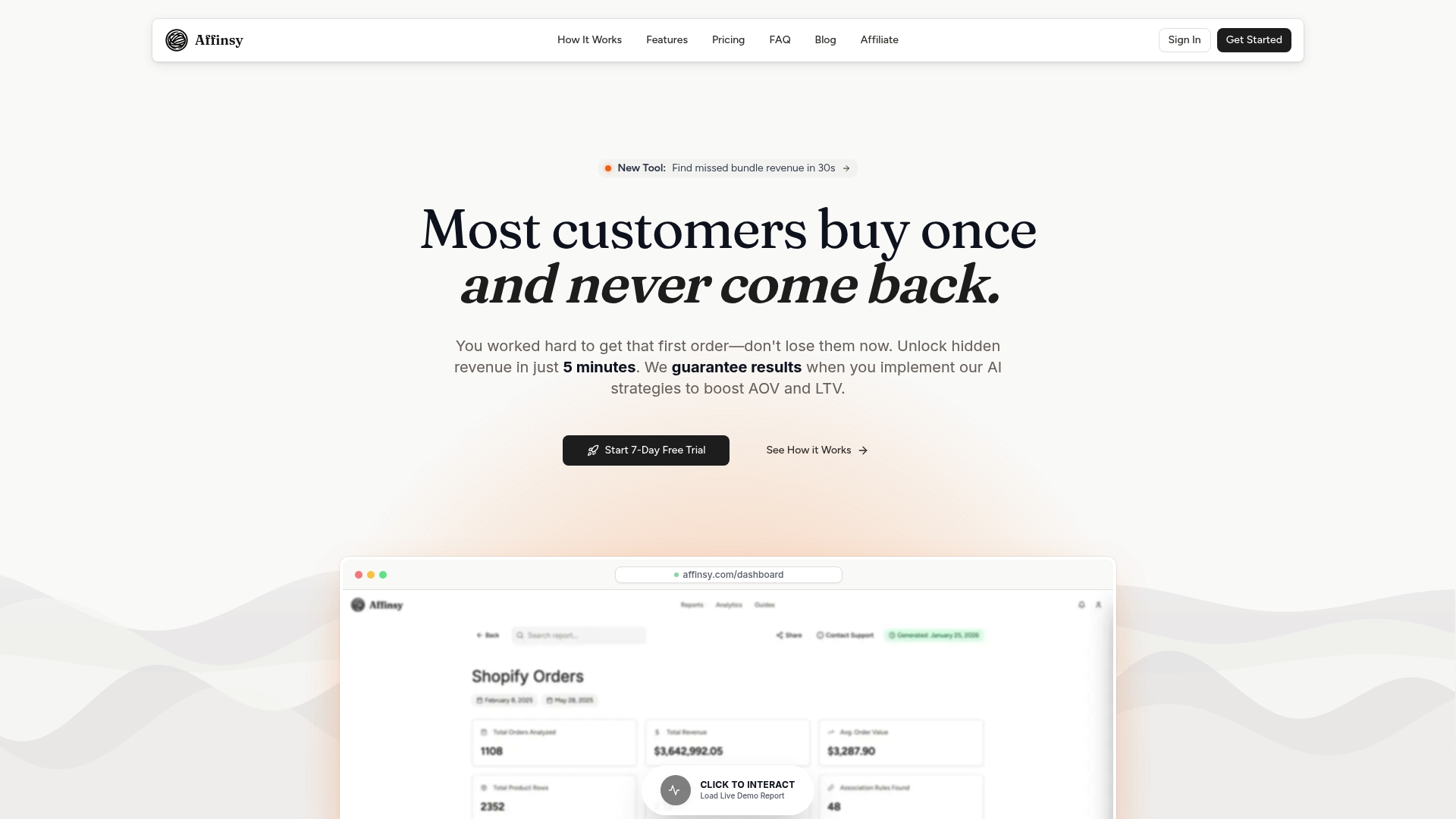
Market basket analysis uncovers which products customers frequently purchase together, enabling data-driven bundling and cross-selling strategies that increase average order values. Predictive customer segmentation identifies high-value buyers and at-risk customers, allowing you to allocate marketing resources where they generate maximum returns.
Explore key concepts powering modern e-commerce analytics through Affinsy’s comprehensive glossary covering predictive analytics, customer segmentation, and market basket analysis methodologies. These resources help you understand the techniques transforming retail data into competitive advantages.
FAQ
What are the main benefits of AI in e-commerce marketing analytics?
AI dramatically improves predictive accuracy, enabling personalized targeting and enhanced customer retention that boost conversion rates up to 25%. Machine learning algorithms identify patterns across thousands of customer attributes simultaneously, creating dynamic segments that adapt as behavior changes. The role of ai in ecommerce continues expanding as retailers leverage automated insights to optimize everything from pricing to inventory allocation.
How does real-time analytics enhance e-commerce sales?
Real-time analytics enables instant personalization and rapid reactions to customer behavior changes, raising average order value by up to 18%. Marketing teams respond to campaign performance shifts within minutes rather than waiting for daily or weekly reports, preventing budget waste on underperforming initiatives. Automation reduces decision latency by 60%, accelerating marketing effectiveness across all channels. Understanding why use ai in ecommerce reveals how real-time insights create competitive advantages through speed and precision.
What should I prioritize when choosing a marketing analytics platform in 2026?
Prioritize AI-driven predictive capabilities that deliver automated customer segmentation and demand forecasting without requiring data science teams. Seamless integration with your e-commerce platform, real-time analytics dashboards, intuitive interfaces, and strict data privacy compliance form the foundation of effective tools. Ensure the platform aligns with your business size, budget constraints, and specific marketing goals rather than selecting based solely on feature lists. The ecommerce analytics trends 2026 landscape shows clear differentiation between solutions optimized for different market segments.
Recommended
- Ecommerce Analytics Trends 2026: Unlocking Growth Through AI - Affinsy Blog | Affinsy
- Analytics trends in 2026: AI boosts ecommerce sales 95% ROI - Affinsy Blog | Affinsy
- AI Sales Optimization Strategies for E-commerce in 2026 - Affinsy Blog | Affinsy
- Top 6 Best Ecommerce Analytics Tools 2026 for Boosting Sales - Affinsy Blog | Affinsy