
You’ve built customer segments with perfect clustering scores, yet engagement remains flat and sales haven’t budged. This frustrating scenario plays out across countless e-commerce teams because segmentation alone doesn’t drive results. What matters is aligning those segments to clear business objectives and actionable marketing strategies. This guide cuts through the confusion, showing you exactly why customer segmentation works when done right, which methods deliver real impact, and how to avoid the pitfalls that turn promising data into wasted effort. Let’s transform your approach to customer segmentation in 2026.
Table of Contents
- The Business Case For Customer Segmentation In E-Commerce
- Key Methods To Segment E-Commerce Customers For Targeted Marketing
- Challenges And Pitfalls To Avoid In Customer Segmentation
- How To Implement Effective Customer Segmentation For Your E-Commerce Store
- Enhance Your Segmentation With Affinsy’s E-Commerce Analytics
Key takeaways
| Point | Details |
|---|---|
| Align segments to business goals | Effective segmentation targets specific objectives like retention and average order value, not just clustering accuracy. |
| Combine RFM with behavioral data | Layering recency, frequency, and monetary analysis with lifecycle stages improves personalization and targeting precision. |
| Limit actionable segments | Keep customer groups to 5-7 segments to maximize marketing impact without overwhelming complexity. |
| Address the confidence gap | While 71% of consumers expect personalization, only 23% of e-commerce teams feel confident in their segmentation approach. |
| Refresh segments quarterly | Regular updates ensure segments remain relevant as customer behaviors and market conditions evolve. |
The business case for customer segmentation in e-commerce
Customer expectations have fundamentally shifted. Today’s shoppers demand experiences tailored to their preferences, purchase history, and browsing behavior. Generic mass marketing no longer cuts it in competitive e-commerce environments where personalization directly impacts conversion rates and customer loyalty.
The numbers tell a compelling story. Consumer demand for personalization has reached critical mass, with 71% expecting tailored experiences and 91% of e-commerce teams recognizing segmentation as essential. Yet confidence remains surprisingly low, with only 23% of teams feeling certain their approach delivers results. This gap between recognition and execution creates massive opportunity for those who get segmentation right.
“While 71% of consumers expect personalized experiences and 91% of e-commerce teams view segmentation as critical, only 23% express confidence in their segmentation effectiveness.”
Effective customer segmentation addresses several core business objectives that directly impact your bottom line:
- Retention improvement: Identifying at-risk customers before they churn allows proactive engagement with targeted win-back campaigns.
- Average order value growth: Recognizing high-value segments enables strategic upselling and cross-selling matched to purchase patterns.
- Customer lifetime value optimization: Understanding segment behaviors helps allocate marketing spend where it generates maximum long-term returns.
- Churn reduction: Behavioral triggers reveal early warning signs, letting you intervene with personalized retention offers.
- Marketing efficiency: Focused campaigns targeting specific segments outperform generic blasts while reducing wasted ad spend.
The challenge isn’t whether to segment, it’s how to do it effectively. Many teams struggle with complexity, choosing the right segmentation variables, and translating analytical insights into actionable marketing strategies. Understanding why segmentation boosts e-commerce sales starts with clarity about your specific business goals and the customer behaviors that drive them.
Without this foundation, even sophisticated clustering algorithms produce segments that look impressive on paper but fail to move business metrics. The key is connecting analytical rigor with marketing practicality, ensuring every segment has a clear purpose and corresponding campaign strategy.
Key methods to segment e-commerce customers for targeted marketing
Multiple segmentation approaches exist, each with distinct strengths depending on your objectives and data maturity. Choosing the right method means balancing sophistication with actionability.
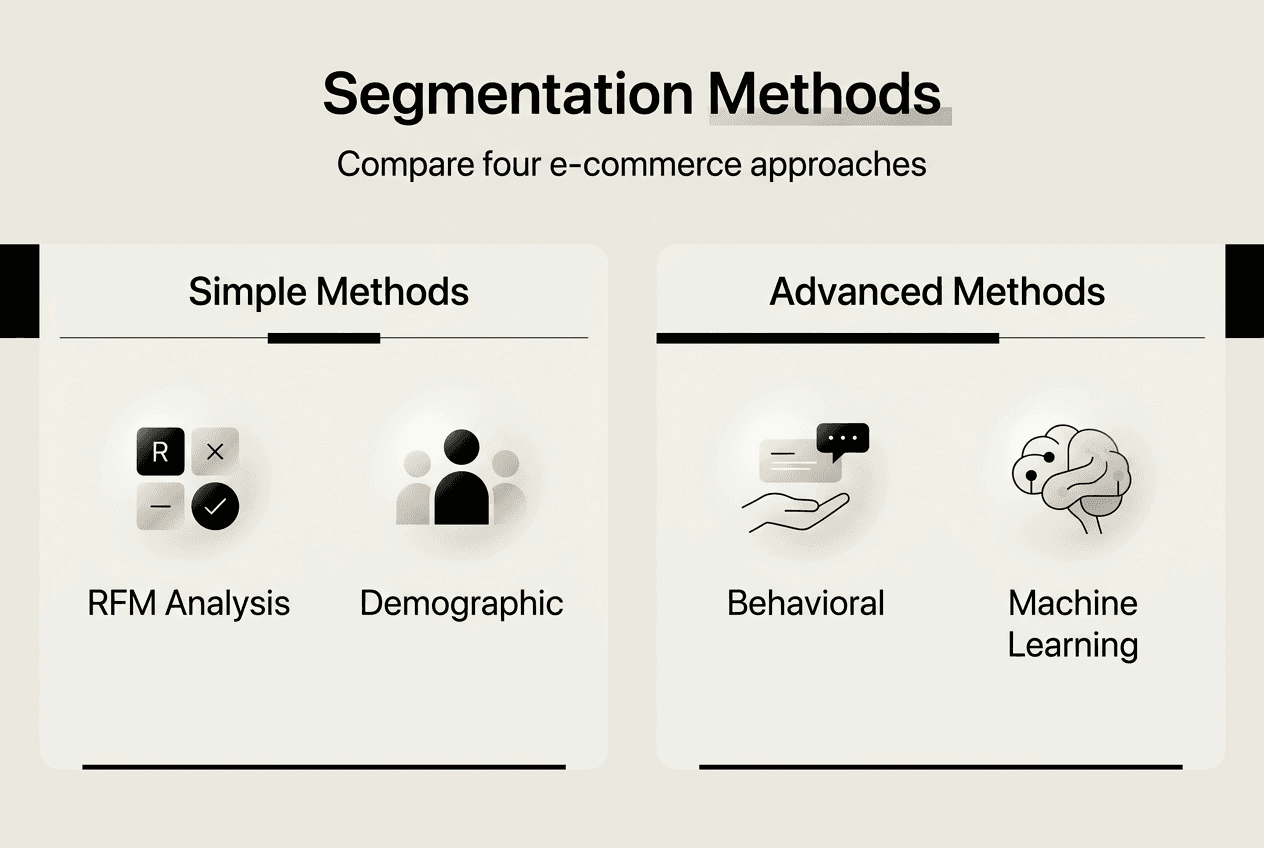
RFM analysis stands as the foundation for most e-commerce segmentation strategies. This method divides customers based on three critical dimensions: how recently they purchased (Recency), how often they buy (Frequency), and how much they spend (Monetary value). RFM analysis quickly identifies your most valuable customers, those at risk of churning, and dormant accounts worth reactivating. The beauty of RFM lies in its simplicity and immediate actionability.
Layering behavioral data onto RFM creates more nuanced segments. Purchase category preferences, browsing patterns, email engagement, cart abandonment frequency, and product affinity all add depth. Lifecycle stages provide another dimension, distinguishing new customers from repeat buyers, loyal advocates, and lapsed users. This combination delivers the personalization granularity modern consumers expect.

Traditional demographic segmentation using age, location, or income still has value but works best as a supplement rather than primary approach. Demographics tell you who customers are, while behavioral and transactional data reveal what they actually do. The latter predicts future actions far more reliably.
Advanced teams increasingly explore machine learning techniques like K-Means clustering to discover patterns humans might miss. Research validates combining RFM with machine learning, achieving Silhouette scores around 0.65 that indicate high-quality segment separation. However, algorithmic sophistication brings risks. Complex models can produce segments that lack clear business interpretation or actionable distinctions.
| Method | Complexity | Actionability | Best For |
|---|---|---|---|
| RFM Analysis | Low | Very High | Quick wins, identifying high-value and at-risk customers |
| RFM + Behavioral | Medium | High | Personalized campaigns, lifecycle marketing |
| Demographic | Low | Medium | Geographic targeting, age-specific offers |
| Machine Learning Clusters | High | Medium | Pattern discovery, large datasets |
| Predictive Segments | High | High | Churn prevention, lifetime value forecasting |
Pro Tip: Limit your active segments to 5-7 actionable groups. More segments sound sophisticated but create operational complexity that undermines execution. Each segment should have distinct characteristics and a clear corresponding marketing strategy.
The most effective approach typically starts with RFM for foundational insights, adds behavioral triggers for personalization depth, and potentially incorporates predictive elements as your analytics maturity grows. Align every segmentation decision to specific marketing objectives rather than pursuing analytical elegance for its own sake.
Review and adjust segments quarterly. Customer behaviors shift, seasonal patterns emerge, and market conditions evolve. Static segments quickly become outdated, reducing their effectiveness. Exploring diverse customer segmentation examples helps you understand which approaches fit different business models and objectives.
Challenges and pitfalls to avoid in customer segmentation
Perfect clustering algorithms don’t guarantee business success. The gap between analytical accuracy and marketing impact trips up even experienced teams. Understanding common pitfalls helps you avoid wasting resources on segmentation that looks impressive but delivers disappointing results.
The harsh reality is that misaligned or overly complex segments can actively harm business outcomes despite high clustering scores. When segments don’t connect to clear marketing actions or business objectives, they become analytical exercises that consume time without driving revenue.
Here are the five most common segmentation mistakes and how to avoid them:
-
Over-segmentation: Creating too many segments fragments your marketing efforts and makes execution impossible. Stick to 5-7 actionable groups with meaningful differences. If you can’t articulate a distinct campaign strategy for a segment, it shouldn’t exist.
-
Ignoring behavioral data: Relying solely on demographics misses the predictive power of actual customer actions. Purchase patterns, engagement metrics, and browsing behavior reveal intent far better than age or location. Layer transactional and behavioral signals for segments that actually predict future actions.
-
Failing to align with marketing goals: Building segments without clear business objectives produces interesting data that doesn’t move metrics. Before segmenting, define what you’re trying to achieve: retention, average order value growth, churn reduction, or customer acquisition efficiency. Every segment should map to a specific goal.
-
Not refreshing segments regularly: Customer behaviors change, especially in fast-moving e-commerce environments. Quarterly reviews ensure segments remain relevant and reflect current patterns. Stale segments waste marketing spend on outdated assumptions.
-
Insufficient team confidence: When marketing teams don’t understand or trust segmentation logic, they won’t use it effectively. Ensure segments have intuitive labels, clear definitions, and transparent criteria. Complexity that impresses data scientists often confuses marketers who need to execute campaigns.
Pro Tip: For every segment you create, write a one-sentence campaign strategy describing exactly how you’ll market to that group differently. If you can’t articulate this clearly, the segment lacks actionability and should be reconsidered or combined with others.
Understanding different customer segmentation types helps you choose approaches that balance analytical rigor with practical execution. The goal isn’t perfect clustering, it’s segments that drive measurable improvements in engagement, conversion, and customer lifetime value.
Another subtle pitfall involves focusing exclusively on acquisition while neglecting retention segments. New customer acquisition costs continue rising across most e-commerce categories. Segments identifying high-value repeat customers or at-risk accounts often deliver better ROI than endless acquisition optimization. Balance your segmentation strategy across the full customer lifecycle.
How to implement effective customer segmentation for your e-commerce store
Moving from theory to practice requires a systematic approach that connects data analysis with marketing execution. Follow these steps to build segmentation that actually drives results:
-
Define clear marketing goals: Start by identifying what you want to achieve. Are you focused on reducing churn, increasing average order value, improving retention, or optimizing acquisition spend? Your objectives determine which segmentation variables matter most.
-
Collect relevant customer data: Gather transactional history, behavioral signals like email engagement and browsing patterns, purchase recency and frequency, and any relevant demographic information. Data quality matters more than quantity.
-
Perform RFM analysis: Calculate recency, frequency, and monetary scores for each customer. This creates your foundational segments: Champions, Loyal Customers, At-Risk, Hibernating, and Lost. RFM provides quick wins by identifying high-value and at-risk customers immediately.
-
Layer behavioral and lifecycle data: Add purchase category preferences, product affinity, cart abandonment patterns, and lifecycle stage to create more nuanced segments. This depth enables personalization that resonates.
-
Create limited actionable segments: Consolidate your analysis into 5-7 distinct customer groups, each with clear defining characteristics and meaningful differences. Name segments intuitively so marketing teams immediately understand who they’re targeting.
-
Develop tailored campaigns: Design specific marketing strategies for each segment. High-value loyalists might receive early access to new products, while at-risk customers get win-back offers. Ensure every segment has a corresponding action plan.
-
Review and adjust quarterly: Schedule regular segment reviews to assess performance and update criteria based on changing customer behaviors. Static segments quickly lose relevance in dynamic e-commerce environments.
Here’s a sample segment structure showing how definitions translate to action:
| Segment Name | RFM Criteria | Behavioral Signals | Campaign Strategy |
|---|---|---|---|
| VIP Champions | Recent, Frequent, High-Spend | High engagement, broad category interest | Exclusive previews, loyalty rewards, personalized recommendations |
| Growth Potential | Recent, Low Frequency, Medium-Spend | Engaged with emails, narrow category focus | Cross-sell campaigns, category expansion offers |
| At-Risk Loyalists | Not Recent, Previously Frequent, High-Spend | Declining engagement | Win-back offers, feedback requests, special incentives |
| Bargain Hunters | Variable Recency, High Frequency, Low-Spend | Only purchases on promotion | Flash sales, bundle deals, volume discounts |
| New Customers | Very Recent, Low Frequency, Variable Spend | High initial engagement | Onboarding series, second purchase incentives |
Best practices for ongoing segment management include:
- Track key performance indicators for each segment: conversion rate, average order value, retention rate, and lifetime value.
- Use integrated dashboards that visualize segment performance and trends over time.
- Test campaign variations within segments to optimize messaging and offers.
- Link segmentation with predictive analytics to forecast customer lifetime value and churn probability.
- Share segment insights across teams so customer service, product, and marketing align their approaches.
Pro Tip: Implement dashboards that automatically track segment composition and performance metrics. When you can see segment sizes shifting and engagement changing in real-time, you’ll catch issues early and capitalize on opportunities faster.
Exploring creative customer segmentation ideas sparks innovation in how you group and target customers. Understanding how segmentation boosts retention connects your segmentation strategy directly to long-term business value.
The implementation process isn’t one-and-done. Effective segmentation evolves as your business grows, customer behaviors shift, and you gain insights from campaign performance. Start simple with RFM, prove value through improved metrics, then gradually add sophistication as your team’s analytical capabilities mature.
Enhance your segmentation with Affinsy’s e-commerce analytics
Implementing sophisticated customer segmentation manually consumes significant time and requires specialized data science skills. Affinsy automates this entire process, helping e-commerce teams build, monitor, and act on powerful customer segments without technical complexity.
Our platform combines RFM analysis with behavioral triggers and machine learning to create actionable segments tailored to your specific business objectives. Whether you’re focused on retention, average order value growth, or churn prevention, Affinsy delivers the insights you need in formats your marketing team can immediately use.
Key capabilities include:
- Dynamic customer segments that automatically update as behaviors change
- Predictive analytics forecasting customer lifetime value and churn risk
- Real-time dashboards tracking segment performance and composition
- Seamless integration with Shopify, WooCommerce, and Google Analytics
- Custom report generation for specific marketing questions
Affinsy transforms your existing transaction data into strategic advantages, identifying hidden patterns in product associations and customer behaviors that manual analysis misses. Explore our customer segmentation glossary to deepen your understanding of segmentation concepts, learn how predictive analytics enhances targeting precision, and discover how market basket analysis reveals cross-sell opportunities within your segments.
FAQ
What is customer segmentation and why is it important?
Customer segmentation divides your customer base into distinct groups based on shared characteristics like purchase behavior, engagement patterns, or lifecycle stage. It matters because personalized marketing targeting specific segments dramatically outperforms generic campaigns, improving conversion rates, retention, and customer lifetime value. Segmentation lets you allocate marketing resources efficiently by focusing on high-value opportunities.
How do RFM analysis and machine learning differ in customer segmentation?
RFM analysis segments customers based on recency, frequency, and monetary value, providing quick, interpretable segments with clear marketing applications. Machine learning discovers complex patterns across many variables simultaneously, potentially revealing insights humans miss. However, ML segments can lack business interpretability and actionability without careful design, while RFM delivers immediate value with simpler implementation.
Why do some perfect segmentation models fail to improve business outcomes?
Even technically perfect clustering fails when segments don’t align with clear marketing objectives or actionable campaign strategies. High clustering accuracy measures statistical separation, not business value. Segments must connect to specific goals like retention or average order value growth, have distinct marketing strategies, and be simple enough for teams to execute confidently.
What is the ideal number of customer segments in e-commerce?
Limit segments to 5-7 actionable groups linked to specific campaign strategies for optimal results. This balance maximizes personalization impact without creating operational complexity that undermines execution. More segments sound sophisticated but fragment marketing efforts and make consistent execution nearly impossible. Each segment should have meaningfully different characteristics and a clear corresponding marketing approach.
Recommended
- Why segment online customers to boost e-commerce sales - Affinsy Blog | Affinsy
- Customer segmentation explained: boost retention 2026 - Affinsy Blog | Affinsy
- AI Sales Optimization Strategies for E-commerce in 2026 - Affinsy Blog | Affinsy
- Marketing analytics trends 2026: optimize ecommerce sales - Affinsy Blog | Affinsy
- Seasonal pricing trends 2026: save smart shopping | PriceLix