
Over 60% of ecommerce retailers still rely primarily on manual analytics processes, missing critical opportunities to boost revenue and customer loyalty. While competitors harness AI-powered automation to predict trends and optimize product strategies in real time, manual approaches leave money on the table. Automating retail analytics transforms raw transaction data into actionable insights that drive smarter bundling decisions and stronger retention strategies. This guide reveals why automation has become essential for ecommerce success in 2026 and how you can leverage it to outperform competitors.
Table of Contents
- How Retail Analytics Automation Transforms Ecommerce Management
- Advanced Predictive Frameworks Boosting Retention And Bundling Performance
- Implementing Automated Retail Analytics For Actionable Insights And Competitive Edge
- Frequently Asked Questions
Key takeaways
| Point | Details |
|---|---|
| Real-time processing advantage | Automated analytics process multiple data sources instantly, eliminating manual delays that cost sales opportunities. |
| Predictive power transforms decisions | AI-driven models forecast demand patterns and customer behavior with accuracy impossible through manual analysis. |
| Bundling optimization increases revenue | Automation identifies profitable product combinations that boost average order value by 30-50%. |
| Retention strategies become adaptive | Big data frameworks enable personalized customer experiences that reduce churn and increase lifetime value. |
| Competitive necessity in 2026 | Retailers without analytics automation face growing disadvantages against data-driven competitors. |
How retail analytics automation transforms ecommerce management
Retail analytics automation represents the systematic use of AI and machine learning technologies to process, analyze, and generate insights from multiple ecommerce data sources without manual intervention. These systems continuously monitor sales transactions, inventory levels, customer browsing patterns, and purchase histories to identify trends and opportunities. Unlike traditional manual analytics that require hours or days to compile reports, automated systems process data in real time from sales, inventory, and customer interactions.
The shift from reactive to proactive management defines automation’s core value. Manual analytics forces you to look backward, analyzing what already happened and hoping patterns repeat. Automated systems predict what will happen next, enabling you to adjust inventory, pricing, and marketing before trends fully emerge. This predictive capability stems from machine learning algorithms that recognize subtle patterns across thousands of variables simultaneously, connections human analysts would never spot manually.
Real-time processing eliminates the dangerous lag between data collection and action. When a product combination starts trending, automated systems flag it immediately, allowing you to capitalize while demand peaks. Manual processes might discover the same trend weeks later, after the opportunity has passed. This speed advantage compounds over time, with automated retailers consistently staying one step ahead of market shifts.
Integration across data sources creates comprehensive visibility impossible with manual tools. Your automated system connects point-of-sale data with website behavior, email engagement, social media interactions, and supply chain information. This holistic view reveals how different business aspects influence each other, like how Instagram engagement predicts next week’s sales patterns or how inventory delays affect customer retention rates.
Pro Tip: Begin automation by connecting just your sales and inventory data streams to demonstrate quick ROI before expanding to more complex integrations. This phased approach builds team confidence and identifies workflow adjustments needed for broader automation success.
The role of AI in ecommerce analytics extends beyond simple reporting to strategic recommendation. Advanced systems don’t just show you what’s happening but suggest specific actions like which products to bundle, which customers to target with retention offers, and when to adjust pricing. These recommendations improve continuously as algorithms learn from outcomes, creating a self-optimizing analytics engine that gets smarter with every transaction.
- Automated systems process millions of data points simultaneously, identifying correlations humans would miss
- Machine learning models adapt to seasonal patterns and market shifts without manual reprogramming
- Integration APIs connect analytics platforms with existing ecommerce infrastructure in hours, not months
- Cloud-based automation scales instantly to handle traffic spikes and growing data volumes
Advanced predictive frameworks boosting retention and bundling performance
Cutting-edge analytics automation relies on sophisticated algorithms that transform raw data into strategic advantages. Principal Component Analysis (PCA) reduces complex datasets with hundreds of variables into manageable dimensions while preserving the most important information patterns. This dimensionality reduction lets algorithms process customer behavior data faster and identify the critical factors driving purchase decisions without getting lost in noise.
Modified Particle Swarm Optimization combined with Gravitational Search Optimization (MPSO-GSO) represents the next generation of supply chain and inventory optimization. These hybrid algorithms simulate natural phenomena to find optimal solutions for complex problems like dynamic product bundling and personalized offer timing. Adaptive frameworks using these techniques boost retention by continuously adjusting strategies based on real-time customer responses and market conditions.
XGBoost, an extreme gradient boosting algorithm, delivers exceptional accuracy in predicting customer churn, lifetime value, and product affinity. Unlike traditional models that plateau in accuracy, XGBoost builds ensembles of decision trees that correct each other’s errors, achieving prediction accuracy rates above 90% for well-structured ecommerce datasets. This precision enables confident investment in retention campaigns and bundling strategies that manual analytics could never justify.

| Algorithm | Primary Strength | Typical Retail Application |
|---|---|---|
| PCA | Simplifies complex datasets | Customer segmentation with dozens of behavioral variables |
| MPSO-GSO | Optimizes dynamic decisions | Real-time inventory allocation and bundle pricing |
| XGBoost | Prediction accuracy | Churn forecasting and lifetime value estimation |
| Neural Networks | Pattern recognition | Image-based product recommendation and visual search |
The impact on retail analytics and bundling strategies becomes clear when you see these algorithms in action. Automated systems analyze every transaction to identify which product combinations generate the highest margins and lowest return rates. They recognize that customers who buy product A with product B have 40% higher lifetime value than those buying A alone, insights buried too deep for manual discovery.
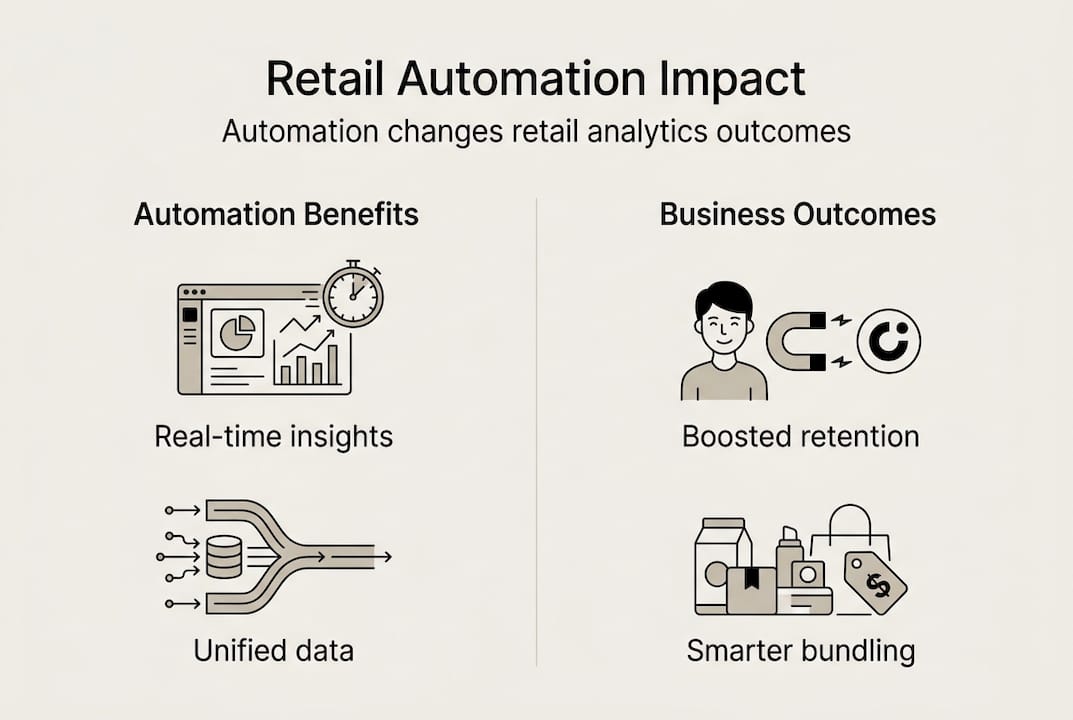
Customer retention strategies transform when powered by predictive models that anticipate churn before it happens. Algorithms identify early warning signals like decreased email engagement, longer gaps between purchases, or shifts in product category preferences. Automated systems trigger personalized retention offers at precisely the moment customers become receptive, dramatically improving campaign effectiveness compared to generic scheduled promotions.
Pro Tip: Layer multiple algorithms for complementary insights rather than relying on a single model. Use PCA to identify customer segments, MPSO-GSO to optimize offers for each segment, and XGBoost to predict which customers will respond best, creating a comprehensive automated strategy.
The empirical supply chain benefits from big data analytics extend beyond forecasting to include automated reordering, dynamic safety stock calculations, and supplier performance optimization. Systems learn seasonal patterns, promotional impacts, and external factors like weather or economic indicators that influence demand. This intelligence prevents both stockouts that lose sales and overstock that ties up capital, optimizing inventory investment automatically.
Implementing automated retail analytics for actionable insights and competitive edge
Successful automation implementation begins with selecting platforms that align with your technical capabilities and business scale. Modern analytics tools offer varying complexity levels, from no-code solutions for smaller retailers to enterprise platforms with extensive customization options. Evaluate options based on integration capabilities with your existing ecommerce platform, the sophistication of AI models offered, and the learning curve your team can realistically handle.
Integration with existing infrastructure requires careful planning but shouldn’t become a barrier to adoption. Most quality analytics platforms provide pre-built connectors for major ecommerce systems like Shopify, WooCommerce, Magento, and BigCommerce. These connectors automatically sync sales, inventory, and customer data without custom development. For specialized systems, API-based integration typically requires only basic technical skills or support from the platform vendor.
Transforming automated insights into data-driven retail decisions demands establishing clear workflows for acting on recommendations. Designate team members responsible for reviewing daily automated reports, set thresholds for automatic actions versus manual review, and create feedback loops so the system learns from your decisions. The most successful implementations treat automation as a collaborative partner, not a replacement for human judgment.
Product bundling optimization through automation follows a continuous improvement cycle. Systems analyze which bundles customers actually purchase versus which they view but abandon, revealing price sensitivity and product compatibility. Automated analytics identifies trends that predict inventory needs and spot bottlenecks, enabling proactive bundle adjustments that maintain optimal margins while maximizing appeal.
Personalized retention campaigns powered by automated insights achieve dramatically higher engagement than generic approaches. Systems segment customers based on purchase patterns, browsing behavior, and predicted lifetime value, then automatically generate tailored offers for each segment. A high-value customer showing churn signals receives a premium retention offer, while a price-sensitive segment gets volume discounts, all without manual campaign creation.
- Connect your primary data sources (sales and inventory) to establish baseline automation and demonstrate value quickly.
- Define key performance metrics you want to improve, like average order value, customer retention rate, or inventory turnover.
- Set up automated alerts for significant pattern changes, ensuring your team responds promptly to opportunities or problems.
- Implement A/B testing for automated recommendations to validate their effectiveness and build confidence in the system.
- Gradually expand automation to additional data sources and more complex analyses as your team gains experience.
- Schedule monthly reviews of automation performance to identify optimization opportunities and celebrate wins.
Monitoring the right metrics proves automation’s value and guides ongoing refinement. Track not just revenue growth but efficiency gains like time saved on manual reporting, accuracy improvements in demand forecasting, and reduction in stockouts or overstock situations. Compare customer retention rates and average order values before and after automation to quantify impact. These metrics justify continued investment and help prioritize which automation capabilities to expand next.
The predictive analytics capabilities that drive retail growth become more powerful as your automated system accumulates data and learns from outcomes. Early implementations might achieve 70% accuracy in predictions, but after six months of learning, accuracy often exceeds 85%. This improvement curve means automation delivers increasing returns over time, making early adoption even more valuable.
Explore Affinsy’s advanced ecommerce analytics solutions
Affinsy specializes in transforming complex ecommerce data into actionable strategies that boost revenue and customer loyalty. Our AI-powered platform automates the discovery of profitable product associations and customer segments hidden in your transaction history, eliminating the guesswork from bundling and retention decisions. We’ve helped hundreds of online retailers increase average order values by 30-50% through data-driven bundling strategies.
Our comprehensive glossary resources help your team master essential concepts quickly. Explore our predictive analytics guide to understand forecasting methodologies, dive into market basket analysis techniques that reveal product affinities, or learn advanced customer segmentation strategies that personalize retention campaigns. Affinsy makes sophisticated analytics accessible to ecommerce teams without requiring data science expertise, delivering enterprise-level insights through an intuitive interface designed for rapid decision-making.
Frequently asked questions
What data sources are typically integrated in retail analytics automation?
Sales transactions, inventory levels, and customer interaction data form the foundation of most automated analytics systems. These core sources provide the transaction history, stock information, and behavioral patterns needed for basic predictive modeling. Additional valuable sources include website analytics showing browsing patterns and cart abandonment, email engagement metrics indicating communication preferences, social media interactions revealing brand sentiment, and supply chain data tracking fulfillment performance. The most sophisticated implementations also incorporate external data like economic indicators, weather patterns, and competitive pricing to enhance prediction accuracy.
How does automating retail analytics improve product bundling strategies?
Automation rapidly analyzes purchase patterns across thousands of transactions to identify which product combinations customers actually buy together versus which combinations you assume make sense. Systems detect subtle affinities like customers who buy product A and product C together but rarely purchase B, even though B seems related. This precision enables dynamic bundling that adapts to seasonal trends, inventory levels, and customer segments. Advanced market basket analysis automation also optimizes bundle pricing by testing different price points and measuring impact on conversion rates and profit margins, continuously refining offers for maximum performance.
What challenges should ecommerce managers expect when adopting automated analytics?
Data quality and integration complexity represent the most common initial hurdles, as automated systems require clean, consistent data across all sources to generate reliable insights. Many retailers discover their data contains duplicates, inconsistencies, or gaps that need resolution before automation delivers full value. Team adoption requires investment in training and workflow adjustments, as staff must learn to interpret automated recommendations and integrate them into daily decisions. Some resistance to trusting algorithmic suggestions over intuition is natural and diminishes as the system proves its accuracy. Our AI implementation guide for store owners addresses these transition challenges with practical strategies that smooth the adoption process and accelerate time to value.
Can small ecommerce businesses benefit from retail analytics automation?
Automation tools have become increasingly accessible and affordable for businesses of all sizes, with many platforms offering tiered pricing that scales with transaction volume. Even limited automation of basic functions like inventory forecasting or customer segmentation delivers measurable improvements in decision speed and accuracy. Small retailers often see proportionally larger benefits because they’re competing against larger competitors who already use automation, and adopting these tools levels the playing field. Cloud-based solutions eliminate the infrastructure costs that once made analytics automation exclusive to enterprise retailers, while no-code interfaces remove the need for dedicated data science teams.
Recommended
- Analytics trends in 2026: AI boosts ecommerce sales 95% ROI - Affinsy Blog | Affinsy
- Marketing analytics trends 2026: optimize ecommerce sales - Affinsy Blog | Affinsy
- Ecommerce Analytics Trends 2026: Unlocking Growth Through AI - Affinsy Blog | Affinsy
- Predictive Analytics in Retail: Driving Ecommerce Growth - Affinsy Blog | Affinsy