
TL;DR:
- Customer segmentation enables targeted marketing, increasing conversion rates and customer retention.
- Combining demographic, behavioral, and psychographic data creates more effective, layered segments.
- Using multiple segmentation types together improves campaign personalization and overall ROI.
Every e-commerce brand faces the same core problem: your customer base is not one person. A 22-year-old buying streetwear and a 55-year-old shopping for home goods need completely different messages, offers, and timing. Segmentation allows brands to deploy more targeted marketing strategies that actually convert. This article breaks down the five main types of customer segmentation, compares their strengths, and gives you a clear framework for choosing the right mix. Whether you manage campaigns for a mid-size DTC brand or analyze data for a multi-channel retailer, you will walk away with something you can act on today.
Table of Contents
- What is customer segmentation and why does it matter?
- Demographic segmentation: The classic approach
- Behavioral segmentation: Targeting actions and habits
- Psychographic segmentation: Interests, values, and motivations
- Other segmentation types: Geographic and firmographic
- Our perspective: Why mixing segmentation types outperforms the one-size-fits-all approach
- How Affinsy helps you succeed with segmentation
- Frequently asked questions
Key Takeaways
| Point | Details |
|---|---|
| Segmentation boosts targeting | Dividing customers into groups enables precise and more effective marketing campaigns. |
| Behavioral insights drive action | Understanding what customers do helps optimize real-time offers and messaging. |
| Mix segmentation types | Combining demographic, behavioral, and psychographic segmentation unlocks maximum value. |
| Data collection is vital | Gathering accurate customer data ensures your segments are actionable and reliable. |
| Tools enable better results | Using specialized software can make segmentation faster, deeper, and more profitable. |
What is customer segmentation and why does it matter?
Customer segmentation is the practice of dividing your customer base into distinct groups based on shared characteristics. Those characteristics can be anything: age, buying frequency, location, lifestyle values, or company type. The goal is simple. When you send the right message to the right person at the right time, your campaigns perform better and your customers stick around longer.
For e-commerce brands, segmentation is not optional anymore. Generic email blasts and one-size-fits-all promotions are losing ground fast. Customers expect personalization, and brands that deliver it win. Segmentation increases ROI by focusing campaigns on relevant audiences instead of spraying a message at everyone and hoping something lands.
Here is what effective segmentation actually gives you:
- Better targeting: You stop wasting budget on audiences who will never convert.
- Higher retention: Relevant messaging keeps customers engaged and coming back.
- Smarter personalization: Product recommendations, offers, and content feel tailored, not random.
- Improved sales forecasting: Knowing which segments buy what and when makes planning easier.
- Stronger brand loyalty: Customers who feel understood are more likely to advocate for your brand.
Segmentation is not just a marketing tactic. It is a strategic lens that shapes everything from product development to pricing to customer support priorities.
If you are new to the concept, the customer segmentation glossary is a solid starting point before you build out your first segment framework. Understanding the vocabulary makes the strategy much easier to execute.
Demographic segmentation: The classic approach
Demographic segmentation groups customers by measurable, descriptive traits. Age, gender, income level, education, marital status, and occupation are the most common variables. It is the oldest form of segmentation and still widely used because the data is relatively easy to collect and interpret.
In e-commerce, demographic segmentation shows up constantly. A fashion retailer might create separate campaigns for women aged 25 to 34 versus women aged 45 to 54, knowing that style preferences, price sensitivity, and channel behavior differ significantly between those groups. A consumer electronics brand might segment by income to decide who sees premium product ads versus entry-level options.
Demographic data helps brands tailor messages to different age groups and incomes, which is especially useful when your catalog spans multiple price points or product categories.
Key advantages of demographic segmentation:
- Easy data collection: Age and location data often come from account registration or purchase records.
- Clear audience definition: Segments are easy to explain to stakeholders and align with ad platform targeting options.
- Broad applicability: Works across nearly every product category and industry.
- Budget-friendly to start: No advanced analytics required to build basic demographic segments.
But demographic segmentation has real limits. It tells you who the customer is, not why they buy or how they behave. Two people with identical demographic profiles can have completely different shopping habits and brand loyalties. Relying on demographics alone leads to messaging that feels generic even when it is technically targeted.
Pro Tip: Use demographic segmentation as your baseline layer, not your only layer. Combine it with behavioral or psychographic data to move from broad audience buckets to genuinely useful segments. The ecommerce segmentation guide walks through how to layer these approaches effectively.
Behavioral segmentation: Targeting actions and habits
Behavioral segmentation is where things get interesting. Instead of grouping customers by who they are, you group them by what they do. Purchase history, browsing patterns, email open rates, cart abandonment behavior, loyalty program engagement, and response to past promotions all feed into behavioral segments.

This approach is powerful because behavior is a direct signal of intent. A customer who has bought from you three times in the last 90 days is fundamentally different from someone who bought once two years ago. Treating them the same is a missed opportunity.
Analyzing purchase behavior enables dynamic campaign adjustments that respond to what customers are actually doing right now, not what a static profile says they might do.
Here is how to implement behavioral segmentation in practice:
- Define your key behaviors: Start with purchase frequency, average order value, and last purchase date. These three alone give you a strong foundation.
- Build your segments: Group high-frequency buyers, lapsed customers, one-time purchasers, and cart abandoners separately.
- Map messaging to behavior: Win-back campaigns for lapsed customers, upsell campaigns for high-frequency buyers, and first-purchase incentives for new visitors.
- Automate triggers: Use behavioral data to fire emails or ads at the right moment, not on a fixed calendar schedule.
| Dimension | Behavioral segmentation | Demographic segmentation |
|---|---|---|
| Based on | Actions and habits | Age, income, gender |
| Data source | Transaction and engagement data | Registration and survey data |
| Adaptability | Dynamic, updates with behavior | Static, changes slowly |
| Personalization depth | High | Moderate |
| Best for | Retention and lifecycle campaigns | Broad audience targeting |
Pro Tip: RFM analysis (Recency, Frequency, Monetary value) is one of the most effective behavioral segmentation frameworks for e-commerce. It scores customers on three dimensions and surfaces your most valuable segments fast. Explore segmentation examples and segmentation ideas for practical inspiration.
Psychographic segmentation: Interests, values, and motivations
Psychographic segmentation goes deeper than behavior. It maps the attitudes, interests, values, and lifestyle choices that drive why customers make the decisions they do. Two customers with identical demographics and similar purchase histories might buy the same product for completely different reasons. One values sustainability. The other values status. Psychographics help you speak to both without sounding tone-deaf.
For e-commerce brands, common psychographic segments include eco-conscious shoppers, deal-seekers, early adopters, brand loyalists, and convenience-first buyers. Each of these groups responds to very different messaging, even when the product is the same.
Understanding values and motivations provides deep targeting for loyalty and brand affinity, which is especially valuable for brands competing in crowded categories where product differentiation alone is not enough.
Here is a quick comparison to clarify the difference:
| Attribute | Psychographic segmentation | Demographic segmentation |
|---|---|---|
| Focuses on | Values, attitudes, lifestyle | Age, gender, income |
| Data type | Qualitative and behavioral | Quantitative and descriptive |
| Depth of insight | Deep motivational understanding | Surface-level profile |
| Collection method | Surveys, reviews, preferences | Forms, purchase records |
How to collect psychographic data without a research budget:
- Post-purchase surveys: Ask one or two quick questions about why they chose your brand.
- Product review analysis: Look for recurring language around values, lifestyle, and motivations.
- Browse and wishlist behavior: Products saved or repeatedly viewed often signal interests and aspirations.
- Social media engagement: Which content themes generate the most interaction from your audience?
For a deeper breakdown of how psychographics fit alongside other methods, the segmentation types guide covers the full spectrum with practical e-commerce examples.
Other segmentation types: Geographic and firmographic
Geographic and firmographic segmentation often get less attention than behavioral or psychographic methods, but they solve specific problems that the other types cannot.
Geographic segmentation groups customers by location: country, region, city, climate zone, or even urban versus rural. For e-commerce brands with physical inventory constraints or region-specific product lines, this is not a nice-to-have. It is essential.
Geographic segmentation personalizes offers by region for higher conversions, particularly when seasonal demand, shipping costs, or local regulations vary significantly across markets.
Practical geographic segmentation use cases:
- Seasonal promotions: Push winter gear to customers in colder regions while promoting summer products to warmer markets simultaneously.
- Regional inventory management: Prioritize stock replenishment based on where demand is highest.
- Localized pricing: Adjust offers to reflect purchasing power differences across markets.
- Language and currency personalization: Serve the right version of your site automatically based on location.
Firmographic segmentation applies to B2B e-commerce. It groups business customers by company size, industry, revenue, number of employees, or organizational structure. If you sell wholesale, supply chain products, or business software, firmographic data tells you whether you are talking to a five-person startup or a 500-person enterprise, and those conversations are very different.
Pro Tip: Do not treat geographic segmentation as just a language or currency switch. Region-specific cultural preferences, gift-giving seasons, and local competitor activity all affect conversion rates. Brands that segment online customers by geography consistently outperform those that treat all markets as one.
The real power of geographic and firmographic segmentation comes when you layer them with behavioral or demographic data. A high-income customer in a cold-weather region who buys frequently is a very specific and valuable segment worth building a dedicated campaign around.
Our perspective: Why mixing segmentation types outperforms the one-size-fits-all approach
Here is something most segmentation guides will not tell you: picking one segmentation type and sticking with it is one of the most common and costly mistakes e-commerce teams make. We see it regularly. A brand invests in behavioral segmentation, builds solid RFM tiers, and then wonders why their win-back campaigns still underperform. The answer is almost always that behavior alone does not explain motivation.
The brands that consistently outperform their benchmarks are the ones building layered segments. They start with demographics to define the audience, add behavioral data to understand the lifecycle stage, and layer in psychographics to sharpen the message. The result is not just better open rates. It is higher lifetime value and lower churn.
The uncomfortable truth is that most teams avoid layered segmentation because it feels complex. But the complexity is manageable when you start small and build incrementally. Start with two layers. Measure the lift. Then add a third. Understanding how to boost retention in 2026 starts with accepting that no single segmentation type tells the whole story.
How Affinsy helps you succeed with segmentation
Ready to move from theory to execution? Affinsy gives marketing managers and data analysts the tools to turn raw transaction data into actionable customer segments without needing a data science team.
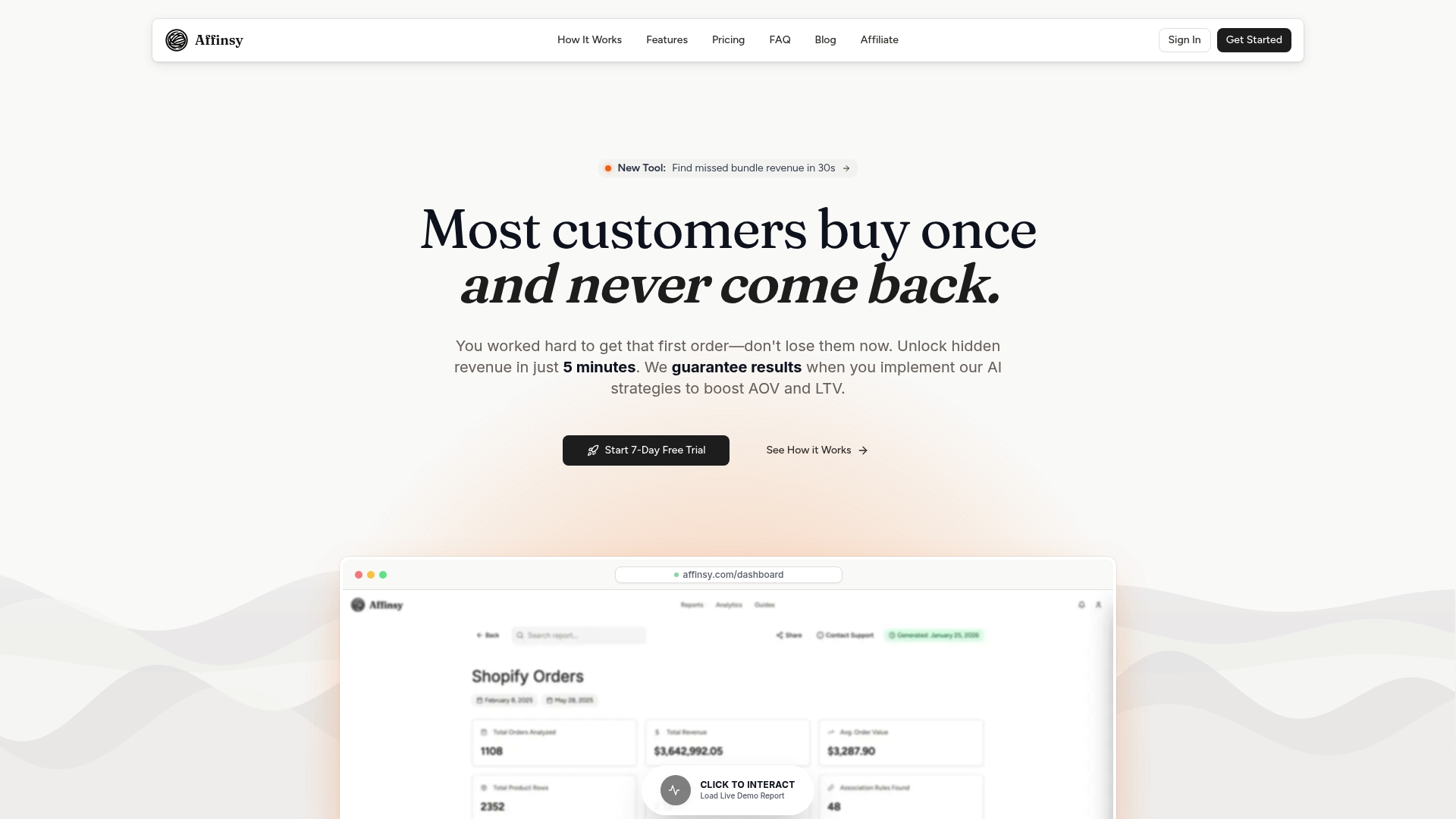
Start by exploring the customer segmentation glossary to sharpen your framework vocabulary, then dig into market basket analysis to uncover which products your best segments buy together. For teams ready to go further, Affinsy’s predictive analytics capabilities help you forecast segment behavior and get ahead of churn before it happens. The free tier supports up to 20,000 line items with no credit card required, so you can validate your segmentation strategy before committing to a paid plan.
Frequently asked questions
What is the most effective type of customer segmentation for e-commerce?
Behavioral segmentation often drives the best results because it adapts to real-time customer actions and preferences rather than relying on static profile data.
Can e-commerce brands combine different segmentation types?
Yes, and they should. Mixing demographic, psychographic, and behavioral segmentation yields more targeted campaigns, and layered segmentation consistently maximizes campaign effectiveness across the customer lifecycle.
How do you choose the best segmentation type for your store?
Match segmentation types to your brand goals, available data, and customer diversity. The complete e-commerce guide recommends starting with behavioral data if you have transaction history and layering from there.
Is geographic segmentation relevant for all online stores?
Geographic segmentation is most effective for brands with region-specific products or campaigns. Regionally tailored offers consistently drive higher conversions than generic promotions sent to all markets.
How can I collect psychographic data from e-commerce customers?
Use post-purchase surveys, analyze product reviews for recurring themes, and track wishlist behavior. Psychographic data from preference analysis gives you the motivational context that demographic and behavioral data alone cannot provide.
Recommended
- 7 Effective Customer Segmentation Examples for E-commerce - Affinsy Blog | Affinsy
- Customer Segmentation: Complete Guide for E-Commerce - Affinsy Blog | Affinsy
- Customer Segmentation Types: Complete Guide for E-commerce - Affinsy Blog | Affinsy
- Why segment customers: boost e-commerce sales in 2026 - Affinsy Blog | Affinsy
- Top 5 Etsy.com Alternatives in 2026 for Craft Enthusiasts – Gaurash Beauty Supply
- Build a Successful Construction Clothes Shop Online Today – WorkWearComfort