
TL;DR:
- Most e-commerce segmentation fails due to poor data foundation and skipping essential workflow steps.
- Effective segmentation relies on a solid data audit, integration, and ongoing optimization of segments.
- Automation of dynamic segments enables real-time personalization, significantly improving campaign performance and revenue.
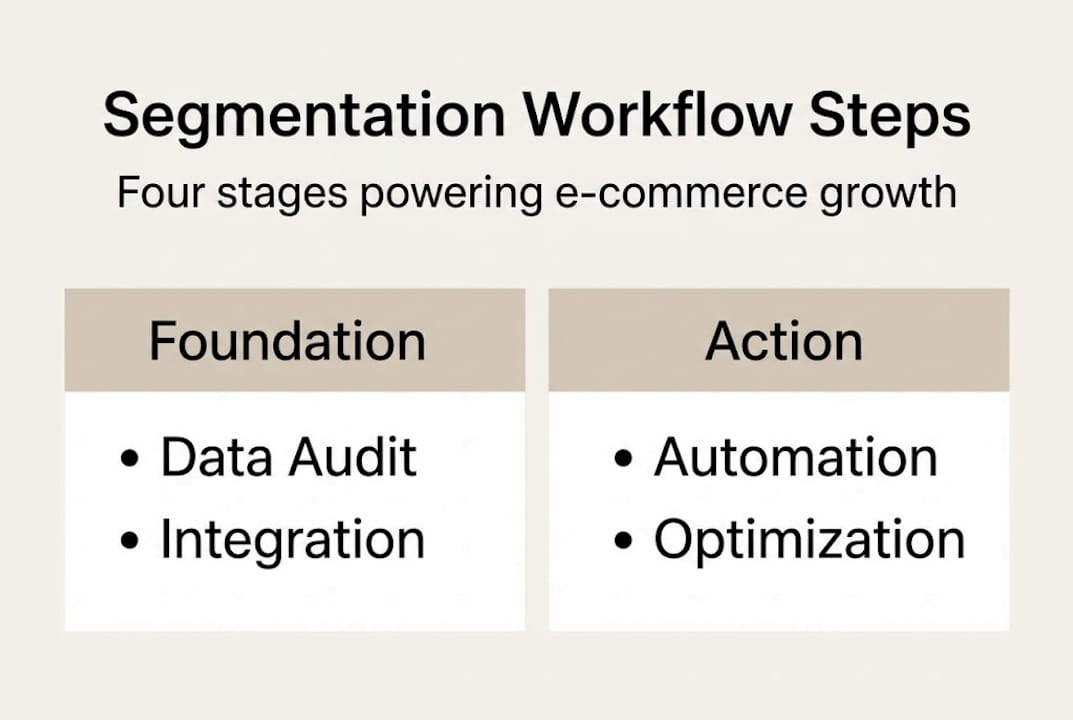
Most e-commerce brands attempt customer segmentation at some point. Very few do it well. 82% of e-commerce brands fail at segmentation not because they lack ambition, but because they skip critical workflow steps. They jump straight to campaign execution without building a solid data foundation or designing a feedback loop. The result? Campaigns that underperform, budgets that get wasted, and customer relationships that stagnate. This guide walks you through every essential phase of a reliable segmentation workflow, from data preparation to ongoing optimization, so your team can build a system that actually compounds over time.
Table of Contents
- Laying the groundwork: Data foundation and integration
- Building effective segment architecture: RFM, lifecycle stages, and beyond
- Automating segmentation: Dynamic workflows in action
- Activating and optimizing: Targeted campaigns and continuous improvement
- Why most segmentation workflows fail — and how to break the cycle
- Scale your segmentation success with expert tools and support
- Frequently asked questions
Key Takeaways
| Point | Details |
|---|---|
| Solid data foundation | A clean, integrated data set is the single biggest enabler for all segmentation success. |
| Segment with purpose | Use RFM and lifecycle stages to tie segments directly to business goals. |
| Automation drives impact | Set up dynamic segments and workflow automations to scale targeted campaigns efficiently. |
| Measure and optimize | Monitor campaign KPIs and regularly fine-tune segments for the highest returns. |
Laying the groundwork: Data foundation and integration
Before you create actionable segments, your data foundation must be truly solid. Skipping this phase is the single biggest reason segmentation projects collapse before they even launch. Customer segmentation workflows follow structured phases, and the data foundation sits at the very beginning for good reason.
Start with a data audit. This means identifying every touchpoint where customer data is generated: your e-commerce storefront, email platform, CRM, paid media accounts, loyalty programs, and customer support tools. Each of these systems holds a piece of the customer picture. The goal is to map all those pieces before you try to connect them. You need to know what data you have, where it lives, and whether it’s clean enough to use.
Data quality issues are more common than most teams realize. Duplicate customer records, inconsistent naming conventions, missing purchase timestamps, and untracked abandoned carts all corrupt your segmentation logic downstream. A practical audit checklist includes:
- Confirming all customer IDs are unique and consistent across systems
- Verifying that purchase dates, order values, and product SKUs are complete
- Checking that email addresses are formatted uniformly and deduplicated
- Identifying gaps in behavioral data, such as missing browse or click history
Once you’ve audited, integration becomes the priority. You need your e-commerce platform, CRM, and email tool talking to each other. Analytics for e-commerce platforms can bridge many of these gaps, but the underlying data still needs to be reliable before any tool can help. Below is a quick comparison of common integration approaches:
| Integration method | Best for | Key consideration |
|---|---|---|
| Native connectors | Small to mid stacks | Limited customization |
| API connections | Developer-resourced teams | Requires maintenance |
| CSV upload | Smaller or static datasets | Manual, time-sensitive |
| Middleware tools | Complex multi-system stacks | Added cost layer |
Understanding customer segmentation definitions at this stage helps align your whole team on what you’re building toward. It also prevents scope creep when stakeholders start requesting segments that your data simply cannot support.
“A segmentation system is only as smart as the data feeding it. Build your data architecture like it matters — because it does.”
Pro Tip: Schedule a data hygiene review every 60 days. Customer behavior shifts, new products get added, and your integrations can develop silent failures that corrupt data without any visible errors. Regular monitoring keeps your foundation strong.
Building effective segment architecture: RFM, lifecycle stages, and beyond
With data readiness achieved, you can now design meaningful segments that drive business action. Segment architecture, including RFM scoring and lifecycle stages, is the framework that turns raw transaction data into actionable customer groups.

RFM stands for Recency, Frequency, and Monetary value. Recency measures how recently a customer purchased. Frequency tracks how often they buy. Monetary value captures how much they spend in total. Each dimension gets scored, typically on a 1 to 5 scale, and the combination of those scores assigns a customer to a meaningful group. An RFM score of 5,5,5 is your champion buyer. A score of 1,1,1 is a lapsed customer who barely engaged. The power of RFM analysis is that it creates segments rooted in actual purchase behavior, not assumptions.
Here is a step-by-step process for building your RFM segments:
- Export your transaction data. Pull order history including customer ID, order date, order value, and item count for at least 12 to 24 months.
- Calculate each RFM metric. Compute days since last purchase (recency), total number of orders (frequency), and total spend (monetary) per customer.
- Assign scores. Divide each metric into quintiles and score each customer 1 to 5 for each dimension.
- Create composite segments. Combine scores into named groups: Champions, Loyal Customers, At-Risk, Lost, and New Customers.
- Map segments to lifecycle stages. Align each segment to where that customer sits in the buyer journey: acquisition, growth, retention, or reactivation.
- Set rules for segment transitions. Define exactly what score change moves a customer from one segment to another, so transitions happen automatically as behavior changes.
Here is a practical summary of segment types and their primary business uses:
| Segment | RFM profile | Primary use case |
|---|---|---|
| Champions | 5,5,5 | VIP campaigns, referral programs |
| Loyal customers | 4-5 across all | Upsell and cross-sell offers |
| At-risk customers | High F/M, low R | Win-back campaigns |
| New customers | Recent, low F/M | Onboarding and nurture series |
| Lost customers | 1,1,1 | Reactivation or suppression |
Explore RFM segmentation strategies in practice to see how direct-to-consumer brands use these groups to recover at-risk revenue. The Shopify retention playbook also shows how RFM maps directly to retention workflows for Shopify-based merchants.
Pro Tip: Don’t stop at pure RFM. Layer in custom dimensions like product category affinity, acquisition channel, or geographic region. A customer who is “at-risk” but exclusively buys seasonal items may not be lapsing — they may just be off-season. Context changes everything.
Automating segmentation: Dynamic workflows in action
With clear segment rules established, automation allows your strategy to scale and adapt effortlessly. This is where segmentation shifts from a quarterly reporting exercise into a living system that responds to customer behavior in real time.
A dynamic segment is one that automatically updates when a customer’s behavior changes. If a Champion’s recency score drops because they haven’t purchased in 90 days, they get moved to the At-Risk group automatically, and the appropriate campaign fires without any manual intervention. This is the core mechanic behind scalable personalization.
The contrast with static segments is significant. Static segments are snapshots, a list of customers who met a condition on a specific date. Dynamic segments are living filters. A customer who buys today doesn’t wait until your next manual export to enter the new customer welcome series. They enter it immediately.
Segmented cart recovery workflows achieve 52% better recovery rates than generic cart abandonment emails, and welcome series built on dynamic segments generate 3x more revenue than broadcast welcome blasts.
Key automation triggers to build into your workflows include:
- Welcome series trigger: First purchase or first signup event
- Abandoned cart trigger: Cart created but no purchase within a defined window (typically 1 to 4 hours)
- Churn risk trigger: Recency score drops below a set threshold
- Replenishment trigger: Time since last purchase of a consumable product equals average repurchase interval
- Post-purchase trigger: Order confirmed, initiating upsell or review request sequence
Here is a practical setup process for segment-based automations:
- Choose your automation platform. Klaviyo, Attentive, and Drip are popular for e-commerce. Your platform needs to accept dynamic list inputs.
- Define your trigger conditions. Be specific. “Recency drops below 2” is actionable. “Customer goes quiet” is not.
- Map the message sequence. Decide on the number of touchpoints, timing intervals, and channel mix (email, SMS, push).
- Personalize at the segment level. Use merge tags, product recommendations, and dynamic content blocks to tailor messaging by segment.
- Set suppression rules. Exclude customers who have already converted or who are in a conflicting campaign to avoid message fatigue.
- Monitor trigger fires. In the first two weeks, review how many customers are entering each automation to confirm your rules are working correctly.
Learning from automation in e-commerce growth shows how brands systematically apply these workflows at scale. For a broader process view, CRO workflow best practices align automation with conversion rate improvements across the full funnel.
Activating and optimizing: Targeted campaigns and continuous improvement
Automation is only powerful when paired with active campaign management and a feedback loop. Launching segmented campaigns is not the finish line. It’s the starting gun for the optimization phase.
Your campaign strategy should be mapped directly to each segment’s goal. Here is how that looks in practice:
- VIP and Champions: Exclusive early access to new products, loyalty rewards, and referral incentives. These customers have the highest lifetime value and respond to recognition.
- At-risk customers: A win-back series with a compelling offer, social proof, and urgency. The message should acknowledge the gap without being aggressive.
- New customers: An onboarding sequence that educates them about your catalog, sets expectations, and guides toward a second purchase.
- Lapsed customers: A lighter reactivation attempt, with a clear opt-down option. If they don’t respond after three touches, move them to suppression lists to protect deliverability.
Segmented emails generate a 40% or greater revenue lift compared to broadcast emails. That number changes how you justify segmentation investment to leadership. It’s not theoretical. It’s measurable.
The measurement framework matters as much as the campaigns themselves. Follow these steps to build your optimization loop:
- Define KPIs per segment. Revenue per recipient for Champions. Reactivation rate for lapsed customers. Second-purchase rate for new customers.
- Set reporting cadence. Weekly reviews for active campaigns. Monthly reviews for lifecycle performance.
- Run A/B tests continuously. Test subject lines, offer structures, send times, and message length. One variable at a time per test.
- Audit segment membership monthly. Are customers moving through stages as expected? Stagnant segments signal a rule or data problem.
- Feed results back into your segment definitions. If at-risk customers respond better to a different recency threshold, update the rule.
Explore how to reduce cart abandonment with segmented triggers to see what a well-optimized recovery workflow looks like. A step-by-step view of marketing campaigns for e-commerce rounds out the execution picture. For broader revenue impact, understanding why segmentation boosts sales builds the strategic case for sustained investment.
Pro Tip: The most common reason segmentation fails at the campaign stage is not a bad offer. It’s a skipped optimization cycle. Teams launch, see early results, and move on. The compounding gains come from iteration, not from the initial launch.
For additional execution frameworks, advanced store strategies cover how leading e-commerce brands combine segmentation with broader growth levers.
Why most segmentation workflows fail — and how to break the cycle
When we look at why segmentation projects stall, the conversation almost always goes to tools. Teams assume they need a better platform, a more sophisticated CRM, or a bigger data science budget. That framing is almost always wrong.
The real culprit is internal silos. Marketing owns campaign execution. Tech owns data infrastructure. Finance owns reporting. Nobody owns the workflow end to end. Each team does their part well, but the handoffs break down. A data team delivers clean segments. Marketing launches campaigns. Nobody closes the loop back to the data team with performance results. The segments never get refined. The system calculates once and then slowly decays.
Process discipline consistently beats tool sophistication. Teams that commit to every phase of their segmentation workflow, including the unglamorous work of data auditing, segment rule reviews, and post-campaign analysis, outperform teams that invest in premium tools but apply them inconsistently.
The in-depth retention guide shows how retention-focused brands structure their workflows to maintain discipline across every phase. The pattern is consistent: the brands that win are the ones where a single person or team owns the segmentation lifecycle from data to optimization.
Editorial pro tip: Leadership buy-in is often the single biggest differentiator between segmentation projects that scale and ones that stall. When a CMO or VP of Marketing actively reviews segmentation performance in monthly business reviews, teams prioritize the optimization work that compounds results over time.
Scale your segmentation success with expert tools and support
Ready to move from planning to action? Segmentation workflows are only as strong as the tools and data infrastructure behind them.
Affinsy is built for exactly this kind of work. The platform ingests your historical transaction data via API, CSV upload, or MCP, and surfaces RFM segmentation patterns and product association insights without requiring a data science team. Whether you’re on Shopify, WooCommerce, BigCommerce, or any system that produces transactional data, you can start building meaningful customer segmentation immediately. The permanent free tier covers up to 20,000 line items with no credit card required. Pro and Max plans unlock larger datasets and full API access for teams ready to scale.
Frequently asked questions
What is the most common reason customer segmentation fails in e-commerce?
The top reason is skipping key workflow steps, especially continuous optimization and data integration. 82% of brands fail segmentation by missing these phases rather than from poor campaign creative.
How much revenue can segmentation workflows actually boost?
Segmented emails produce a 40% or greater revenue lift, and segmented cart recovery workflows achieve 52% better results compared to generic abandoned cart messages.
What is a dynamic customer segment?
A dynamic segment auto-updates as customer behaviors change, which makes real-time automated personalization possible without manual list management.
Which workflows work best for e-commerce segmentation?
Welcome series, abandoned cart, and replenishment reminders are the three highest-performing segmentation-driven workflows, with welcome series generating up to 3x more revenue than unsegmented alternatives.
How often should you review and update your segmentation?
Quarterly reviews are the minimum to keep segmentation aligned with shifts in customer behavior and evolving business goals. High-volume brands benefit from monthly segment membership audits.
Recommended
- Optimize e-commerce with a data-driven marketing workflow - Affinsy Blog | Affinsy
- Customer segmentation explained: boost retention 2026 - Affinsy Blog | Affinsy
- Why segment online customers to boost e-commerce sales - Affinsy Blog | Affinsy
- Customer Segmentation: Complete Guide for E-Commerce - Affinsy Blog | Affinsy