
TL;DR:
- Automation in e-commerce analytics streamlines data workflows, improving decision quality and speed.
- Successful automation requires workflow redesign, not just tool implementation, with strong governance.
- Hybrid human-machine systems are vital to handle complex, irregular, or long-tail data scenarios effectively.
Automation in analytics is one of the most misread shifts happening in e-commerce right now. Most teams assume it simply replaces manual spreadsheet work, freeing up a few hours per week. The reality is more complex and far more valuable. When applied strategically, automation restructures how your entire analytics workflow operates, from data ingestion to insight delivery, changing not just speed but the quality of decisions your team can make. This guide breaks down what automation actually does for customer retention and product optimization, where it falls short, and how to build a system that sustains long-term gains.
Table of Contents
- How automation transforms analytics in e-commerce
- Core benefits: Driving customer retention and product optimization
- Edge cases, exceptions, and the limits of automation
- Best practices: Implementing and scaling automation in analytics
- Why workflow redesign, not just automation, is the real competitive edge
- Delivering smarter analytics automation with Affinsy
- Frequently asked questions
Key Takeaways
| Point | Details |
|---|---|
| Automation amplifies analytics | It streamlines repetitive tasks, empowering teams to focus on strategic decision making for e-commerce growth. |
| Human oversight is essential | Edge cases and exceptions require governance and contextual judgment, ensuring analytics automation delivers real value. |
| Workflow redesign beats isolated tools | End-to-end process integration unlocks more value than simply automating individual analytics tasks. |
| Continuous improvement needed | Scaling automation in analytics requires constant monitoring and adjustment to adapt to new data and business goals. |
How automation transforms analytics in e-commerce
The first thing automation does in an analytics workflow is remove the bottlenecks that slow everything down. Manual data pulls, report formatting, and scheduled exports consume analyst time that could go toward interpretation and strategy. When you automate retail analytics, you shift your team’s focus from producing data to acting on it.
This shift matters more than it sounds. Analysts who spend less time on data wrangling can spend more time on the questions that actually drive revenue: Why did conversion drop in a specific segment? Which product pairings are underperforming relative to their traffic? What does the retention curve look like for customers acquired through paid versus organic channels? These are judgment calls, not calculation problems.
Here is what automation genuinely handles well in an e-commerce analytics stack:
- Real-time data refresh across dashboards and reports
- Scheduled cohort updates for RFM segmentation and customer lifecycle tracking
- Anomaly flagging when KPIs move outside expected ranges
- Automated report distribution to stakeholders without manual intervention
- Trend detection across large SKU catalogs faster than any manual review
But automation has a ceiling. As AI-driven analytics trends continue to evolve, the risk is that teams mistake speed for intelligence. Automation excels in repetitive tasks but cannot replace the judgment needed to interpret outliers, seasonal anomalies, or data quality issues. It can even intensify workload if it generates more iterations than your team can meaningfully act on.
Pro Tip: The real transformation comes from workflow integration, not tool adoption. Connecting automated outputs directly to decision workflows, not just dashboards, is what drives measurable business outcomes.
The businesses that benefit most from automation are those that treat it as a workflow redesign problem, not a software problem. When data-driven decisions are embedded in automated pipelines, the entire organization moves faster and with more consistency.
Core benefits: Driving customer retention and product optimization
Once your analytics workflow is automated, the two areas that see the most immediate lift are customer retention and product performance. Both depend on pattern recognition at scale, which is exactly where automation earns its place.

Customer retention through automated segmentation
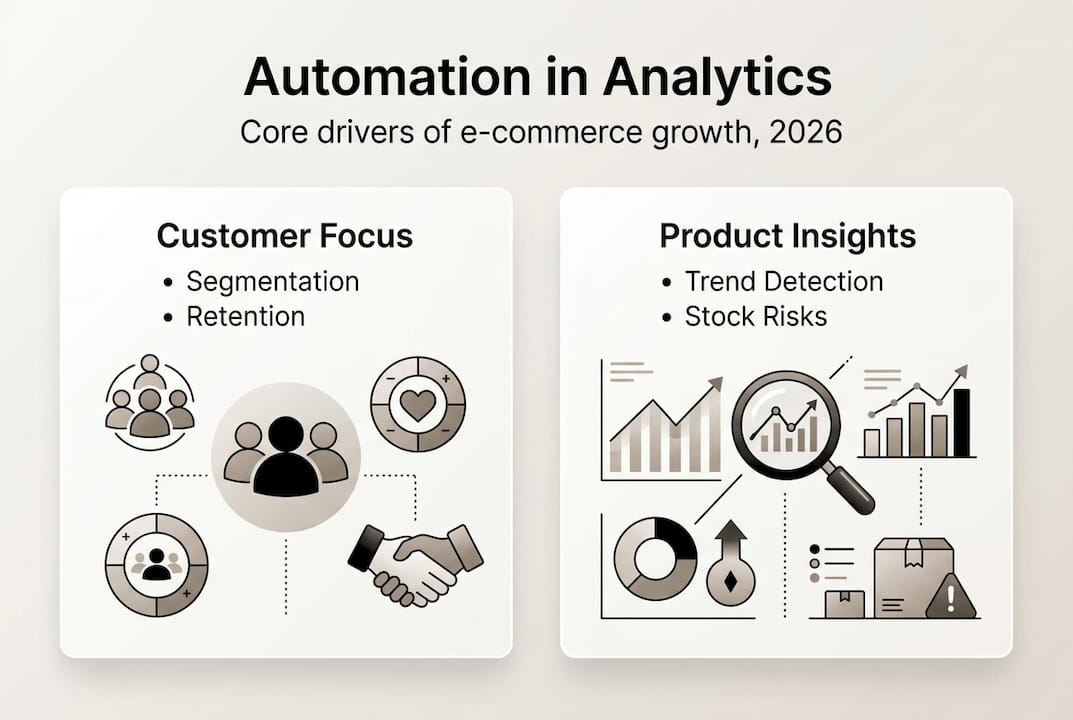
Automated cohort analysis lets you track how different customer groups behave over time without rebuilding the analysis from scratch each month. RFM segmentation (Recency, Frequency, Monetary value) updated in real time means your retention campaigns are always targeting the right tier. A customer who drops from high-frequency to low-frequency buying triggers an alert, not a monthly report.
Product optimization through trend detection
Automated analytics surfaces opportunity gaps and overstock risks faster than manual review. When you connect sales data analysis to automated trend detection, you catch underperforming SKUs before they become margin problems. You also spot rising demand signals earlier, which matters for inventory planning and bundling strategy.
Here is a comparison of outcomes before and after workflow automation:
| Metric | Manual workflow | Automated workflow |
|---|---|---|
| Segmentation refresh rate | Monthly | Real-time or daily |
| Anomaly detection lag | 3 to 7 days | Same day |
| Report generation time | 4 to 8 hours | Under 30 minutes |
| Analyst time on strategy | 20% of week | 60%+ of week |
| Campaign personalization depth | Broad segments | Micro-segments |
The true value comes from end-to-end workflow redesign, not isolated tools. A business that automates only its reporting layer but keeps manual processes for exception handling and campaign activation will hit a ceiling quickly.
Pro Tip: When evaluating retail bundling analytics, look for platforms that surface association rules automatically, so your merchandising team sees cross-sell opportunities without running manual queries.
Governance is the part most teams skip. Automated systems need exception management built in, clear rules for when a human reviews flagged data, and periodic audits to confirm the automation is still producing accurate outputs. Without this, the automation ceiling arrives faster than expected.
Edge cases, exceptions, and the limits of automation
No automation system handles every scenario cleanly. The further you push automation into complex or irregular data, the more its limits show.
Where automation struggles most:
- Long-tail SKUs with sparse transaction history produce unreliable trend signals
- Irregular sales patterns caused by promotions, seasonality, or supply disruptions confuse forecasting models
- Poor data quality from mismatched product IDs, duplicate orders, or missing timestamps amplifies errors
- Privacy-related data gaps where customer records are incomplete by design
Long-tail SKUs and irregular sales challenge forecasting because automation amplifies exceptions without human judgment. A model that sees three orders for a niche product over six months cannot reliably predict demand. Without oversight, it either over-orders or ignores the product entirely.
“We keep trying to automate the thing that was never a machine. Some decisions require context that no algorithm currently holds.”
The fix is a hybrid model: automation handles volume and speed, humans handle judgment and exceptions. Here is a practical framework for managing sales data analysis edge cases:
Stepwise exception handling framework:
- Define thresholds for what counts as an exception (e.g., SKUs with fewer than 10 transactions per quarter)
- Flag automatically when data falls outside normal ranges
- Route exceptions to the appropriate analyst or category manager
- Document decisions made on flagged items to improve future rule sets
- Review governance rules quarterly to keep them aligned with business changes
| Approach | Speed | Accuracy on exceptions | Scalability |
|---|---|---|---|
| Fully automated | High | Low | High |
| Fully manual | Low | High | Low |
| Hybrid (automation + human review) | High | High | High |
The hybrid model is not a compromise. It is the correct architecture for any e-commerce analytics system that deals with real-world data complexity.
Best practices: Implementing and scaling automation in analytics
Implementing automation without a plan produces noise, not insight. Here is a practitioner’s approach to getting it right from the start.
Step-by-step implementation framework:
- Identify your highest-impact workflows first. Segmentation refresh, anomaly detection, and report distribution are usually the best starting points.
- Audit your data quality before automating anything. Garbage in, garbage out applies more aggressively when automation runs at scale.
- Start narrow, then expand. Automate one workflow end-to-end before adding the next. This limits failure surface and makes debugging easier.
- Build exception reporting into every automated workflow from day one, not as an afterthought.
- Measure business outcomes, not automation metrics. Tracking how many reports run automatically is less useful than tracking whether retention rates improved.
Choosing the right tools matters too. When reviewing ecommerce analytics platforms, prioritize platforms that support workflow integration, not just dashboard automation. The goal is to connect insights to actions, not just display them.
Key governance practices to build in from the start:
- Assign ownership for each automated workflow (who reviews exceptions, who updates rules)
- Schedule quarterly audits of automation accuracy and business alignment
- Document rule sets so institutional knowledge does not live only in the algorithm
- Create feedback loops where analyst decisions on exceptions improve future automation
The end-to-end workflow redesign principle applies here too. Isolated automation tools create isolated gains. When you redesign the full workflow around automation, from data input to decision output, the compounding effect on efficiency and accuracy is significant.
Pro Tip: When exploring retail analytics implementation, map your current decision workflows before selecting tools. The best platform is the one that fits how your team actually makes decisions, not the one with the most features.
Scaling comes after you have proven the model works at a smaller scope. Use marketing analytics trends to benchmark your automation maturity against what leading e-commerce teams are doing, and set realistic milestones for expanding scope.
Why workflow redesign, not just automation, is the real competitive edge
Most e-commerce teams treat automation as a feature upgrade. They add a tool, automate a report, and call it a transformation. The dashboard looks better. The meeting prep takes less time. But the decisions being made are the same ones, made the same way, just faster.
The businesses pulling ahead are not the ones with the most automated dashboards. They are the ones that have redesigned how decisions flow through the organization. They have built systems where retail bundling insights automatically surface to merchandising, where retention alerts trigger campaign workflows without a meeting, where exception management is a defined process rather than a reactive scramble.
This is the uncomfortable truth about automation in analytics: speed without structure creates confident mistakes at scale. The teams that sustain analytics gains are the ones that have invested as much in governance and decision design as they have in tooling. Human oversight is not a weakness in the system. In fast-changing markets, it is the only thing that keeps automated outputs honest.
Delivering smarter analytics automation with Affinsy
If the frameworks in this article resonate, Affinsy is built to put them into practice. The platform applies AI-powered analytics to your historical transaction data, surfacing market basket analysis patterns and RFM segmentation insights without requiring data science expertise.
For teams focused on product bundling and cross-sell optimization, Affinsy automates the pattern detection that typically takes analysts days to produce manually. You connect via API, CSV upload, or MCP, and the platform handles the rest. The Affinsy platform offers a permanent free tier for up to 20K line items, with Pro and Max plans for larger datasets and API access. No credit card required to start.
Frequently asked questions
What types of e-commerce analytics benefit most from automation?
Customer segmentation, inventory trend tracking, and campaign reporting see the strongest gains, since these workflows involve repetitive, high-volume tasks that automation handles reliably, freeing analysts for strategic interpretation.
How can automation handle long-tail SKUs or irregular sales patterns?
It often cannot do so reliably on its own. Long-tail SKUs and irregular patterns require human oversight to review flagged exceptions and refine the rule sets that govern automated outputs.
What is the automation ceiling in analytics?
The automation ceiling is the point where adding more automation delivers diminishing returns, typically because exception handling and governance have not been designed into the workflow.
Is pure automation enough for e-commerce analytics success?
No. Coordination and human judgment are essential for catching outliers, managing exceptions, and ensuring that automated outputs remain aligned with real business conditions over time.
Recommended
- Why automate retail analytics for smarter ecommerce in 2026 - Affinsy Blog | Affinsy
- Analytics trends in 2026: AI boosts ecommerce sales 95% ROI - Affinsy Blog | Affinsy
- Ecommerce Analytics Trends 2026: Unlocking Growth Through AI - Affinsy Blog | Affinsy
- Marketing analytics trends 2026: optimize ecommerce sales - Affinsy Blog | Affinsy
- Amazon Analytics: Unlocking Sales Growth Globally - Searchoneers