
Choosing the right retail analytics feels overwhelming when dozens of platforms promise better product bundling and customer retention. You face endless dashboards, conflicting metrics, and limited clarity on which data actually drives revenue. This checklist cuts through the noise, giving you a focused framework to evaluate analytics tools and metrics that directly increase average order value and customer loyalty for your e-commerce store.
Table of Contents
- Selection Criteria For Retail Analytics Tools
- Key Metrics For Product Bundling And Customer Retention
- Product Bundling Optimization Techniques
- Comparison Of Retail Analytics Tools
- Situational Recommendations For Applying Retail Analytics
- Optimize Your Retail Analytics With Affinsy Solutions
Key takeaways
| Point | Details |
|---|---|
| Clear selection criteria boost bundling success | Focus on real-time analysis, seamless integrations, and user-friendly interfaces when choosing retail analytics tools. |
| Track essential metrics for retention and AOV | Monitor GA4 ecommerce events, RFM segmentation, conversion rates, and AOV uplift from bundling efforts. |
| Complementary bundles raise AOV significantly | Well-matched product combinations can increase average order value by 20-50% through natural buying patterns. |
| Regular review cadence keeps strategies agile | Weekly analytics checks and monthly deep-dives enable rapid response to market changes and customer behavior shifts. |
| Tool choice depends on business scale | SMBs benefit from integrated Shopify Analytics while enterprises need advanced platforms like Looker or Sisense. |
Selection criteria for retail analytics tools
You need the right tool to unlock actionable insights from your transaction data. The retail data analytics market is growing from $7.73 billion in 2025 to $11.97 billion by 2030, creating both opportunity and confusion as dozens of platforms compete for your attention. Focus on these critical criteria to cut through the marketing noise.
Start with data capabilities. Your tool must analyze both real-time customer behavior and historical transaction patterns to identify product associations. Look for platforms that surface hidden relationships between items your customers buy together, not just basic sales reports.
Integration determines success or frustration. The best analytics tools connect seamlessly with your existing tech stack, particularly Shopify, WooCommerce, and Google Analytics. Data silos kill productivity and accuracy, so prioritize native integrations over tools requiring complex API work.
User experience matters more than you think. Marketing managers and store owners need AI analytics tools for e-commerce that deliver insights without requiring data science degrees. Dashboards should be intuitive, reports should be actionable, and recommendations should be clear enough to implement immediately.
Balance cost against value carefully:
- Small stores (under $500K annual revenue): Focus on affordable, integrated solutions with essential bundling features
- Mid-market businesses ($500K to $5M): Invest in AI-powered platforms offering advanced segmentation and predictive analytics
- Enterprise operations (over $5M): Consider robust BI tools with custom reporting and multi-source data integration
- Growth-stage companies: Prioritize scalable pricing models that won’t break your budget as transaction volume increases
Key metrics for product bundling and customer retention
Metrics transform raw data into revenue decisions. Track the wrong numbers and you waste time optimizing things that barely move the needle. Focus on these essential KPIs that directly impact your bundling strategy and retention efforts.
Google Analytics 4 Enhanced Ecommerce events provide the foundation. Monitor product views, add-to-cart actions, checkout initiations, and purchase completions to understand your customer journey. These events reveal where shoppers abandon their carts and which product pages generate the most engagement before purchase.
Customer acquisition cost (CAC) and retention rates determine profitability over time. New customers cost five times more than retaining existing ones, making retention metrics crucial for sustainable growth. Calculate your CAC by dividing total marketing spend by new customers acquired, then compare against customer lifetime value.
RFM (Recency, Frequency, Monetary) segmentation identifies your most valuable customer groups. This framework scores customers based on how recently they purchased, how often they buy, and how much they spend. High-scoring segments deserve personalized bundling offers and retention campaigns.
Average order value (AOV) uplift measures bundling effectiveness directly. Track AOV before and after implementing product bundles to quantify their impact. Calculate AOV by dividing total revenue by number of orders, then segment by customer type and product category for deeper insights.
Conversion rates and repeat purchase frequency reveal retention health:
- Overall conversion rate shows how many visitors become buyers
- Bundle-specific conversion rates indicate which combinations resonate
- Repeat purchase rate within 90 days signals customer satisfaction
- Time between purchases helps predict when to send re-engagement campaigns
- Churn rate identifies at-risk customers who need immediate attention
Product bundling optimization techniques
Data-driven bundling strategies transform average transactions into high-value purchases. The right combinations feel intuitive to customers while dramatically increasing your revenue per transaction. Start with your existing sales data to uncover natural buying patterns.

Product affinity analysis reveals which items customers frequently purchase together. Mine your transaction history to identify these relationships, then create bundles around the strongest associations. Items bought together in 15% or more of orders make excellent bundle candidates.
Complementary bundles increase AOV by 20-50% by matching products that solve related problems or enhance each other. A yoga mat bundled with blocks and a strap makes sense because customers need all three items for effective practice. This approach reduces decision fatigue while increasing perceived value.
Mixed bundling models give customers flexibility while encouraging larger purchases. Offer bundles at a discount compared to individual items, but still allow separate purchases. This strategy captures both bundle buyers and customers who only want specific items.
Prioritize bundles based on gross margin data to maximize profit. High-margin items paired with moderate-margin products create profitable combinations while maintaining attractive pricing. Calculate potential profit for each bundle before promoting it heavily.
Test bundles continuously through A/B experiments. Try different product combinations, pricing strategies, and presentation formats to find what resonates with your specific audience. Give each test at least two weeks and 100 transactions before drawing conclusions.
Pro Tip: Analyze cart abandonment data to identify near-miss bundles. When customers add multiple items but don’t complete checkout, those combinations reveal natural interest you can formalize into promoted bundles with better pricing.
Successful bundling requires ongoing refinement:
- Review bundle performance weekly to catch declining interest early
- Rotate seasonal items in and out of bundles based on demand
- Create exclusive bundles for high-value customer segments
- Use scarcity tactics like limited-time bundle offers to drive urgency
- Monitor competitor bundling strategies to identify market opportunities
Comparison of retail analytics tools
You need a clear picture of available platforms to make an informed choice. Retail analytics platforms like Shopify, Looker, and Sisense each serve different business needs with varying complexity and cost structures. This comparison helps you match platform capabilities to your specific requirements.
| Platform | Best For | Key Features | E-commerce Integration | User Accessibility | Pricing Range |
|---|---|---|---|---|---|
| Shopify Analytics | SMBs on Shopify | Real-time dashboards, sales reports, customer insights | Native Shopify only | Very easy, no training needed | Included with Shopify plans |
| Looker | Large enterprises | Predictive analytics, custom data modeling, advanced BI | Requires API integration with Shopify/WooCommerce | Requires technical skill | $3,000+ monthly |
| Sisense | Mid to large businesses | AI-powered insights, multi-source integration, embedded analytics | Good API support for major platforms | Moderate learning curve | $1,000-2,500 monthly |
| Daasity | E-commerce focused | Product affinity analysis, bundle visualization, RFM segmentation | Strong Shopify/WooCommerce support | Easy for marketing teams | $500-1,500 monthly |
| Google Analytics 4 | All business sizes | Free web analytics, ecommerce tracking, audience segmentation | Requires setup with any platform | Moderate complexity | Free (premium at $50K+ annually) |
Shopify Analytics delivers fast insights for store owners who need immediate visibility without technical complexity. The platform provides essential metrics like sales trends, top products, and customer behavior directly within your admin dashboard. However, it lacks advanced segmentation and predictive capabilities needed for sophisticated bundling strategies.
Looker powers enterprise-grade business intelligence with deep customization options. Data teams can build complex models incorporating inventory, CRM, and financial data alongside sales metrics. The platform excels at predictive analytics but requires dedicated analysts to maximize its potential.
Sisense bridges the gap between ease of use and advanced capabilities through AI-powered insights. Marketing managers can explore data through natural language queries while technical users build custom dashboards. Its strength lies in combining data from multiple sources without extensive coding.
Daasity specializes in e-commerce product relationships and bundling optimization. The platform visualizes which items customers buy together and suggests bundle opportunities based on your actual transaction data. This focus makes it ideal for stores prioritizing bundling and market basket analysis over broad business intelligence.
Situational recommendations for applying retail analytics
Your business context determines which analytics approach delivers the fastest ROI. A startup with 50 daily orders needs different tools than an enterprise processing 5,000 transactions. Match these recommendations to your specific situation for immediate impact.
Start with Shopify Analytics if you run a small to mid-size Shopify store and need quick wins without technical overhead. The native integration means zero setup time, and the dashboard provides sufficient insights for basic bundling decisions. Upgrade to specialized tools once you hit $1M in annual revenue or need deeper customer segmentation.
Enterprise operations requiring predictive modeling and advanced forecasting should invest in Looker or similar BI platforms. These tools justify their cost when you have dedicated data analysts who can build custom models incorporating inventory planning, demand forecasting, and sophisticated customer lifetime value calculations.
SMBs seeking AI-powered affinity analysis without data science teams benefit most from specialized platforms like Daasity. These tools automate the heavy lifting of finding product relationships and surface actionable bundle recommendations within days of connecting your store data.
Mixed bundling models suit businesses with diverse product catalogs where customers have varying needs. Offer curated bundles at discounts while maintaining individual product availability. This flexibility increases customer satisfaction by letting shoppers customize their purchases while still encouraging larger basket sizes.
Establish a weekly analytics review cadence to stay agile in competitive markets. Schedule 30 minutes every Monday to check bundle performance, customer retention metrics, and AOV trends. Monthly deep-dives should examine longer-term patterns and inform strategic adjustments to your bundling and retention programs.
Pro Tip: Prioritize tools that integrate directly with your existing e-commerce platform to avoid data silos. Manual data exports and spreadsheet analysis waste time and introduce errors that undermine decision quality. Seamless integration means you spend time acting on insights rather than preparing data.
Actionable steps to implement today:
- Audit your current analytics setup to identify gaps in bundling and retention metrics
- Choose one AI analytics solution for retention based on your business size and technical resources
- Set up automated weekly reports for your core KPIs to eliminate manual tracking
- Create your first three test bundles based on product affinity data from the past 90 days
- Schedule your first monthly analytics review meeting with key stakeholders
Optimize your retail analytics with Affinsy solutions
Transform your transaction data into revenue growth with purpose-built analytics designed for e-commerce success. Affinsy’s AI-powered platform analyzes your historical sales to uncover hidden product relationships and customer segments you’re missing right now.
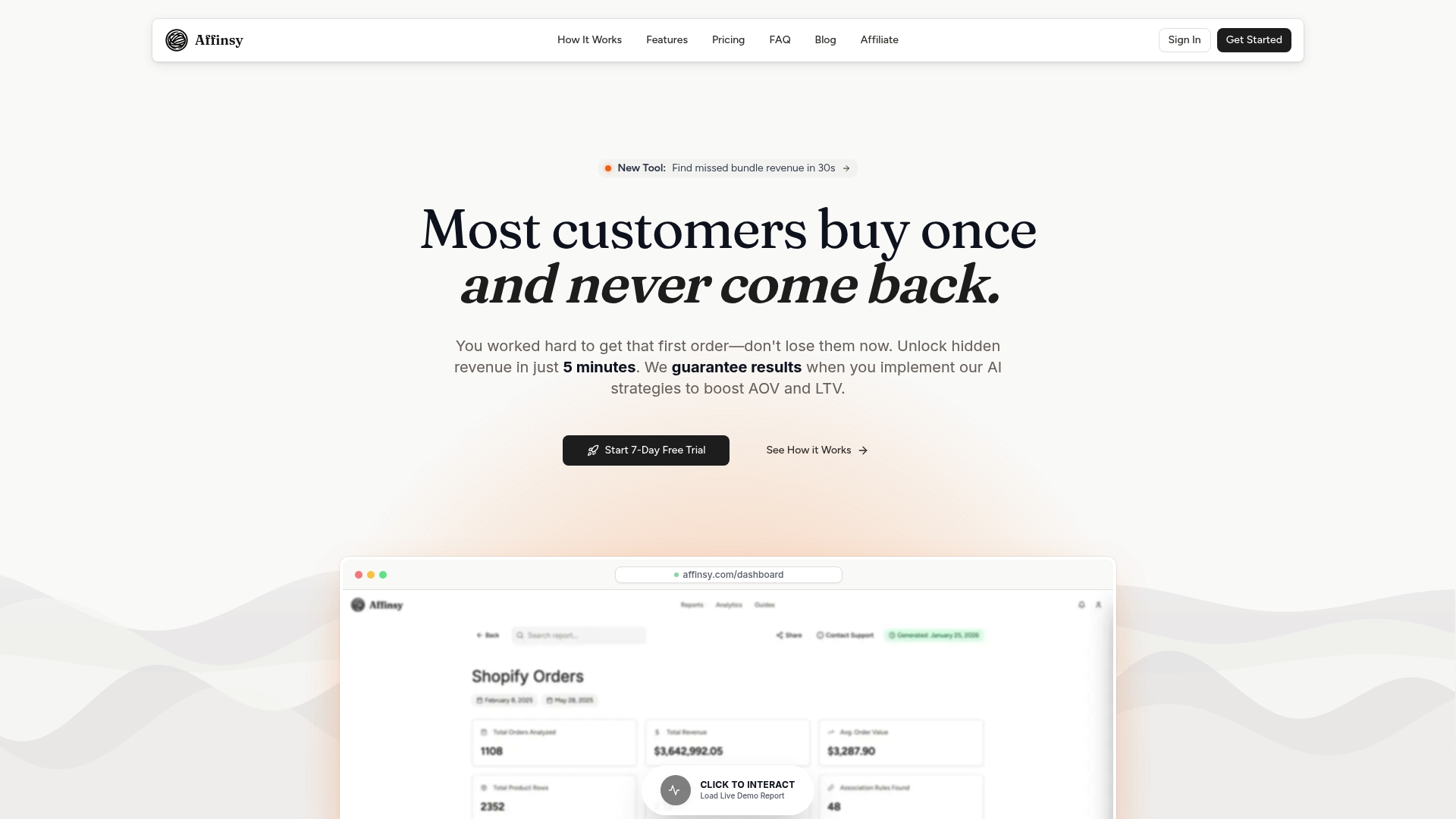
You get market basket analysis that reveals which products your customers naturally buy together, plus RFM segmentation that identifies your most valuable shoppers. These insights translate directly into profitable bundles and targeted retention campaigns that increase both AOV and customer lifetime value. The platform integrates seamlessly with Shopify, WooCommerce, and Google Analytics, eliminating data silos that slow down decision making.
Explore how AI transforms ecommerce analytics to understand the technology powering smarter bundling decisions. Discover why leading retailers achieve 20% sales boosts through AI-driven retention strategies. Review the best AI analytics tools for 2026 to see how Affinsy compares against alternatives. Start optimizing your retail analytics today and turn your existing customer data into your strongest competitive advantage.
FAQ
What is a retail analytics checklist and why is it vital for e-commerce?
A retail analytics checklist is a prioritized framework of metrics and tools that focus your data efforts on activities driving revenue. It ensures you track KPIs directly linked to sales growth and customer loyalty rather than vanity metrics that look impressive but don’t impact your bottom line. Following a structured checklist prevents analysis paralysis and helps you make faster, more confident decisions about product bundling and retention strategies.
How often should I review my retail analytics data to optimize product bundles?
Weekly reviews keep you responsive to performance changes and allow quick adjustments to underperforming bundles. These 30-minute check-ins should focus on conversion rates, AOV changes, and immediate customer feedback. Monthly deep-dives enable strategic planning by revealing longer-term trends in customer behavior, seasonal patterns, and segment shifts that inform your next quarter’s bundling strategy.
Which retail analytics tools integrate best with Shopify and WooCommerce?
Shopify Analytics provides native integration for Shopify stores with zero setup required, delivering immediate insights through built-in dashboards. Daasity and Sisense offer strong integration with both Shopify and WooCommerce through robust APIs and pre-built connectors that sync data automatically. Looker suits enterprises needing advanced, multi-source integrations that combine e-commerce data with ERP, CRM, and financial systems for comprehensive business intelligence.
What are common pitfalls when using retail analytics for e-commerce?
Ignoring recent data by relying on outdated reports leads to missed opportunities as customer preferences shift rapidly. Choosing tools without proper integration creates data silos that force manual exports and reconciliation, wasting hours each week. Tracking too many irrelevant metrics causes confusion and delays action by overwhelming teams with information that doesn’t drive decisions. Focus exclusively on actionable KPIs tied directly to bundling performance and retention rates to avoid these productivity killers.
Recommended
- How to Improve Average Order Value with Data-Driven Bundling - Affinsy Blog | Affinsy
- Importance of Bundles for Agentic Commerce Success - Affinsy Blog | Affinsy
- Basket Analysis Agentic Commerce: Smarter Bundling - Affinsy Blog | Affinsy
- Ecommerce Analytics Trends 2026: Unlocking Growth Through AI - Affinsy Blog | Affinsy
- Sales Reporting from Samtouch Back Office Solution