
TL;DR:
- Static customer segmentation models are outdated and miss real-time behavioral insights.
- AI-powered segmentation updates automatically, providing more precise, predictive customer groups.
- Hybrid approaches combining RFM and AI deliver the best results for personalized marketing and revenue growth.
Automated behavioral segmentation increases revenue per customer by 30% within six months compared to demographic methods, yet most mid-to-large e-commerce brands are still running campaigns off static customer buckets that haven’t changed since last year. The gap between what today’s AI-powered segmentation can do and what most teams actually use is enormous, and that gap is costing you real money. This guide breaks down why simple segmentation fails, how AI transforms it, and exactly how to apply these strategies to product bundling and customer retention programs that move the needle.
Table of Contents
- Why simple segmentation falls short in modern e-commerce
- How AI-powered segmentation transforms customer insights
- Operationalizing segmentation: Strategies for product bundling and retention
- Best practices and common pitfalls in AI-driven segmentation
- Our take: Why nuanced, hybrid segmentation beats automation alone
- Next steps: Take action on smarter customer segmentation
- Frequently asked questions
Key Takeaways
| Point | Details |
|---|---|
| AI boosts revenue fast | Moving from static to AI-driven behavioral segmentation can improve per-customer revenue by 30% in just six months. |
| Hybrid segmentation wins | Combining RFM and AI behavioral models outperforms using either alone by 3-5x. |
| Bundling lifts retention | Segment-driven product bundling increases average order value by up to 35% and customer retention by 40%. |
| 6-8 segments is optimal | Focusing on 6-8 well-defined segments captures most of the revenue impact and keeps execution practical. |
| Human and AI, not either-or | AI powers dynamic segmentation, but human oversight ensures alignment with business strategy. |
Why simple segmentation falls short in modern e-commerce
Basic segmentation still has genuine appeal. Splitting customers by age, location, or purchase history is fast, easy to explain to stakeholders, and requires no technical lift. RFM segmentation, which groups customers by recency, frequency, and monetary value, adds more texture and has been a reliable workhorse for email marketers for decades. The problem is that neither approach keeps up with how customers actually behave today.
A customer who bought from you three times last year and then went quiet for four months looks “at-risk” in a standard RFM model. But that same customer might have been quietly browsing your highest-margin categories every week, clicking through social ads, and adding items to their wish list. A static RFM score misses all of that. You send them a discount that eats your margin when they were probably going to buy anyway.
This is the core failure: static segments cannot adapt to real-time behavior changes. Your customers are not the same person they were six months ago. Their financial situation, preferences, and product needs shift constantly, and a segment built in January cannot capture the person they are in July. You end up making decisions based on outdated snapshots rather than living data.
The signals buried in your data are also far richer than demographic or RFM filters can surface. Consider the segmentation and retention math: the customers who buy two specific product categories together have dramatically different lifetime value profiles than those who only buy one. No basic RFM model surfaces that automatically. And that’s just one example of the nuance being left on the table.
Here are the core limitations that make simple segmentation problematic at scale:
- Static by design. Segments don’t update when customer behavior changes, leading to irrelevant messaging.
- Ignores behavioral context. Browsing patterns, wish lists, and abandoned carts are invisible to demographic or pure RFM models.
- Treats all “active” customers the same. A customer who buys monthly out of habit and one who buys monthly because they’re in your loyalty program need very different treatment.
- Can’t predict. Traditional segmentation tells you what happened, not what’s likely to happen next.
“Traditional RFM is simple and intuitive but static and nuance-losing. AI is dynamic and predictive but requires quality data integration. The hybrid approach, combining RFM with behavioral and AI signals, outperforms either method alone by 3 to 5 times.”
The reasons to segment your customer base go far deeper than just personalizing email subject lines. Segmentation drives which products to bundle together, which customers to prioritize for retention spend, and which audiences to exclude from discount campaigns entirely. When your segmentation model is weak, every downstream decision built on it is also weak.
How AI-powered segmentation transforms customer insights
Given these shortcomings, let’s examine what AI-powered segmentation actually does differently.
AI segmentation uses machine learning algorithms like K-means and DBSCAN clustering to group customers based on behavioral patterns, purchase history, browsing, and engagement data. Unlike traditional methods, these dynamic segments update automatically as new data flows in, which means a customer who suddenly starts buying premium products gets reclassified into a high-value segment in real time rather than waiting for your next quarterly analysis.
K-means clustering works by assigning each customer to the nearest “centroid” in a multi-dimensional data space, where each dimension is a behavioral variable (average order value, purchase frequency, product category affinity, days since last visit, and so on). DBSCAN, which stands for Density-Based Spatial Clustering of Applications with Noise, is particularly good at finding irregular-shaped clusters and identifying outliers who don’t fit any main segment. Both approaches reveal groupings that human analysts would never spot by looking at spreadsheets.
The business impact becomes concrete when you look at real examples. Amazon’s behavior-driven segmentation of Prime members shows roughly 10x customer lifetime value (CLV) compared to non-Prime customers, a gap that exists because Prime membership itself changes behavior, and AI segments can detect and act on those behavioral signals at scale. For your brand, identifying which non-Prime-equivalent customers are exhibiting Prime-like engagement patterns gives you a target list for loyalty program conversion that RFM alone would never surface.
Here is a comparison of static versus AI-powered segmentation across key operational dimensions:
| Dimension | Static / RFM segmentation | AI-powered segmentation |
|---|---|---|
| Update frequency | Manual, periodic | Automatic, real-time |
| Data inputs | Purchase history, demographics | Behavior, browsing, engagement, purchase |
| Segment count | 3 to 5 broad buckets | 6 to 12 precise clusters |
| Predictive capability | None | Churn risk, next purchase, LTV projection |
| Personalization depth | Moderate | High |
| Operational complexity | Low | Medium (depends on tooling) |
The most actionable AI-generated segments for e-commerce brands tend to fall into a few recurring categories:
- VIP customers. High recency, high frequency, high spend. These customers represent the top 10% of your base but often generate 40 to 50% of revenue. Treat them with early access, exclusive bundles, and proactive retention outreach.
- Rising stars. Recent, growing purchase frequency. These are the future VIPs. AI models can identify them before your marketing team would manually spot them, giving you a critical window to deepen loyalty.
- At-risk customers. Behavioral signals show declining engagement before purchase frequency actually drops. AI catches them 4 to 6 weeks earlier than RFM, giving you time to intervene.
- One-and-done buyers. These customers bought once and never returned. Understanding which products triggered single purchases helps you design better post-purchase sequences and bundle offers.
Pro Tip: Start with just three priority segments for your first AI-powered campaign: VIPs, rising stars, and at-risk customers. These three groups alone typically represent 60 to 70% of your total revenue impact, so early wins here fund your investment in expanding the model.
Operationalizing segmentation: Strategies for product bundling and retention
With a new segmentation toolkit, the next step is transforming insight into tangible business growth.

The most direct application is product bundling. When you know that your VIP segment consistently buys Product A within 14 days of purchasing Product B, you have the data foundation for a bundle offer that feels helpful rather than pushy. Segment-based product bundling boosts average order value (AOV) by 20 to 35%, improves retention by up to 40%, and increases CLV by 25 to 35%. Personalized bundling for high-value segments yields 22% higher transaction values, and mixed bundling strategies (combining mandatory and optional product add-ons) generate 25 to 35% more revenue than pure bundling approaches.
The RFM and AI strategy becomes most powerful when you layer it onto your bundling decisions. A rising star customer who has bought two products from your skincare line is statistically more likely to purchase a third if offered a bundle at a modest discount than if they receive a generic newsletter. That’s not a guess; it’s a pattern your data already contains.
Here is a sample performance snapshot showing how segment-targeted bundling changes core metrics:
| Customer segment | Baseline AOV | Bundle offer AOV | Retention rate | Churn rate |
|---|---|---|---|---|
| VIP customers | $185 | $240 | 78% | 8% |
| Rising stars | $90 | $118 | 62% | 18% |
| At-risk customers | $75 | $94 | 41% | 34% |
| One-and-done buyers | $52 | $68 | 22% | 71% |
Real-world results confirm these patterns. In a case study from Cotera, a food and beverage brand using custom AI segments achieved a 5% upsell revenue lift (generating $18K in incremental revenue), a 14 to 20% reactivation rate for lapsed customers, and 2x lower churn compared to control groups using standard segmentation. These numbers represent real revenue, not vanity metrics.
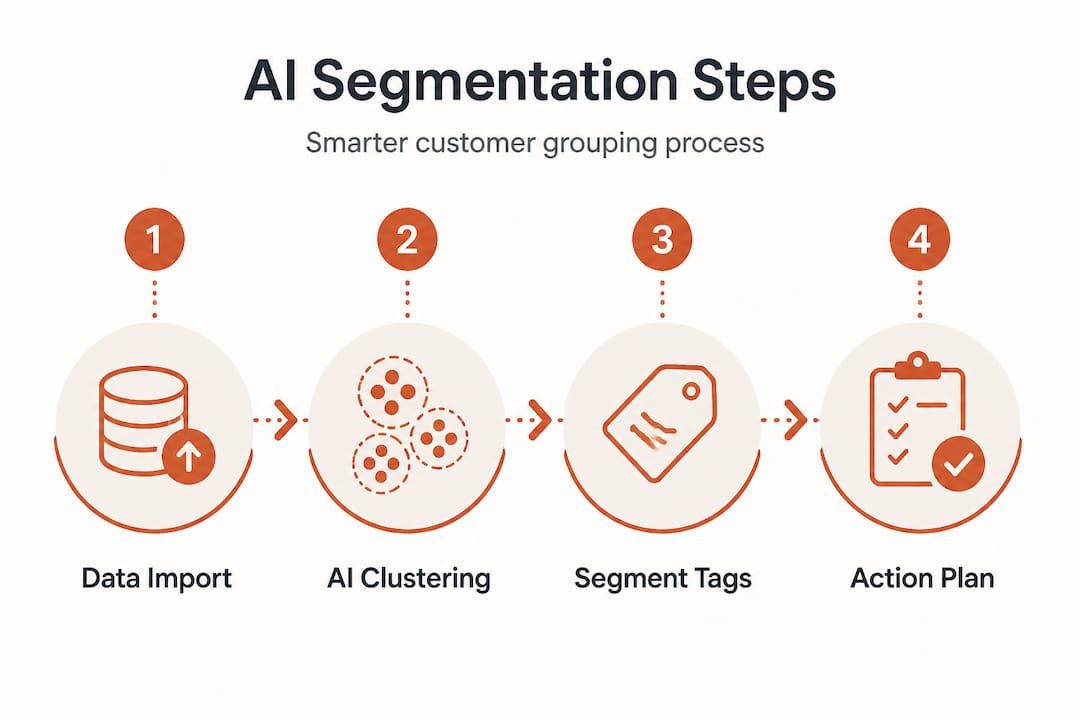
Here is a stepwise approach to piloting and scaling AI-powered segment targeting for bundling and retention:
- Export your transaction data. Pull at least 12 months of order history including product SKUs, timestamps, customer IDs, and order values.
- Run initial segmentation. Use your AI tool to generate clusters. Validate that segments make intuitive sense before acting on them.
- Select one high-impact segment for your pilot. Rising stars or at-risk customers typically show the fastest response to targeted offers.
- Design segment-specific bundle offers. Use your market basket data to identify which product combinations appear naturally in your top segment’s purchase history.
- Run a controlled test. Split the segment into a treatment group (bundle offer) and a control group (standard experience). Run for 30 to 45 days minimum.
- Measure AOV, retention rate, and revenue per customer. These three metrics tell you whether the segment strategy is actually working.
- Scale winners, retire losers. Expand successful bundle offers to related segments and cut offers that underperform the control.
Pro Tip: Look at the practical segmentation examples that work in your specific vertical before designing bundles. A bundle strategy that works brilliantly for a pet supply brand may not translate directly to a home goods store. Context matters as much as the algorithm.
Best practices and common pitfalls in AI-driven segmentation
To maximize results, it’s crucial to avoid the most common AI segmentation mistakes.
The most frequent one is over-segmentation. More segments feel more precise, but once you push past eight to ten distinct groups, your team loses the ability to create meaningfully differentiated campaigns for each one. Limiting to 6 to 8 segments maintains operational feasibility while capturing over 90% of the total revenue impact that segmentation can deliver. Beyond that threshold, the marginal precision gain does not justify the operational complexity.
The second most damaging mistake is treating AI segments as “set and forget.” Automated systems will keep updating segments based on incoming data, but the business rules layered on top (which bundle to offer, which discount to apply, which message to send) still require periodic human review. Customer preferences shift, product catalogs change, and a campaign that made sense in Q1 might actively hurt margins by Q3 if no one has reviewed the logic.
Here are the best practices that consistently drive better outcomes:
- Start with an RFM foundation. Layer AI predictions on top of a solid RFM baseline rather than replacing RFM entirely. This hybrid approach is faster to implement and easier to explain to stakeholders.
- Use data-driven strategy tips like validating your segment logic against business intuition before automating campaigns at scale. If an AI segment contains customers who seem completely unrelated to each other, dig into the model before trusting it.
- Review AI recommendations monthly. Set a calendar reminder. Check segment composition, campaign performance by segment, and whether your VIP segment is growing or shrinking as a percentage of total customers.
- Prioritize data quality above everything else. Garbage in, garbage out. If your transaction data has duplicate customer IDs, missing timestamps, or inconsistent product labeling, your AI segments will be unreliable regardless of the algorithm used.
- Maintain human judgment for edge cases. AI is excellent at pattern recognition at scale, but a human marketing manager will catch the moment when a model starts recommending bundles that contradict a key brand value or seasonal moment.
Segmentation that drives action requires alignment between your data science function (or your AI tool) and your marketing execution team. The best model in the world produces zero revenue if the campaign it should power never gets built.
Our take: Why nuanced, hybrid segmentation beats automation alone
Stepping back, here’s what we’ve learned that most companies miss about segmentation’s potential.
The narrative around AI in marketing tends to run toward one of two extremes: either AI will replace all manual segmentation work, or AI is overhyped and classic RFM is fine. Both positions miss the actual opportunity. The hybrid approach of RFM plus behavioral AI outperforms either method alone by 3 to 5 times, and that multiple isn’t driven by the algorithm. It’s driven by the combination of machine-speed pattern recognition and human-level business judgment.
We’ve seen segmentation projects stall repeatedly for one specific reason: the team automates the segmentation layer but doesn’t automate the decision layer, and then no one owns the gap in between. The AI produces segments. The marketing team waits for instructions on what to do with them. Nothing ships. The project is declared a failure and shelved, when the real failure was organizational, not technical.
The brands that get it right treat AI segmentation as a living input into a continuous campaign cycle, not a one-time deliverable. They assign a segment owner, someone who reviews the AI’s output weekly, challenges it when it doesn’t make sense, and updates campaign rules when the business changes. In our experience, adding that single layer of human oversight has doubled campaign ROI in situations where purely automated approaches were producing mediocre results.
AI’s real value is speed and scale: it can process millions of behavioral signals and update thousands of customer profiles in the time it takes a human analyst to pull a single report. But humans add creativity (choosing which bundle concept to test), context (knowing that a particular segment skews toward customers who respond poorly to discount messaging), and empathy (understanding that an at-risk customer who just received a poor product experience should not receive an upsell campaign that week). Neither the algorithm nor the analyst alone produces the best outcome. The combination does.
Explore how AI sales optimization can give your team the speed advantage while keeping your marketing judgment in the driver’s seat.
Next steps: Take action on smarter customer segmentation
If these frameworks resonate, practical resources are just a click away.
Smarter segmentation consistently delivers measurable results: higher AOV through targeted bundling, stronger retention through proactive outreach to at-risk clusters, and better CLV through loyalty investment in rising stars. The math is clear, and the tools to execute are more accessible than ever.
Affinsy is built for exactly this kind of work. Whether you export a CSV from Shopify or connect via API, the platform analyzes your historical transaction data to surface customer segmentation patterns, product associations through market basket analysis, and predictive analytics that tell you where your next revenue opportunity lives. The permanent free tier (up to 20K line items, no credit card required) means you can validate the approach against your own data before committing to anything. If your dataset is larger or you need API access, Pro starts at $49/mo and Max at $199/mo. Start with your data, and let the patterns guide your next campaign.
Frequently asked questions
What is the most effective way to segment e-commerce customers?
Combining RFM analysis with AI-driven behavioral data creates the most effective segmentation model, since the hybrid approach outperforms either method alone by 3 to 5 times according to current research.
How many customer segments should I target for optimal results?
Limiting to 6 to 8 segments maximizes operational efficiency while capturing over 90% of the total revenue impact that segmentation can realistically deliver.
How much can product bundling improve my e-commerce metrics?
Segment-based bundling can boost AOV by 20 to 35% and improve retention rates by up to 40%, with personalized bundles for high-value segments generating 22% higher transaction values.
Does AI replace the need for manual oversight in segmentation?
AI accelerates and improves segmentation significantly, but human oversight remains essential for setting business goals, reviewing model logic, and ensuring campaigns align with brand strategy and current market conditions.
Recommended
- Top AI applications for ecommerce sales & segmentation - Affinsy Blog | Affinsy
- Why segment online customers to boost e-commerce sales - Affinsy Blog | Affinsy
- AI Sales Optimization Strategies for E-commerce in 2026 - Affinsy Blog | Affinsy
- Customer segmentation explained: boost retention 2026 - Affinsy Blog | Affinsy
- Nectar Blog | 7 Top 2025 Ecommerce Marketing Tips for Brand Growth